 Extension Service Extension Service
Russian thistle (Salsola tragus L. — synonym of Salsola kali L., Salsola australis R. Br. and Salsola iberica Sennen & Pau) is the most economically important summer-annual broadleaf weed found in the low-precipitation zone of the inland Pacific Northwest.
Russian thistle infestations on 4.5 million acres cost growers more than $50 million annually in control measures, reduced wheat yield and impacts on wheat quality. This weed causes serious management problems in wheat after the harvest and during summer fallow.
In conventional tillage systems, an average of three rod weedings are typically performed over the course of the fallow year for weed control. Intensive tillage has a range of well-documented negative effects in the region, including dramatically increased wind erosion and soil quality losses, and public health and safety concerns.
No-till farming, also known as direct seeding, has become an important conservation tool in northeastern Oregon and parts of eastern Washington over the last decade. It reduces soil erosion caused by wind and water. In addition, it is potentially cost-effective, as fewer tillage operations not only reduce fuel and labor costs but also improve water infiltration. These benefits are being threatened by the ongoing development of herbicide resistance in Russian thistle.
Russian thistle is an herbaceous annual with a deep, extensive, and water-depleting root system. Stems are multiple to numerous, spreading, curved (arcuate), and often striped with vertical red to purple lines. Plants are 6 inches to 3 feet tall, often growing into a bushy, spherical shape and becoming stiff and spiny at maturity. After senescence, plants often break off at the base of the stem and become tumbleweeds, aided in wind dispersal by their shape and stiff, springy branches.
Russian thistle reproduces only by seed. It is an indeterminate species that flowers and produces seed as long as environmental conditions allow. Russian thistle uses an efficient carbon-fixation pathway, resulting in high water-use efficiency that contributes to its drought tolerance and competitive ability in warm, moisture-limited conditions. Roots can grow to a depth of 5 feet and have a lateral spread of up to 6 feet.
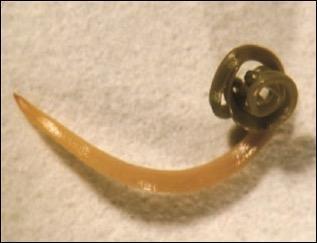
Russian thistle does not produce a true seed with endosperm. Instead, the seed is a coiled, fully differentiated seedling in the form of a spiral helix (Figure 1). Germination consists of uncoiling and can be quite rapid — on the order of hours under favorable conditions. After a short, internally controlled, after-ripening period, germination can occur under a wide range of soil moisture and temperature conditions. This after-ripening requirement helps ensure that seeds do not germinate under typical early autumn conditions in the Pacific Northwest but are ready for spring germination.
Optimal temperatures for Russian thistle germination range from 45°F to 95°F. Seeds can germinate under cooler conditions when nighttime temperatures are below freezing and daytime temperatures are above freezing. However, young seedlings (Figure 2) are very susceptible to frost. Seedlings can commonly be seen under Russian thistle plants of the previous year. Emergence typically begins in late March or early April, extending through the summer if sufficient precipitation occurs.
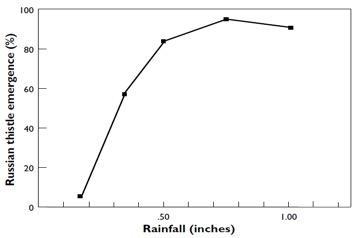
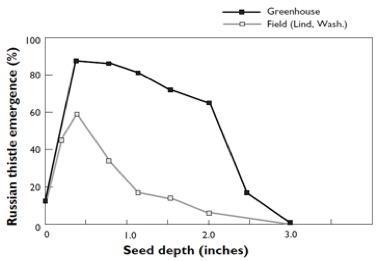
Russian thistle seeds require only a short moist period to germinate rapidly and emerge from the soil. It can emerge in significant numbers after very light rains (about 0.1 inch) on dry soil (Figure 3). Another factor affecting Russian thistle establishment is seed depth in soil (Figure 4, page 3). Emergence is optimal at depths less than 1 inch, although some seedlings can emerge from depths of 3 inches under favorable conditions. Russian thistle establishment can be limited by compacted soils. The roots cannot effectively penetrate compacted soil as the coiled embryo unwinds during germination. In addition, shoot emergence can be restricted by crusted surface soil, even if seeds are buried shallowly. However, seedlings can emerge through cracks in the soil surface.
In the Great Plains, Russian thistle seed longevity has been found to be only one year for most of the seeds in the two locations studied. Under irrigated conditions at Prosser, Washington, about 99% of Russian thistle seeds either germinated the first year or died before germinating. Research has been initiated to confirm the short seed life in soils and environmental conditions in the dryland production regions of the inland Pacific Northwest. Russian thistle seed is soft and porous, and that likely contributes to its lack of longevity and ability to germinate rapidly.
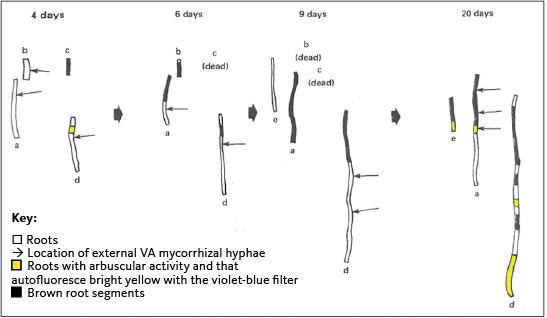
Russian thistle seedlings establish best in disturbed and eroded soils, including cropland and areas adjacent to roads. Disturbed and cultivated soils generally have reduced populations of mycorrhizal fungi. While most plants can establish relationships with these mycorrhizal fungi, some plants, like Russian thistle, do not.
In fact, Russian thistle root tissue dies where these fungi attempt to enter root tissue (Figure 5). Intact rangelands maintain higher fungal populations and lower Russian thistle populations, reducing Russian thistle movement from rangeland to cropland.
Russian thistle usually remains small when growing in a competitive winter wheat crop but grows rapidly immediately after wheat harvest. Russian thistles grow larger in a less competitive crop, such as spring wheat, or in low-density stands of winter wheat, particularly under drought conditions.
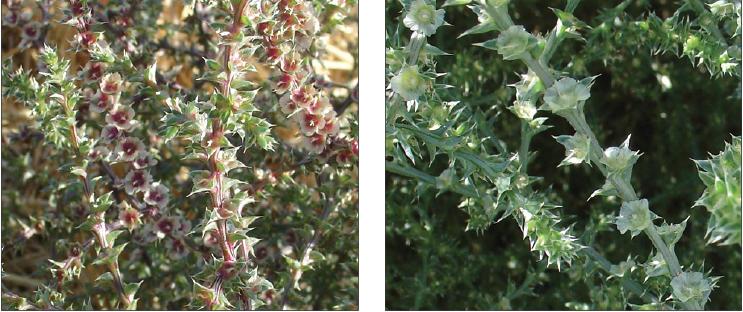
Flowering begins in midsummer with pollination primarily occurring by wind and seed produced both via self- and cross-pollination (Figures 6a and 6b, page 4). There is evidence that some insect pollination may also occur, based on the high diversity and number of insects observed on plants.
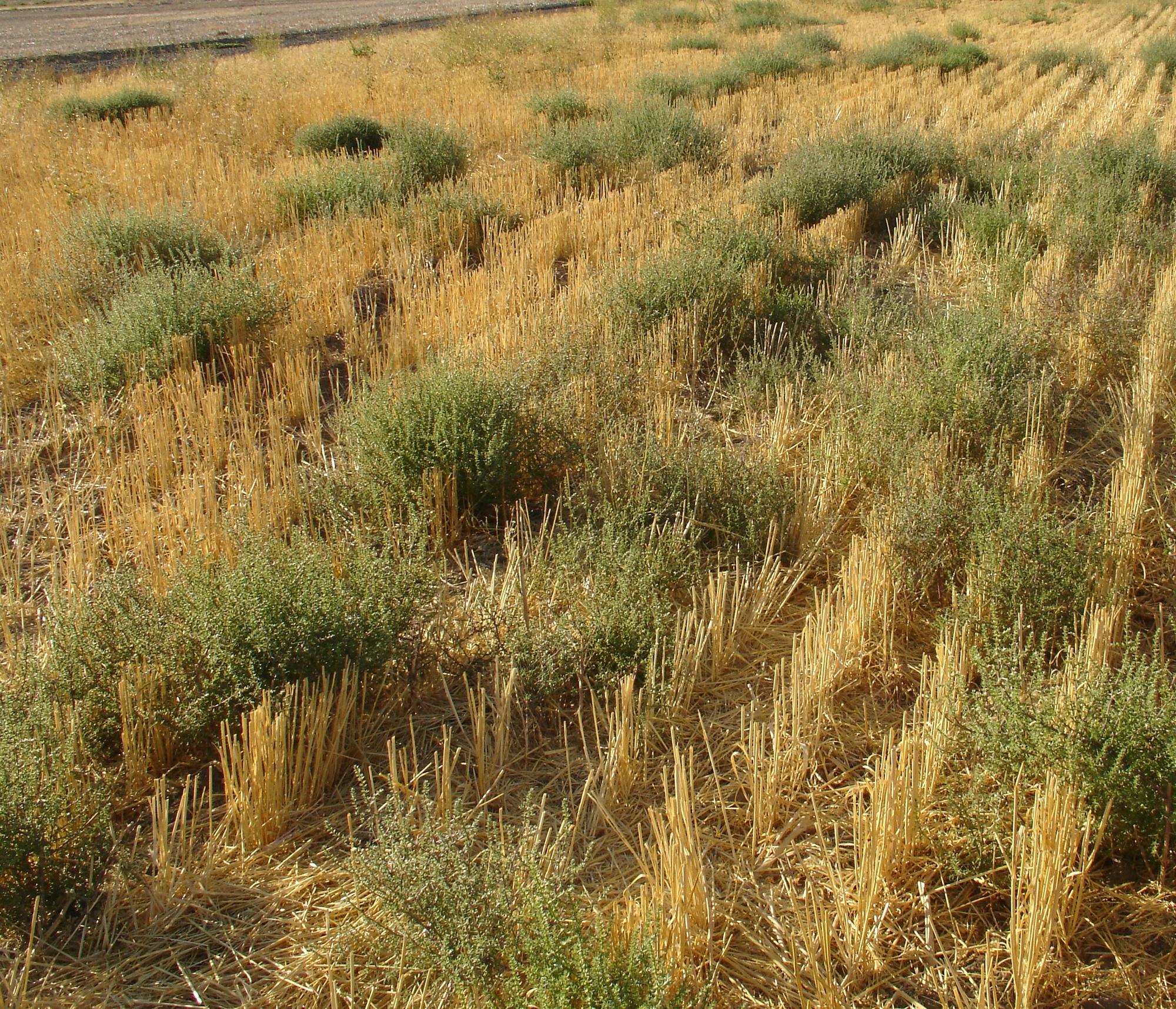
Flowering increases greatly after harvest, when about 90% of Russian thistle growth and most of the seed set commonly occur. Russian thistles can regrow quickly after harvest, extracting soil water that was unavailable to wheat, even though their top portions are cut and removed by the combine (Figure 7).
Uncontrolled Russian thistle plants in fallow produce about 150,000 seeds per plant. Seeds from uncontrolled plants in winter wheat and spring wheat are about 4,500 and 17,000 per plant, respectively.
Preliminary work on Russian thistle seed production after spring wheat in the Pacific Northwest showed significant year-to-year variability, but no viable seed is produced before the second week of September. Viable seed production is stopped by the first killing frost, which usually occurs sometime in October.
Due to a special layer of cells where the stem joins the roots, mature Russian thistle plants break at ground level and disperse seeds when the plant tumbles in the wind. Researchers found that over six weeks in early fall, Russian thistle plants traveled on average 0.6 to 1.9 miles.
However, they can travel greater distances before accumulating in ditches or becoming lodged in crop stubble, fences or other obstacles. About 60% of each plant’s seeds are dispersed by tumbling, while remaining seeds stay attached to the mother plant or are dispersed nearby.
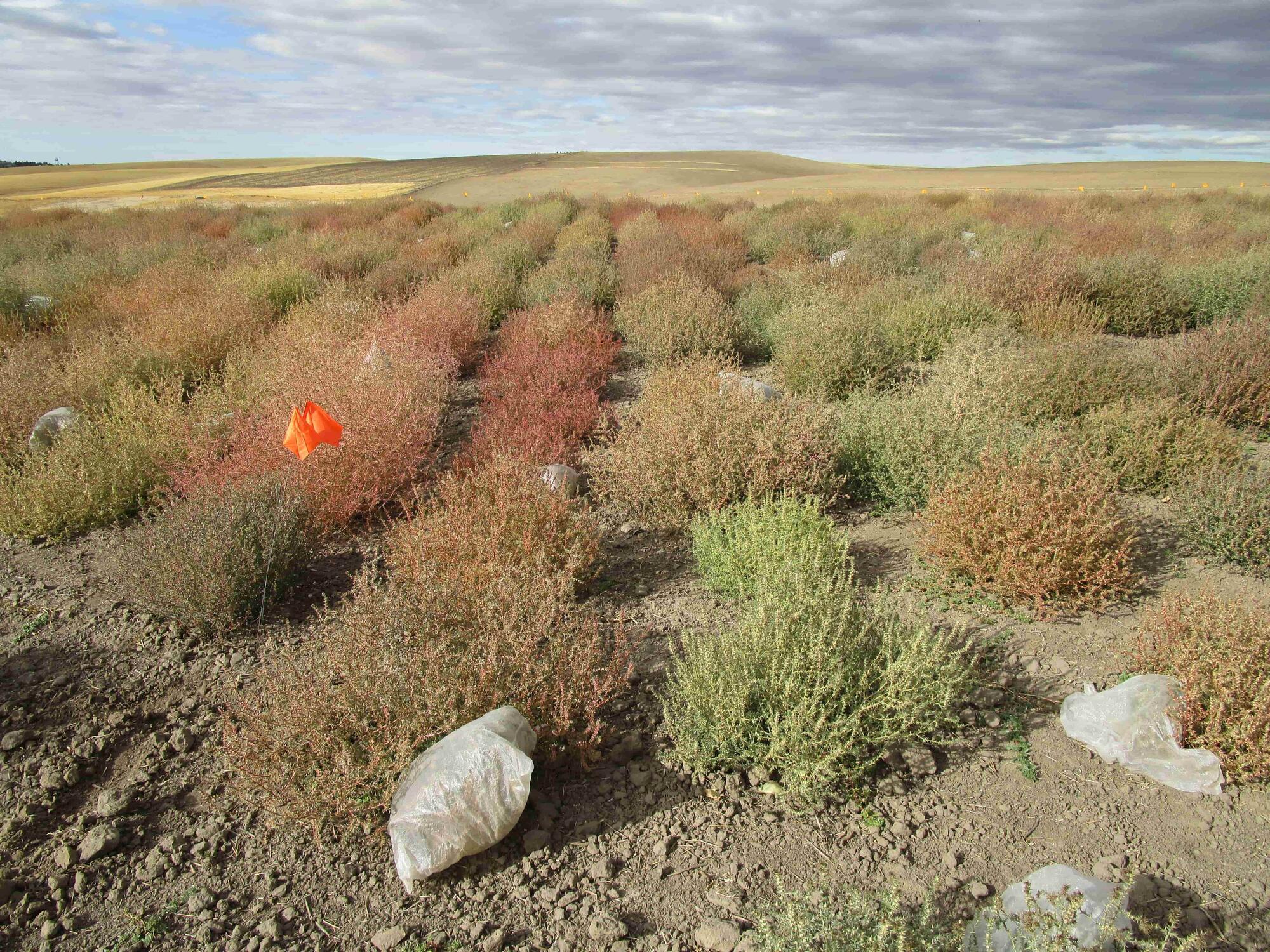
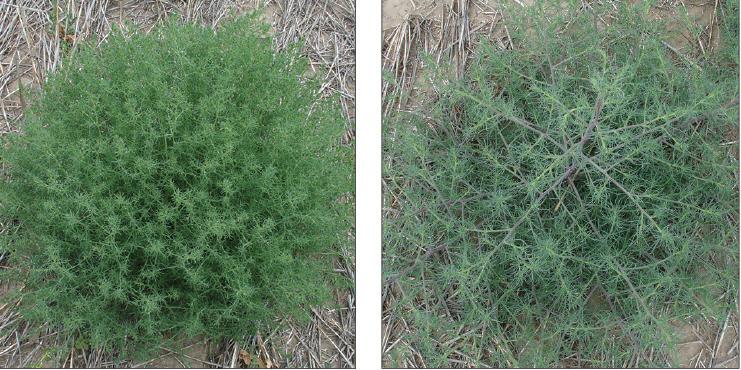
Russian thistle is known to be highly variable morphologically (Figure 8, page 5). Several subspecies (races) may be recognized within S. tragus (Figures 9a and 9b, page 6). In a preliminary screening of plants collected throughout eastern Washington and northeast Oregon, only a single species (Salsola tragus) with a high level of genetic diversity and no population structure or subdivision was found.
No studies have evaluated a potential different response of the phenotypic and genetic diversity in Russian thistle populations to herbicide treatments.
The largest impact of Russian thistle in wheat crops is direct yield loss resulting from competition for soil moisture. Years with low moisture have greater yield reduction than years with higher precipitation — likely due to Russian thistle’s ability to outcompete wheat under dry, hot conditions.
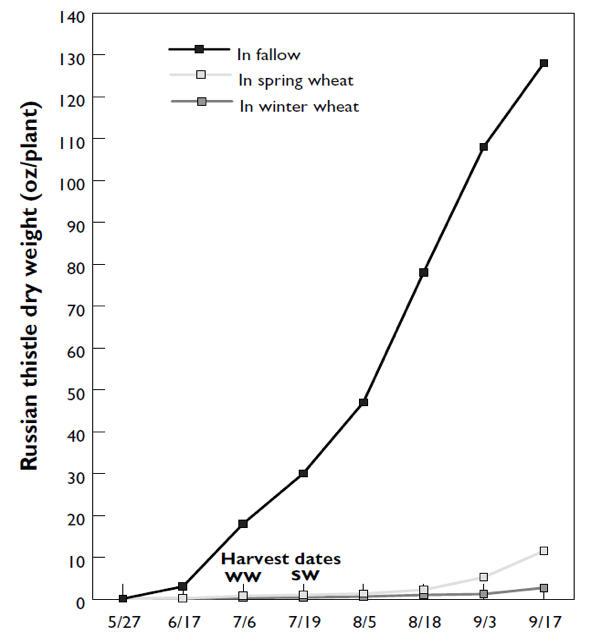
Healthy stands of winter wheat compete effectively with Russian thistle, and severe infestations often occur when winter wheat stands are poor or plants are stressed as a result of winter kill, disease or drought. In contrast, spring cereals are highly susceptible to infestation and often suffer severe reductions in yield — up to 50% in heavy infestations. In a study conducted at Lind, Washington, in 1982 and 1983, the dry weight of Russian thistle plants grown in winter wheat was 75% less than plants grown in spring wheat and 98% less than plants grown in fallow with no weed or crop competition (Figure 10, page 6).
Winter wheat reduced Russian thistle emergence 44%, seedling survival 42%, and seed production 74% compared with spring wheat. Even though spring wheat is less competitive against Russian thistle than winter wheat, management practices that increase spring wheat’s competitiveness can help suppress the weed. A 1983-85 study in Lind, Washington, revealed the importance of early spring wheat establishment (Table 1). Although Russian thistle density was highest in 1984, wheat yield loss was much lower than in 1983 or 1985. This can be partially attributed to seeding the spring wheat one week earlier in 1984 and to spring wheat emergence two weeks ahead of Russian thistle, compared with one week ahead in 1983 and 1985. Although weed densities were similar in 1983 and 1985, Russian thistle was much more competitive in 1985 when rainfall was low.
| Year | Russian thistle density (plants/sq ft) | Seeding date | Wheat emergence ahead of Russian thistle | March–June rainfall (inches) | Wheat yield loss (%) |
|---|---|---|---|---|---|
| 1983 | 5 | March 18 | 1 week | 3.9 | 31 |
| 1984 | 10 | March 9 | 2 week | 5.5 | 11 |
| 1985 | 4 | March 15 | 1 week | 1.8 | 55 |
Source: Young, F.L. 1988. Effect of Russian thistle (Salsola iberica) interference on spring wheat. Weed Science 36: 594-598.
Russian thistle infestations can also result in dockage due to contamination of grain or elevated grain moisture levels (its foliage is green at harvest), as well as reduced harvest efficiency. Uncontrolled plants will resume growth after harvest, resulting in substantial biomass accumulation due to a lack of crop competition. These plants might interfere with later tillage or seeding operations. It has been estimated that individual plants use approximately 18 gallons of soil water while growing in spring wheat, and an additional 26 gallons of soil water for post-harvest growth.
Management and control of Russian thistle in wheat-fallow cropping systems can be divided into three distinct periods over the course of the crop rotation: in-crop, the time between wheat harvest and killing frost (post-harvest), and the fallow year.
In the wheat crop, the most effective management practice is ensuring a competitive crop. Healthy winter wheat stands provide effective control through competitive suppression. Timely planting, adequate crop densities, narrow row spacing, and agronomic practices that promote a vigorous crop stand can improve competitive suppression of Russian thistle in spring wheat as well. Multiple herbicides with various degrees of effectiveness and cost are available for in-crop control (some are indicated in Table 2, page 7). See the product labels and the current PNW Weed Management Handbook for specific herbicide recommendations. Most recommended herbicides control Russian thistle best when applied to small plants 2 inches or shorter.
| Common name (active ingredient/s) | Group | Commercial name | Manufacturer |
|---|---|---|---|
| Bromoxynil | 6 | Brox® 2EC, Moxy® 2E | Albaugh LLC, WinField United |
| Bromoxynil + bicyclopyrone | 6+27 | Talinor™ | Syngenta Crop Protection LLC |
| Bromoxynil + MCPA | 6+4 | Bromac® Advanced | Loveland Products Inc |
| Bromoxynil + pyrasulfotole | 6+27 | Huskie® | Bayer CropScience |
| Bromoxynil + fluroxypyr | 6+4 | Starane® NXT | Dow AgroSciences LLC |
| Bromoxynil + 2,4-D | 6+4 | Deadbolt®*, Maestro® D | Wilbur-Ellis Company LLC, Nufarm Agricultural Products |
| Clopyralid + fluroxypyr | 4+4 | WideMatch® | Dow AgroSciences LLC |
| Clopyralid + 2,4-D | 4+4 | Curtail® | Dow AgroSciences LLC |
| Carfentrazone | 14 | Aim® EC | FMC Corporation |
| Dicamba | 4 | Banvel®, Clarifier®, Clarity®, Dicamba XP, Rifle®, etc. | Arysta LifeScience LLC, WinField United, BASF Ag Products, Dupont Crop Protection, Loveland Products Inc |
| 2,4-D | 4 | 2,4 – D LV 6 | Albaugh LLC/Agri Star |
| 2,4-D + bromoxynil + fluroxypyr | 4+6+4 | Kochiavore™ | WinField United |
| Fluroxypyr | 4 | Starane® Ultra | Dow AgroSciences LLC |
| Metribuzin | 5 | Dimetric® DF 75 | WinField United |
The source of this information is from multiple field trials conducted at the Columbia Basin Agricultural Research Center during 2017 and 2018 and the PNW Weed Management Handbook. Notes: Read the product labels for application rates, application times and other requirements. Group 2 herbicides are not listed because Russian thistle biotypes resistant to that mode of action are very common in the Pacific Northwest.
* This herbicide is not available in Idaho
Russian thistle control is recommended within two weeks following grain harvest to minimize water use and seed production.
Noninversion tillage with wide, overlapping sweep blades (undercutter) that cut Russian thistle roots while leaving surface crop residue largely intact can halt plant growth and prevent most seed production. Although Extension agents have actively promoted use of the undercutter implement in the region, adoption has been limited. A number of growers adopted and continue to use undercutters, but the majority of growers that choose tillage for post-harvest control use a heavy double-disk or achieve weed control as a secondary outcome of fall fertilizing using an applicator with straight shanks and cultivator points.
Dislodged by tillage, killed Russian thistle plants are typically moved out of the field by wind, and although they do not contain viable seed at this time, the resulting loss of residue is a possible soil conservation concern in extremely low-residue situations.
When chemical control is selected, a 2017 survey conducted with 27 growers from Gilliam, Morrow, Umatilla, and Union counties in northeastern Oregon found that 57% of the growers used glyphosate as the only herbicide, 14% used glyphosate in a tank mix with other herbicides, and 29% used paraquat as the only herbicide to manage Russian thistle.
The use of paraquat for post-harvest control has recently increased with the discovery of glyphosate-resistant biotypes of Russian thistle (see Herbicide resistance section on page 8).
Paraquat is a restricted-use herbicide that requires personal protective equipment while tank mixing. Read the label for required protective equipment and know the symptoms of paraquat exposure. Application of paraquat also requires a well-sealed, enclosed cab vehicle with an air filtration system set to recirculate the cab air.
Under good application and environmental conditions, chemical control, particularly with paraquat, is as effective as tillage. But often poor application conditions (large, dusty, and moisture-stressed plants) and herbicide-resistant plants can make chemical control inconsistent. Even though biomass accumulation and soil moisture consumption are limited with herbicide use, in many cases some viable Russian thistle seed is produced.
In the fallow year, broadleaf weed control (of which Russian thistle is generally the largest component) can be conducted with tillage, herbicides or a combination of both. A conventional, tillage-based fallow system will have an early season primary tillage with a heavy double-disk or sweep plow and two or more secondary tillage operations with a rod weeder throughout the season.
Many growers now use lighter primary tillage and most substitute a nonselective herbicide application (typically glyphosate) for at least some of the traditional secondary tillage, in what is known as a reduced tillage fallow system. A no-till or chemical fallow system will rely solely on herbicides for weed control. In 2018, a research study with residual herbicides applied at different times (late November, mid-March, or both in a split application using half rate each time) showed that there are several herbicide options to rotate with, including sulfentrazone (Spartan® Charge), flumioxazin + pyroxasulfone (Fierce®), or metribuzin (several trade names available). These options can provide residual control of Russian thistle and reduce the need for additional post-emergence herbicides or tillage (or both) during summer fallow (Figure 11). Adequate precipitation following application of these herbicides is required to achieve acceptable control. According to the Spartan Charge herbicide label, the length of residual control will increase in basic (pH greater than 7), coarse, and low-organic-matter soils. The soil indicated in Figure 11 had a pH of 5.4, a silt-loam texture (65% silt, 27% sand, and 8% clay), and an organic matter of 1.8% as an average of soil samples taken at three different depths: 0–4 inches, 4–8 inches and 8–12 inches.
Commercial spot-spraying systems that regulate individual nozzles based on the presence of green plant tissue in the spray path can help reduce herbicide use during the fallow and post-harvest periods. These systems maintain levels of control equivalent to broadcast application in controlled field trials. The main disadvantage of these systems is that their initial cost is prohibitively high for many growers. However, these application systems may allow the use of herbicides that have been too expensive for many growers to use as a broadcast application in fallow.
Russian thistle control improved in the 1980s with registration of sulfonylurea (Group 2, ALS inhibitors) herbicides. However, repeated and widespread use of these products set the stage for development of a significant resistance problem. By 1992, resistance to Group 2 herbicides had spread to 75% of Russian thistle populations in farm fields of the inland Pacific Northwest.
Results from 2017 dose-response studies confirmed glyphosate (Group 9; EPSP synthase inhibitors) resistance in three of 10 Russian thistle populations collected from Oregon. The same outcome was validated for one population from Montana and another from Washington.
Ongoing development of glyphosate resistance highlights the need to diversify Russian thistle control strategies. The failure to do so will threaten the sustainability of semi-arid cropping systems of the Pacific Northwest. For more information on preventing and controlling herbicide-resistant weeds, see Herbicide-Resistant Weeds and Their Management (PNW 437).
Management strategies for Russian thistle that focus on preventing seed production throughout the wheat-fallow rotation can reduce a serious Russian thistle infestation to a manageable one.
The major weak points in the Russian thistle life cycle are its short seed longevity and the lack of seedling vigor and competitiveness. Preventing seed production and controlling plants while they are small are the keys to effective control of Russian thistle.
Control Russian thistle along field borders, roadways and other noncropped areas to prevent introduction or reinfestation of the weed. Because of the high mobility of Russian thistle plants and their seed distribution, an areawide Russian thistle control strategy, including cooperation by neighboring upwind producers, could help control the weed.
Roadside management can be enhanced by fostering a perennial plant community adjacent to roads. Perennial plants have strong associations with the mycorrhizal fungi, and high populations of these fungi can kill roots of establishing Russian thistle seedlings. Roadside management of Russian thistle can help reduce movement from roads into cropland. Russian thistle herbicides registered for roadsides are listed in the PNW Weed Management Handbook.
Authors thank Frank Young, Roger Veseth, Donn Thill, William Schillinger and Dan Ball, the original authors of the publication that served as the foundation for this revision. We also thank John Spring for giving us permission to use Image 6 and for sharing some of his dissertation results on Russian thistle with us.
Use pesticides safely! Wear protective clothing and safety devices as recommended on the label. Bathe or shower after each use. Read the pesticide label—even if you’ve used the pesticide before. Follow closely the instructions on the label (and any other directions you have). Be cautious when you apply pesticides. Know your legal responsibility as a pesticide applicator. You may be liable for injury or damage resulting from pesticide use.


© 2019 Published and distributed in furtherance of the Acts of Congress of May 8 and June 30, 1914, by the Oregon State University Extension Service, Washington State University Extension, University of Idaho Extension and the U.S. Department of Agriculture cooperating. The three participating Extension services offer educational programs, activities and materials without discrimination on the basis of race, color, national origin, religion, sex, gender identity (including gender expression), sexual orientation, disability, age, marital status, familial/ parental status, income derived from a public assistance program, political beliefs, genetic information, veteran’s status, reprisal or retaliation for prior civil rights activity. (Not all prohibited bases apply to all programs.)
Accessibility: This publication will be made available in an accessible alternative format upon request. Please contact [email protected] or 541-737-3311.
