Transcript
when you're considering spur printing
there's an important consideration for
renewing cordons so I'm going to walk
you through kind of what not to do or
some pitfalls of not renewing cordons um
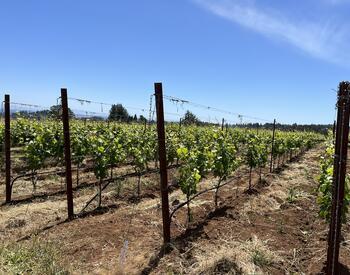
over time so we're in a Vineyard that's
25 years old and it was established as
uh Cordon train spur pruned at about
year five of its life so it has a
20-year-old Cordon here 25y old trunk
and it's never really been renewed since
it became a cordon the head position is
really nicely done it's you've got the
the head uh below the training Wire by
about four five in is what you really
ideally want and the cordons were
trained out bilaterally along the
training wire however the unfortunate
thing was when they trained these Vines
they wrapped the cane that became the
Cordon around around the wire and if you
can see here The Cordon has
completely grown around this training
wire and this becomes a problem over
time because it needs to the The Cordon
needs to be replaced and it's almost
impossible to do this without removing
parts of the trellis so you want to
avoid wrapping canes around the the
training wire it can be done but only
for the first year you normally wrap
that cane around that's going to be your
cordon and you unwrap it in the second
dormant season so that you can have a
cordon that's stiffened but not wrapped
around this wire so when establishing a
new Cordon on a a Vine like this it's
important to leave some spurs that you
anticipate renewing over time so the
vineyard manager in this Vineyard uh
wisely left behind a sucker on the trunk
so this this shoot is being left and
retained so that we can retrain the
trunk and then possibly retrain it along
this Cordon it might take a couple years
to get the trunk reestablished uh or
they could come this next season and
have another sucker or keep a sucker
that's growing here to train out but
that's going to be an absolute necessary
thing when we need to cut out big
cordons like this previously I showed
you how it grew into the wire and that
we're going to renew it from a Spur
that's been left down here an
adventitious shoot that that's now a
cane that'll be retrain from much lower
in the canopy but first I'm going to
start by just removing the old Spurs
from the
canopy we'll just cut it out just so we
can make it easier to deal
with and I should really be wearing eye
protection for this process we got to be
careful so we have all of the upper
canopy off of this some longer Spurs are
still left but we're going to remove
this whole Cordon and in order to do
this I'm going to actually use a power
tool to make it a little bit faster
process
here and whenever you're taking out um
the cordons when possible start from
further back and move in but another uh
factor is when you're looking at
diseases it's always best to start
looking from behind or the furthest end
and moving towards the head of the plant
so this is an example here we can't
really cut out it out very much because
it's
growing the wood is growing
into the wire there and pretty difficult
to just cut
out so I'm going to go a little bit more
towards the base
here so there's some black areas
there that could be some trunk disease
but it might also just be some necrotic
areas but it's something to keep an eye
on it's pretty
most of it it's pretty healthy now I'm
going to go further down
here yeah so you can see some the middle
there is black but still got a healthy
circumference and so we have this shoot
here that could be used to train up the
plant um would have to extend the trunk
perhaps in this first year it wouldn't
be ready to lay down as a cordon but for
a plant that has pretty old cordons you
need to start lower but the other
important thing to point out is this is
coming from above the graft unit so in
this plant The graft unit is about right
here we can't take a Spur that's coming
from or sucker that's coming from below
that point
When to renew a cordon
- Periodic removal of cordons will be necessary to maintain productivity.
- Remove cordons when yield declines or when there dead areas on the cordon, poor spur locations, or too few spurs.
- Renewal requires pre-planning: Maintain a shoot at the head of the vine (to of trunk) or sucker along the trunk during the growing season for replacing the cordon during winter pruning.
How to renew a cordon
- Cut out the old cordon by starting from distal portions of the cordon and work toward the vine trunk. This will allow you to assess vine health (look for cankers as noted in the video).
- Be sure to select a new 1-year old cane from the trunk to replace each cordon, making sure it arises from above the trunk graft union (to ensure training from the scion cultivar rather than the rootstock).
- Position the cane on the wire, wrapping it no more than one rotation and affix.
- Unwrap the new cordon the following winter so that it does not grow around the wire over time. This will lead to girdling if left wrapped.
- Continue to maintain a renewal spur at the top of the trunk (head) for future cordon renewal.

Want to learn more about this topic? Explore more resources from OSU Extension:
Wine grapes