AURORA, Ore. — In winter, the nursery production research plots at Oregon State’s North Willamette Research and Extension Center (NWREC) rest under bare branches and steady rain.
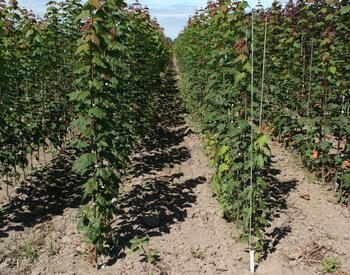
Red maples stand leafless. Nursery containers are tucked away. By summer, the quiet pad warms to life, becoming a living laboratory; a working nursery packed with young plants and students.
Heat waves and drought are shaping production decisions, with water efficiency and plant resilience rising in importance.
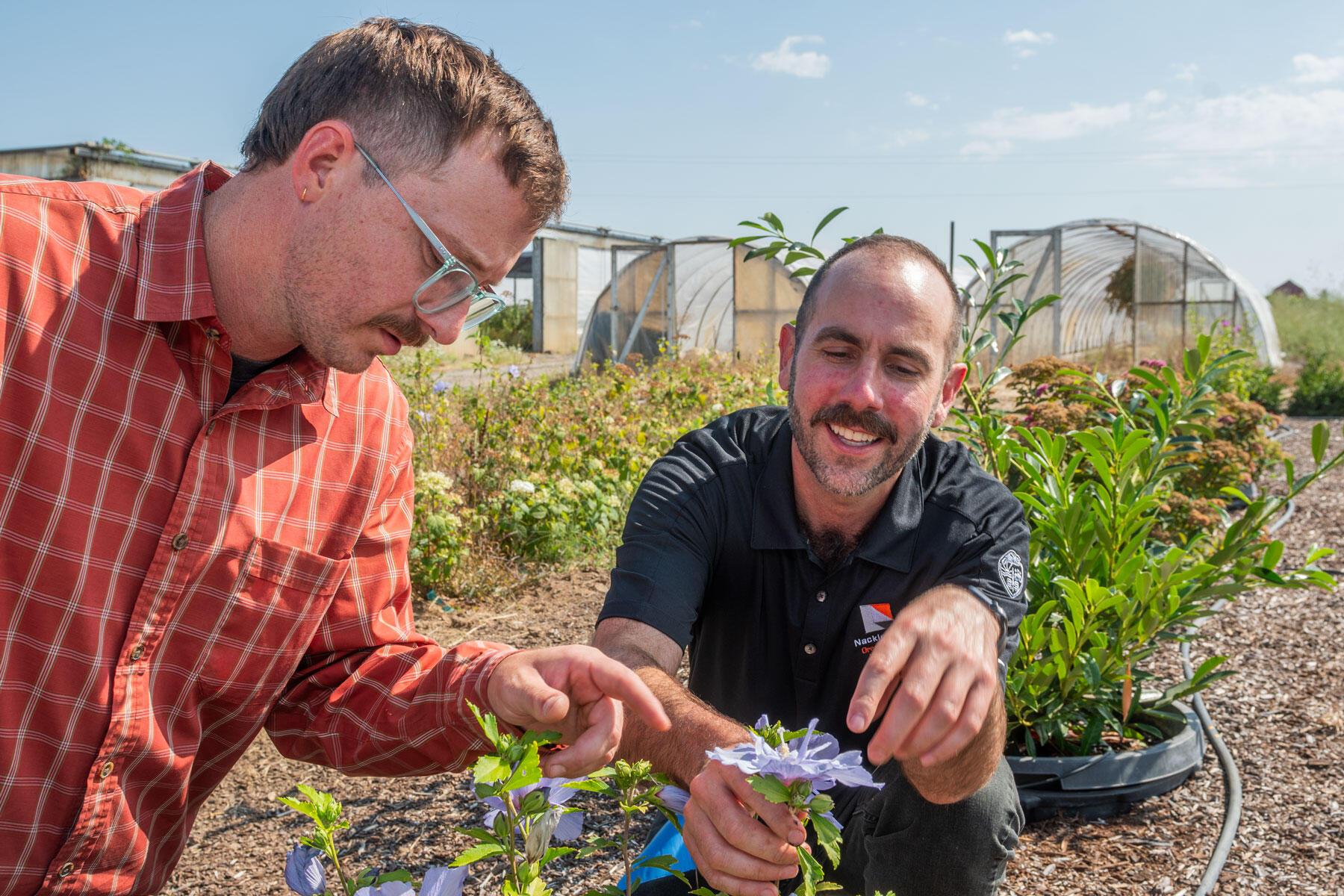
At the center of the work is a practical question for Oregon growers: how to keep plants healthy during hotter, drier summers while using water and other inputs efficiently. At NWREC, Nackley’s nursery production lab studies how trees and other nursery crops respond to heat and drought — and what growers can do about it.
Nackley is an associate professor in Oregon State University’s College of Agricultural Sciences and an OSU Extension specialist focused on nursery production and greenhouse management. He works with the nursery and greenhouse industry on applied research questions and practical production guidance. That includes trials in red maples to fine-tune irrigation, tests of “smarter” containers designed to influence roots and water use, and monitoring tools that track plant water loss and soil conditions.
Oregon’s nursery and greenhouse industry is Oregon agriculture’s top commodity, valued at $1.22 billion in 2022, according to the Oregon Department of Agriculture. Heat waves and drought are shaping production decisions, with water efficiency and plant resilience rising in importance.
Shade trees under stress
Shade trees — non-fruiting trees such as oaks and maples — are among Oregon’s most valuable nursery crops. Nackley said shade trees contribute more than $300 million annually in Oregon. They’re common in urban environments, where they can cool neighborhoods, improve air quality, manage stormwater and create healthier spaces for people and wildlife.
Young trees can be especially vulnerable to heat waves, Nackley said, and stress early in production can follow a tree as it grows.
“We’re trying to grow the healthiest trees in a nursery environment,” Nackley said. “A tree is like an archive, so if something goes wrong with it in its early stages, sometimes it gets grown over and covered up, but those types of damage last with the tree. So if we can grow healthy and vigorous trees here in Oregon, we help support a vigorous urban forest.”
The lab is also measuring how nursery production affects carbon and water.
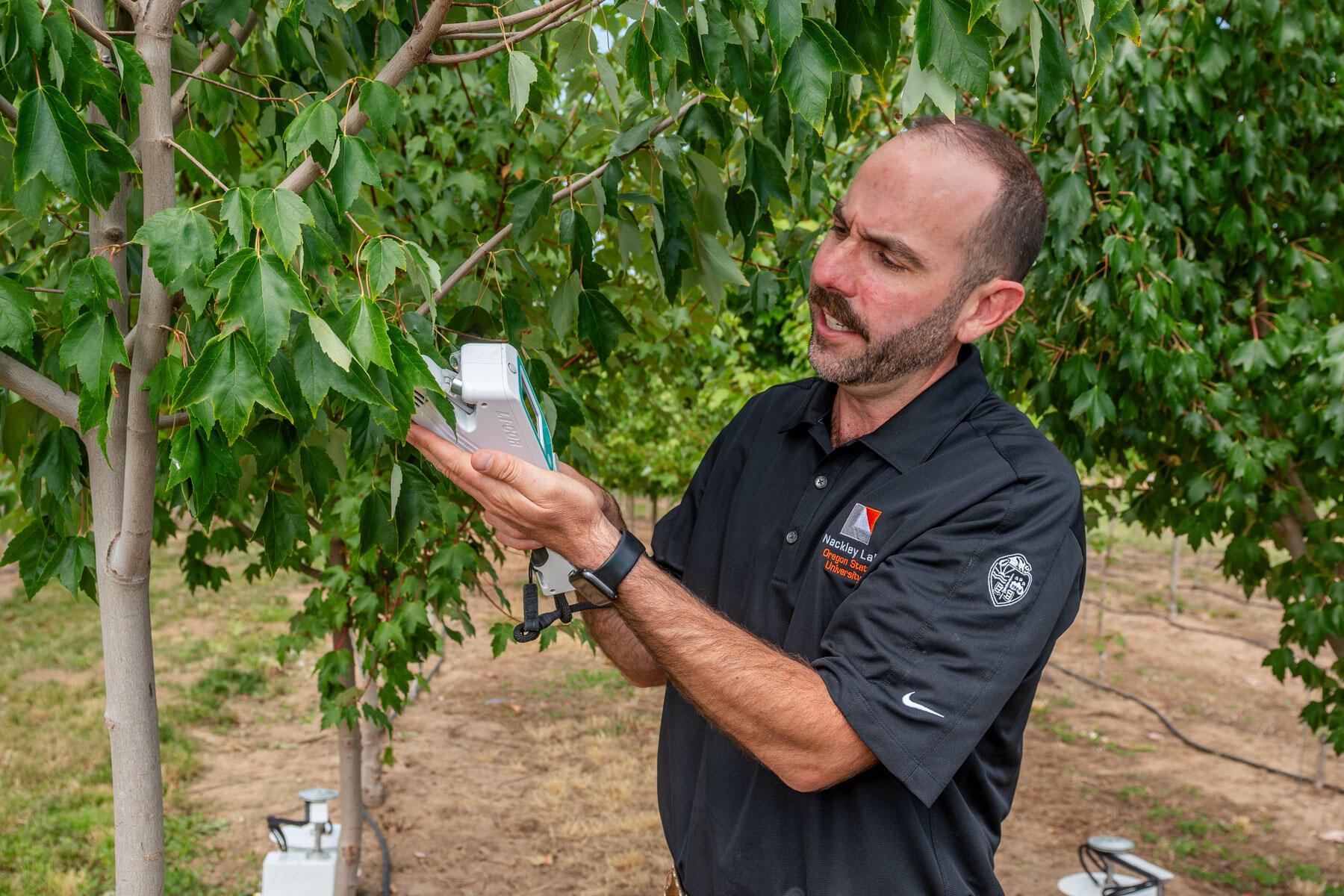
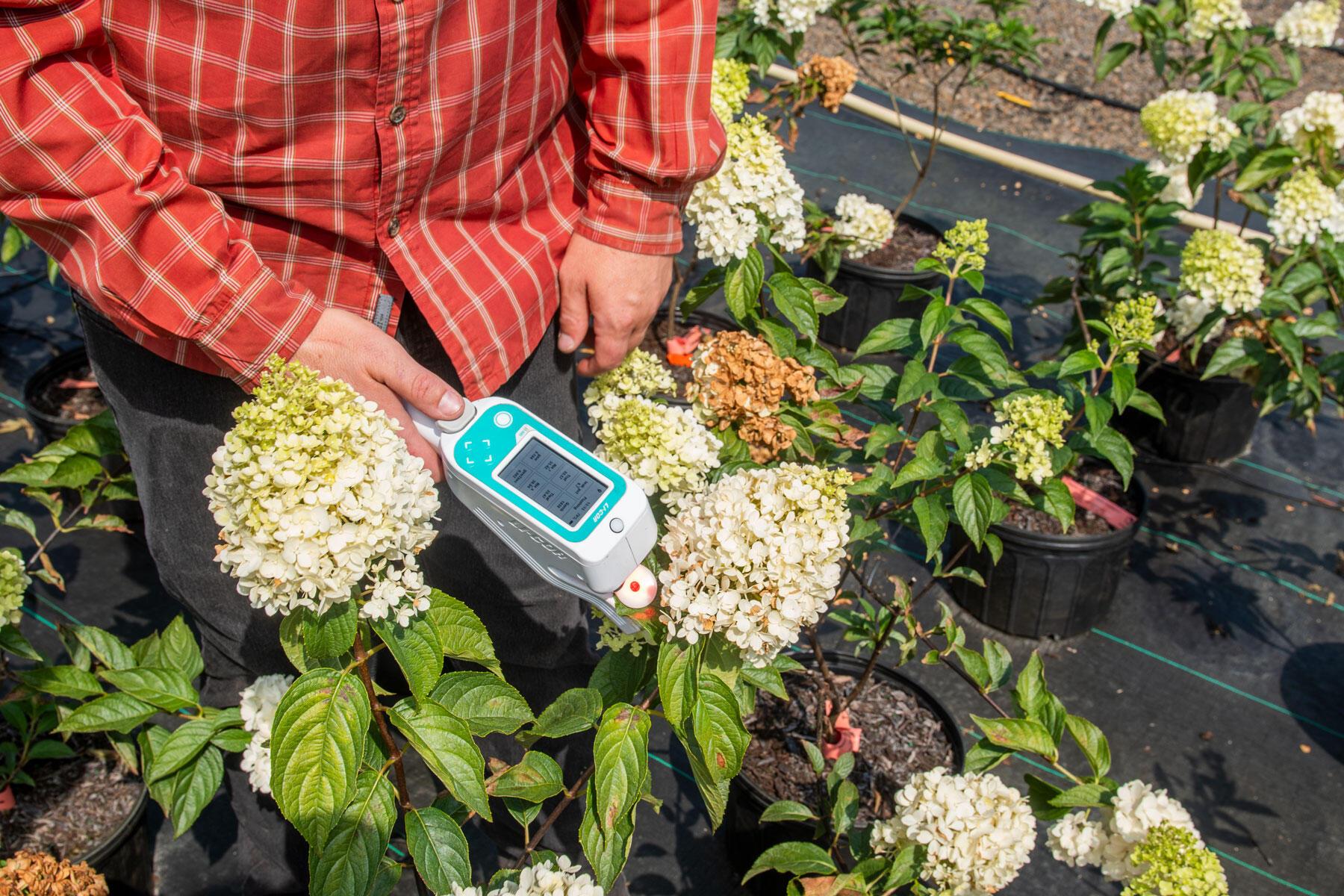
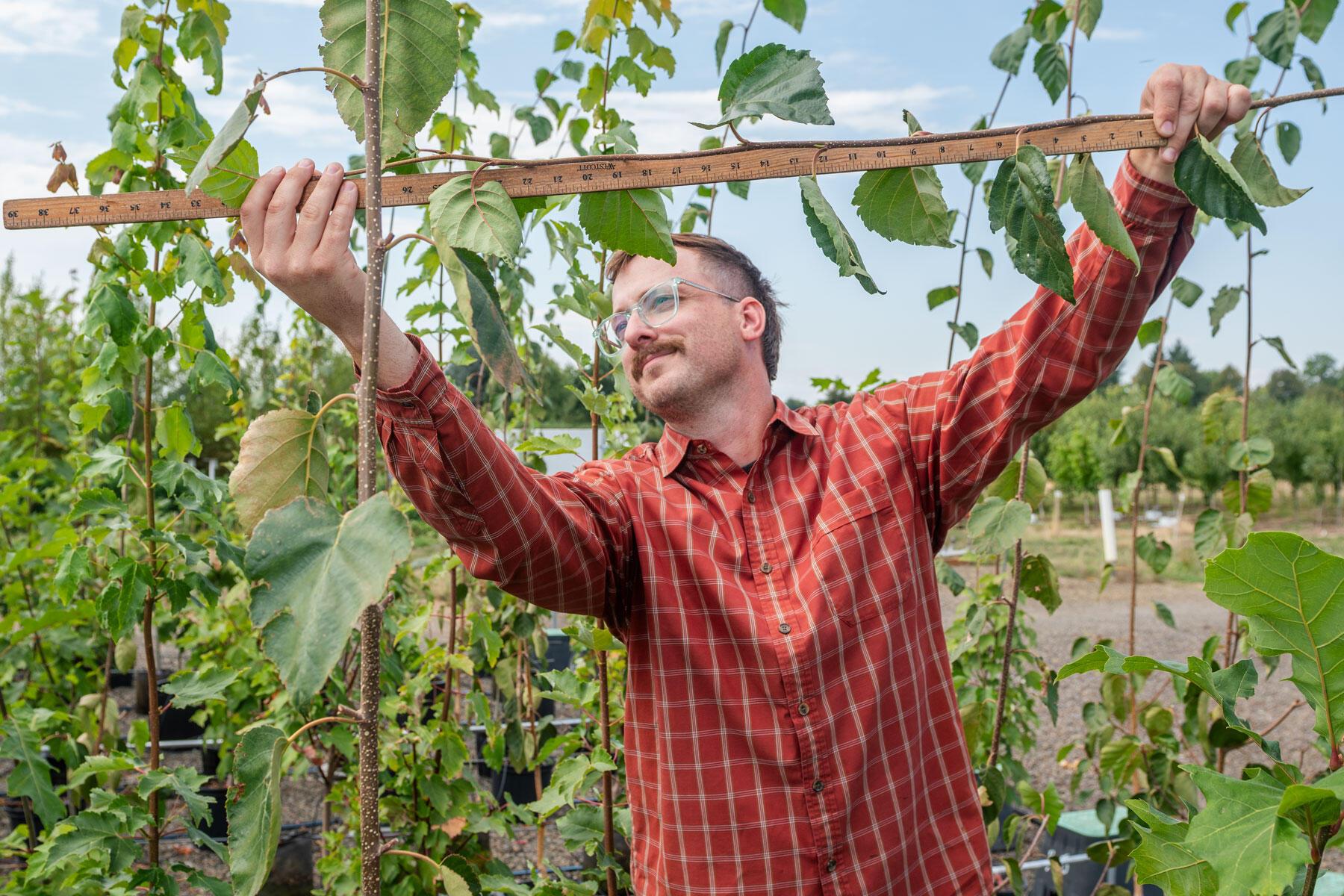
Walking through the maple field in late August, Nackley and Clint Taylor, a faculty research assistant in the Nackley Lab, demonstrated a clamp-on device used to measure water transpiration at the leaf level. The readings track how plants respond to watering and weather.
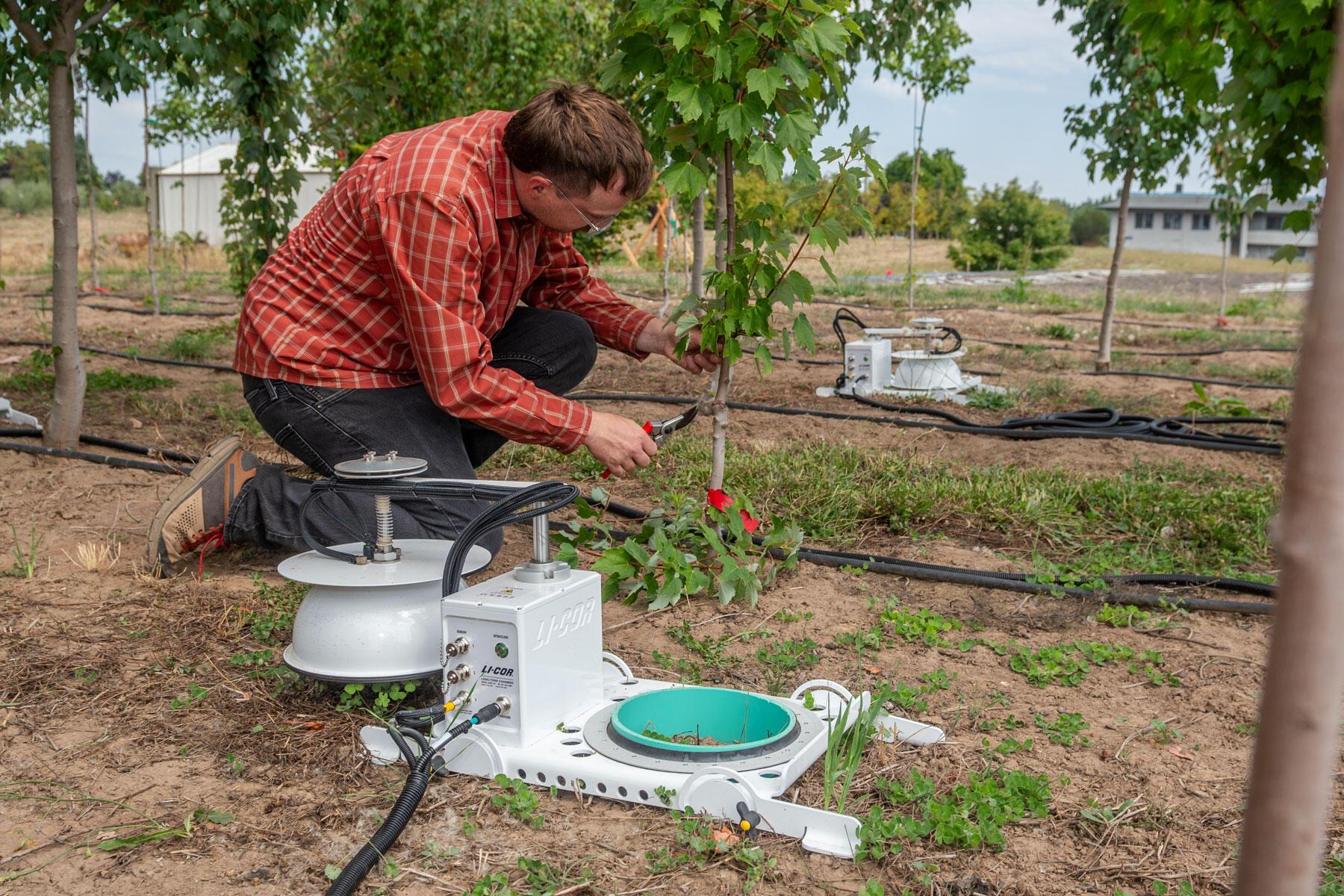
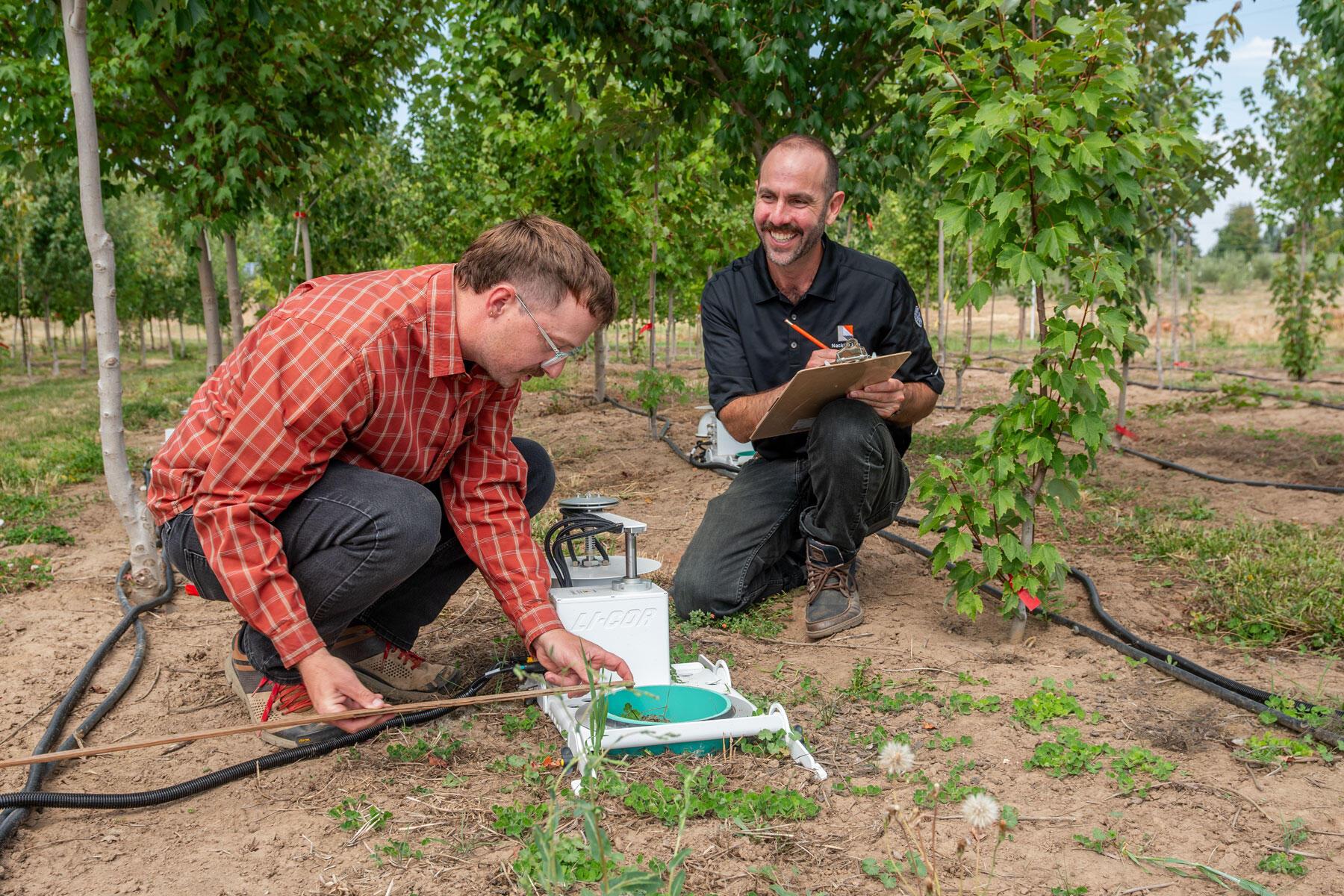
The work is part of a soil carbon dioxide flux system used to compare production systems for trees grown in Oregon before they’re shipped and planted elsewhere. The research is funded by a grant from the Oregon Department of Agriculture in cooperation with the Oregon Association of Nurseries.
Heat in pots
Heat can be harder on nursery crops grown in pots than on plants grown in the ground. Containers and the surfaces around them absorb heat, driving temperatures higher and increasing irrigation demand.
“They’re so much hotter than field because they have black plastic, or the ground cloth and the gravel, so they’re absorbing all this heat so it’s driving higher irrigation demand,” Nackley said, adding that temperatures in pots can reach 115 degrees, sometimes up to 140 degrees.
“We don’t have any modeling for plants in pots; it’s all based on what plants do in fields,” he said.
During the growing season, the researchers place rows of potted plants, connected by sensors, across an area that simulates a nursery. NWREC is one of four sites across the United States — Florida, Ohio and Tennessee are the others — studying energy flux.
Energy flux describes how energy moves in and out of a system — such as how sunlight warms a plant, how the plant uses that energy to grow, and how heat and moisture are released back into the air.
“Nurseries are growing plants in pots, so it’s an artificial growing environment,” he said. “When you farm, you grow your plant in one spot. In nurseries, you grow it and it’s moving. That aspect is really challenging. The idea is to eventually come up with something like a weather alert system. This will be valuable information for nurseries.”
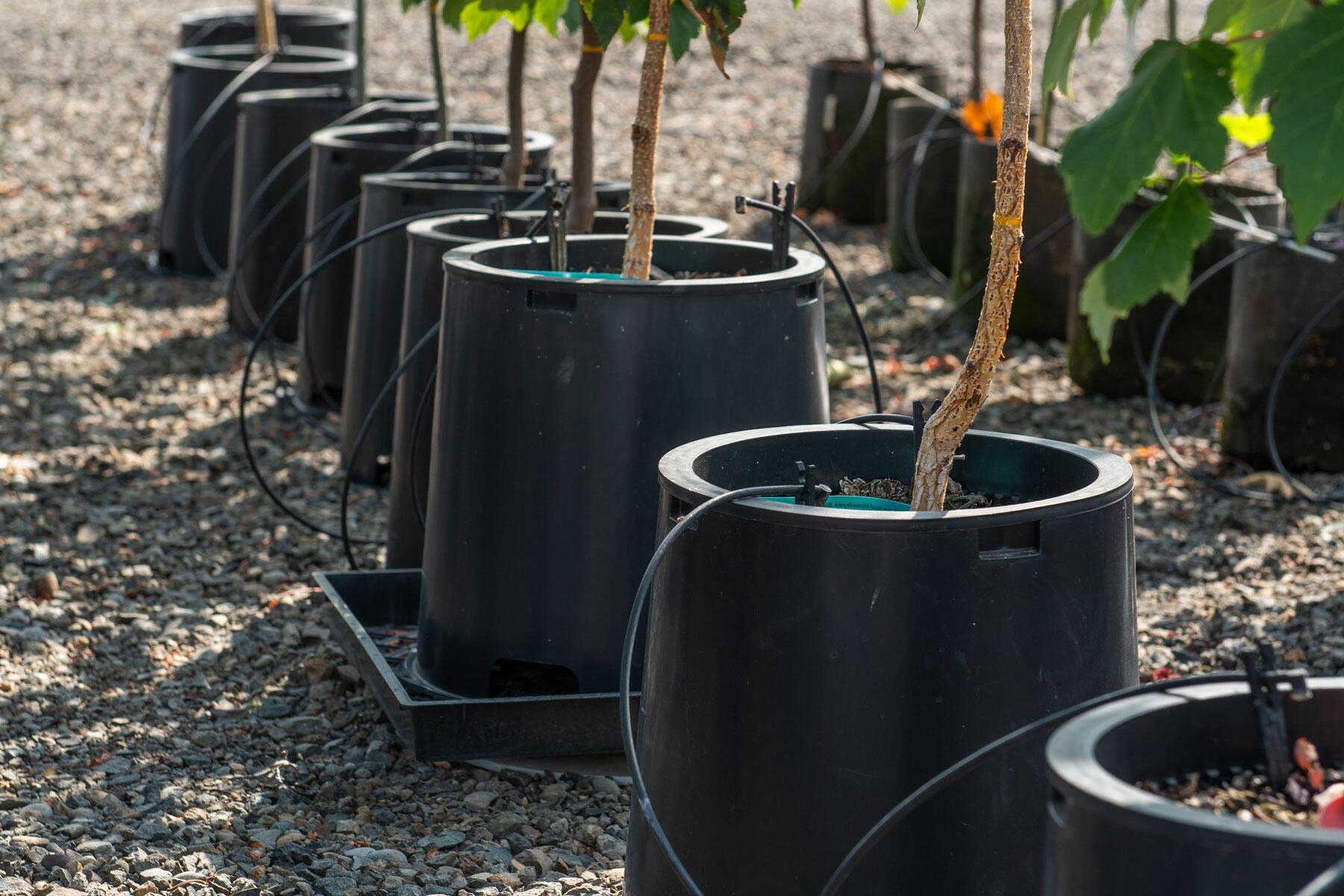
Over the past three years, the lab has tested nursery containers to find simple, scalable ways to keep plants cooler and reduce water use during heat waves.
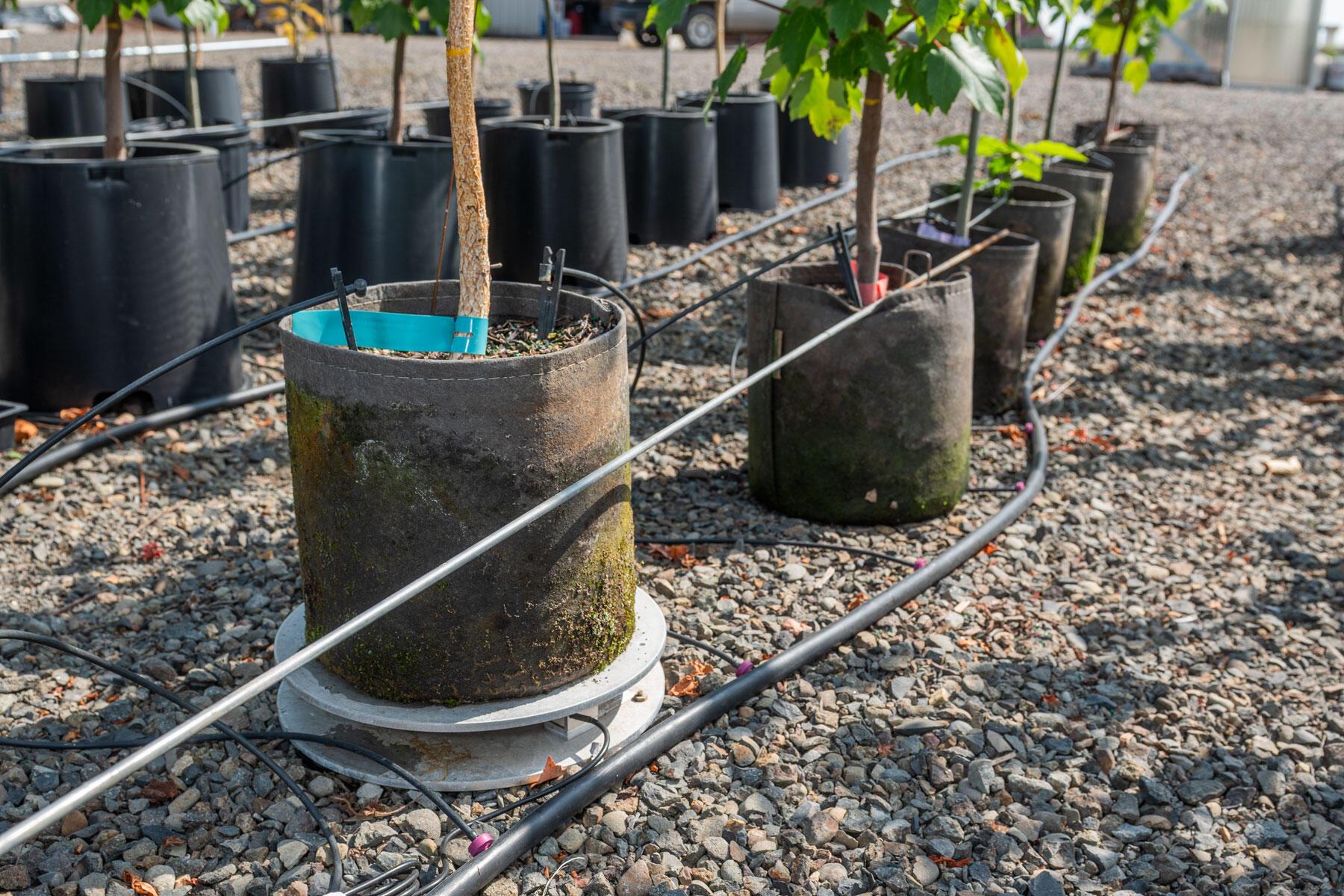
One study compares four pot types to see how each affects water use and root architecture. Taylor said the goal is to understand how container design influences roots and long-term tree quality.
Taylor described a smooth wall “classic” pot, where roots can hit the wall, circle and eventually girdle the tree. Other pot types are designed to prune roots and encourage better architecture. The study also includes a combination approach that uses a “shield” component to reduce drying.
To make fair comparisons in the pot trials, Taylor described a scale-and-lysimeter system the team built that weighs each pot and triggers irrigation when it dries down.
Cost is part of the question. Nackley said some specialty pots can cost more than twice as much as standard pots, and growers want to know whether benefits show up later.
Irrigation tools and why research matters
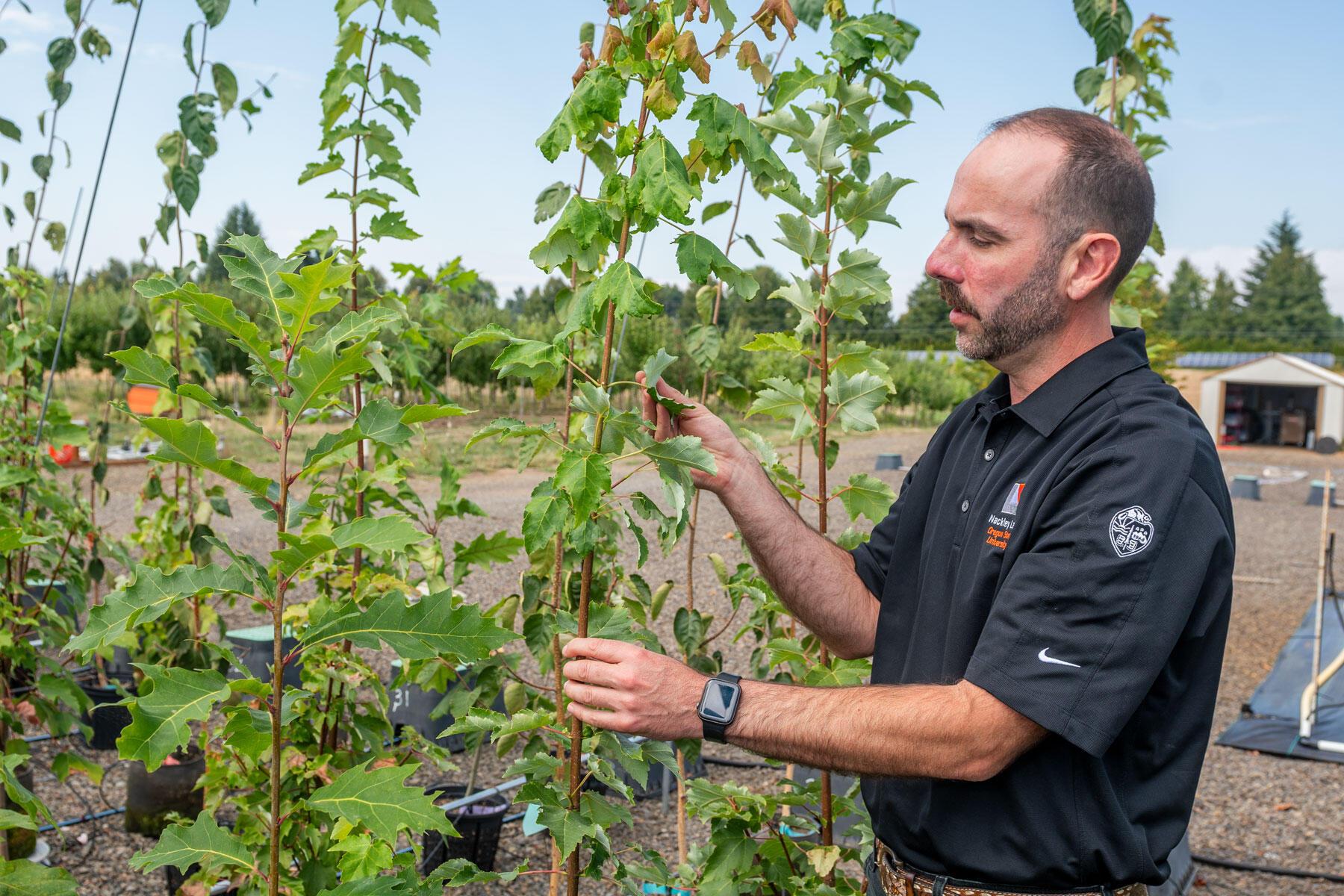
Irrigation guidance for trees grown in containers is limited compared with field-grown crops. The lab is working on irrigation strategies for container nurseries, especially for vulnerable, pencil-sized young trees.
Nackley said improved irrigation can help keep fertilizer in the pot, reducing waste and downstream impacts tied to nutrient runoff or leaching.
“If we can improve how we grow the plants, we can do a better job with irrigation so that we’re not losing money by flushing fertilizer out of the pot,” Nackley said.
Nackley said some companies do this research, but many can’t afford the time, space and risk. University trials can push conditions to the edge and share results with the industry.
“We kill plants, so they don’t have to,” Taylor said.