CORVALLIS, Ore. — Like many agricultural scientists, Shayan Ghajar is a bit of a detective, searching for clues.
Since 2022, Ghajar — an Extension organic pasture and forages specialist at Oregon State University — has been on a case to find crops grown for food and forage that can withstand Western Oregon’s changing climate.
“It was important to me that growers had options. These weren’t just experimental plots. They were real tools farmers could use for food, forage or both.”
The region — despite its rainy reputation — experiences long, dry summers typical of a Mediterranean climate. These dry periods are becoming hotter, longer and less predictable. This puts pressure on local farmers, who must find crops that can withstand drought and heat, require less irrigation, and still provide food and forage for people and livestock.
Ghajar’s goal is to help farmers grow crops that can serve multiple purposes — human food, livestock feed and soil cover — without relying on irrigation. He and his research colleagues select a mix of grasses and legumes, grown at the U.S. Department of Agriculture Plant Materials Center in Corvallis and local farms.
Their most recent research shows that warm-season crops — particularly sorghum, pearl millet, cowpea and sunn hemp — can be viable forage and food options in Oregon’s drying climate. However, variety selection matters. In some cases, poor performance may have been due to the specific seed variety used, not the crop species.
Over 185 farmers and 62 agricultural professionals engaged with the project through field days, webinars and one-on-one consultations. Outreach events were held at Oregon State’s research farms and included demonstrations, soil moisture tracking and hands-on learning.
For Ghajar, the value of the study lies in its practical relevance — by working directly with farmers in diverse settings, the research offers grounded, scalable insights into how multi-use crops can support both food and forage production in a changing climate.
“It was important to me that growers had options,” he said. “These weren’t just experimental plots. They were real tools farmers could use for food, forage or both.”
From pilot plots to multi-farm trials
Ghajar, who was hired in 2021 and is a faculty member in the OSU Organic Agriculture Program in the Center for Resilient Agriculture and Food Systems, started trials in 2022. Through a grant from Oregon State’s Agricultural Research Foundation, he planted randomized blocks of annual forages and evaluated them for yield and nutritive value. He also set out to determine the best sowing dates and growing conditions.
He concentrated on cowpeas (Vigna unguiculata), mung beans (Vigna radiata), lablab (Lablab purpureus) and crabgrass (Digitaria ciliaris), which is considered a weed by most but is a good forage species. Cowpeas, lablab and mung bean have the added advantage of fixing nitrogen in the soil, making it available to plants.
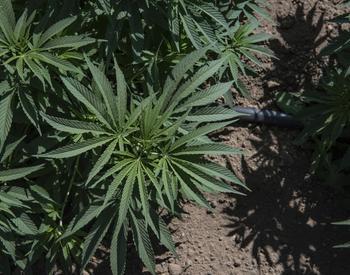
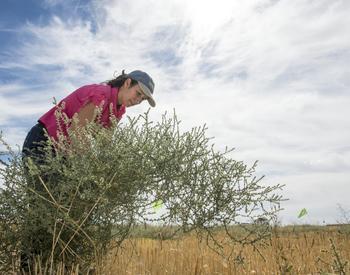
His research continued in 2023, when he added Maximilian sunflower (Helianthus maximiliani), safflower ‘Baldy’ (Carthamus tinctorius var. ‘Baldy’), sesbania (Sesbania sesban), sunn hemp (Crotalaria juncea) and sweet blue lupine (Lupinus angustifolius).
Based on those results, Ghajar received a grant in 2024 from Western SARE (Sustainable Agriculture Research and Education) to expand the project: new species, additional farms and a research partner — Lucas Nebert, an assistant professor of practice who led the OSU Dry Farming Project and is now an Extension organic seed and planting stock specialist.
“Collaborating with Dry Farming was exciting because that program reaches thousands of people,” Ghajar said. “I knew the information would spread.”
Ghajar and Nebert measured crop performance by looking at how much biomass the plants produced (both forage and seed), how much ground they covered, and how well they regrew after simulated grazing. Farmers also shared observations on livestock preference and estimated savings on feed.
“I’ve not seen another study with this many different sites in Western Oregon,” Ghajar said. “It was a very exhaustive and diverse set of farms.”
Standout performers and lessons learned
Results varied among the crops tested:
- Sorghum was the standout performer, yielding the most forage across all sites. It’s a top choice for farmers, but under stress it can produce prussic acid, which is toxic to livestock. This risk can be managed by testing before grazing.
- Pearl millet was less consistent but still a good option, especially since it doesn’t carry the same toxicity risk as sorghum. Both grasses can accumulate nitrates under stress, another livestock risk that’s manageable with soil and plant testing.
- Teff performed poorly and needs further evaluation with different seed varieties.
- Cowpeas and sunn hemp were the best legume performers. Cowpeas did well in a variety of soils and were more palatable to livestock, while sunn hemp grew tall and competed well with weeds.
- Lablab and mung beans showed inconsistent results. Lablab partnered well with tall grasses due to its vining habit but should be used as a secondary component in seed mixes.
- Tepary beans struggled due to pests and produced less biomass overall.
Only four crops — sorghum, pearl millet, mung beans and tepary beans — matured enough to produce harvestable seed. Sorghum and millet were the easiest to harvest and process, making them strong candidates for dual use. Pearl millet, however, was more sensitive to drought stress, affecting seed production. Cowpeas and lablab didn’t mature fully, but different varieties might perform better.
Mixed plots often didn’t outperform the best single-species plots. The inclusion of weaker-performing species — such as teff or tepary beans — reduced overall biomass. However, these mixes may offer better nutritional variety and could perform better with refined planting rates and combinations.
"All the species we trialed were multi-use — that was the goal,” Ghajar said. “If they didn’t work out as a food crop, they could still be grazed or treated as pure cover crops. Everyone ended up grazing them, using them as cover crops, or both.”
Farmers appreciated the crops’ ability to grow with minimal water and were excited about options for extending grazing seasons and reducing feed costs. However, there was a strong call for better seed availability, especially for organic production.
Looking ahead
The research isn’t finished. Plans call for:
- Testing more seed varieties, especially those bred for forage or adapted to drought
- Refining multi-species mix strategies for better balance between productivity and nutrition
- Exploring warm-season perennials as long-term forage options
- Developing better guidelines for planting timing and soil management to maximize rooting depth and moisture access
“This research lays the groundwork for a more climate-resilient agriculture in the Pacific Northwest,” Ghajar said. “By identifying crops that thrive with little water and serve multiple purposes, the project offers farmers tools to adapt, diversify and thrive under changing conditions.”
Ghajar is an assistant professor of practice in the Department of Crop and Soil Science in the College of Agricultural Sciences.
Western SARE is a program of the U.S. Department of Agriculture National Institute of Food and Agriculture.