Transcript
Episode 72: Cultivating Shitake Mushrooms
This transcript was generated by Ai and edited by humans for correctness, accuracy, spelling, and syntax.
Oregon State University’s In the Woods podcast host Jacob Putney interviews Washington State University Extension colleagues Patrick Shults and Justin O’Dea about agroforestry and cultivating shiitake mushrooms on logs as a forest-farming enterprise. They describe shiitake’s origins in China and modern log-cultivation roots in Japan, and explain why shiitake is a reliable, versatile choice for hobbyists and small woodland owners. The episode covers low-capital startup needs (fresh hardwood logs, drill/inoculation tool, spawn, wax, and a stock tank for soaking), species recommendations and pitfalls (avoid conifers and Oregon ash; red alder and Oregon white oak perform well; bigleaf maple is variable; cultivated hazelnut shows promise), inoculation and timing (fell late winter, wait ~6 weeks, drill and fill holes with sawdust spawn, wax, then a 12–18 month spawn run), forced fruiting by soaking, typical yields, and key lessons on moisture management, bark care, and site logistics, plus resources including pnwforestmushroomgrowers.net.
[00:00:32] welcome and guests
[00:01:26] patrick’s extension journey
[00:02:28] justin’s mushroom background
[00:03:36] why shiitake and agroforestry
[00:03:59] origins of log-grown shiitake
[00:05:23] why shiitake is so popular
[00:07:08] gear and setup basics
[00:11:16] best tree species for bolts
[00:16:53] bolt size and handling tips
[00:17:42] inoculation step-by-step
[00:19:58] timing fresh logs and seasonality
[00:21:06] why wait six weeks
[00:22:05] shiitake growth and competition
[00:22:48] spawn rate teaser
[00:23:01] drilling hole spacing
[00:23:48] sawdust vs plug spawn
[00:25:47] spawn run timeline
[00:28:36] forced fruiting schedule
[00:30:31] expected yields over time
[00:31:51] first timer lessons
[00:34:28] moisture management tips
[00:36:07] forest farming takeaways
[00:39:18] lightning round q and a
[00:40:47] recommended resources
[00:43:26] closing thanks and wrap up
[00:00:00] Lauren Grand: From the Oregon State University's Extension Service, you are listening to In the Woods with the Forestry and Natural Resources Program. This podcast brings the forest to listeners by sharing the stories and voices of forest scientists, land managers, and enthusiastic members of the public. Each episode, we will bring you research and science-based information that aims to offer some insight into what we know and are still learning about forest science and management.
Stick around to discover a new topic related to forests on each episode.
[00:00:32] Welcome and Guests
[00:00:32] Jacob Putney: All right. Welcome back everyone to In The Woods Podcast, presented by the Forestry and Natural Resource Extension Program at Oregon State University. I'm Jacob Putney, extension agent in Baker and Grant Counties, and your host for today's episode. I'm excited to be joined today by two extension colleagues from Washington State, Patrick Shults and Justin O'Dea
Patrick is an extension forestry specialist. He holds a Master's and Bachelor's in Forestry, both from Michigan State University. Justin is an associate professor and regional agricultural specialist. He holds a master's in agriculture from Montana State University. Patrick, Justin, thank you both so much for joining us today.
I want to give you both a chance to introduce yourselves. So why don't we start with you, Patrick. Could you tell us a little bit about your background and your work with Washington State Extension?
[00:01:26] Patrick’s Extension Journey
[00:01:26] Patrick Shults: Sure. Yeah. Thanks Jake. I started at WSU extension back in 2018. Came right from Michigan. I'm a forester by trade, so it's kind of fun to work with Justin 'cause we come at this from different angles - him, more agricultural. Me, more forestry. But I did study agroforestry in graduate school.
So when I started a program mostly in southwest Washington I was doing primarily for stewardship kind of stuff which I imagine is what a lot of what you do. A lot of outreach to forest owners, but then slowly started to integrate more kind of agroforestry stuff in, and now it's a significant part of what I do.
It's not most of what I do, but projects like this with Justin have been a lot of fun. And just exploring those alternative sources of income for forest owners. So I consider that a good part of my program now.
[00:02:12] Jacob Putney: Yeah. No, that's exciting. I've worked together in the past, so it's great to have you here today. For the. Episode here. Great to hear how your position's kind of evolved over time.
[00:02:23] Patrick Shults: Yeah.
[00:02:23] Jacob Putney: Okay. Let's turn it over to you, Justin. Tell us a little about your work in extension.
[00:02:28] Justin’s Mushroom Background
[00:02:28] Justin O'Dea: Yeah. So I've been at WSU since 2017, so right around when Patrick started. Before that I was in New York State also doing extension. And my background's mostly centered around agriculture versus forestry, but I got introduced to producing mushrooms on logs through working on a farm that did shiitake mushrooms as part of their CSA.
And so when I got here got to know Patrick some, and we both had this interest in Agroforestry and approached Patrick about doing a project on shiitake mushrooms 'cause I kept hearing there was interest in it and nobody was really doing the work. So at least at the, at the university level.
So there was kind of a wide open space there for a need to be met. But most of my other program work is focused around trying to help farmers adapt to urbanization. And this is kind of one of those things. This is a specialty crop that kind of has a niche that can be used in that kind of context.
[00:03:36] Why Shiitake and Agroforestry
[00:03:36] Jacob Putney: As Patrick and Justin both alluded to today we're gonna be talking a little bit about agroforestry, and specifically we'll dive into cultivating a well-known delicacy, the shiitake mushroom. So to kick us off why don't we start with some background. Where did log grown shiitake cultivation originate, and how has that practice evolved over time?
[00:03:59] Origins of Log-Grown Shiitake
[00:03:59] Justin O'Dea: it originated in China. And they used to just take logs and make little cuts into them and try and rub the, literally the spores into them. So it was a pretty crude process that they started with. But the methods that we use today really have the roots in Japan. And Japan is the place globally where this is still practiced on a larger scale . And so this modern version, this modernized version of producing shiitake on logs started in around the 1940s in Japan.
[00:04:38] Jacob Putney: Is that where these mushrooms are native to?
[00:04:40] Justin O'Dea: They're native to Asia. Yeah. So not just Japan, but also China and Korea.
[00:04:46] Patrick Shults: I'll add that as part of our last or the grant we're currently on. A couple of years ago, Justin and I and some other colleagues got to go to Japan and actually tour some of these operations, some research farms, some forest owners that have been doing this for a long time. It was really fascinating to see just how it's very ingrained in the culture, right?
It's been going on first centuries obviously. And it was, yeah, I mean it was incredibly informative to be able to do that. Very rewarding.
[00:05:20] Justin O'Dea: Yeah.
[00:05:21] Jacob Putney: That's really cool.
[00:05:23] Why Shiitake Is So Popular
[00:05:23] Jacob Putney: So kinda on that note, so what makes the shiitake mushroom itself such a popular choice for this cultivation? Particularly for a hobbyists or small woodland owners?
[00:05:34] Patrick Shults: I'll try that one. So I think it's reliable. You can reliably force. These logs to fruit in a way that for many other types of mushrooms it's just more difficult. There's a lot of resources available, even though for a long time here, those resources are from the East coast. Now Justin and I have developed some resources more tailored to our region.
It's just, a mushroom that's pretty easy to cultivate compared to some of the other specialty mushrooms. And as I said, reliable. And also it's delicious. I mean, the shiitake mushroom's very versatile. You could do a lot with it and also it dries in stores very easily. So there's just a lot of things that make it a popular choice.
I will say, and Justin, I don't know if this is the case for you, but I do, every time people find out that I, I know a bit about shiitake cultivation. People inevitably ask me about, oysters and lion's mane and all these others Yeah. That they want to do. So, and. You would, I could argue that those are arguably more popular in this region at least.
But those you can do at a hobby scale, but they just don't produce as reliably. And that's why, we've been looking at Shiitake primarily.
[00:06:45] Justin O'Dea: Yeah. And a lot of the work that we've been doing has been beyond hobby scale too. There's a lot of interest for hobbies, but growing for market's been a big focus of our programs work.
[00:06:55] Jacob Putney: Yeah.
[00:06:56] Justin O'Dea: Yeah. And the, I, the only thing I'd add to Patrick is that it generally yields pretty well, which kind of falls under the umbrella of reliable.
[00:07:05] Jacob Putney: Yeah.
[00:07:06] Justin O'Dea: Yeah.
[00:07:08] Gear and Setup Basics
[00:07:08] Jacob Putney: So let's talk a little bit about the cultivation process. So just generally, what are the steps involved and what kind of supplies or equipment might someone need to get started?
[00:07:20] Justin O'Dea: Yeah. So I guess one of the, one of the draws for people is that it doesn't take a huge amount of capital. Or a huge amount of equipment to get going with this. It's generally like a low input process or as economists like to say, has low barriers to entry. And so that's one of the nice parts about it.
And so it's really good for new and beginning growers, first generation growers, either to do as a side business or as an addition to a farm, if they're already producing. Or, in Patrick's case, somebody that's producing timber, they just wanna add a side business. Yeah. So there's not a ton of specialized equipment that's needed either. Like a lot of the time you'll have a lot of the things that you need already on a farm. I think the most difficult thing would be like if you were in like an urban apartment or something like that, and then you know, you, maybe you partnered with somebody who had land that would be more intensive of like an equipment buildup to get what you need. But most people are gonna have a truck around or maybe access to a trailer or a hatchback even that they could put logs in and move them around. They're gonna have a chainsaw maybe for felling timber that you need for it.
And I think like of all of the specialized equipment that you need what's just called like an inoculation tool, which is what actually puts the shiitake mycelium in the wood. You need some kind of like high speed drill. We typically use like a modified angle grinder 'cause it's very fast at drilling holes.
And I'm, maybe I'm forgetting something here, Patrick, but.
[00:09:19] Patrick Shults: We got very creative in how we apply wax. 'cause when you drill the holes in the log and you would put the spawn in. You have to cover it with a kind of wax. We've tried many different, there's a lot of different cheap options. Yeah. I like the Turkey baster. A metal Turkey baster full of hot wax.
Works really well personally.
[00:09:37] Justin O'Dea: I like that version too. Yeah.
[00:09:41] Patrick Shults: I will say too, I do know the inoculation tool is cheap, right? You said it's like one of the only specialized things that you need to buy, and it's really not that much. But I do know a farmer who used a it was like a what A medicine. Like a, it was like a pill plunger for, it wasn't a syringe exact, it was like a pill plunger for cows, basically.
Yeah. And the, uh, and it was like the exact right size, and so he just put like a spring in it and it was plastic. I thought that was pretty creative.
[00:10:10] Justin O'Dea: Should have them send us a link to it so we could showcase it.
[00:10:14] Jacob Putney: Yeah. There you go.
[00:10:15] Patrick Shults: I did take a picture somewhere. I'll have to send that to you.
[00:10:17] Justin O'Dea: Yeah. Yeah. But I think that's all the specialized equipment you need. Maybe I'd include this though, because we soak the logs part partly to like rehydrate the logs, but also to force fruit. And that requires something like a stock tank. We usually use like the metal type stock tanks, and those are actually the biggest like financial investment you'll make if you've got, if you've got like a chainsaw already and you've got a, a truck to move stuff around.
[00:10:50] Patrick Shults: I have seen people get creative. I know you have too, Justin, with like how to soak them, but the livestock tank is really
[00:10:56] Justin O'Dea: yeah.
[00:10:57] Patrick Shults: unbeatable. It's very easy.
[00:10:59] Justin O'Dea: Yeah. Yeah. It's really optimized for it in a way.
As long as they
[00:11:03] Jacob Putney: he had a swimming pool handy.
[00:11:06] Patrick Shults: I've heard of people doing just a couple logs in their bathtub, but then it gets full of bark and all. Yeah.
[00:11:12] Justin O'Dea: Yep. Yeah.
[00:11:16] Best Tree Species for Bolts
[00:11:16] Jacob Putney: Let's talk about these logs then. Which tree species are gonna work best, and, which ones should be avoided for cultivating these?
[00:11:26] Patrick Shults: Justin, you've done so much work with this. I think you should take that.
[00:11:29] Justin O'Dea: Yeah. So we've trialed a lot of different species. One of the main, tree categories or tree like subsets that you need to avoid are any kind of conifer or soft wood. it just doesn't work. The shiitake fungus can't digest it. It's just a totally different type of food for the shiitake fungus to eat.
And it doesn't work. So you're looking mainly at broadleaf tree species, which in the northwest we're somewhat more limited in our variety of species that, that we have of broadleafs versus someplace like the Eastern United States or Japan. But the ones that we've generally advise growers against are Oregon ash.
For some reason the shiitake fungus just will not eat it. We've had shiitake bolts once a log is inoculated. We call it a bolt just to get that out of the way. So we have these shiitake bolts of ash, and I think I've, I'm three years deep on them right now. Not a single mushroom has come out of those ash logs.
[00:12:42] Patrick Shults: Same here. Yeah, nothing.
[00:12:45] Justin O'Dea: Patrick, you. Yep,
[00:12:46] Jacob Putney: Is there any other research in other fraction species or is
[00:12:50] Justin O'Dea: Y well, I don't know if research, but like
[00:12:54] Jacob Putney: trial
[00:12:55] Justin O'Dea: on the East coast they advised against they, yeah. Like they, they advised against Rex sinus.
[00:13:02] Jacob Putney: Yeah.
[00:13:02] Justin O'Dea: And then other ones to avoid our this, our second most. Abundant species is big leaf maple and shiitake will eat it like shiitake. In fact, it can yield well, but it's really variable.
And the problem is that it, those logs lose too much moisture too easily and. What it, what happens is you get a pretty big delay on when the shiitake fungus actually starts to fruit on those logs. And sometimes if you don't manage it it may never fruit at all. But I've, I always tell people I've had big leaf maple I think it's one of our bolts that's big leaf maple is like our second highest yielding, like single bolt, but it also has the highest number of logs that just never fruited at all,
[00:13:54] Patrick Shults: Right.
[00:13:55] Justin O'Dea: All the things that we've,
All the things that we tried besides Oregon Ash..
[00:13:59] Patrick Shults: I know we both had logs that took Yeah, three or four years to do anything, which is a long time to wait for some mushrooms, even if you're a hobbyist.
[00:14:09] Justin O'Dea: Yeah. Yeah, exactly. So we consider it not commercially viable for people that are wanting to grow from market, but you know, even if you're not, you're waiting a long time. I'm trying to think of any other species that are generally like a no go.
[00:14:25] Patrick Shults: I'm trying out some fruit trees this year. We'll see how they do. But no data on that. I don't know if you've done anything with fruit trees.
[00:14:33] Justin O'Dea: Not besides just feral cherry, so feral, sweet cherry. We've done quite a bit with feral sweet cherry, and it yields like moderately low. But it's a really like robust bolt. It's very tough. It can take a lot of abuse. So it's a double-edged sword with that species. And I think it just doesn't yield as well.
Mostly I think 'cause mushrooms can't poke through the bark. It's got very tough bark on it. And it, I think that's maybe why, because. Birch also has the mushrooms have trouble getting through and they have the same sort of symptoms, even though Birch initially is a lot more robust as far as yield goes.
But the main like workhorse species in the northwest is red alder. You just have to manage it well 'cause it can lose moisture pretty quick. And moisture's a really key part of how you manage shiitake bolts viability over the long term and how you get it to start fruiting early, as early as possible.
But yeah, red Alder and then Gary Oak or Oregon White Oak. That those two are the, like the major like workhorse pieces, they both work well. The only thing with Oregon White Oak or Gary Oak is that it takes about 18 months to two years to begin starting to begin to start fruiting. Once it starts going it, it yields well, but it takes a while because it's such a dense wood.
And then in our trials, one of like the up and coming. All Stars appears to be hazel, common. Hazel, not the native species. The native species is kind of iffy, but the cultivated non-native hazel hazelnut Filbert wood works really well. It's sort of a, almost like a unicorn combination of bark that really really helps keep the integrity of the log over the long term. But it's not so tough that the mushrooms can't poke through. Yeah, there's a bunch of different species that will work. It's just that maybe those three and then like Birch initially in the first two years or so, works really well too. Yeah.
[00:16:53] Bolt Size and Handling Tips
[00:16:53] Patrick Shults: I was just gonna say real quick that, in terms of size that you're looking for, it's you're genuinely wanting like a four to six inch diameter. And then bolts, we typically recommend about four feet. That's just great for moisture management and for saving your back like heavier logs will do, but you know, they're not gonna produce much more than a four to six inch diameter.
So with hazelnut. That is one of the challenges. I had a really hard time finding Hazel that was sufficient diameter and you could try smaller stuff, but it'll dry out more quickly generally. But yeah, so, and then we'll also add Oregon Oak for us. Washingtonians is a little bit harder to find, especially north of where Justin's at and a lot of, and sometimes can be protected too.
So, yeah, you do have to consider that as well.
[00:17:38] Justin O'Dea: Yeah. Yep. Exactly.
[00:17:42] Inoculation Step-by-Step
[00:17:42] Jacob Putney: So let's talk about the inoculation process. Can you kinda walk me through that and what that looks like? So you have your bolt and you're ready to inoculate. What does that look like?
[00:17:54] Justin O'Dea: Yeah. You start with your log
[00:17:57] Jacob Putney: the log before the bolt, sorry.
[00:17:58] Justin O'Dea: yeah, the log before the bolt,
[00:18:00] Jacob Putney: Log before the bolt.
[00:18:01] Justin O'Dea: People get confused and I even interchange them sometimes. So you have your log, so you've got your four to six, six inch diameter log, and it's, we usually use a four foot long bolt, and we use four feet.
It's a complicated answer to why four feet. But four foot is what we use for our system, and it works throughout the whole process really well. And what you need to do is essentially it's you insert mycelium, which is actually the vegetative part of the shiitake fungus. It's not spores 'cause spores are gonna produce a random strain,
Like certain plants do that. Like if you let them go to seed, they'll always produce a different a different variety. So what you do with using mycelium is you assure that the strain is gonna be true to type. It's gonna be, you're gonna know what to expect.
And usually what the mycelium comes in is it's like sawdust that's been it's been colonized by the shiitake fungus. And what we do is we drill holes in the log into the sap wood because the sap wood is where the shiitake fungus will grow. And then you insert the spawn that contains the mycelium into the hole, and then we cap it off with melted wax. And what that does is it prevents the spawn from drying out and it prevents the log from also drying. And it also, adds, this adds a sort of a barrier from other like feral or weedy fungi species that could have otherwise got into the log through that injury. And once your log is an entirely inoculated, then it is a shiitake bolt.
[00:19:58] Timing Fresh Logs and Seasonality
[00:19:58] Patrick Shults: The timing is also really important, and I think may important now because I don't know when this podcast is gonna come out, but it could work out really well for some folks to try this out themselves because you really want to, well, we didn't mention this, but you need fresh logs. You don't want to go and pick up a log just that's been laying on the ground in the woods because it may have already been inoculated with all kinds of other fungi and also it's probably dried out quite a bit.
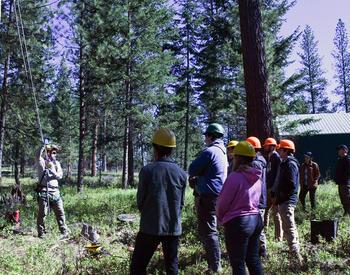
So we are felling our own trees and we're using small diameter wood, so it's very conducive to things like thinning. A lot of, I always joke, every forest owner in Washington has some red alder that needs some thinning, so this is really works. So we do that in late February which is a really good time 'cause the SAP's not running yet in the tree, so the bark stays intact, which is really important. There's lots of carbohydrates in the tree still. So we fell those late February. We let them sit for six weeks and then we come out and buck them up into four foot lengths and go get them over to where we're gonna inoculate them like Justin described.
So I imagine some folks could be listening to this right now and thinking about trying it out for themselves this year. It's a really good time.
[00:21:05] Justin O'Dea: Yeah. Yep.
[00:21:06] Why Wait Six Weeks
[00:21:06] Jacob Putney: What's why do you let him sit for six weeks?
[00:21:10] Justin O'Dea: Because the shiitake fungus is a fungus that eats dead things, and so the tree has to die back. So you give it a little period of time in order to do that, and by the time it starts to actually die, the fungus is just really ready to invade. And in Japan, they do it for a moisture reason too.
But our context is different. So it's not really for that. It's more to just let the tree die back a little bit.
[00:21:42] Patrick Shults: Yeah, that was interesting to hear that. And the timing also works out too, so that you're inoculating right as the temperature's starting to warm up. As Justin said, it just really gives, it's all about giving the shiitake a head start, basically, over other things that want to get into the log. 'Cause it, it's not native, but it's certainly not invasive and it's not gonna outcompete most of our native fungi.
[00:22:04] Justin O'Dea: Yeah.
[00:22:05] Shiitake Growth and Competition
[00:22:05] Justin O'Dea: It's like a, it's almost like a warm weather fungus in a way. Like it will fruit. It will fruit in cooler weather, but most of its growth is like between 70 to 80 degrees. So it's unique in that way. And I mean, I should add too, like we've never, I've never seen shiitake, if you get it in the log just that bulk addition of mycelium to the log to inoculate it and the shiitake fungus is very competitive.
Though at the same time, I've never seen like a feral shiitake mushroom come up around what we call a laying yard, which is where we produce shiitake in the woods.
[00:22:48] Spawn Rate Teaser
[00:22:48] Jacob Putney: So thinking about, your standard four foot log, how much of this spawn would you inoculate it with? Like how many holes are we drilling?
[00:22:57] Justin O'Dea: Yeah. We use a pretty standard method.
[00:23:01] Drilling Hole Spacing
[00:23:14] Justin O'Dea: So you're gonna make a row of holes that are about four inches apart along the length of the log, and then about two inches between the rows. And it's gonna work out to two to three because you're never gonna be able to fit the exact amount of rows, 'cause there's different sizes of log.
So I don't know what that works out to off the top of my head.
I think we can get, you can get through about 12 to 15
[00:23:30] Patrick Shults: It'd be like 12 holes per row, roughly,
[00:23:33] Justin O'Dea: Yeah. Something
[00:23:34] Jacob Putney: It doesn't have to be exact. I was just
[00:23:36] Patrick Shults: and then a row for each day.
We have to figure it out. 'cause he said it
[00:23:39] Jacob Putney: yeah.
[00:23:40] Patrick Shults: and now I can't let
[00:23:41] Jacob Putney: somebody's gonna have to do the math real quick.
[00:23:44] Justin O'Dea: Data driven.
[00:23:45] Patrick Shults: Yeah.
[00:23:48] Sawdust vs Plug Spawn
[00:23:48] Justin O'Dea: But I think yeah, I think it's around 15 logs you can get through, depending on the size of the log with a single five and a half pound bag, which is a pretty common standard of a commercial spawn that you can buy.
[00:24:05] Patrick Shults: A lot of people too immediately go to the little wooden dowel,
what we call those plugs. Plug Spawn.
[00:24:12] Justin O'Dea: Yeah.
[00:24:13] Patrick Shults: and Justin, more about the disadvantage of those, but it does take, it usually takes a longer spawn run. That's one of the bigger things is that it just takes a little bit longer for the log to, to get fully colonized.
And they are slightly more expensive as well. So if you're doing it in bulk the spawn the saw-dust spawn that we use in inoculation tools tends to be more effective.
[00:24:34] Justin O'Dea: In Japan okay, let me back up. So in the Northwest at least, a lot of the growers that we're working with, they're interested in fresh market, shiitake and in Japan. They use a very similar inoculation rate and style. So they'll use sawdust spawn and they'll at the same rate that we do.
A lot of the, a lot of the bolts that are that use plug spawn are in a different type of system in Japan that are targeted towards dried shiitake. It's like a lower input, larger scale option. And our context is just different. Like our market context is just different here. So that's why we really focus on the sada spawn method with a bit of a higher rate.
And I think it takes an extra 30% of time to for plug spawn to, to colonize a log. 'cause typically it's, it's added at a lower inoculation rate, so there's a less number of holes and the dowels actually a smaller hole than than you would use with sawdust spawn.
[00:25:47] Spawn Run Timeline
[00:25:47] Jacob Putney: So I wanna go back to something that Patrick mentioned, the Spawn run. Could you tell us a little bit about that and why it's so important for this process?
[00:25:57] Patrick Shults: It takes place right after what Justin described as the inoculation process. So once you've got all your holes drilled, filled with spawn waxed over nice and good that's basically when the spawn run starts and it's a period of about 12 to 18 months, really depending on the variety of the shiitake, what substrate you're working with, even, weather conditions, that kind of thing.
That takes for the fungus to basically colonize the log, move through and fully inoculate, achieve dominance over certainly any non-native fungis to get to a point where it could then start to create fruiting bodies. So a lot of people do think that they're gonna be able to inoculate in, April and then, get some mushrooms that summer. That's unfortunately not the case, but if you do everything right, you should be able to get some the following summer. So I do really encourage, that's why it's always nice to, get in while the getting's good you put a little investment in. And those logs last a while too.
[00:26:57] Justin O'Dea: I generally think of 'em as, they're almost like a perennial crop.
[00:27:00] Patrick Shults: Yeah.
[00:27:02] Justin O'Dea: Like you put a bunch of time in, in the beginning, there's a big,
[00:27:05] Jacob Putney: yeah.
[00:27:05] Justin O'Dea: Glut of work in the beginning and then you wait,
But it's gonna keep producing for three to five years
and a lot, if you're doing it like, for a hobby, you can keep the log around for longer.
[00:27:18] Patrick Shults: Yeah, the logs we did in 2019 we haven't talked to since the last harvest season. And I think Justin about like I have 6-year-old logs that are still producing, which is just yeah, it's crazy.
[00:27:29] Justin O'Dea: I retired my 5-year-old bolts. But I noticed that some of them were still, yeah, were still putting up like spontaneous mushrooms after a rain or something like that.
[00:27:42] Patrick Shults: It's something too where a, definitely a commercial producer would do this, but even a hobbyist would probably inoculate logs every year just to kinda keep that going, making sure they have that longevity and always have some colonized logs ready to produce.
[00:27:55] Justin O'Dea: Yeah. And also that, that early period of production, like the first two years or so, it, you're gonna get bigger yields. It's gonna decline over time. Yeah. As the fungus uses up, readily available food and has to start scrounging around for more food in the log in order to produce.
[00:28:16] Jacob Putney: Yeah, that's kind of what I was gonna ask next actually is, um, that kind of harvesting process. So, 12 to 18 months. Starting to produce what do those kind of yields look like? And you said they start to decline over time, but kind of initially for those first two years, like what would a, a four foot bolt produce?
[00:28:33] Justin O'Dea: Yeah. Yeah.
[00:28:36] Forced Fruiting Schedule
[00:28:36] Justin O'Dea: So the fruiting process. So after your spawn run period, the log should be about ready to fruit, uh, within 12 to 18. Depending on things, especially if you're using like Organ Oak, then it's gonna be like two years maybe is gonna be able to start producing.
And one of. The nice parts about shiitake, one of the actually key aspects, from like a commercial standpoint is that you can do this thing called forced fruiting, which is, which some people have probably seen, which is where you immerse the log in cold water, for a period of time, we usually use 24 hours as a standard amount of time.
And what that'll do is it'll actually incite the shiitake fungus to fruit.
[00:29:23] Jacob Putney: Huh.
[00:29:23] Justin O'Dea: And so that's what really it makes the harvest a lot more reliable and a lot more like under control as far as controlling quality goes. And we typically do that three times a season with about a seven to eight week gap in between where the log is resting, as they call it, is getting ready to be able to fruit again. And so it's typically in very early June or late May. And then it about the third week of July and then about the second week of September was the general schedule that I, that we use. And it all depends too on, on the strain that you have, there's a couple different strain types.
There's warm weather strains, and then there's wide range strains, and then there's cold weather strains
[00:30:27] Patrick Shults: It gets pretty complicated.
[00:30:29] Justin O'Dea: gets a little complicated. Yeah.
[00:30:31] Expected Yields Over Time
[00:30:31] Patrick Shults: And in terms of yield, it's, it can, it obviously varies, especially in that first year if you're not getting all three harvests and then again later, as Justin pointed out it'll taper off. But just, we expect somewhere between a half a pound and maybe a pound on the high end per log, per summer.
[00:30:52] Justin O'Dea: Yeah, early on. I've done a four year average on well-managed alder equaled 0.37 pounds of shiitake per log per harvest. So that's a total of 12 harvests worth. Yeah. A little over a pound in the beginning. It's gonna be more, it's gonna vary. A lot of times you'll, your bolt will get what I call like a hangover. Like it has a really bark busting, like yield. It might not fruit like the rest of the season.
[00:31:28] Patrick Shults: Yeah, I've seen that. Yeah. That's funny way to put it.
[00:31:31] Justin O'Dea: yeah. And other times you'll just get, like a, a quarter to a half pound, per time or.
It just really depends.
[00:31:41] Patrick Shults: And that's pretty comparable too with what they Yeah. East Coast and Japan. Yeah, we're really happy with that.
[00:31:48] Justin O'Dea: Yeah.
[00:31:51] First Timer Lessons
[00:31:51] Jacob Putney: So for folks that are interested in getting started what would you say are some of the big biggest lessons or lessons learned for first time growers?
[00:31:59] Justin O'Dea: One of the things that people have to maybe keep in mind is this is a method that's not really suited for large scale so people can be thinking about that. It's more suitable for a small scale context because you can't really scale it up that well.
And even though they do it on a large scale in. Japan, just their market context in Japan is very different, and the fact that it's very ingrained in the culture and people know how to do it and who knows the history of it and all these things. So here it's really most intended, most suitable for smaller scale and for something to add to a business you already have, maybe. Some other aspects that I was thinking of is people tend to have trouble if they don't have timber on site. If they don't already have a forest where they can get their timber from. It's complicated to figure out where you're gonna get your timber from. It's one of the bottlenecks. And then something that people tend to have to get used to is people are most used to treating timber of that size, like firewood, like throwing it around. And it's very different for this context of growing mushrooms on, because you really need to keep the bark intact.
The bark is very important to the long-term viability of the log, so it's hard to get people used to treating it better throughout the whole process of when you have that, when you have that log, you really can't be throwing it around and banging it up. Especially with something like Alder that has brittle bark. It's, it just it takes away from the long-term viability of the log. And then I was gonna say too that making sure that you have a suitable site and an inoculation site as well, that are like in close proximity because some people get overwhelmed with the number of logs that they get and they figure out that they can't get, they can't get water to their site, or they can't get electricity to their site, or they have trouble moving them around.
As they need to as well. And then yeah. Are there other things that you're thinking of too, Patrick?
[00:34:25] Patrick Shults: You touched on a lot of 'em, I think.
[00:34:28] Moisture Management Tips
[00:34:31] Patrick Shults: The big kind of broad one I would say is just get used to thinking in terms of moisture. Just be thinking about elements that are gonna dry out your logs. Short term, long term. It's especially important during the spawn run. To be thinking about that.
But little things like Justin, I know you experienced this when you were transporting logs the first time you didn't cover them and they lost a lot of moisture. Going on like a 20 minute ride down the highway. You just gotta be really our biggest hurdle of this region, and the reason many hobbyists have failed, is because we have these really dry summers compared to the Midwest, where it's very humid and they get, periodic rains.
We don't, yeah, we don't have that. So we have to be really thinking about moisture management.
[00:35:16] Justin O'Dea: yeah, and we developed a couple methods that we use now.
[00:35:21] Patrick Shults: That's the other just broad piece I'd say. 'cause it can be really easy to kind of hear this and be like, oh, well I'm just gonna, I'm just gonna try it. I don't need to like read these instructions very carefully. I'm guilty as that, of that as anyone is but I would just say like, really read these guidance that we've come up with closely, even for a hobbyist, because you don't want to invest all that time only to find out a year later that this isn't gonna work. They're not gonna yield, or you're gonna have to wait a really long time. Right. Because that's the other consequence.
So, and it's not a ton of stuff, but it's, like you said, Justin's some really important tips and tricks that are unique to our region.
[00:35:58] Justin O'Dea: Yeah. Yep. Absolutely.
[00:36:03] Jacob Putney: We're nearing the end here, but I just wanna make sure we don't miss anything.
[00:36:07] Forest Farming Takeaways
[00:36:07] Jacob Putney: So do either of you have any parting thoughts on cultivating shiitake mushrooms or just agroforestry in general? Are any of your work any cool projects that either of you are working on?
[00:36:15] Patrick Shults: I'll just say that there's a lot of things like this. This Shiitake falls under the category of forest farming, which is just, alternative ways to manage for non timber forest products. And like I said earlier, it's becoming a bigger part of my program. And I know there's a lot of people out there that are excited about those opportunities, whether, for personal use or maybe scaling up.
So I hope they consider extension a resource. And we love to hear what people are interested in, and I am particularly interested in those folks that have tried something like this unique and have had successes or failures. So I'm always interested to hear from people that are doing it.
It's hard to track 'em down sometimes.
[00:36:58] Jacob Putney: Yeah.
[00:36:58] Justin O'Dea: Yeah. Yeah. Maybe I'd add. Just that there's some aspects to this. That the fact that it really doesn't take a lot of forested space to produce mushrooms on. So the land impact is pretty small. And even though, for instance, like the soaking you're filling up this giant tank in front of you and that's a lot of water.
Right? But if you look at it compared to growing something in a field, a crop in a field and irrigating with one inch of water. It's vastly lower water use with the shiitake production method in the forest like this. And it's not displacing farmland.
So it's kind of like this really nice, like little niche side thing that people up until now really aren't doing. One other sort of almost like non-quantifiable aspect is that like the, just like the sheer profit margin alone on this method isn't necessarily a big cash cow.
You can make money on it, but it's not a huge money maker. But a lot of the growers that I've interviewed, that we've been working with, as they start up this process, they just enjoy the process of doing it. They like the opportunity to work in the woods, and see the mushrooms grow and just I'm working with a farmer who's working growing crops out in a field, during the heat of the summer it's nice to just shift in the middle of the day and go into the woods and like work in a cool place and still be, working towards your end goal, which is your business of, producing food and producing for your farm.
[00:38:40] Patrick Shults: A very rewarding process to see those logs start to fruit.
[00:38:44] Justin O'Dea: Yeah.
[00:38:45] Jacob Putney: Oh, I bet, especially after waiting for, a year and a half, two years,
[00:38:48] Justin O'Dea: One of the hardest parts that, yeah, people have for sure that wait..
[00:38:54] Jacob Putney: Patrick, Justin, I wanna thank you so much for sharing your expertise with us today. Speaking for myself, I didn't realize how much went into this process as I was preparing for this today. I was just fascinated with kind of everything that goes into this. So I wanna thank you for taking the time to walk me through it.
I know we discussed a lot today, so if any questions came up while you were listening or if you'd like to learn more please drop us a comment or send us a message on our website.
[00:39:18] Lightning Round QandA
[00:39:18] Jacob Putney: Before we wrap up here, though we conclude each episode with what we call our lightning round, or a few questions that we ask each of our guests.
[00:39:33] Jacob Putney: So Patrick, let's start with you first. The first question, I know that we're talking about mushrooms today, but what is your favorite tree?
[00:39:41] Patrick Shults: I feel guilty not saying shiitake. Yeah. I personally, I love Oregon Oak. I wish we had, I wish it was just more present where I'm at, up in Olympia. I love the form of it. I love seeing a big old one knowing how long it took to get there. 'Cause it is pretty slow growing. So I'm all about Organ Oak.
[00:40:00] Jacob Putney: I grew up in the Willamette Valley, so I was privileged, and then I had a lot of it around. All right, so the second question is, what is the most interesting thing you bring with you in the field?
[00:40:15] Patrick Shults: Yeah, that's, I got just like a standard cruising vest. I guess the answer to this would be, especially this time of year, 'cause one of the other projects I have is with Big leaf maple syrup. So when I go into the field to do some sugaring, I have a totally different vest. In fact, it's like a big heavy apron that has all kinds of stuff.
Fittings, tubing, pliers. Nothing you would find at a forestry vest for sure. Except maybe a pruning saw. So maybe that, yeah, my, my sugaring vest.
[00:40:46] Jacob Putney: No, that's good.
[00:40:47] Recommended Resources
[00:40:47] Jacob Putney: And then lastly what resources would you recommend for our listeners if they're interested in learning more about cultivating shiitake mushrooms or other kind of agroforestry related topics?
[00:40:59] Patrick Shults: I'll let Justin talk about what shitake specific resources are available and then I'll, maybe I'll just give some tips for some like broader agroforestry resources. So I just developed a online toolkit called the Working Riparian Lands program, which is basically taking some of these agroforestry concepts and applying them to riparian buffers where we're really limited in how we can manage, and hopefully that create income for forest owners and farmers.
And so that's the working riparian land program. And then also plug a nonprofit that I work really closely with up here in Washington called Agroforestry Northwest, which is doing a lot of work to advance Agroforestry in the region. So yeah, more broad, less related to shiitake, but good resources.
[00:41:44] Jacob Putney: No, that's great. Thank you Patrick. Justin, let's turn it over to you. Same questions. Again, I added what is your favorite tree, it's okay if you have the same one.
[00:41:53] Justin O'Dea: Maybe like Pacific Madone.
And most interesting thing that I bring with me to the field. I do a lot of infield like agriculture work too, and probably the thing that draws the most attention is that we have a 1954 John Deere combine.
So it's like this big old behemoth we drive around the farm. That, I use probably once a season. And then, I was thinking with shiitake wise, I have a sort of a little mirror on a stick, like an automotive mirror that we use for when we harvest shiitake mushrooms was a little thing that we picked up.
I picked it up in Japan from a grower, they use it to see how open the cap of the mushroom is to see when it's ripe. It's hard to look underneath, so we just have this little mirror that has really sped up the process.
[00:42:45] Jacob Putney: And then yeah, lastly is just what resources might you recommend for folks.
[00:42:49] Justin O'Dea: So we developed a website for this and it's like an ongoing thing. We keep adding to it and refining it, but it's pnwforestmushroomgrowers.net.
There's a lot of pictures and a couple schematics and trying to make it as accessible as possible for people to learn from.
And then I think if you're gonna look in some more, like in depth information just about Shiitake. There's a book that's out of print. It's by Paul Perowitz and John Donahue.
It's called the Shiitake Grower's Handbook.
[00:43:26] Closing Thanks and Wrap
[00:43:26] Jacob Putney: So well again, thank you both for being here today. I definitely learned a lot. This topic is certainly out of my wheelhouse, but it was very interesting to hear both of you talk about the, this process and how folks could get started.
With that, this concludes another episode of In the Woods. Thank you all so much for listening. Don't forget to subscribe and we will see you all next time. Bye everyone.
[00:43:53] Lauren Grand: The In The Woods Podcast is produced by Lauren Grand, Jacob Putney, and Scott Leavengood, who are all members of the Oregon State University Forestry and Natural Resources Extension team. Other members of the team who've been involved in the podcast include Carrie Berger, Jason O'Brien and Steven Fred Geral episodes are edited and produced by Carrie Cantrell.
Music for In the Woods was composed by Jeffrey Heino and graphic design was created by Christina Friedhauf. funding for in the Woods is provided by Oregon State University Forestry Natural Resources Extension, the Oregon Forest Resources Institute and the USDA Renewable Resources Extension Act funding.
We hope you enjoyed the episode and we can't wait to talk to you again next month. Until then, what's in your woods?
Oregon State University’s In the Woods podcast host Jacob Putney interviews Washington State University Extension colleagues Patrick Shults and Justin O’Dea about agroforestry and cultivating shiitake mushrooms on logs as a forest-farming enterprise. They describe shiitake’s origins in China and modern log-cultivation roots in Japan, and explain why shiitake is a reliable, versatile choice for hobbyists and small woodland owners. The episode covers low-capital startup needs (fresh hardwood logs, drill/inoculation tool, spawn, wax, and a stock tank for soaking), species recommendations and pitfalls (avoid conifers and Oregon ash; red alder and Oregon white oak perform well; bigleaf maple is variable; cultivated hazelnut shows promise), inoculation and timing (fell late winter, wait ~6 weeks, drill and fill holes with sawdust spawn, wax, then a 12–18 month spawn run), forced fruiting by soaking, typical yields, and key lessons on moisture management, bark care, and site logistics, plus resources including pnwforestmushroomgrowers.net.