CENTRAL POINT, Ore. — Nationally, 83% of farmworkers identify as Hispanic or Latino. In Oregon, that percentage is likely even higher.
For Artemio Gutierrez, a foreman at Dark Hollow Farm in Medford, it’s essential that farmworkers understand how to identify pests and diseases that threaten crops.
“We are the first ones to see the problems,” said Gutierrez, who attended a bilingual field day in September at Oregon State University's Southern Oregon Research and Extension Center, known as SOREC.
Historically, most agricultural education materials have been offered only in English — a barrier for many farmworkers with varying levels of English fluency or literacy.
Luisa Santamaria, a nursery plant pathology specialist and bilingual educator with the OSU Extension Service, has made it her mission to close that gap.
“My main objective is to provide education in plant health to prevent plant diseases,” said Santamaria, who is based at OSU's North Willamette Research and Extension Center. “There is a real need for bilingual education.”
More than translation
Santamaria says effective bilingual education requires more than translating words.
“It has to come together with education,” she said.
That means explaining the science behind why workers are trained to look for specific pests or diseases. Santamaria takes time to describe differences between bacteria, fungi and viruses and why correct identification matters in the field.
She also cautions against rigid translation of terminology. In some cases, using the English common name for a pest makes more sense because that is what workers already use on the job.
“No one is going to call it cochinilla when referring to the mealybug, right?” Santamaria said. “Workers agree it’s better to use the English common name sometimes, because that’s what they’re familiar with.”
Learning in the field
At the September field day, Santamaria collaborated with OSU researchers to present their work in Spanish. She worked alongside Alexander Butcher, an OSU entomology doctoral student, and Achala KC, an associate professor of plant pathology at SOREC and the event organizer.
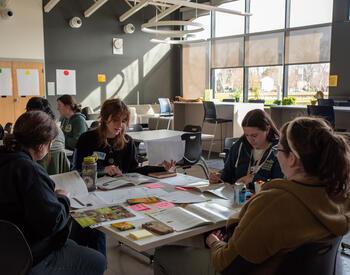
The bilingual field day combined indoor instruction with hands-on vineyard visits. Twelve Spanish-speaking farmworkers participated, focusing on pests and diseases affecting Oregon vineyards.
“They’re boots on the ground in the vineyard,” Butcher saud. “This field day was designed to give them information that helps them be better scouts in the field.”
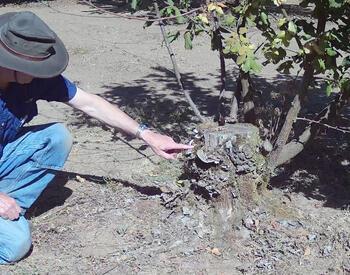
Participants collected samples of pest and disease damage in commercial vineyards, then examined them under microscopes back at SOREC.
“They had the opportunity to see symptoms up close and learn what to look for,” KC said. “That hands-on experience makes a big difference.”
Benefits for workers and growers
The impact of the trainings is felt by farmworkers, instructors and vineyard managers alike.
“We want to learn what we can do on the farm before things happen and we lose plants,” Gutierrez said. He also values learning alongside peers. “I learn from the other people there, too.”
KC said vineyard managers often follow up after trainings to share positive feedback.
“One manager told us their workers started looking for problems more proactively because they were more aware,” KC said.
Santamaria hears similar responses from participants.
“They tell me they’re grateful to have someone explain things in different ways,” she said. “I can see they value what I’m doing.”
For Butcher, the experience was meaningful as an instructor as well.
“This field day felt different,” he said. “Participants were extremely attentive and appreciative. At the end of the day, every person shook our hands and thanked us for the opportunity to learn more about their work.”
Building future opportunities
KC has hosted bilingual field days at SOREC for several years with support from Santamaria and educators from California. Attendance often reaches 30 participants.
Beyond field days, Santamaria provides bilingual education across departments in the OSU College of Agricultural Sciences, conducts research on soilborne pathogens and offers customized trainings for nurseries.
She also developed a bilingual certification program in plant disease prevention and diagnosis that provides pesticide recertification credits through the Oregon Department of Agriculture and is working to make the program mobile friendly.
Gutierrez encourages employers and educators to continue offering learning opportunities.
“It’s hard to see all the problems outside,” he said. “Let’s spend one day every couple of months letting workers take a class and learn.”
“I enjoy what I’m doing,” he added. “It’s important to me.”
Previously titled Bilingual education has an impact on Southern Oregon wine grape growers