ONTARIO, Ore. — When Barbara Brody picked up the 32-foot RV in Corvallis, she didn’t mind navigating it through the Cascade Mountains to deliver it to Nyssa. She knew the newly outfitted 4-H Mobile Maker Studio would make a meaningful difference in students’ lives.
"Older generations may remember the days of the mobile libraries that would bring books to communities without libraries. Our 4-H Mobile Maker Studio is doing the same thing — but with cutting-edge technology, curriculum and equipment."
The RV, part of the Oregon State University Extension Service 4-H Youth Development program, brought equipment and hands-on learning directly to students at Nyssa High School — helping them gain the skills needed to start a business and bring it to life.
“Many rural schools do not have the resources to provide a makerspace,” said Brody, OSU Extension 4-H faculty member and co-coordinator of the project. “The 4-H Mobile RV Makerspace provides an opportunity for youth to engage in activities that are aligned with an entrepreneurship curriculum. Through this opportunity, youth improve their 21st-century skills and build their cognitive abilities while fostering independence and mastery.”
Before students got involved, 18 OSU faculty and volunteers were trained by the OSU College of Business, which also provided the RV, equipment and curriculum. Once trained, Extension staff and volunteers worked with students to guide them through the full business development cycle — from concept to market.
Tools, teamwork and creativity
The mobile makerspace came equipped with T-shirts, an apparel printer with a laser transfer and heat press system, 3D printers, a laser cutter and a variety of hand tools.
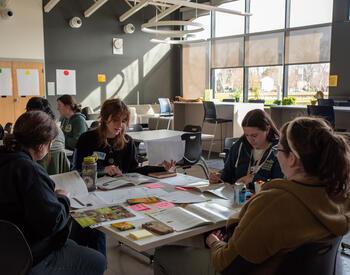
Students formed teams and launched their own microbusinesses. One group created a logo featuring a map of Oregon with a star marking Nyssa, paired with the phrase “Where in the world is Nyssa?” They printed it on T-shirts and sold them successfully, Brody said. Other student teams produced luggage tags and “coolie cups,” similar to can coolers, and sold them at community events.
“They learned, designed, collaborated and made decisions,” Brody said. “It was a full circle — learning, creating and selling.”
Nyssa High School was the first stop for the mobile studio. Twenty-nine students completed the program during its first year, with another 23 enrolled for the current year. Teacher Anna Long used the curriculum in both her business and entrepreneurship class and with the school’s Future Business Leaders of America club.
“Nyssa is a rural area with a high poverty rate and limited access to resources and opportunities for the students,” Long said. “This type of training and resources are greatly lacking in rural areas, and as a teacher, I appreciate the opportunity to partner with OSU and bring programs to Nyssa High School that have a life-long impact on student success.”
One of Long’s students told Brody he plans to study business at Oregon State.
“He said he had learned basic business practices and was proud he made a marketable product in the Makers Studio,” Brody said. “He valued it because opportunities like this aren’t available in small towns.”
Students also have the option to attend a summer 4-H Makers Day Camp to further expand their skills.
Building skills and strengthening communities
The mobile studio is designed to build youth proficiencies in digital literacy, interpersonal communication and business skills through a high-touch, STEAM-based approach, said Maureen Hosty, OSU Extension 4-H faculty member and program co-coordinator. The goal is to inspire students to pursue college and entrepreneurship — and even if they don’t, to understand the value of higher education.
“Older generations may remember the days of the mobile libraries that would bring books to communities without libraries,” Hosty said. “Our 4-H Mobile Maker Studio is doing the same thing — but with cutting-edge technology, curriculum and equipment. It gives youth the tools they need to create products for their own businesses. Perhaps even more important, the 4-H Maker Studio is encouraging and supporting rural youth and their families to contribute to the economic revitalization of their communities.”
A second mobile studio — the Thinker Tinker Trailer — was recently donated by the OSU College of Business. It will serve 4-H programs in western Oregon counties.
Previously titled Malheur County students tinker their way to business success