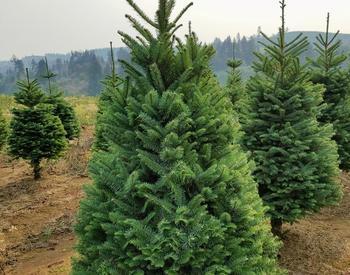
CORVALLIS, Ore. — It sounds like the setup for a holiday romantic comedy — Priya Rajarapu works as a Christmas tree expert for Oregon State University’s Extension Service, helping Oregon’s 300-plus Christmas tree growers produce a healthy crop each holiday season so the state can export millions of trees worldwide.
“If you’re sick, you call a doctor. If you’re a Christmas tree grower who has a sick tree, you call me.”
But the job is more science than sentiment.
In her Extension role and as an assistant professor in the College of Forestry, Rajarapu, who earned her doctorate in entomology, studies how to keep Oregon’s holiday tree industry thriving as the climate changes.
“If you’re sick, you call a doctor,” she said. “If you’re a Christmas tree grower who has a sick tree, you call me.”
Oregon’s mild summers and wet winters have long made the state ideal for growing evergreen species such as noble fir and Douglas-fir, two of the most popular Christmas trees in the western United States.
But as temperatures rise and weather patterns shift, the cost of maintaining healthy trees is increasing. Once-rare extreme climate events — including the 2020 wildfires and the 2021 heat dome — can have long-term effects on forests and tree farms.
“Our goal is to help current and future growers sustain Christmas tree production on their land,” Rajarapu said.
A vital Oregon industry
Christmas tree farming has long been a sustainable industry, with at least one tree planted for every tree harvested. It is also a major agricultural sector in Oregon.
In 2023 — the most recent year with federal data — Oregon sold 3.17 million Christmas trees, ranking first nationally and contributing $118 million to the state’s economy.
Industry associations estimate prices will remain stable this year, averaging about $12 to $15 per foot, and do not anticipate significant impacts from tariffs or trade policies.
Research for resilience
To support growers, Rajarapu and her colleagues conduct research at the North Willamette Research and Extension Center in Aurora, where they test strategies to improve resilience.
One ongoing study examines mulch alternatives to determine whether they improve seedling survival during the first year of growth. While noble fir accounts for just over half of Oregon’s Christmas tree sales, OSU Extension researchers are also studying the genetics of introduced species from Eurasia that may be more tolerant of drought, pests and heat.
Before retiring, Rajarapu’s predecessor, Chal Landgren, collected seeds in Georgia, establishing new species at the research site. Nordmann and Turkish fir — both native to that region — now make up a small but growing share of Oregon’s crop and are known for holding their needles longer after harvest.
“They’re drought- and pest-tolerant,” Rajarapu said. “That reduces the need for inputs such as chemical insecticides.”
From farm to living room
More than half of Oregon’s Christmas trees are sold in California each year. Other major markets include Mexico, Canada, Hong Kong, Japan, Panama, Singapore and the Maldives, according to the Oregon Department of Agriculture.
“With consistent water, these new species can hold their needles for four to six weeks indoors,” Rajarapu said.
She noted that additives such as sugar or alcohol — often marketed to extend tree life — are not supported by scientific evidence. Adequate water, especially in the first few days after purchase, is the most important factor.
“When you buy a real tree, you’re supporting a local business,” said Rajarapu, who plans to display a noble fir in her home this year. “And it just smells and feels like Christmas.”