
Summary
Climate change, prolonged droughts and water shortages are prompting many producers to reevaluate traditional irrigation practices. To sustain crop quality and productivity while conserving water, producers are exploring innovative approaches and adopting new irrigation technologies.
These technologies include irrigation scheduling programs, updates to irrigation systems and equipment, and automated tools that help manage the timing, application, and distribution of irrigation water. When used effectively, these technologies can improve water conservation, optimize soil moisture, reduce environmental impacts and support crop production.
Irrigation water scheduling programs
Irrigation water scheduling programs have been around for many years and are becoming increasingly popular among producers. These tools are typically linked to agricultural weather networks and can be used on any mobile device or computer that has internet access. They automatically pull in evapotranspiration and rainfall estimated data from nearby weather stations and may incorporate soil moisture information, helping producers determine when to irrigate and how much water to apply.
Scheduling programs range from simple tools that provide irrigation reminders to more sophisticated platforms that automate your irrigation system based on soil water depletion thresholds.
Irrigation monitoring, control and automation systems
Efficient irrigation management is essential for optimizing crop production, reducing labor and energy, and sustaining water resources. Irrigation automation refers to technologies that assist or fully control irrigation timing, frequency, and application amounts with minimal human intervention.
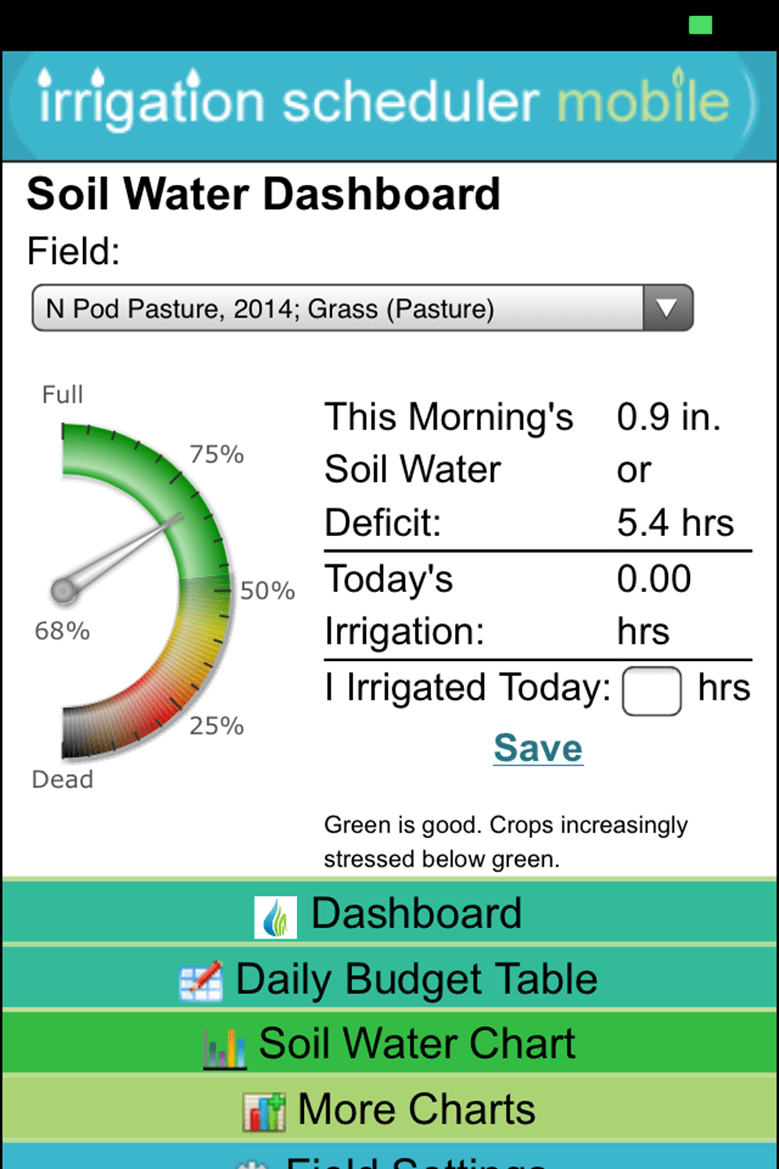
These systems use sensors, controllers and software platforms to monitor field conditions and make irrigation decisions based on soil moisture, crop water demand and environmental data.
Automation can range from simple decision-support tools that notify the producer when to irrigate, to fully integrated systems that open valves and operate pumps automatically.
Technologies used in irrigation automation may include:
- Crop and soil sensors: Devices such as capacitance probes, tensiometers, granular matrix sensors, infrared canopy thermometers and multispectral tools measure soil moisture, plant stress or environmental conditions in real time. For instance, when a controller connects to soil moisture sensors, they automatically trigger irrigation to maintain an optimal soil moisture range in the root zone for crop growth.
- Smart irrigation controllers: These controllers receive input from the sensors or weather-based data such as evapotranspiration estimates. They then determine the timing and the amount of irrigation needed. Smart irrigation controllers are often programmable, allowing producers to set specific irrigation schedules based on factors like crop type, soil texture, allowable depletion and weather conditions. Many controllers adjust irrigation schedules automatically as conditions change.
- Actuators and control hardware: Valves, pumps and other hydraulic components can be automated to open, close or modulate flow rates, regulating the distribution of water to different areas of the farm.
- Remote monitoring and management platforms: Cloud-based software and mobile applications allow producers to remotely monitor and control their irrigation systems. These platforms provide real-time access to in-situ sensor data, system pressure, flow rates, pump performance and irrigation schedules from a computer or smartphone. They support data-driven management by logging irrigation events, analyzing water use and issuing alerts when abnormalities such as leaks, pressure drops or equipment failures occur. Users can adjust system settings or initiate irrigation remotely, improving operational efficiency and reducing the need for on-site intervention.
- Leak detection systems: These systems integrate pressure sensors, flow meters and acoustic monitoring devices to rapidly identify and locate malfunctioning equipment or leaks in irrigation pipelines. When tied to automation software, the system can generate warnings or shut down irrigation sections to prevent water loss.
- Satellite and remote sensing tools: satellite-based platforms provide field-scale information on crop water use, vegetation condition and spatial variability. These tools use vegetation indices such as Normalized Difference Vegetation index, or NDVI, and energy balance approaches to estimate crop water use through evapotranspiration (ET), such as OpenET. They support irrigation scheduling by estimating how much water crops have used over time, identifying areas of water stress and evaluating irrigation performance across fields. While not used in direct system control, remote sensing tools complement in-field sensors by providing broader spatial context for irrigation management.
Performance considerations
Research has shown that automated irrigation systems can reduce water use substantially, sometimes by as much as 70%, depending on the irrigation system, water supply, soil texture, soil depth, weather and crop types. Water savings arise from better matching of irrigation to crop evapotranspiration, reduced over-irrigation and improved efficiency. However, automation systems can require significant upfront investment, ongoing maintenance and customization.
Despite these challenges, automation offers important benefits: reduced labor, improved crop water status, more uniform soil moisture and better alignment between water supply and crop demand.
Variable rate irrigation
Variable rate irrigation, commonly referred to as VRI, is a precision-agriculture technology that allows an irrigation system to apply different water amounts of water to specific areas within a field. These variable application rates are determined using spatial information such as differences in soil texture, soil depth, organic matter, topography, crop type, crop growth stage and environmental conditions. The goal is to match irrigation to crop water needs more accurately, reducing over- or underwatering and improving water use efficiency.
You can implement variable rate irrigation using either a speed-control system or a zone-control system, and you can integrate it into center-pivot, lateral-move and drip irrigation systems.
- Center pivot and lateral move systems: For center pivots, variable rate irrigation technology can adjust the pivot’s speed and independently control the application rate of individual sprinklers.
- Drip irrigation systems: Variable rate irrigation can regulate the timing and flow rate of individual drip lines or zones, allowing highly targeted irrigation across areas with differing soil-water-holding capacities or crop water demands.
Variable rate systems require digital field maps (such as soil maps, Normalized Difference Vegetation Index zones or electrical conductivity surveys) to assess vegetation health and density. The level of precision depends on the chosen approach:
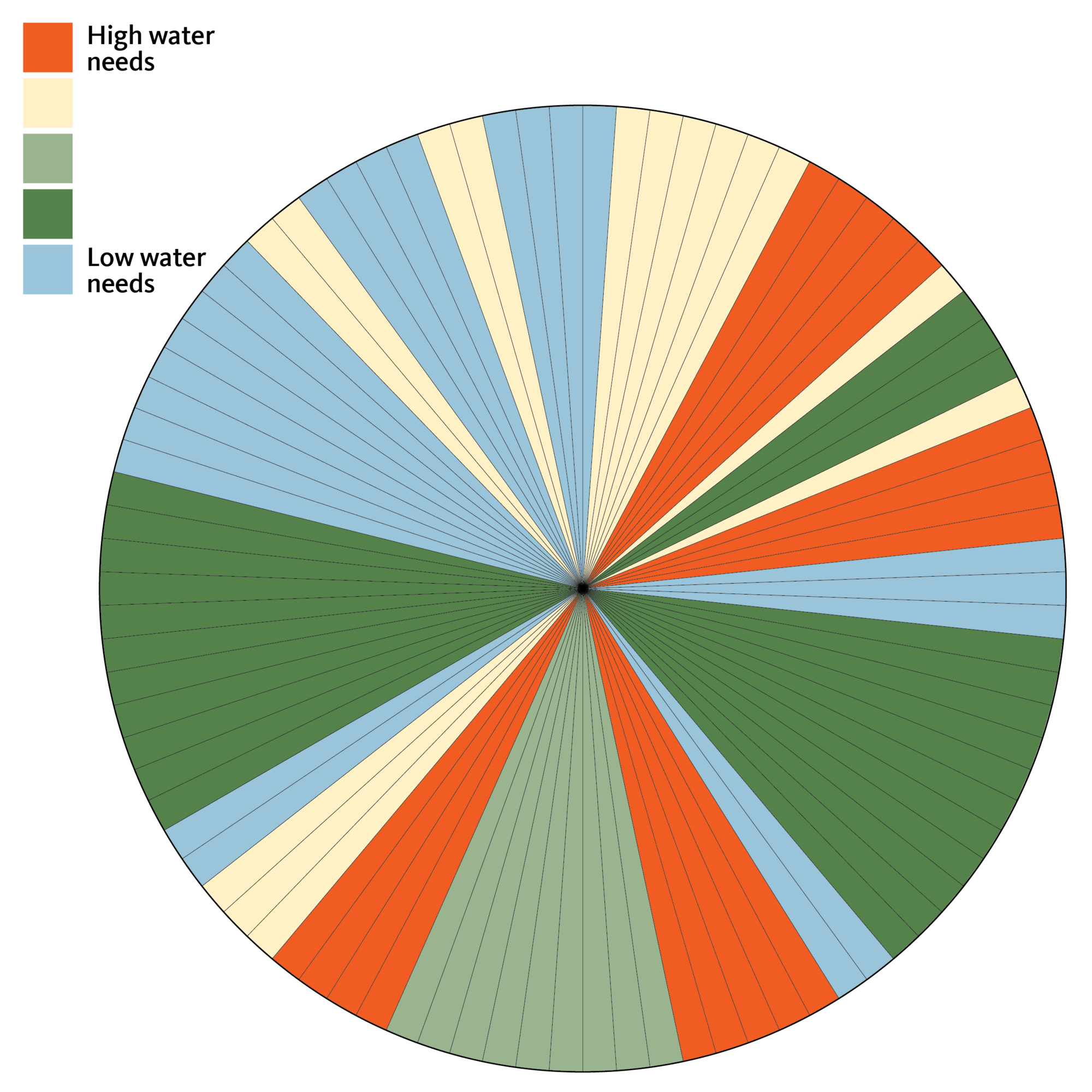
- Variable speed irrigation: adjusts pivot travel speed to vary water application depth across the field (Figure 2A)
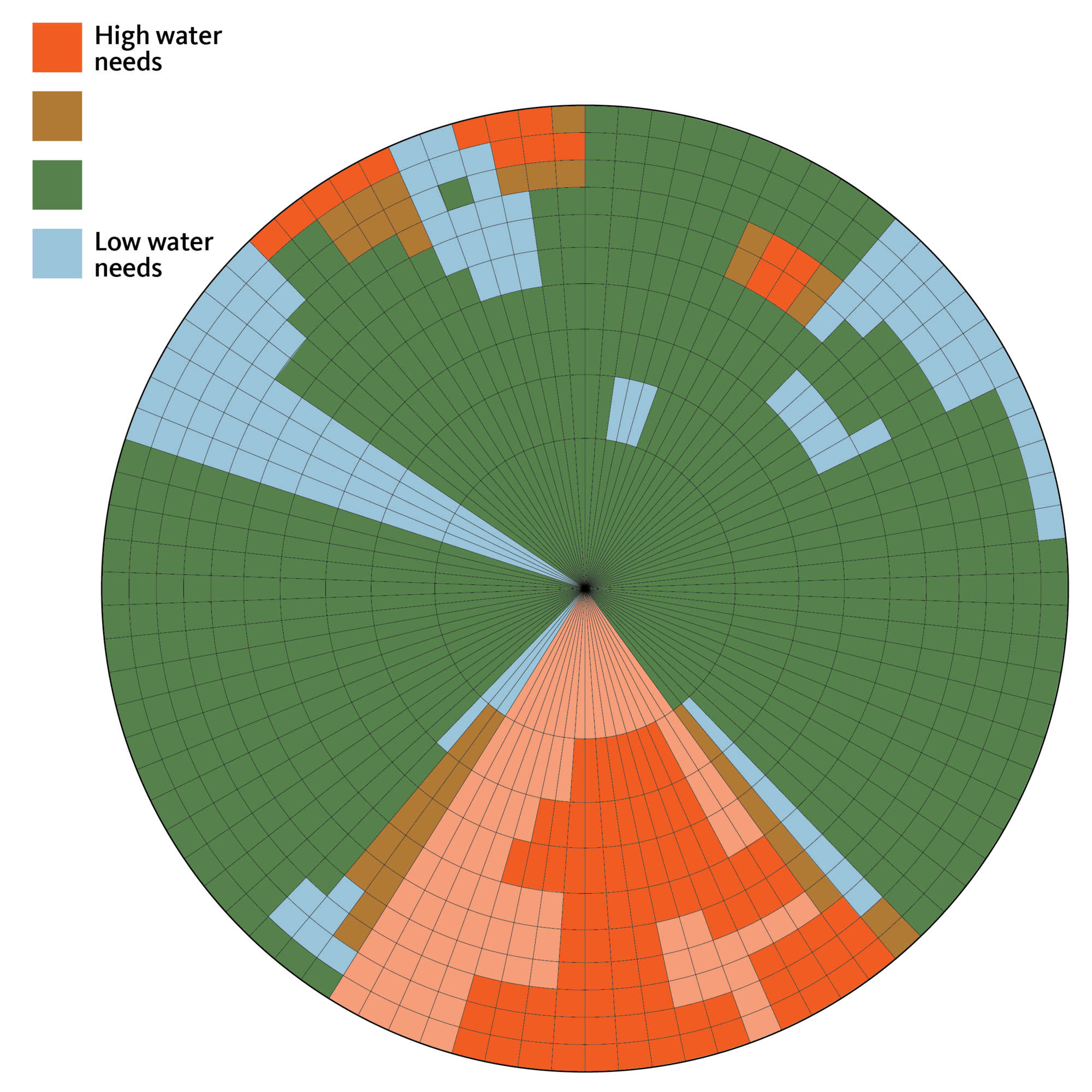
- Variable zone irrigation: controls sprinklers or drip zones individually for higher spatial precision (Figure 2B)
How can variable rate or variable speed irrigation help? When used correctly, variable rate irrigation can save water, reduce runoff, improve crop uniformity and increase input-use efficiency; however, its benefits depend on accurate field mapping, system calibration and coordinated irrigation management.
Variable speed irrigation
Variable speed irrigation adjusts the travel speed of the pivot to apply different irrigation depths across the field without modifying the flow rate of individual sprinklers (Figure 2A).
How does it work?
This technology uses advanced control panels or aftermarket GPS-based systems to automatically slow down or speed up the pivot along specific segments of its rotation.
- In areas where the pivot travels slower, the application depth increases (more water is applied).
- In areas where the pivot travels faster, the application rate decreases (less water is applied).
Because the adjustment follows the circular travel path, variable speed irrigation creates pie-shaped application zones across the field (Figure 2A).
How much does it cost?
Because VSI relies on modifications to the electronic speed control, variable speed irrigation is relatively inexpensive (about $2,000–$4,000 per pivot). Consult with local representatives for current pricing.
When is variable speed irrigation most beneficial?
This technology is most effective in fields with differences in infiltration capacity due to soil texture, slope or topography, or where crops with differing water needs occur along the pivot’s path.
Variable zone irrigation
Variable zone irrigation provides a higher level of precision than variable speed irrigation by adjusting both the pivot’s travel speed and the flow delivered by individual sprinklers or groups of sprinklers (Figure 2B). This allows the system to apply different irrigation depths exactly where needed in the field according to its spatial variability.
How does it work?
Variable zone irrigation divides the pivot into multiple management zones, each controlled independently through valves, solenoids or nozzle cycling. This enables:
- Turning individual sprinklers on and off for various amounts of time
- Pulsing sprinklers to vary application depth
- Combining speed changes with sprinkler control for the greatest spatial precision
Because adjustments occur along the length of the pivot span (not just via speed), variable-zone irrigation creates irregularly shaped applications that follow true spatial variability rather than pie-shaped wedges.
How much does it cost?
Variable zone irrigation requires developing and modifying irrigation plans, the installation of additional hardware (valves, wiring, manifolds or wireless nodes) in addition to a more sophisticated control technology. These factors make variable zone irrigation significantly more expensive than variable speed irrigation (about $15,000–$25,000 per pivot). Consult with local representatives for current pricing.
When is variable zone irrigation most beneficial?
Variable zone irrigation is ideal for fields with fine-scale variability, including:
- Highly variable soil textures or layered soils
- Changes in organic matter, salinity or infiltration
- Topographic depressions or runoff-prone areas
- Localized constraints such as rocky zones, shallow soils or seepage areas
- High-value crops where precise water management impacts yield or quality
Key advantages
- Greater control of application depth
- Reduced over- and underwatering
- Improved uniformity and crop performance
- The ability to integrate with soil, crop or remote-sensing maps for true precision irrigation
* Note: Actual costs vary widely based on the number of zones, pivot length, field conditions and equipment manufacturer. Producers should contact their local irrigation dealer or system representative for an accurate estimate.
For more information about how variable zone and variable speed irrigation technology works, see Variable Rate Irrigation Precision Irrigation Technology.
Sprinkler modifications within center pivots or lateral-move systems
Technology used in center-pivot and linear-move irrigation systems continues to evolve, with a strong focus on improving irrigation efficiency, uniformity and precision application while applying irrigation water closer to the soil surface for better water uptake. These improvements can help reduce wind drift and evaporation, conserve water, and optimize crop growth.
High-pressure impact sprinkler application
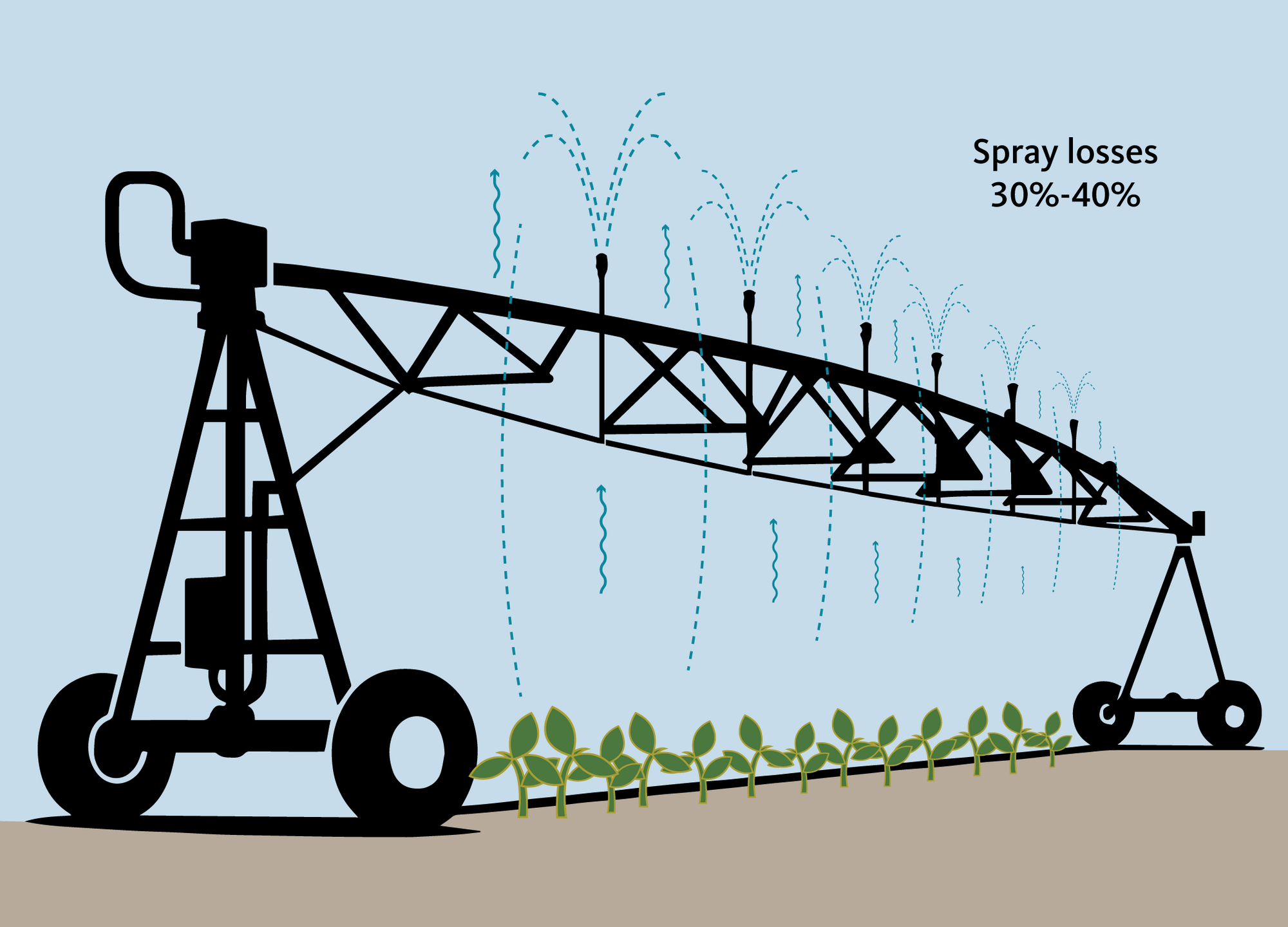
When center pivots were first introduced, they used high-pressure impact sprinklers located on top of the pipeline (Figure 3).
Key characteristics
- Sprinkler nozzles spacing: about 20–30 feet apart
- Operating pressure: about 70–110 psi
- Typical water loss: about 30%–40% due to water being dispersed over a greater distance, making it susceptible to wind and evaporation (Figure 3)
Benefits
- Due to the large wetting distance, there is more time for the water to infiltrate into the soil.
Limitations
- High energy costs and high evaporation losses.
-
Placing sprinklers closer to the crop canopy substantially reduces wind drift and evaporative losses.
Mid-elevation spray application
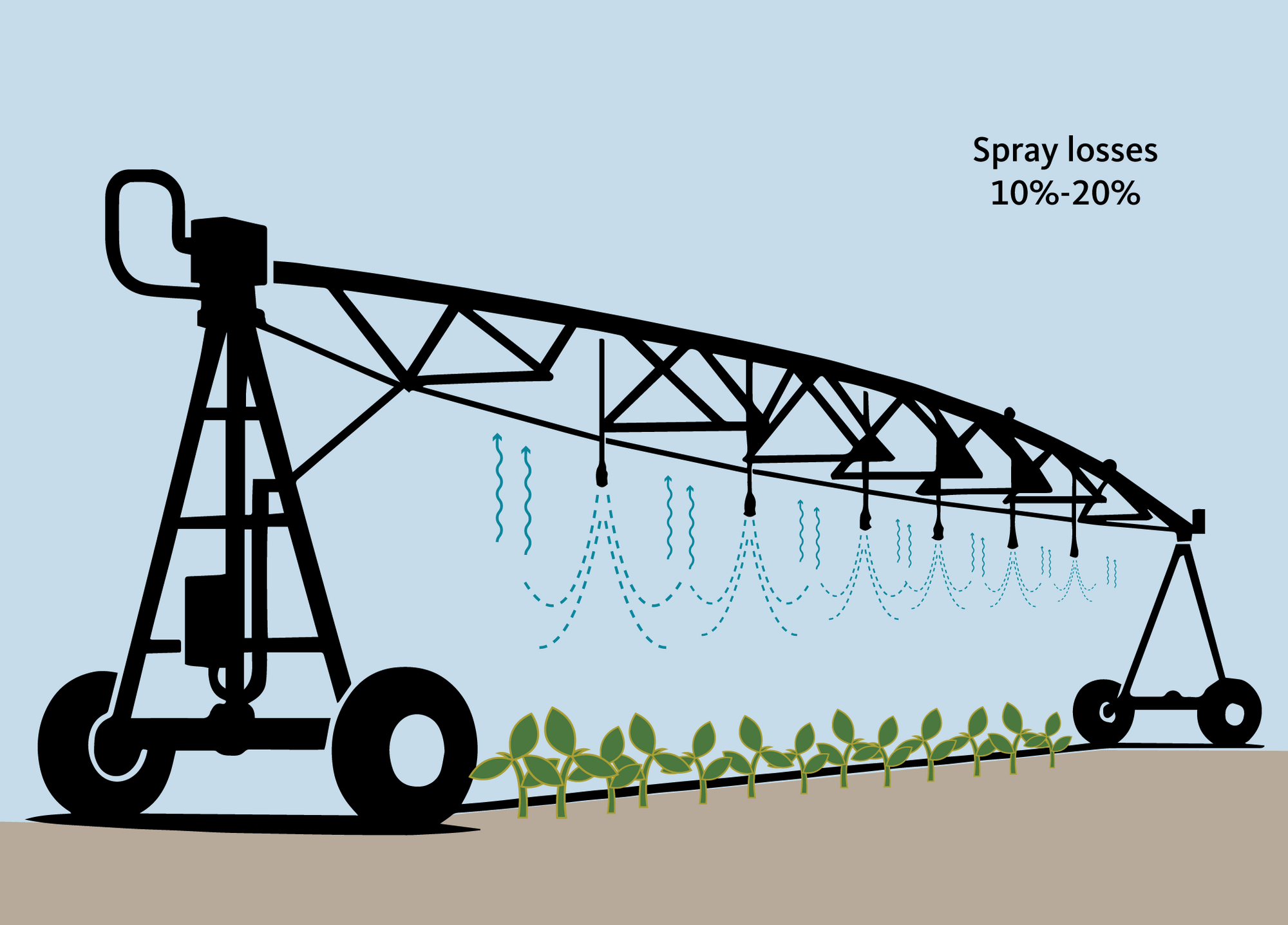
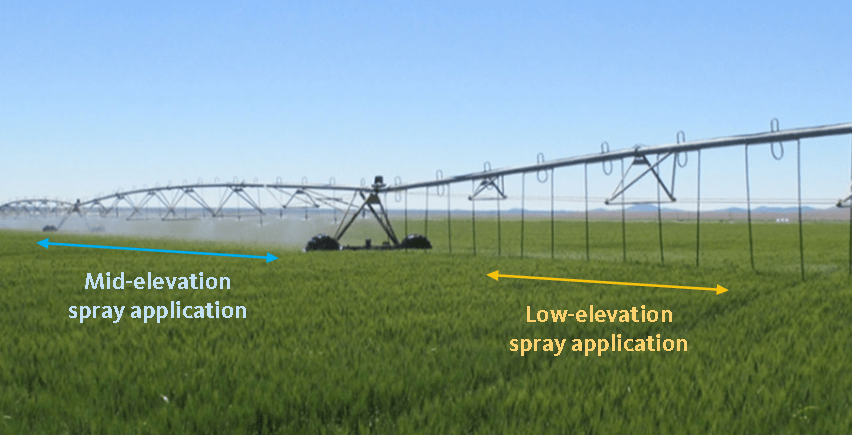
Mid-elevation spray application, commonly referred to as a MESA system, is a widely used sprinkler package for center-pivot and lateral-move irrigation systems. In mid-elevation systems, spray nozzles are mounted approximately 5 feet or more above the ground and spaced about 10 feet apart (closer together than impact sprinklers).
Operating at moderate pressures (typically 15–20 psi, requiring about 25–40 psi at the pivot point), mid-elevation systems provide good uniformity but experience greater evaporative and wind losses than lower-elevation systems. Mid-elevation systems have historically been a standard package and remain suitable for many crop and field conditions.
Key characteristics
- Sprinkler nozzles mounted at 5 feet above ground or higher
- Typical nozzle spacing of about 10 feet
- Operates with 15–20 psi pressure regulators (25–40 psi required at pivot point)
- Produces a spray pattern with moderate droplet exposure to wind
- Provides about 85% application efficiency
- Typical water loss of 15%–20%
- Compatible with most crops and field slopes greater than 4%
Benefits
- Good overall water distribution and coverage
- Less risk of runoff because water is applied over a wider wetted footprint
- Works well on fields with slopes of more than 3%
- Suitable for taller crops, reducing nozzle interference
Low-elevation spray application and low-energy precision application
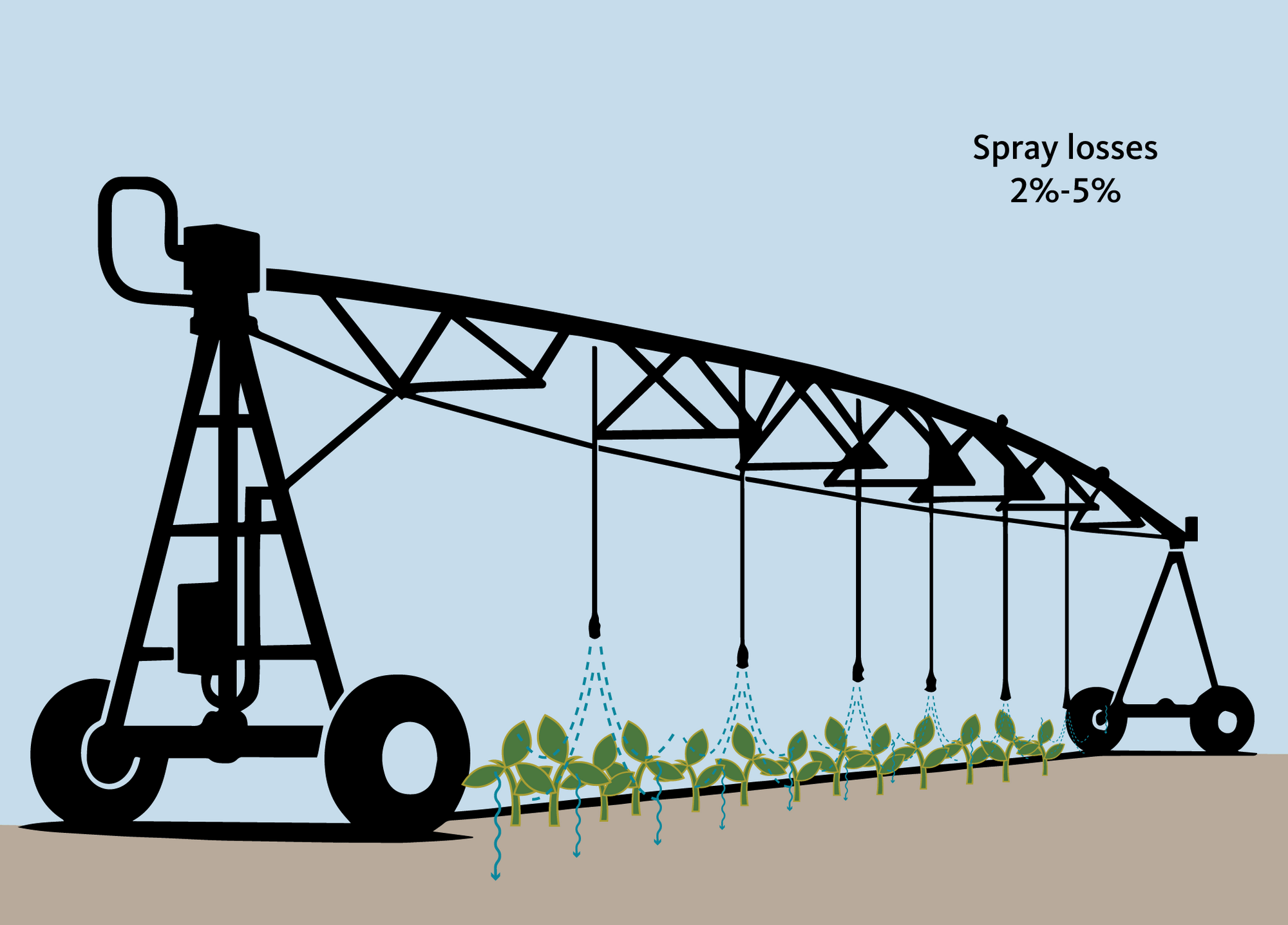
Low-elevation spray and low-energy precision applications are modern, high-efficiency sprinkler packages designed for center-pivot and linear-move irrigation systems. Both place nozzles closer to the soil surface than traditional sprinkler packages, reducing wind drift, lowering evaporation losses and improving application efficiency (Figure 5).
Low-elevation spray applications distribute water as a spray pattern a short distance above the ground, while low-energy precision applications deliver water directly to the soil surface using bubble applicators for maximum efficiency.
Both operate at low pressure (6–20 psi), reducing pumping costs and improving uniformity when properly matched to field slope, soil type and crop row spacing. These systems can significantly improve water-use efficiency compared with mid- or high-elevation sprinkler packages, especially in arid climates where evaporative losses are high.
Considerations
- Higher wind drift and evaporation losses (typically 10%–20%) compared with low-elevation spray application/low-energy precision application
- Requires higher operating pressures, resulting in increased energy use
- Shorter contact time with soil may reduce infiltration on coarse soils
- More sensitive to wind conditions during operation
- Not as efficient as low-elevation spray or precision application systems
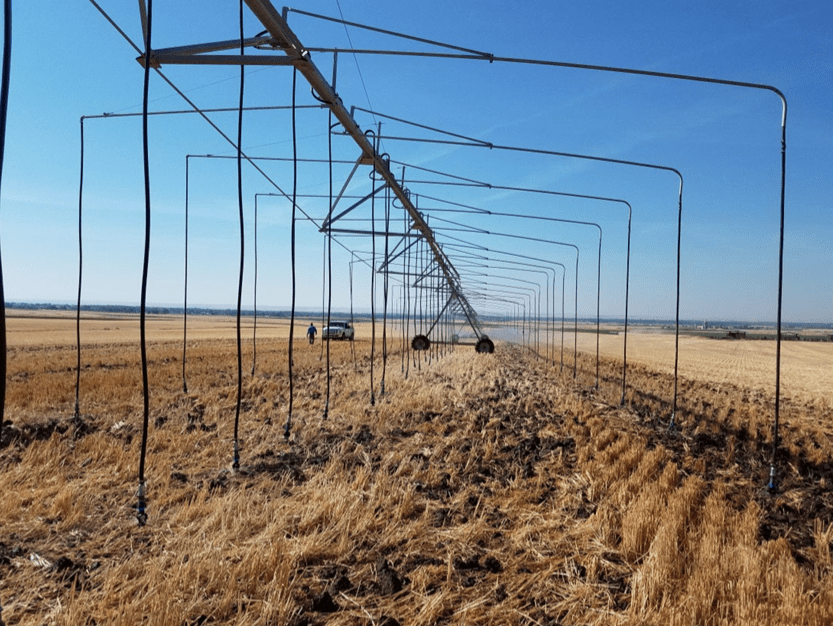
Low-elevation spray application
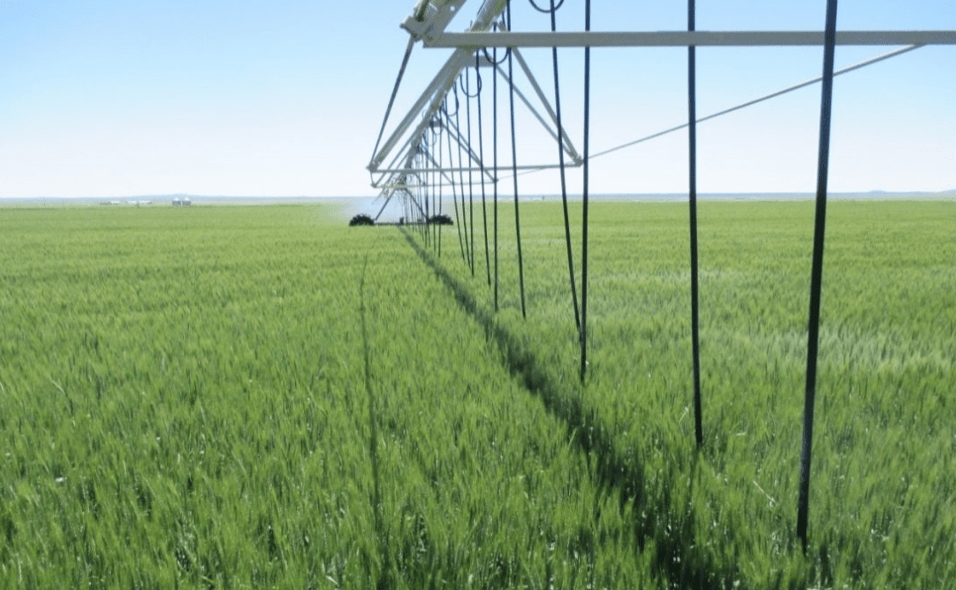
Low-elevation spray application, commonly referred to as LESA, is a high-efficiency sprinkler package for center-pivot and linear-move systems. It applies water as a uniform spray pattern that reduces wind drift and evaporation while improving infiltration.
Key characteristics
- Spray nozzles suspended close to the soil surface (1–3.5 feet)
- Nozzle spacing typically more than 5 feet apart
- Operates at low pressure (6–20 psi), reducing pumping energy
- Produces a spray pattern, providing a more uniform application of water and time for the water to infiltrate into the soil
- Suitable for fields with slopes up to or about 3%
- Requires filtration to prevent nozzle plugging
Benefits
- Higher application efficiency than high-pressure or mid-elevation systems
- Lower evaporative loss due to reduced droplet exposure to wind
- Lower energy use because of reduced operating pressure
- Improved infiltration and more uniform water application closer to the root zone
- Adaptable to a wide range of crops and soil types
Considerations
- Shorter wetted diameter means less time for infiltration, which is good for light, frequent irrigations. But it also may require cycle/soak management or other adjustments to prevent runoff on tight or shallow soils.
- Spray pattern still has some exposure to wind (more than a low-energy precision application).
- Filtration is required to avoid plugging of low-pressure nozzles.
- Performance depends on crop height. Taller crops may interfere with pendulum hoses and spray patterns, affecting overall application performance.
To find out if a low-elevation spray application is right for you, consult your local irrigation dealer or a Watermaster.
Low-energy precision application
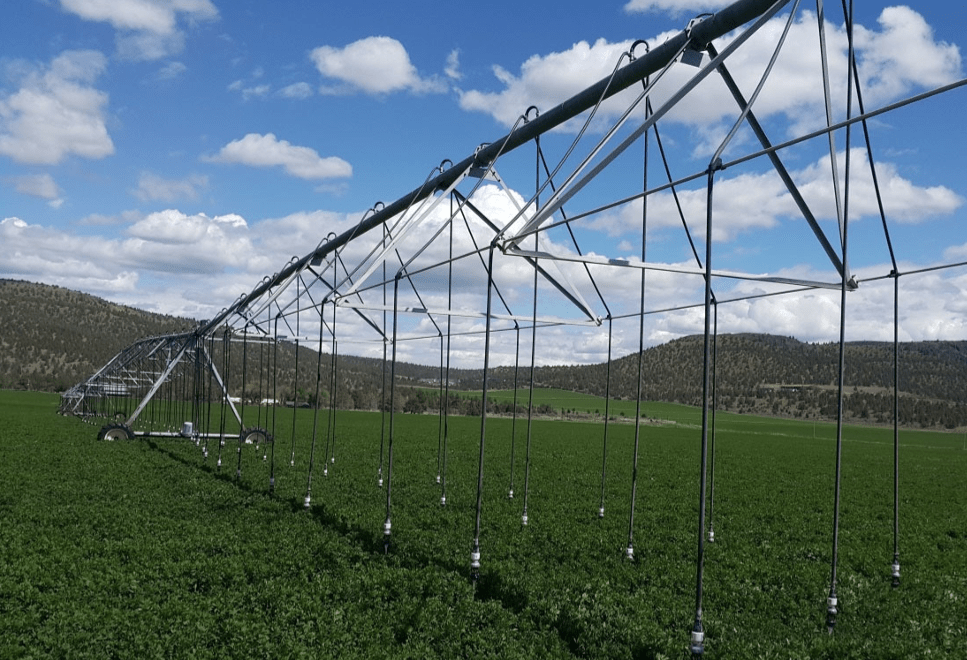
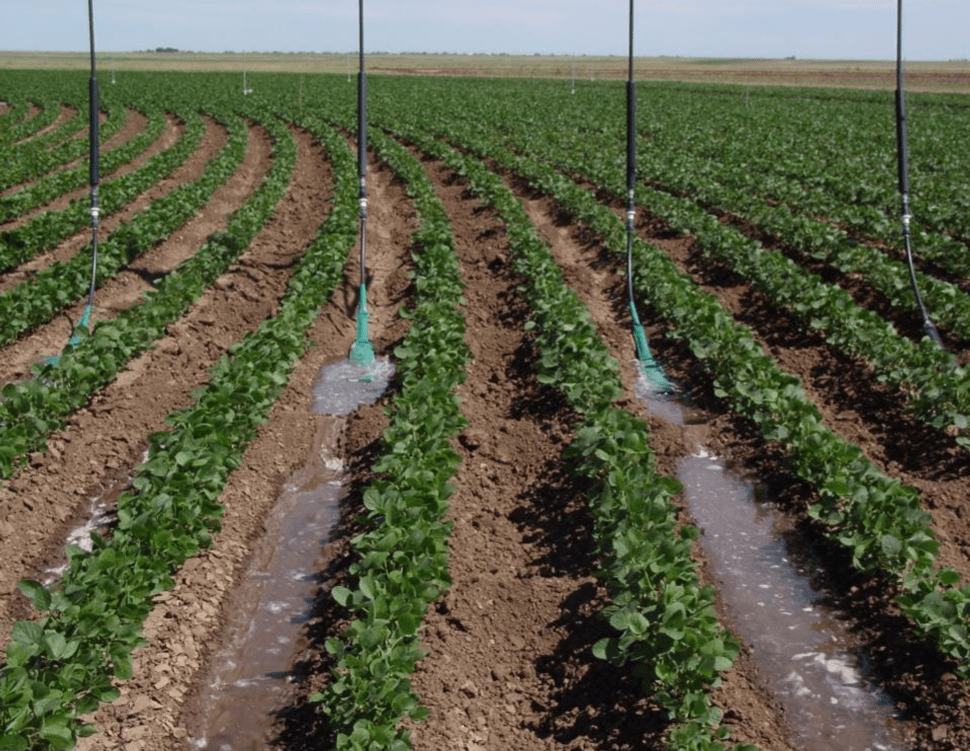
Low-energy precision application, or LEPA, delivers water directly to the soil surface using bubble applicators close to the ground at a low operating pressure. This application minimizes evaporation and wind drift. It can achieve efficiencies greater than 95% when managed correctly.
Key characteristics
- Bubbler applicators positioned 8–18 inches above the soil surface
- Nozzle spacing typically 30–40 inches apart
- Operates at low pressure (6–20 psi), reducing pumping energy
- Applies water directly to the soil surface in narrow streams or bubbles, allowing water to infiltrate into the soil
- Designed for very high efficiency with minimal evaporation
- Ideal for fields with slopes up to 1%
- Requires furrow management (drag socks and dammer diking, among others)
- Requires filtration to prevent nozzle plugging
Benefits
- Among the highest application efficiencies of any sprinkler package (greater than 95%)
- Lower evaporative loss due to close proximity to the soil surface
- Reduced wind drift compared to spray systems, because of reduced droplet exposure to wind
- Lower pumping energy use because of low operating pressure
- Potential for improved yields when matched to crop row spacing
Considerations
- Greater risk of runoff or ponding if field slopes are greater than 1% or furrows are unmanaged
- Not suited for no-till or flat planting unless water is contained
- Bubble pattern may not wet the full soil surface unless row spacing matches application pattern
- Requires consistent maintenance of filtration and applicators
To find out if a low-energy precision application system is right for you, consult your local irrigation dealer or Watermaster.
Mobile drip irrigation technology
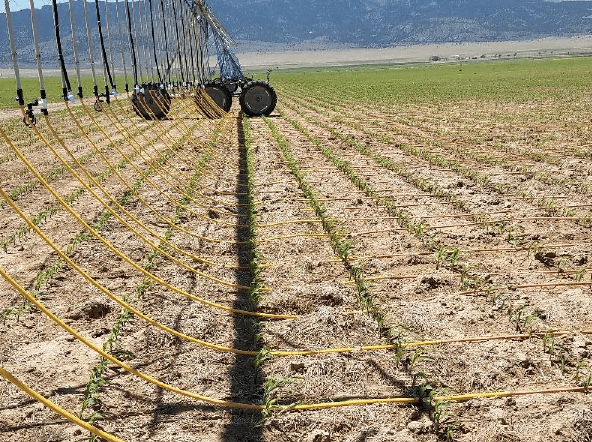
Mobile drip irrigation, known as MDI or Dragon-Line systems, deliver irrigation water directly to the soil surface using drip tubing attached to center-pivot or lateral-move systems. Like a low-energy precision application, a mobile drip system operates at low pressure and minimizes evaporation and wind drift by applying water close to the ground. By wetting the soil in a slow, controlled pattern, mobile drip irrigation improves infiltration and can achieve water-use efficiencies comparable to a low-energy precision application when properly managed, while offering flexibility to switch between drip and sprinkler application as field conditions require.
Key characteristics
- Driplines attached to pivot spans and pulled across the field.
- Spacing: 20–40 inches between hoses, 6-inch emitter spacing in drip lines. Spacing depends on the crop, soil type and rooting depth.
- Low-pressure operation (similar to a low-energy precision application).
- Uniform strip-wetting pattern directly over the soil surface.
- Can be combined with standard sprinkler packages on the same pivot, allowing irrigators to switch between different watering applications.
Benefits
- Significantly reduces wind drift and surface evaporation
- Improves infiltration and reduces runoff on coarse soils
- Potential water-use efficiency similar to low-energy precision application systems
- Flexible operation (sprinkler mode vs. drip mode)
- Lower pumping energy due to low operating pressures
Considerations
- Requires good filtration to prevent emitter clogging.
- Driplines must be heavy-walled to avoid tearing or splitting.
- Drag hoses can snag on residue in heavy crop systems.
- Performance may be reduced on fields with rocks, ruts or uneven terrain.
- Higher upfront costs for hoses and retrofitting.
For more information, see Mobile Drip Irrigation.
Subsurface drip irrigation
Subsurface drip irrigation applies irrigation water directly to the crop root zone through buried drip tubing, providing highly efficient, low-pressure water delivery below the soil surface. By eliminating surface wetting, subsurface drip irrigation minimizes evaporation, runoff, soil crusting and weed germination while improving application uniformity and root-zone moisture control. When properly designed and managed, it can substantially improve water-use efficiency and crop performance, particularly in arid regions or coarse-textured soils.
Key characteristics
- Buried drip tubes installed 2–15 inches below the soil surface.
- Lateral spacing 24–84 inches. Spacing depends on crop.
- Low operating pressures (7–14 psi).
- Emitters deliver slow, consistent flow (0.07–2.5 gallons per hour).
- Water applied below the soil surface directly to the root zone.
Benefits
- Greatly reduces evaporation and eliminates runoff
- Enhances irrigation uniformity in sandy or arid soils
- Reduces weed pressure by limiting moisture at the soil surface
- Improves nutrient delivery when combined with fertigation
- Can increase water-use efficiency, water savings and yield in many crops.
Considerations
- Requires high-quality filtration to prevent emitter clogging.
- Root intrusion can occur without proper system design.
- Installation is more expensive than surface drip.
- Repairs are more difficult because tubing is buried.
- Not suitable for all tillage systems or crops with deep mechanical cultivation.
Although not new, several technological advances have made these systems more efficient. To learn more about how subsurface drip irrigation works, see Subsurface drip irrigation for corn by Netafim.
Sprinkler head and nozzle technology
Modern sprinkler nozzles used in pivots, laterals, handlines and wheel-lines have improved substantially in uniformity, ease of maintenance and resistance to wind drift and evaporation. Many nozzles now include pressure regulators, multipattern spray options and self-flushing features (turning on/off nozzles to flush debris without requiring uninstall). These features ensure consistent output across a range of operating conditions. Upgrading nozzle packages is one of the most cost-effective ways to improve irrigation efficiency.
Key characteristics
- Improved droplet size control to reduce misting
- Side-delivery or fan-pattern sprays for better coverage
- Pressure-regulating stems for consistent flow
- Multi-function designs allowing flushing without removal
- Available for pivots, laterals, wheel-lines and handlines
Benefits
- Better water distribution uniformity
- Reduced evaporative loss and wind drift
- Improved infiltration due to optimized droplet size
- Lower maintenance requirements and easier nozzle management
- Often the least expensive upgrade for increasing system efficiency

Considerations
- Must match nozzle package to pivot pressure and flow.
- Inadequate pressure can reduce uniformity.
- Regular nozzle inspection is needed to detect wear.
- Some nozzles may require filtration upgrades to avoid plugging.
- Improper nozzle selection can increase runoff or reduce coverage.
References and resources
LEPA Close Spacing Irrigation, Senninger.
Irrigation Scheduler Mobile tool aids, Washington State University.
Effects of Variable-Rate Sprinkler Cycling on Irrigation Uniformity. (n.d.). Retrieved May 14, 2024.
Kranz, W., S. Irmark, D. Martin, T. Shaver and S. van Donk, (2014). Variable Rate Application of Irrigation Water with Center Pivots. EC200. University of Nebraska Lincoln Extension Service.
LEPA irrigation system evaluation. (n.d.). Retrieved May 14, 2024.
Low Energy Irrigation Technology. (n.d.). Retrieved May 14, 2024.
Molaei, B., R. Troy Peters, I. Kisekka, Mobile Drip Irrigation (MDI).
Mufute, Ngonidzashe L., M.A. Yost, D. Larsen, B. Barker, T. Peters and M. Zamora-Re. (2024). Center-pivot maintenance trends in the Western United States. Journal of Irrigation and Drainage Engineering, 150 (3), 04024005.
Peters, R. Troy, B. Molaei and M. Flury. Variable Rate Irrigation on Center Pivots. What Is It? Should I Invest? Washington State University.
Peters, T., H. Neibling, R. Stroh, B. Molaei and H. Mehanna. Low-Energy Precision Application (LEPA) and Low-Elevation Spray Application (LESA) Trials in the Pacific Northwest, Washington State University.
Peters, R.T., and S.R. Evett. (2008). Automation of a center pivot using the temperature-time-threshold method of irrigation scheduling. Journal of Irrigation and Drainage Engineering, 134 (3), 286–291.
Reich, D., R. Godin, J.L. Chavez and I. Broner (2014). Subsurface Drip Irrigation. Fact Sheet 4.716. Colorado State University Extension.
Utah State University (2020). Irrigation Technology Cost/Benefit Analysis Calculator. Retrieved May 14, 2024.
Utah State University (n.d.). Guide to Irrigation Sprinkler Packages for Pivots and Laterals. Retrieved May 14, 2024.
Vellidis, G., V. Liakos, J.H. Andreis, C.D. Perry, W.M. Porter, E.M. Barnes, K.T. Morgan, C. Fraisse and K.W. Migliaccio. 2016. Development and assessment of a smartphone application for irrigation scheduling in cotton. Computers and Electronics in Agriculture, 127, 249–259.
Acknowledgments
This material is based upon work that is supported by the National Institute of Food and Agriculture, U.S. Department of Agriculture, under award No. 2021-38640-34695 through the Western Sustainable Agriculture Research and Education program under project number WPDP22-020. USDA is an equal opportunity employer and service provider. Any opinions, findings, conclusions, or recommendations expressed in this publication are those of the authors and do not necessarily reflect the view of the U.S. Department of Agriculture.
Gordon B. Jones, Associate Professor of Practice, Oregon State University, contributed to this report. Reviewers included Matthew Alongi, NRCS State Irrigation Engineer; Mylen Bohle, Associate Professor, Emeritus, Oregon State University; Troy Peters, Professor and Extension Irrigation Engineer, Irrigated Agriculture Research and Extension Center, Washington State University; Rex Barber of Big Falls Ranch, Terrebonne, Oregon; Mike Macy of Macy Farms, Culver, Oregon; Patrice Spyrka of Tumalo Alpen Ranch, Tumalo, Oregon; Greg Mohnen of Triple S Ranch; and Darrell Abby of Rock Island Ranch.
About the authors

