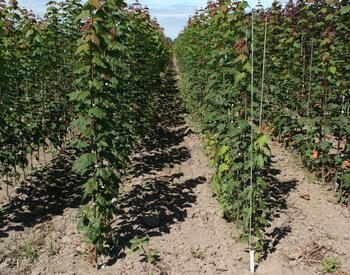
Oregon produces the vast majority of the nation’s hazelnuts, and the industry supports family farms, rural jobs and local tax bases. The rapid expansion of new orchards over the past decade has strengthened the state’s agricultural economy. That growth also has created opportunity for emerging pests.
Preventing even a small share of tree loss in new orchards can protect substantial farm revenue over time. It can also improve stewardship by aligning management actions with documented pest timing and risk, reducing guesswork and supporting more efficient use of inputs.
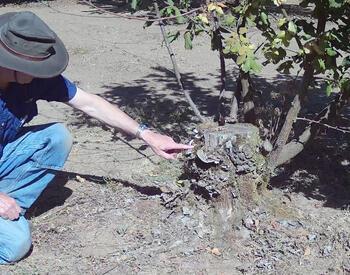
One of those pests, the Pacific flatheaded borer (Chrysobothris mali), is native to the region. Its larvae feed beneath the bark of young trees, cutting off water and nutrient flow. Damage can cause dieback or tree death, forcing growers to replant and absorb significant losses.
Despite its growing impact in hazelnut orchards and nurseries, baseline information about flatheaded borers in the Pacific Northwest has been limited. Growers and agricultural professionals need practical answers about when adult beetles are active, how risk varies by location, what plants the insects use as hosts and which strategies can protect newly planted trees.
Researchers with the Oregon State University Extension Service and the College of Agricultural Sciences, led by orchard crops specialist Nik Wiman, launched complementary studies to fill those gaps.
Graduate student Anthony Mugica, under Wiman’s supervision, focused on Pacific flatheaded borer in Oregon hazelnuts for his 2021 master’s thesis. His research used field emergence cages over multiple years to document when adult beetles emerged and how long the emergence period lasted.
Mugica’s thesis tied beetle activity to accumulated heat — growing degree days — to improve seasonal predictions. He tested monitoring approaches adapted from other borer pests, including funnel traps and sticky cards paired with attractants, but trap catches were too low to provide reliable field detection.
To identify new leads, he collected chemical compounds released by stressed trees and identified two dozen volatile and semi-volatile compounds that could help inform future attractant development.
Finally, field trials in two locations evaluated multiple plant protection strategies, including systemic insecticides, organic products and physical or residue barriers, comparing application timing and rates. Several treatments reduced borer damage, giving growers science-based options to protect young trees.
Study expands regional understanding
In 2023, Wiman and Erica Rudolph, then a graduate student and research assistant, expanded the lens through a study published in the Annals of the Entomological Society of America that examined preserved museum specimens of Pacific flatheaded borer and a related species, flatheaded appletree borer (Chrysobothris femorata), from major arthropod collections in the West.
By compiling label data from hundreds of specimens, Wiman and Rudolph mapped the distribution of both species, summarized recorded host plant associations and identified new reproductive host records.
The study also flagged a critical gap: tree species commonly damaged today in commercial orchards and nurseries were not represented in historical specimen labels, underscoring the need to pair collection-based insights with modern field research.
Findings support management
Together, the applied hazelnut research and the broader specimen-based study provide Oregon agriculture with a stronger foundation for managing flatheaded borers. The work clarifies seasonal timing and regional patterns, helps researchers and educators prioritize unanswered questions, and supports more targeted, research-based outreach for orchardists and nursery operators.
Field-tested plant protection strategies can reduce losses in young plantings, while improved understanding of species distribution and host use helps focus monitoring and future research where it matters most.
For growers, that information protects long-term investments. Hazelnut orchards require years of up-front cost before they reach full production, and losing young trees can set back profitability and increase replanting expenses.
Public value
State investment in Oregon State University helps sustain the research and Extension infrastructure that makes rapid, coordinated responses to emerging agricultural threats possible.
That model delivers a strong return on investment. Preventing even a small share of tree loss in new orchards can protect substantial farm revenue over time. It can also improve stewardship by aligning management actions with documented pest timing and risk, reducing guesswork and supporting more efficient use of inputs.
By pairing foundational ecological research with field-tested management strategies, OSU helps Oregon growers remain competitive while strengthening the resilience of the state’s agricultural economy.
The 2023 study was funded by USDA’s National Institute of Food and Agriculture through Specialty Crops Research Initiative award No. 2020-51181-32199, “Flatheaded Borer Management in Specialty Crops.”