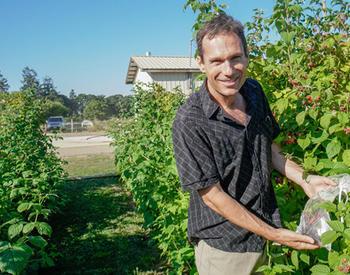

Vaughn Walton

Tenga en cuenta que es posible que esta persona no hable español.

Content by Vaughn Walton

Oregon State University Extension Service

Distribution and Monitoring of Grape Mealybug: A Key Vector of Grapevine Leafroll Disease in Oregon

Daniel Dalton, Vaughn Walton, Kent Daane, Clive Kaiser, Rick Hilton and Linda Brewer
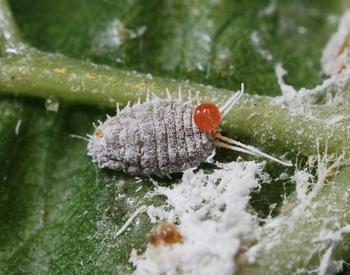
A mealybug
EM 9092
Pheromone-bait trapping is crucial to determine the risk of leafroll disease spread by mealybugs.
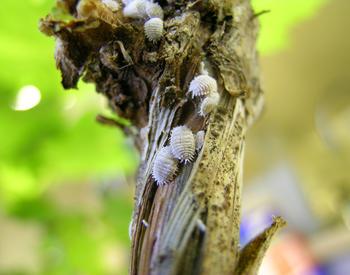
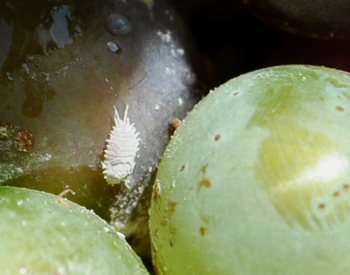
Mealybugs in Pacific Northwest vineyards sometimes infest grape clusters, touching the trunk, reducing fruit quality and, in some cases, rendering them unmarketable. More importantly, the grape mealybug spreads the viruses that cause grapevine leafroll disease.
A pheromone lure baited with the sex pheromone of grape mealybug is the most reliable way to confirm the presence or absence of this important vector of grapevine leafroll-associated viruses.
View now

© 2024 Oregon State University. Extension work is a cooperative program of Oregon State University, the U.S. Department of Agriculture, and Oregon counties. Oregon State University Extension Service offers educational programs, activities, and materials without discrimination on the basis of race, color, national origin, religion, sex, gender identity (including gender expression), sexual orientation, disability, age, marital status, familial/parental status, income derived from a public assistance program, political beliefs, genetic information, veteran’s status, reprisal or retaliation for prior civil rights activity. (Not all prohibited bases apply to all programs.)

Accessibility: This publication will be made available in an accessible alternative format upon request. Please contact [email protected] or 541-737-3311.

Oregon State University Extension Service

Suppressing Spotted-wing Drosophila Egg-laying with Micro-sprinkler Insecticide Application in Highbush Blueberry

Serhan Mermer, Gabriella Tait, Ferdinand Pfab, Edwin T. Harris, Linda Brewer, Christopher Adams and Vaughn Walton
EM 9377
Spotted wing drosophila control in blueberry production.
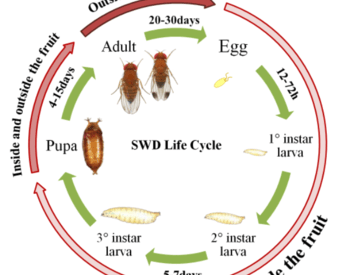
Micro-sprinkler application of certain pesticides suppresses spotted-wing drosophila in highbush blueberries. However, those same pesticides applied by backpack sprayers provide better control.
View now

© 2022 Oregon State University. Extension work is a cooperative program of Oregon State University, the U.S. Department of Agriculture, and Oregon counties. Oregon State University Extension Service offers educational programs, activities, and materials without discrimination on the basis of race, color, national origin, religion, sex, gender identity (including gender expression), sexual orientation, disability, age, marital status, familial/parental status, income derived from a public assistance program, political beliefs, genetic information, veteran’s status, reprisal or retaliation for prior civil rights activity. (Not all prohibited bases apply to all programs.)

Accessibility: This publication will be made available in an accessible alternative format upon request. Please contact [email protected] or 541-737-3311.

Oregon State University Extension Service

Spotted-wing Drosophila, Relative Rankings and Seasonal Strategies for Insecticide Use

Serhan Mermer, Philip Fanning, Gabriella Tait, Ferdinand Pfab, Christopher Adams, Linda Brewer and Vaughn Walton
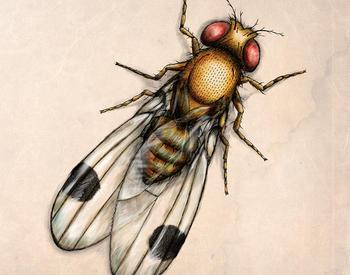
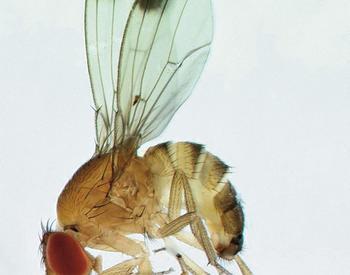
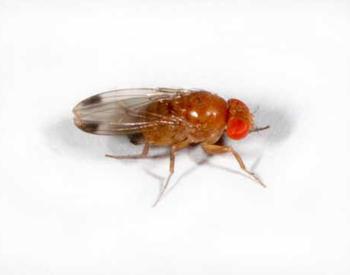
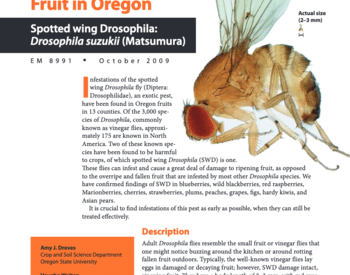
Closeup of a spotted-wing drosophila
EM 9360
What are the most effective pesticides for control spotted-wing drosophila?
Researchers have identified the most effective pesticides for spotted-wing drosophila.
Researchers around the country have ranked the effectiveness of the most-used pesticides to control spotted-wing drosophila populations in the field. These recommendations are focused on controlling immature and adult life stages of SWD.
View now

© 2022 Oregon State University. Extension work is a cooperative program of Oregon State University, the U.S. Department of Agriculture, and Oregon counties. Oregon State University Extension Service offers educational programs, activities, and materials without discrimination on the basis of race, color, national origin, religion, sex, gender identity (including gender expression), sexual orientation, disability, age, marital status, familial/parental status, income derived from a public assistance program, political beliefs, genetic information, veteran’s status, reprisal or retaliation for prior civil rights activity. (Not all prohibited bases apply to all programs.)

Accessibility: This publication will be made available in an accessible alternative format upon request. Please contact [email protected] or 541-737-3311.

Oregon State University Extension Service

Grape Phylloxera: Biology and Management in the Pacific Northwest

Patricia A. Skinkis, Vaughn Walton and Clive Kaiser
EC 1463
Describes the life cycle and injury symptoms of grape phylloxera, Daktulosphaira vitifoliae (Fitch), an aphidlike insect that feeds on grape roots. Discusses strategies for reducing the risk of phylloxera infestation, how to sample vines to confirm the presence of phylloxera, how to monitor the rate of spread, ways to manage a phylloxera-infested vineyard, replanting options, and phylloxera-resistant rootstocks.
View now

© 2021 Oregon State University. Extension work is a cooperative program of Oregon State University, the U.S. Department of Agriculture, and Oregon counties. Oregon State University Extension Service offers educational programs, activities, and materials without discrimination on the basis of race, color, national origin, religion, sex, gender identity (including gender expression), sexual orientation, disability, age, marital status, familial/parental status, income derived from a public assistance program, political beliefs, genetic information, veteran’s status, reprisal or retaliation for prior civil rights activity. (Not all prohibited bases apply to all programs.)

Accessibility: This publication will be made available in an accessible alternative format upon request. Please contact [email protected] or 541-737-3311.

Oregon State University Extension Service

Pest alert: Spotted lanternfly is an invasive insect that may impact Oregon

Serhan Mermer, Gabriella Tait, Josh Vlach, Jana Lee, Man-Yeon Choi, Heather Leach, Linda Brewer and Vaughn Walton
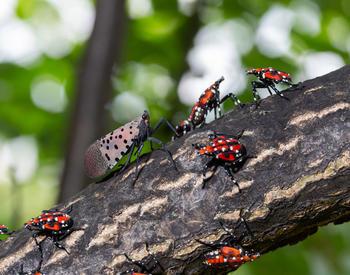
Adult spotted lanternfly
EM 9312
Spotted lanternfly may threaten Oregon plants. Learn to ID, report and stop this invasive pest before it spreads.
Be proactive in reducing the spread of spotted lanternfly, an invasive insect that threatens winegrapes, small fruits, timber and more. This guide covers identification, lice cycle, post plants and methods of control.
Spotted lanternfly is an invasive pest that can impact industries like winegrapes, timber and small fruits. Learn how to ID the pest and report sightings in Oregon.
View now

© 2021 Oregon State University. Extension work is a cooperative program of Oregon State University, the U.S. Department of Agriculture, and Oregon counties. Oregon State University Extension Service offers educational programs, activities, and materials without discrimination on the basis of race, color, national origin, religion, sex, gender identity (including gender expression), sexual orientation, disability, age, marital status, familial/parental status, income derived from a public assistance program, political beliefs, genetic information, veteran’s status, reprisal or retaliation for prior civil rights activity. (Not all prohibited bases apply to all programs.)

Accessibility: This publication will be made available in an accessible alternative format upon request. Please contact [email protected] or 541-737-3311.

Oregon State University Extension Service

Testing and tracking the spread of grapevine red blotch virus in Oregon vineyards

Daniel Dalton, Jessica Buser-Young, Samantha Nizich, Alexander Levin, Vaughn Walton, Richard Hilton and Linda Brewer
EM 9306
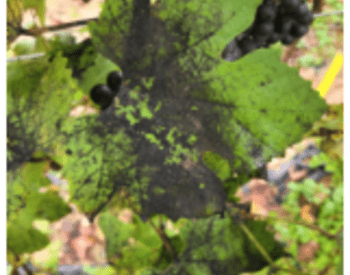
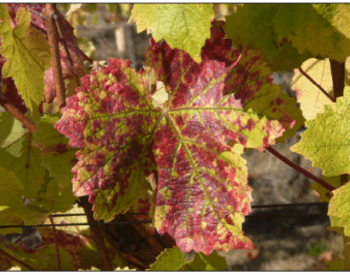
Grapevine red blotch virus affects fruit ripening and impacts the quality of finished wines.
Grapevine red blotch virus affects fruit ripening and impacts the quality of finished wines. GRBV incidence increased from two to 10 times annually in the Willamette Valley and Southern Oregon vineyards sampled and studied from 2014 to 2016.
Grapevine red blotch virus affects fruit ripening and impacts the quality of finished wines.
View now

© 2021 Oregon State University. Extension work is a cooperative program of Oregon State University, the U.S. Department of Agriculture, and Oregon counties. Oregon State University Extension Service offers educational programs, activities, and materials without discrimination on the basis of race, color, national origin, religion, sex, gender identity (including gender expression), sexual orientation, disability, age, marital status, familial/parental status, income derived from a public assistance program, political beliefs, genetic information, veteran’s status, reprisal or retaliation for prior civil rights activity. (Not all prohibited bases apply to all programs.)

Accessibility: This publication will be made available in an accessible alternative format upon request. Please contact [email protected] or 541-737-3311.

Oregon State University Extension Service

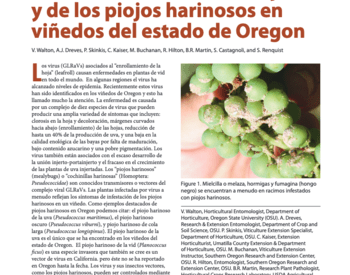
Prevención y manejo del virus del enrollamiento de la hoja y de los piojos harinosos en viñedos del estado de Oregon

Vaughn Walton, Amy J. Dreves, Patricia A. Skinkis, Clive Kaiser, Marcus A. Buchanan, Rick Hilton, Robert Martin, Steve Castagnoli and Steve Renquist
Publication cover
EM 8990-S
Este documento sugiere prácticas que se cree reducen la propagación de enfermedades y virus.
View now

© 2018 Oregon State University. Extension work is a cooperative program of Oregon State University, the U.S. Department of Agriculture, and Oregon counties. Oregon State University Extension Service offers educational programs, activities, and materials without discrimination on the basis of race, color, national origin, religion, sex, gender identity (including gender expression), sexual orientation, disability, age, marital status, familial/parental status, income derived from a public assistance program, political beliefs, genetic information, veteran’s status, reprisal or retaliation for prior civil rights activity. (Not all prohibited bases apply to all programs.)

Accessibility: This publication will be made available in an accessible alternative format upon request. Please contact [email protected] or 541-737-3311.

Oregon State University Extension Service

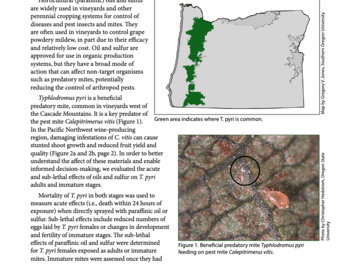
Evaluating Compatibility of Horticultural Oils and Sulfur with Vineyard IPM

Angela Gadino, Vaughn Walton, Amy J. Dreves, Gregory V. Jones and Linda Brewer
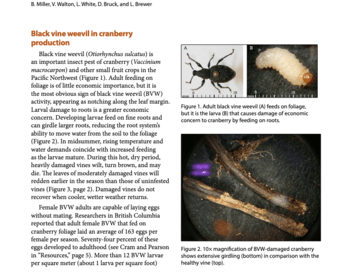
Publication cover
EM 9095
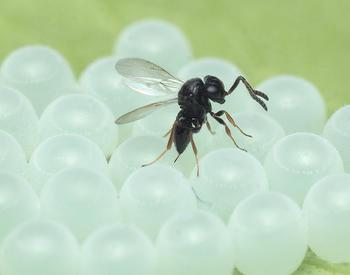
Typhlodromus pyri is a beneficial insect and key predator of Calepitrimerus vitis in Pacific Coast vineyards. C. vitis is closely associated with short-shoot syndrome. The impact of horticultural (paraffinic) oils and sulfur on T. pyri is presented here. This publication contributes to integrated pest management and conservation of beneficial insects in Oregon coastal vineyards.
View now

© 2014 Oregon State University. Extension work is a cooperative program of Oregon State University, the U.S. Department of Agriculture, and Oregon counties. Oregon State University Extension Service offers educational programs, activities, and materials without discrimination on the basis of race, color, national origin, religion, sex, gender identity (including gender expression), sexual orientation, disability, age, marital status, familial/parental status, income derived from a public assistance program, political beliefs, genetic information, veteran’s status, reprisal or retaliation for prior civil rights activity. (Not all prohibited bases apply to all programs.)

Accessibility: This publication will be made available in an accessible alternative format upon request. Please contact [email protected] or 541-737-3311.

Report ID:
Report ID:

Email Vaughn Walton

CAPTCHA
Solve this simple math problem and enter the result. E.g. for 1+3, enter 4.
Esta pregunta es para comprobar si usted es un visitante humano y prevenir envíos de spam automatizado.