Volunteer
When you volunteer with 4-H, you reap many rewards for yourself, 4-H members, and your community.
Why volunteer with 4-H?
- You're needed! You have the potential to make a big difference!
- Help youth become better citizens. Share your skills, talents, and hobbies.
- Meet new people, make new friends, and grow your community.
- Volunteering supports mental health. Volunteering boosts our social connection and sense of belonging.
- Practice skills, including teamwork, communication, problem-solving, project planning, organization, and working with youth.

4-H members and volunteer plans work on a community cleanup project.
With the wide variety of programs offered through 4-H, you can get involved in an activity or club that interests you and develop your skills. At the same time, you enrich the lives of the youth in your community. There are two main roles: 4-H Club Leader, and 4-H Resource/Project Volunteer. Read about both these roles and our application process below.
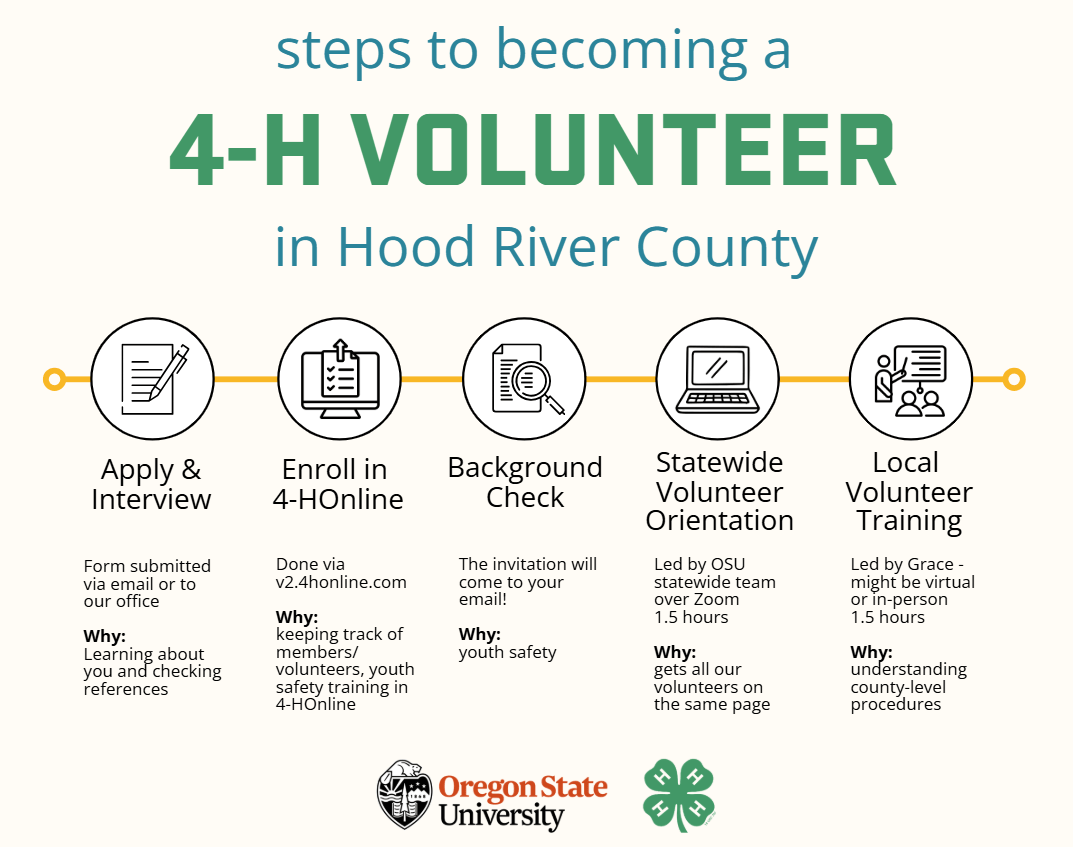
Get Started: Volunteer Application Process
For new volunteers, contact us to learn more about becoming a volunteer.
Step 1: Apply.
Submit your application using one of the following methods:
- Complete the online application form, or
- Deliver a paper application to the Extension office (2990 Experiment Station Drive), or
- Email a PDF of your completed application to [email protected]
Step 2: Interview.
We will have a brief phone or in-person interview to get to know you. Then, we will contact the references listed on your application.
Step 3: Enroll in 4-HOnline yearly.
- Go to v2.4honline.com.
- Make an account if it’s your first time, or log into an existing account.
- Follow all prompts on the webpage.
- When you complete your enrollment, make sure to do the "OSU Youth Safety Training" in 4-HOnline.
- Volunteers are required to re-enroll in 4-HOnline every year before starting club activities.
Step 4: Complete a Background Check
- A background check is required when you apply and every two years afterwards.
- Instructions will be sent to your email.
- There is an extra background check step for applicants who have lived outside Oregon at some point during the past seven years.
Step 5: Training.
- New volunteers are required to complete two trainings:
- A virtual statewide orientation session (1.5 hours)
- A local volunteer training session (1.5 hours)
Step 6: Welcome!
Role Description: Hood River County 4‑H Club Leader
4‑H Club Leaders are the foundation of the Hood River County 4‑H program. Club Leaders (and co‑leaders) guide a community 4‑H club throughout the year, creating safe, inclusive environments where youth ages 5–19 explore interests, build skills, and grow as leaders through hands‑on learning. Club Leaders work in partnership with youth, families, and county faculty to plan educational meetings, encourage youth voice and leadership, and support participation in county events and fair. No prior 4‑H experience is required. Training and ongoing support are provided.
Key Responsibilities
- Plan and facilitate monthly educational club meetings
- Support youth in project work, goal‑setting, and reflection
- Encourage youth voice, leadership, and shared decision‑making
- Create a welcoming, inclusive, and non‑discriminatory environment
- Communicate regularly with families and county 4‑H faculty
- Support participation in record books, events, and fair (as applicable)
- Model respectful behavior and uphold Oregon 4‑H and OSU Extension policies
Club Requirements & Start‑Up Steps
To operate a 4‑H club in Hood River County, Club Leaders agree to complete the following:
- Step 1: Complete Volunteer Onboarding
- Complete the Oregon 4‑H volunteer onboarding process, including required training, enrollment in 4‑HOnline, and background screening.
- Step 2: Secure Two Registered Volunteers
- Identify and work with a second registered 4‑H volunteer. Two enrolled volunteers are required to run the club and must be present at all official meetings to meet supervision guidelines.
- Step 3: Complete a Club Charter
- Complete a club charter that reflects youth voice and shared decision‑making.
- Submit the charter to county faculty ([email protected]).
- Step 4: Recruit Youth Members
- Recruit at least five youth from three or more families. Clubs must not discriminate and must welcome any youth who is interested in learning through 4‑H.
- Step 5: Plan the Club Year
- Create a schedule for the year.
- Clubs typically meet monthly during the school year and may meet more frequently during the summer.
- Step 6: Communicate Regularly
- Check email consistently for updates from county faculty.
- Attend monthly 4‑H leader meetings to stay informed.
- Choose a communication method that works for your families (common options include email, SportsYou, TeamReach, or Band).
- Step 7: Hold Effective Club Meetings
- Begin regular club meetings once enrollment is complete.
- Effective meetings include:
- An activity that builds belonging
- Opportunities for youth voice
- Project learning time
- Fair preparation, when appropriate
- Step 8: Prepare for Fair
- Support youth with fair entry requirements, expectations, deadlines, and participation.
Time Commitment
- Approximately 4–10 hours per month
- Additional time during fair season or special events
- Club leadership is a year‑round commitment, aligned with the 4‑H year (October–September)
Training & Requirements
- Club Leaders must:
- Complete the Volunteer Clearance & Onboarding process
- Enroll annually through 4‑HOnline
- Complete Youth Safety Training annually
- Pass a Criminal History Check every two years
- Follow two‑deep supervision and mandatory reporting requirements
Support Provided
- Training, curriculum, and planning resources
- Ongoing support from Hood River County 4‑H staff
- Guidance on club management, youth development, and safety
- Connection to a community of local and statewide 4‑H volunteers
Is This Role Right for You?
- This role may be a great fit if you:
- Enjoy building long‑term relationships with youth and families
- Can commit to monthly meetings and regular communication
- Value youth leadership and hands‑on learning
- Are organized and willing to collaborate with a co‑leader
- Want to make a meaningful, sustained impact in your community
Role Description: Hood River County 4‑H Resource Leader
4‑H Resource Volunteers support youth learning by sharing skills, knowledge, or time on a short‑term or as‑needed basis. Resource Volunteers do not manage a club but play a vital role by helping with workshops, events, project activities, fair, or special programs. This role is flexible and ideal for adults who want to volunteer without a long‑term commitment.
Key Responsibilities
- As a 4‑H Resource Volunteer, you may:
- Teach or assist with project workshops or demonstrations
- Support club meetings, county events, camps, or fair activities
- Share expertise in areas such as animal science, STEM, arts, leadership, or life skills
- Assist with hands‑on activities, supervision, or logistics
- Model positive behavior and encourage youth engagement
- Follow all youth safety and supervision guidelines while volunteering
Time Commitment
- Flexible and short‑term
- Ranges from one‑time opportunities to seasonal or occasional support
- Typical commitment is 4–10 total hours, depending on the activity
Training & Requirements
- Resource Volunteers must:
- Complete the Volunteer Application & Onboarding process
- Enroll annually as a volunteer through 4‑HOnline
- Complete annual Youth Safety Training through 4-HOnline
- Pass a Criminal History Check every two years
- Follow two‑deep supervision, youth safety policies, and mandatory reporting requirements
Support Provided
- Clear expectations for each volunteer opportunity
- Staff support before and during activities
- Access to curriculum, supplies, and guidance as needed
Is This Role Right for You?
- This role may be a great fit if you:
- Prefer short‑term or occasional volunteering
- Want to share a specific skill, hobby, or expertise
- Enjoy working with youth but can’t commit to leading a club
- Like flexible opportunities with clear start and end points
- Want to support 4‑H in a meaningful but manageable way