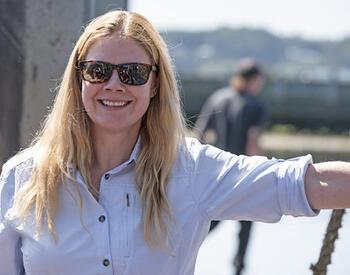
NEWPORT, Ore. — With her group assembled and the squawks of seagulls echoing across Yaquina Bay, Angee Doerr walked down the steel ramp at Dock 5 at the Port of Newport to talk about seafood.
Shop at the Dock was back.
Participants receive behind-the-scenes tours of commercial fishing docks to learn how seafood is caught and how to buy it directly from fishermen selling off their boats.
A popular program of Oregon Sea Grant and Oregon State University Extension Service, the tours began in Newport in 2014 as a way to bring fishermen and the public together. Participants receive behind-the-scenes tours of commercial fishing docks to learn how seafood is caught and how to buy it directly from fishermen selling off their boats.
In 2020, the seafood tours — which had expanded to the Port of Garibaldi in Tillamook County — were canceled due to the COVID-19 pandemic. In response, Amanda Gladics, Sea Grant Extension fisheries management specialist in Astoria, produced a series of videos about Oregon’s seafood industry.
With COVID-19 restrictions lifted in Oregon on June 30, in-person Shop at the Dock tours returned. The two scheduled tours for Friday filled quickly, and Doerr — a Sea Grant Extension marine fisheries educator based in Newport — added a third tour due to the positive response. Newport tours will continue on consecutive Fridays through Aug. 20.
At 9:28 a.m., with the first tour at capacity, Doerr led the group to its first stop: the Monde Uni, a 39-foot longline fishing vessel. Longline boats use a main line with baited hooks attached at intervals, targeting species such as Hippoglossus stenolepis (Pacific halibut) and sablefish (Anoplopoma fimbria), also known as black cod.
Longlining can result in incidental catch, or bycatch, of non-targeted fish and seabirds. Doerr explained that Oregon’s fishing industry has worked with Oregon Sea Grant and other researchers to introduce methods that have nearly eliminated bycatch in longline fishing.
Next to the Monde Uni was a troller — a hook-and-line vessel that selectively targets salmon and tuna.
“All of our salmon and tuna in Newport, to this day, are caught using a hook and a line,” Doerr said.
From crab pots to hagfish
Moving down the dock, Doerr stopped behind a stack of circular steel traps. Crab pots are common during Oregon’s Dungeness crab (Metacarcinus magister) season, which typically runs from December through August.
“Oregon manages its crab fishery based on size, season and sex. For example, we only take male crabs,” Doerr said, smiling. “Males just aren’t as important reproductively. Sorry.”
Nearby, a vessel equipped with large plastic barrels indicated a different fishery: hagfish (Eptatretus stoutii), also known as slime eels for their ability to produce slime to deter predators. Hagfish are considered a “living fossil,” largely unchanged for 300 million years. They are a delicacy in parts of Asia, and nearly all caught in Oregon are exported to South Korea.
Shrimp, squid and groundfish
The Miss Yvonne, a 60-foot Newport boat, is recognizable as a commercial shrimp boat because of its wooden trawl doors, which hold the shrimp net open as it is towed behind the vessel. Oregon fishermen have worked with researchers at Oregon State and the Oregon Department of Fish and Wildlife to make the state’s shrimp fishery nearly 100% bycatch free.
At the Pacific Raider, Doerr introduced the market squid (Doryteuthis opalescens) fishery. As ocean temperatures warm, squid have moved north from California, bringing squid boats with them.
“Market squid boats have lights on the side because most squid fishing occurs at night,” Doerr said. “You shine the light, which draws plankton to the surface — and the squid follow.”
Large vessels known as mid-water trawlers were next. These boats catch large schools of fish, including some species of groundfish — a category with more than 100 species, some endangered. Groundfishing requires a permit, strict quotas and a human observer to record every fish caught.
Tips for buying directly from fishermen
Doerr emphasized that most Newport fishing vessels — aside from the largest crab boats — catch multiple species throughout the year.
When buying directly from fishermen, she advised looking for handmade signs posted near the entrances to Port Docks 3, 5 or 7. Fish are typically sold whole, so ask when the fish was caught to check freshness. If filleting is offered, she recommended accepting — it often yields more meat.
“The nice thing about buying direct is that fewer people have handled the fish,” Doerr said. “The fewer people who have handled the fish, the better it will be.”
Karen and Gary Kone of Lincoln City attended the tour with friends Emily Rice and Kira Saling, visiting from Utah and Idaho. Although the Kones live just 25 miles from Newport, it was their first Shop at the Dock.
“I was excited to see them come back,” Karen Kone said.
“It was interesting to learn about all of the specialties,” Saling said.
Gary Kone added, “I’m a big believer in word-of-mouth, so I’ll definitely let friends and neighbors know about it. This was really cool.”
After the tour, the group visited the Chelsea Rose Seafood Market on Port Dock 3, which operates from the historic fishing vessel of the same name.
Promoting Oregon seafood
In 2020, Gladics, Doerr and Jamie Doyle — a Sea Grant Extension marine resources specialist in Coos and Curry counties — partnered with the Oregon Department of Agriculture and Oregon’s seafood industry on an initiative called Eat Oregon Seafood. They created a website and a social media campaign using the hashtag #EatOregonSeafood.
Oregon Sea Grant Extension offers more information about buying seafood from fishing boats, including a seafood consumer guide.