
Why grow plants?
Whether you have one or 500 acres, if you live along a stream, you need plants along the water’s edge. Why? Healthy plants along a stream benefit both people and wildlife. They can:
- Prevent stream bank erosion
- Filter phosphorus and nitrogen from fertilizers and animal waste
- Capture soil eroding from adjacent pastures, pens and croplands
- Trap sediment flowing downstream
- Intercept pesticides drifting on the wind from adjacent fields
- Help maintain stream flows through the summer
- Shade water
- Nourish livestock
- Feed and shelter wildlife
- Improve fish habitat
- Increase property value
What plants are best?
Oregon’s streamside vegetation differs throughout the state, but healthy streamsides share some common traits:
- Few weeds
- Many plants
- Diverse species
- Mix of young and old plants
- Little or no bare ground
- Plants with strong root masses
- Plants that prefer moist or saturated soils

Many desirable plants have strong roots for holding soils in place. Sedges and rushes look like grasses but are adapted to living in wet soils; they have especially large root systems. A healthy combination of sedges, rushes and willows is as effective as anchored rock for stabilizing stream banks.
The type of vegetation best suited for a particular stream bank will depend on local soils, weather and other factors unique to that site. Depending on site conditions, healthy streamside vegetation may consist of:
- only grasses, sedges and rushes
- grasses, sedges, rushes and shrubs
- grasses, sedges, rushes, shrubs and trees
For example, willows will only grow in moist, gravelly soils that are well aerated.
Dryland plants, such as sagebrush and most grasses, are common along eastern Oregon streams where stream channels have cut deep into the ground. However, these plants do not have bank-stabilizing roots. Plants adapted for streamside living are six to 10 times better at stabilizing stream banks.
What can I do?
- Take a walk along your stream and look for noxious weeds, eroding banks, animal trails, sources of manure and heavily grazed vegetation.
- Ask yourself or a technical expert if the stream bank could be in better shape.
- If so, what activities will allow vegetation to flourish? Examples include:
- Leave a vegetated buffer between streams and adjacent animal pens, barns, pasture and cropland.
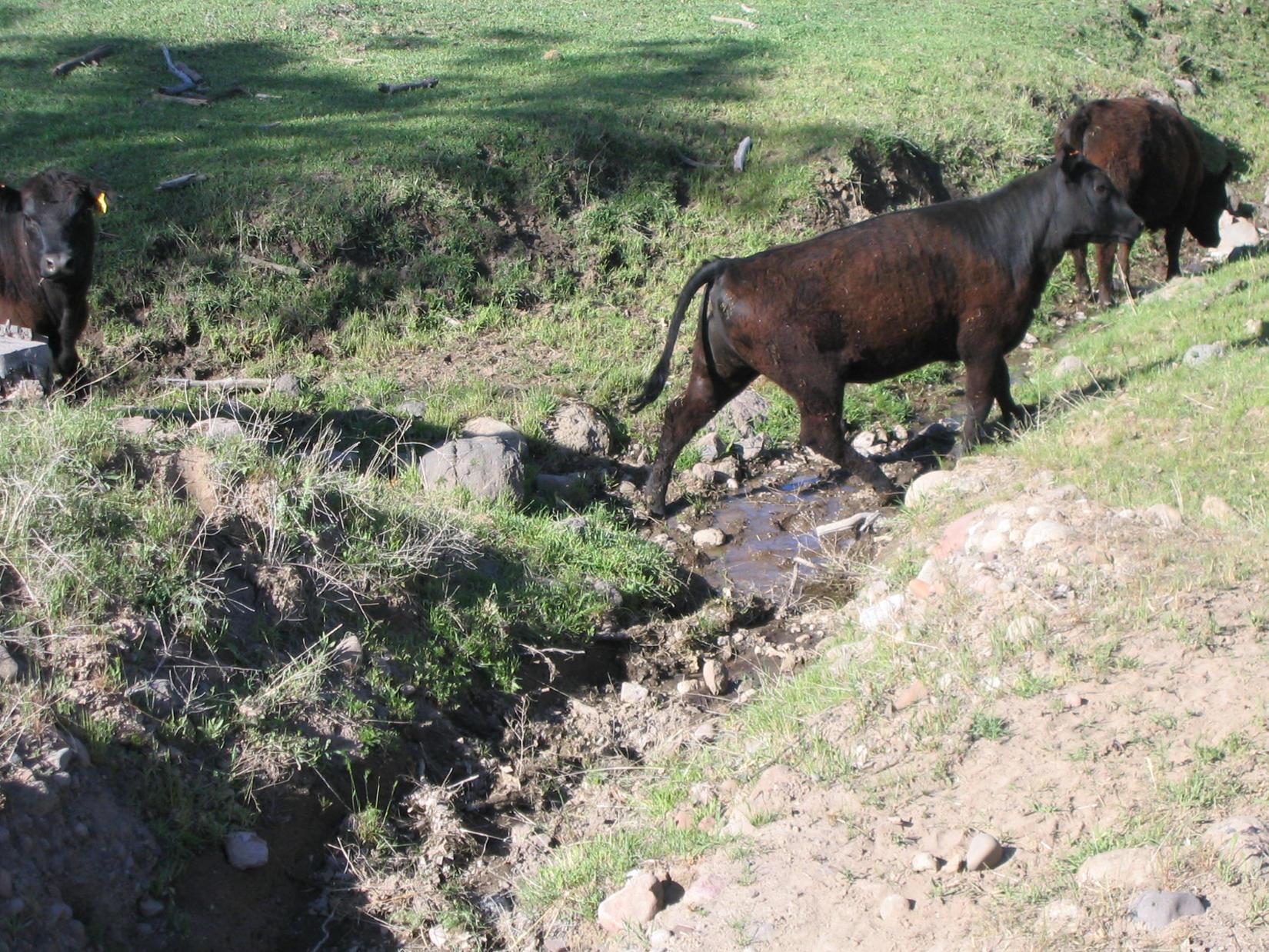
- Fence livestock away from streams, or allow only managed grazing along the stream as part of a rotational grazing system.
- Provide off-stream livestock water through troughs and nose pumps. Frost-free troughs are available. If you must water livestock from a stream, harden access points or stream crossings. Monitor crossings to prevent them from becoming pollution sources.
- Control weeds.
- Plant willows, alders, dogwood and other streamside plants native to your area and where site conditions are appropriate.
- Provide shade for livestock away from streams.
- Place salt and minerals away from streams to encourage livestock to graze in the uplands.
- Maximize forage in your pastures away from your stream by grazing appropriately, e.g., never graze grass below 3 to 4 inches tall.
- Do not straighten or channelize natural streams. In most cases it is illegal. Natural channel shapes and flow patterns help reduce bank erosion and flooding.
Many farmers and ranchers have improved streamside areas on their own, but technical and financial help is available. Various voluntary programs can help farmers and ranchers protect streams and wetlands. The cost-share provided by state and federal agencies usually covers most of the cost.

It’s also the law
In Oregon, farmers and ranchers are required to allow streamside vegetation to stabilize stream banks, shade streams, and filter runoff before it flows into streams. Although compliance with this vegetation regulation is required, how landowners comply depends on farm operation strategies. Many farmers and ranchers are already meeting the requirements by allowing streamside vegetation to establish and develop naturally.
Some streamside areas along agricultural lands still lack adequate and appropriate streamside vegetation. The Oregon Department of Agriculture is working with its partners to help ensure that all agricultural lands bordering streams meet vegetation requirements and achieve healthy streamside vegetation.
For more information on streamside vegetation management, contact your local Extension agent, your local Soil & Water Conservation District, or Oregon Department of Agriculture (503-986-4700). Technical and financial assistance is available for livestock owners wishing to address resource concerns on their property.
The phrase “Living on The Land” is used with permission from Living on The Land Stewardship for Small Acreage, © 2008, UNCE/WSARE.
