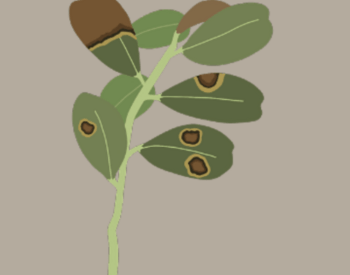
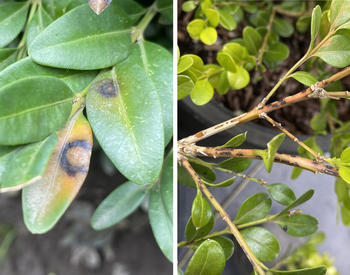
Initial symptoms


Summary
This title includes three products: a publication in English, a publication in Spanish, and a bilingual poster (both English and Spanish). Content includes information on host plants, transmission of the disease, and management, with photos and descriptions of symptoms of boxwood blight and damage to plants.
Common names
-
Boxwood blight
-
Box blight
-
Blight disease of boxwood
-
Boxwood leaf drop
Pathogen causing this disease
-
Calonectria pseudonaviculata
-
Also called Cylindrocladium pseudonaviculatum or C. buxicola
Advanced symptoms


How spores are spread
- Short distance: Splash-dispersed by normal or wind-driven rain, or overhead irrigation.
- Medium distance: Movement of leaf debris by runoff water or wind; contact-dispersed by humans’ contaminated clothing, boots and equipment; small animals carrying spores.
- Long distance: Movement of infected plants, contaminated trucks and shipping containers.
- In production: Pruning infected plant material and then using the contaminated tools; contaminated flats; contaminated water runoff.

Managing boxwood blight
- Start with clean material. Inspect plants or cuttings for symptoms.
- Isolate rooted cuttings or new plants from other boxwood plants for at least 1 month (preferably several months).
- If possible, space plants to improve air circulation and minimize high humidity.
- Avoid working among the plants when they are wet.
- Sanitation practices are key in preventing disease spread:
- Use disposable shoe covers or thoroughly clean and sanitize your shoes, especially if you are working in an area suspected of C. pseudonaviculata infection.
- Disinfect pruners and other tools often within one production area before moving to a different production area.
- Sanitize all tools, shipping containers, benches and equipment. Products for sanitizing: alcohols, ethyl and isopropyl 60–85%; phenolics 0.4–5%; quaternary ammonium 0.5–1.5%; chlorine, 10% household bleach 100–1,000 ppm.
- Never dispose of infected plant material near other production areas.
- Destroy all infected plants and plant material. Burial or incineration is recommended.
- Do not compost infected plants. Resting structures of the fungus can survive at least 5 years in decomposing boxwood leaves.

Other diseases in boxwood
Boxwood plants are susceptible to other pathogens that produce symptoms that could be misidentified as boxwood blight, such as Volutella blight (Figure 10) (caused by the fungus Volutella buxi), boxwood decline, and Macrophoma leaf spot.

Known host plants
In natural conditions, C. pseudonaviculata has only been observed on leaves and shoots of Buxus species. Some varieties of boxwood are more susceptible than others. B. sempervirens “Suffruticosa” (English boxwood) and American or common boxwood are highly susceptible. A host’s susceptibility can vary depending on the cultivar, the region where it is grown, and physical features of the plant, such as foliage that retains water and is compact or dense (Figure 11). Under laboratory conditions, both Sarcococca species and Pachysandra can be infected by this pathogen (Figure 12).


About the authors

Related publications