
Under Oregon law, all water is publicly owned. With limited exceptions, a water right is required before anyone — including municipalities, businesses or other entities — may divert water from its natural course, whether it is groundwater or surface water, and put it to beneficial use. As a result, landowners with water flowing past, through or under their properties do not automatically have the right to use that water without authorization from the Oregon Water Resources Department. Understanding your water right is the first step in using and managing your irrigation water legally.
Beneficial use
Water rights are issued only for beneficial use, without waste. Each water right includes a designated type of use and is limited to that purpose. General categories of beneficial use include, but are not limited to: irrigation, municipal, industrial, commercial and domestic. Since 1987, Oregon law has specifically included in-stream flow protection as a beneficial use for improving fish habitat and water quality.
The doctrine of prior appropriation forms the basis of Oregon’s water law and is shared across many Western states. This doctrine evolved in the law to promote settlement and development in the West. Under this system, individuals or entities may divert water from a surface or groundwater source and apply it to a "beneficial use," such as irrigation.
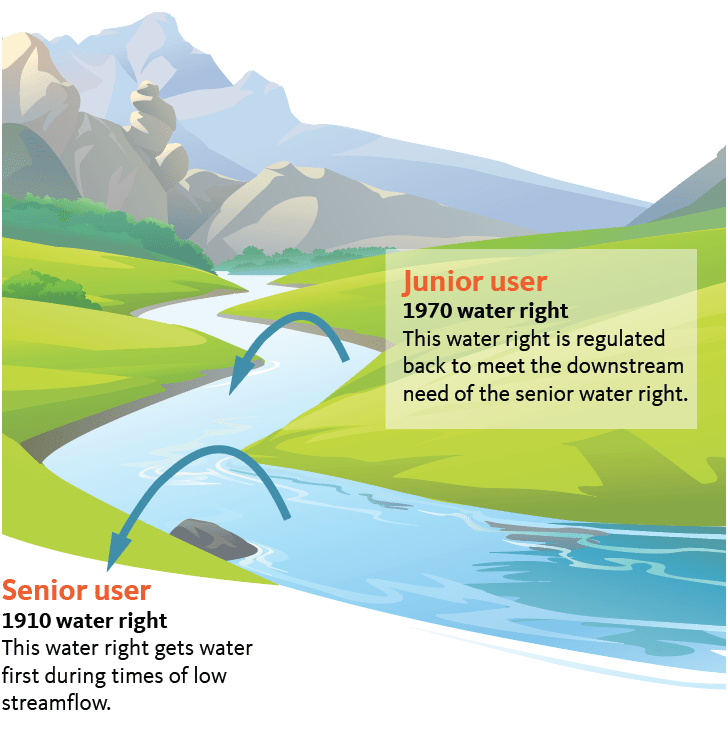
Water rights follow a first-come, first-served approach. This means that the person with the earliest priority date — the senior water right — has the first access to water during periods of limited supply. In a shortage, all water allowed under the senior right must be satisfied before any junior water right holder may divert water.
Each water right also specifies how the water may be used, and using it for a purpose not listed in the right is not allowed. A water right remains valid as long as it is not canceled and beneficial use of the water is continued without a lapse of five or more consecutive years. According to Oregon law, except for municipal rights and in certain other cases, if any portion of a water right is not used for five or more consecutive years, that portion of the right is presumed to have been forfeited and may be subject to cancellation.(OWRD, p.35)
Knowing a parcel of land has water rights attached isn’t enough to guarantee that the allocation will be reliable or sufficient. For example, specific areas in the state are subject to restrictions on water use and limits on new appropriations because they are designated as Critical Groundwater Areas or Groundwater Limited Areas. Senior priority dates also vary greatly from stream to stream. A date that is senior on one stream may not be senior on another. To determine if you are in one of these limited areas or if the water right is considered senior, consult your local watermaster.
Why this matters: Your water right specifies what you are allowed to use the water for, and using water for a different purpose — even on the same property — can put your water right at risk.
Water rights
A water right permit is an authorization from the state to make use of water, either surface water or groundwater. Since 1909, Oregon law has required a water right permit before someone can use surface water. Groundwater has been subject to the permit requirements statewide since 1955. The Oregon Water Resources Department issues water rights permits.
A water right gives a person permission to irrigate a specific piece of land with a specific amount of water during a specific period of time. Oregon keeps detailed records of which lands can be irrigated and how much water is allowed. A water right certificate is attached to the land described in the water right and must be used within the mapped footprint.
If the land is sold, the water right certificate stays with the land and is assumed by the new owner. A water rights certificate can be separated from the land listed on the certificate and moved to another place of use with a water right transfer filed with the OWRD.
The myth of 'use it or lose it'
Many water users have heard the phrase “use it or lose it.” While it contains a grain of truth, it is often misunderstood.
According to Oregon law (OWRD, 2024, p. 35), “A water right (or part of a right) may be subject to forfeiture if it is not used for five or more consecutive years, unless an exemption applies.”
What this really means
- You do not have to use the full authorized quantity (rate or volume) every year. You should only use what is needed. Water use in excess of what is needed may be waste, and is not allowed under Oregon law.
- Only the portion of the right that is completely unused for five consecutive years is at risk.
- If you apply water under the right to beneficially use the water at least once during that five-year period, the right is generally protected.
- Statutory exemptions may apply (for example, seasonal climate conditions; water conservation actions; land idling under government programs; being ready, willing and able to use the full right) to further protect the right.
Why this matters
The “use it or lose it” phrase often leads irrigators to apply unnecessary water simply to preserve their right. Water not put to beneficial use in this manner is waste and an illegal use of water
Exempt water use
Oregon water law provides some limited exemptions that allow water to be used without obtaining a standard water right permit. Examples of exempt surface water uses include:
- Stock watering at certain small ponds constructed and registered before January 31, 1997.
- Water used for fire suppression, and forest and land management practices when water is not being diverted for ongoing use.
- Use of small springs that arise and remain entirely on one property.
Certain groundwater uses are also exempt, including:
- Household (domestic) use of up to 15,000 gallons per day.
- Commercial or industrial use not exceeding a half-acre and using no more than 3,000 gallons per day (not including irrigation of commercial crops).
- Noncommercial lawn and garden irrigation of up to one-half acre.
- Stock watering.
- Down-hole heat exchange systems (ORS 537.545)
Important: For wells drilled after July 22, 2009, landowners must notify OWRD and register the well, even if the water use is exempt. Always check with your local watermaster to confirm whether your planned use qualifies.
Common water right components
Water rights generally include the following components:
- Duty is the maximum volume of water authorized for use under a water right during the allowed period of use specified in the certificate. Duty is typically expressed in acre-feet or cubic feet per second and is established by decree, statute or water right certificate. The actual amount of water available in any year may vary depending on supply conditions and priority.
- Rate is the amount of water authorized to flow to a property at any given time, typically expressed in gallons per minute (gpm) or cubic feet per second (cfs). The allowable rate and the season or period of use are defined in the water right certificate. Both the authorized rate and the allowed period of use may vary depending on the type of water right and beneficial use.
- Season of use is the period specified in a water right during which water may be diverted and applied to the authorized beneficial use.
- Conditions are additional requirements included in a water right that must be met to remain in compliance. These vary by right but may include measurement and reporting of water use, maintenance of measuring devices, fish-screen requirements, mitigation obligations or seasonal restrictions. Failure to comply with water-right conditions may result in enforcement actions, including restrictions on use, civil penalties, or permit cancellation. For clarification regarding the conditions on your water right, contact your local watermaster or the Oregon Water Resources Department.

Ponds and reservoirs
The construction of a reservoir or pond of any size to store water requires a water right permit from OWRD. A permit for a reservoir with the sole purpose of storing water is considered the primary permit. Permittees intending to use stored water will need an additional water use permit, commonly referred to as a secondary permit.
Under Oregon law, water cannot legally be stored and used without an authorized water right permit and certificate that covers both the storage and beneficial use.
In some irrigation systems, growers and districts may use temporary holding places for legally diverted water as part of an irrigation cycle. These are sometimes called “bulges in the system” (temporary storage facilities that hold water only as part of normal irrigation rotations).
A pond or tank used solely to hold water temporarily between scheduled deliveries or irrigation cycles may not require a separate storage water right if it is truly temporary and drained at the end of the irrigation season and the water was diverted under an existing valid water right. If the facility is intended to store water for future use beyond the season of use identified in the water right, a water right permit and certificate for storage are required.
OWRD administers two primary permitting pathways for the construction of ponds or reservoirs:
- Standard reservoir permitting process. This process applies to ponds or reservoirs that will hold more than 9.2 acre-feet of water and have a dam height of 10 feet or greater. Important note: This water storage facility requires engineered plans and specifications that must be approved by the dam safety section of OWRD prior to construction.
- Alternative reservoir permitting process. This applies when a proposed pond or reservoir meets both conditions: storage capacity of 9.2 acre-feet or less, and a dam height of less than 10 feet. Important note: The process involves a review of the project by the local watermaster and the Oregon Department Fish and Wildlife.
Water rights in irrigation districts
When a water right is held by an irrigation district, the district holds the legal right in trust, and the landowner holds the right to receive and apply the water.
Irrigation districts distribute water to their patrons based on the district’s water rights of record. Patrons are property owners or land managers who are entitled to receive irrigation water within the irrigation district boundary, while the irrigation district holds the underlying water right in trust and operates as the water delivery entity.
Patrons do not individually own the district’s water right; rather, they hold the right to receive and apply water under the district’s authority and delivery policies. Property owners located within an irrigation district boundary may or may not have a water right associated with their land.
Irrigation districts manage and distribute water according to the terms and conditions of their water rights, as well as district policies, infrastructure capacity and water availability. Districts are not obligated to deliver the full authorized water right to each patron every year. Districts are also responsible for ensuring that water use by patrons complies with applicable state law and water-right conditions.
To find out if your property has a water right, contact the irrigation district that services your area, OWRD or the title company.
Oregon landowners within an irrigation district water right boundary do not have the authority to:
- Irrigate land that does not have a water right or is not included in the district’s mapped place of use.
- Transfer the water to another property without district and state approval.
- Exceed the rate or duty listed in the water right.
- Sell or transfer the water right independently from the district.
- Lease or transfer water back for in-stream use.
- Construct permanent structures within district canal or ditch easements.
- Change the point of diversion or type of use without an approved transfer.
Any transfer of water rights must be approved by the irrigation district and concurred and filed with OWRD. To be a good manager of your irrigation water, you should have a water right map that identifies areas you can and cannot legally irrigate on your property.
Instream leasing
Oregon’s instream leasing program provides a voluntary mechanism to restore and protect streamflows while preserving existing water rights. This tool benefits both water right holders and instream values by allowing water to remain in the stream temporarily without permanently transferring the right.
Any water right holder may apply to lease all or a portion of their water right instream. The program is not limited to irrigation districts, although coordination with the district is required if the right is held within a district.
Water rights may be leased instream for an initial period of up to five years and may be renewed at the discretion of the water right holder. During the lease term, the water right holder forgoes consumptive use of the leased portion. The Oregon Water Resources Department protects the leased water instream for the benefit of fish habitat, water quality and other instream values.
An important benefit of instream leasing is that it counts as beneficial use. Because Oregon law generally requires a water right to be exercised at least once every five years to avoid forfeiture (unless an exemption applies), leasing can help protect a water right that would otherwise be at risk due to nonuse.
At the end of the lease term, the water right automatically reverts to its original place of use under its original terms and conditions.
Leases are expedited and typically approved within 30 to 45 days of receipt of the application. Because leases undergo expedited review, if injury to another water right is identified, the lease may be modified or terminated to prevent that injury.
For additional information and application guidance, see the Oregon Water Resources Department.
Canals, ditches and easements
Canals and ditches operated by irrigation districts are typically subject to recorded easements or rights-of-way that allow the district to conduct operation and maintenance activities. The legal basis for these easements varies by district.
In some areas, particularly federal reclamation project districts, easements may have originated under federal statutes when the district was formed. In other cases, easements may have been established through private deeds, condemnation proceedings or long-standing use.
These easements generally reserve space necessary for operation, maintenance and access. Permanent structures may not be constructed within those areas without district authorization. The specific width and terms of easements vary by district.
Property owners should consult their irrigation district or review recorded property documents to determine the location and legal status of any canal or ditch easements affecting their property.
Private laterals or ditches beyond the district’s point of delivery are typically the responsibility of the landowner unless otherwise specified by agreement.
Important notes for landowners
- A storage permit alone does not authorize water use.
- Any intended use of stored water requires a valid secondary water use permit.
- Construction or modification of a pond or reservoir may require adjustments to existing water rights, including changes to the place of use, point of diversion or storage authorization.
- Before construction, landowners should consult OWRD, their local watermaster, or their irrigation district to confirm permitting requirements and ensure compliance.
Water rights tools for drought
Oregon and most Western states face continual drought conditions. State water rights laws offer several tools to help landowners. Consult your irrigation district or OWRD to see if they apply to your property.
- Drought transfer: If the governor issues a drought declaration for a county, water users in that county can access emergency water-use tools, one of which is a drought transfer. This is a short-term transfer of a water right to change its type of use, place of use or location of the point of diversion.
- Temporary emergency water-use permit: This tool is only available to drought-declared counties. If an existing surface water right doesn’t have enough water during a drought period, a water user can apply for an emergency permit to temporarily tap into groundwater. These permits are limited to one year and may not be available in groundwater limited areas.
- Temporary transfers: A temporary transfer allows the water user to move water to areas of critical need. The water user can change the place of use, point of diversion or type of use of a certified water right. They can move water on their own property to areas of critical need or temporarily transfer it to another farmer.
- Conserved water right: A conserved water right allows a water right holder who implements an approved water conservation or efficiency project to apply under Oregon’s Allocation of Conserved Water Program. Under this program, conserved water is legally allocated in accordance with state law and program rules. The portion of conserved water retained by the water right holder and the portion protected instream depend on whether public funding was used to complete the conservation project. When public funds are involved, a percentage of the conserved water must be permanently protected for instream use. If private funds are used, the allocation structure may differ. This tool is available at any time and is not limited to drought declarations. In many cases, the Oregon Water Resources Department and the Oregon Watershed Enhancement Board may have funding available to support qualifying conservation projects.
- Limited license: A limited license is a temporary water use authorization for short-term or fixed duration not to exceed five years. Generally, irrigation uses are not allowed. However, a limited license may be used to establish a crop that will not require further irrigation once established. In addition, a limited license may be issued for use of stored water, providing certain criteria are met. Consult OWRD or your irrigation district about this option.
References and resources
- Central Oregon Irrigation District Patron Handbook Services
- Deschutes River Conservancy
- Hammond, E., B. Tuck, R. Wood, S. Olson, S. Kerr. 2017. Using Irrigation Water Legally, EM 1650.
- Oregon Water Resources Department. Allocation of Conserved Water Program.
- Oregon Water Resources Department. Instream leasing.
- Oregon Water Resources Department. 2024. Water Rights in Oregon: An Introduction to Oregon’s Water Laws.
- Schwabe, Williamson and Wyatt, 2023. Oregon Water Law Questions and Answers.
- Tumalo Irrigation District, Handbook for Water Users.
Acknowledgments
This material is based upon work that is supported by the National Institute of Food and Agriculture, U.S. Department of Agriculture, under award number 2021-38640-34695 through the Western Sustainable Agriculture Research and Education program under project number WPDP22-020. USDA is an equal opportunity employer and service provider. Any opinions, findings, conclusions, or recommendations expressed in this publication are those of the authors and do not necessarily reflect the view of the U.S. Department of Agriculture.
Reviewers included Matthew Alongi, Natural Resources Conservation Service State Irrigation Engineer; Mylen Bohle, Associate Professor, Emeritus; Gen Hubert, Deschutes River Conservancy; Troy Peters, Professor and Extension Irrigation Engineer, Irrigated Agriculture Research and Extension Center, Washington State University; Rex Barber of Big Falls Ranch, Terrebonne, Oregon; Mike Macy of Macy Farms, Culver, Oregon; Patrice Spyrka of Tumalo Alpen Ranch, Tumalo, Oregon; Greg Mohnen of Triple S Ranch; and Darrell Abby of Rock Island Ranch.
Contributors included Leslie Clark, Central Oregon Irrigation District; Jeremy Giffin, Carolyn Sufit, Kim Fritz-Ogren and Rachel Lovellford, all of the Oregon Water Resources Department; and Kyle Gorman.
About the authors

Related publications


