
Agricultural producers can gain access to the land they need through two general channels: ownership and rental. Some own their land after purchasing it from another landowner, bidding on it in an auction or inheriting it from a family member. The alternative to ownership is renting land from another producer or a non-operating landowner — a person who owns land but is not actively involved in agricultural production.
According to the most recent Census of Agriculture, 29% of Oregon's farmland is rented. This is relatively low compared to the national figure, which stands at 39%, but still accounts for roughly 4.5 million acres of land in the state.
According to the Census of Agriculture, 29% of Oregon's farmland is rented. This is relatively low compared to the national figure, which stands at 39%.
The relatively low rental percentage in Oregon is likely due to a few things. One is the large amount of grazing (pasture and range) land in the state. If it is not managed by the federal government, grazing land is generally more likely to be owned by the producer using it.
There is also a large amount of irrigated cropland in Oregon, where roughly 46% of all harvested cropland is irrigated. Irrigated cropland is less commonly rented out because of the capital and maintenance costs associated with irrigation infrastructure. For example, among Oregon farms where all harvested cropland was irrigated, only 24% of the land was rented. These fully irrigated crop operations account for 39% of Oregon’s farmland but represent only 10% of all farmland in the United States.
Each year, the U.S. Department of Agriculture’s National Agricultural Statistics Service publishes cash rental rates at the state and county levels. The county-level data come from a cash rental rate survey conducted every summer to collect information on the cash rents paid for non-irrigated cropland, irrigated cropland and pastureland. A unique aspect of this survey is that it provides county-level rent data on an annual basis.
Additionally, at just 1½ pages, the survey is shorter and less complicated than other USDA surveys. As a result, response rates are relatively high. In 2025, 58% of the 3,169 surveyed producers responded to the cash rent survey in Oregon, which is up from the 55% response rate of the 2024 survey. For each year between 2011 and 2020, the response rate was at least 71%. It has now fallen below 60% for three of the past four years, so the latest numbers should be interpreted with that in mind.
The state-level cash rent data come from the same June Area Survey that USDA-NASS uses as the basis for its annual farmland value estimates.

Irrigated cropland
In 2025, irrigated cropland was rented for an average of $264 per acre, which is down $11 (after adjusting for inflation) from the $275 average rent over the previous five years (2020–2024) (Figure 1). Over the past year, the statewide cash rent for irrigated cropland decreased by 2.7% in inflation-adjusted terms, marking the third year-on-year decrease in the past four years. From the recent high of $284 in 2021, irrigated rents are down over 7%.
Irrigated cropland tends to be rented at a premium compared to non-irrigated cropland, due to the higher returns associated with irrigated production and the costs of maintaining irrigation-related equipment and water conveyance infrastructure.
Looking across the state, irrigated rents tend to be highest in the northern Willamette Valley and other counties along the Columbia River: Hood River, Morrow and Umatilla (Figure 2). With one exception — Klamath — counties in the eastern, central, and southern parts of the state tend to see lower irrigated cash rents.
High irrigated rents have been reported for Malheur in previous years, but a small sample size prevents reporting this year. Deschutes saw an enormous 30% gain in irrigated rents over the past year, and large gains over 10% occurred in Clackamas, Jackson and Lane as well. Decreases of more than 10% occurred in Union and Yamhill.

Non-irrigated cropland
In contrast to irrigated cropland, non-irrigated cropland rent, at $110 per acre, was up by 0.8% over the past year (Figure 1). Over the past five years, non-irrigated rents have held steady between $109 and $112 per acre.
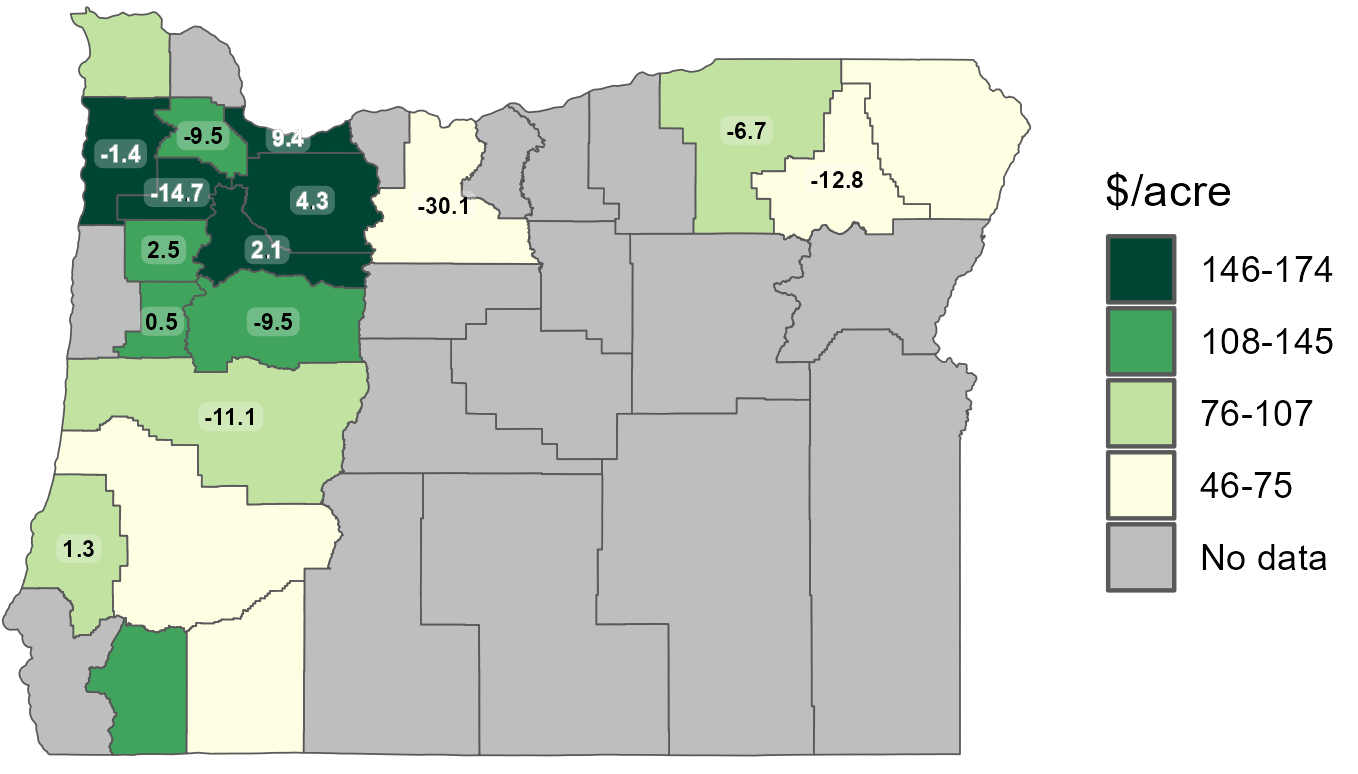
Counties in the northern and mid-Willamette Valley, along with Tillamook and Josephine, tend to have the highest non-irrigated rents (Figure 3). Given its dry climate and the lack of non-irrigated crop operations, Eastern Oregon tends to have lower or unreported non-irrigated cash rents.
Over the past year, the largest annual percentage gains were in Multnomah and Washington, while Lane, Union and Yamhill all had percentage decreases of more than 10%.
Pasture
The average 2025 pasture cash rent was $11 per acre (Figure 1), representing a 6.2% decline that continues a general downward trend since USDA-NASS started its current rental rate reporting program. Although the dollar values involved tend to be lower on a per-acre basis, pasture operations tend to be much larger, so small deviations in per-acre rental rates can amount to large changes on an operational level.
Pasture rents have generally declined continuously since 2009, with the 2025 rent being about $2.40 (or 18%) lower than the 2020–2024 average of $13.40 per acre.

Western Oregon tends to have the highest pasture rents, while Eastern Oregon, where farms tend to be larger, have lower per-acre rents (Figure 4). Lower average pasture rents give way to large percentage changes from year to year. For example, Baker and Lane had gains of 63% and 38%, respectively, while Harney (-48%) and Benton (-38%) had the largest declines.
The USDA-NASS rent survey paints an incomplete picture of the rental market for pasture.
The USDA-NASS rent survey paints an incomplete picture of the rental market for pasture. This is because the USDA survey only reports on land rented for cash, but most private grazing land is rented on a per-animal unit month (AUM), or per-head, basis. In addition, a considerable fraction of land in grazing operations comes from public land owned by the U.S. Bureau of Land Management or U.S. Forest Service, with those lands also rented on a per-AUM basis.
Cash rents
Cash rents can be a valuable snapshot of the overall health of the farm economy, as they are heavily influenced by the net returns to agricultural production. Nationwide, cash rents remained stable this year, after reaching a record high in 2024. High rents can squeeze farm profits when other input costs remain high and commodity prices are low — two factors that characterize conditions for most major crop commodity producers right now. Beef and hazelnut producers, on the other hand, are in better financial shape.
Rents also tend to be a lagging indicator. Leases for the upcoming year tend to be negotiated following harvest in the late fall, winter or early spring. The values reported by NASS are more reflective of what landowners and renters expected the year to bring, not what actually happened. In addition, some leases, particularly for irrigated farmland, tend to be renewed on a multi-year basis. Thus, for example, a three-year fixed-cash lease covering the 2022-2024 production years could also be included in the 2024 NASS rent estimates, further removing it from current production conditions.
Purchasing land outright typically requires extensive financial capital — money for a down payment and other land currently owned as collateral, for example. For this reason, renting is often seen as a way for new producers, or producers who are otherwise financially disadvantaged, to build and grow an operation. Land rental, however, is not limited to smaller producers, as discussed in a 2016 USDA report. Most commercial farms in the United States contain a mix of owned and rented land. In addition, it can be difficult for beginning producers to find land to rent. Landlord-tenant relationships tend to be fairly long-lasting, despite the fact that most contracts for farmland are renewed annually, and about one-third of land is rented between family members.
This is an annually updated article based on the U.S. Department of Agriculture's cash rent estimates. See the previous version of the article.

Related publications

