
Contents
- Executive summary
- Biosolids can help rebuild organic matter in depleted soils
- Managing nitrogen from biosolids
- Managing phosphorus from biosolids
- Conservation planning and the Phosphorus Index
- Appendix A: Biosolids build soil health in a long-term dryland field trial
- Appendix B: The potential for phosphorus movement away from biosolids application sites
- Appendix C: Biosolids increase dryland pasture forage yield and quality
- Appendix D: Soil carbon sequestration in dryland agriculture by biosolids versus other organic amendments

Executive summary
Biosolids are a product of municipal wastewater treatment. Raw sewage solids must be processed to meet U.S. Environmental Protection Agency standards before they can be called biosolids. Biosolids contain organic matter and nutrients that are beneficial for soil, crop and forage productivity.
This publication reviews the long-term effects of biosolids applications on soil health in dryland cropping systems east of the Cascades in Washington and Oregon. Findings reported here come from field trials that have continued for more than 10 years.
Major long-term findings are:
- Biosolids increase soil organic matter. In the three long-term trials summarized here, biosolids increased soil organic matter by more than 50% in the top 4 inches of soil as compared to a no-biosolids control. These field locations were in northcentral Washington near Waterville, and in northeast Oregon near Pendleton and Hermiston.
- Biosolids application enriches the supply of immobile nutrients — for example, phosphorus (P) and zinc (Zn) — in the topsoil. This increase in nutrients near the soil surface benefits crop growth, but it may also increase weed competition with dryland cereals. Soil testing can be used to monitor the accumulation of immobile nutrients following biosolids application.
- Soil salinity has remained low after repeated biosolids applications. Biosolids are low in soluble salts because soluble ions — for example, potassium (K) and chloride (Cl) — are discharged in the effluent from municipal wastewater treatment facilities.
- Biosolids are an effective replacement for commercial nitrogen (N) inputs such as anhydrous ammonia or urea-ammonium nitrate (UAN) in cereal cropping systems. Plant-available N from biosolids can fully replace commercial N fertilizer for the first grain crop following application. The rate of N fertilizer required for grain production is also reduced for subsequent crops. Organic N in biosolids typically releases 30-8-3-1 percent of its N in plant-available form in years 1, 2, 3 and 4 following a one-time biosolids application.
- The combination of increased soil organic matter, increased soil nutrients and improved soil physical properties following biosolids application can sometimes produce higher cereal grain yields than fertilization with inorganic nitrogen and sulfur. Grain yield in a long-term Douglas County, Washington trial averaged 10% to 15% greater with biosolids compared to anhydrous ammonia.
Short- and long-term effects of biosolids application
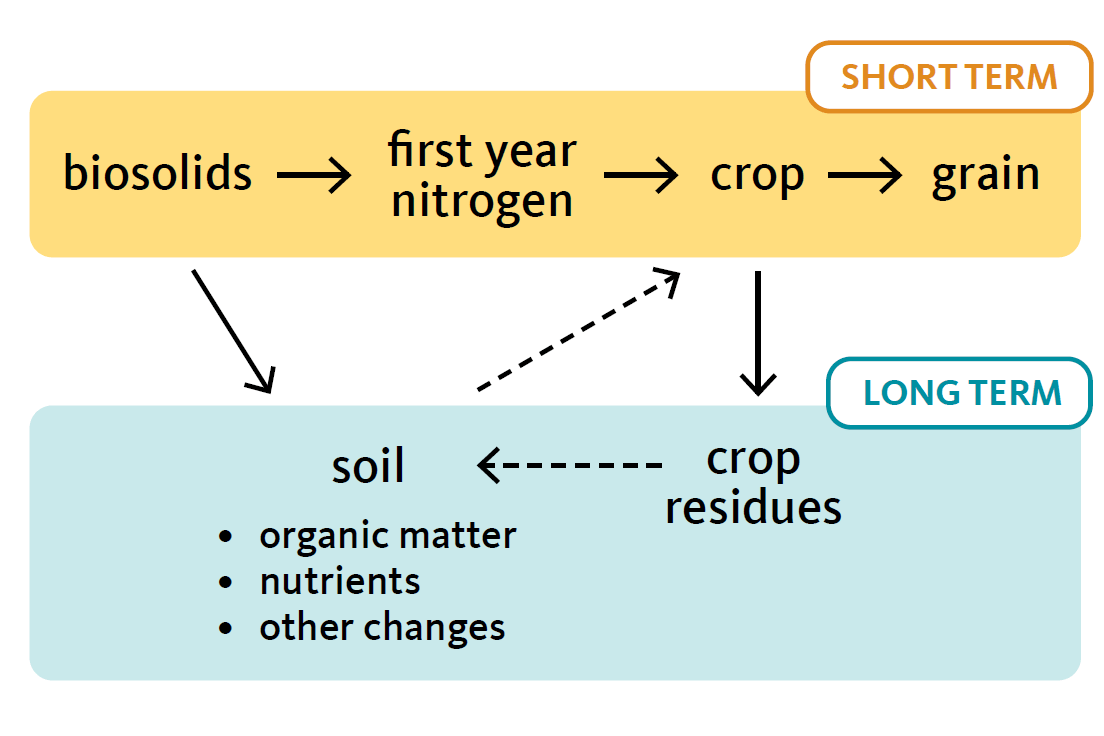
Other Pacific Northwest Extension biosolids publications — Fertilizing with biosolids (PNW 508) and Worksheet for calculating biosolids application rates in agriculture (PNW 511) — emphasize short-term outcomes of biosolids applications, especially the amount of plant-available N provided for the first crop following a biosolids application. This publication addresses long-term outcomes (figure 1).
The challenge of soil organic matter maintenance in dryland cropping systems
Organic matter is important for the maintenance of microbial activity, and associated soil structure, nutrient cycling and water infiltration benefits in soils. Routine maintenance of soil organic matter reduces soil susceptibility to loss by wind and water erosion.
Tillage-intensive agriculture has reduced soil organic matter by 20% to 60% in the course of a few decades through biological oxidation (Brown and Huggins, 2012; Ghimire et al., 2015, Ghimire et al., 2017). The traditional wheat-fallow rotation used in dryland production in the Pacific Northwest is a particularly difficult system in which to maintain organic matter because of the extended, tilled fallow periods that are part of each cropping cycle. During fallow, tillage and lack of biomass input contribute to the depletion of organic matter. Reducing tillage or initiating annual cropping can stop or reverse organic matter loss.
Biosolids can help rebuild organic matter in depleted soils
Biosolids application increases soil organic matter and soil carbon, a major constituent of organic matter. The increase in soil organic matter comes directly from biosolids themselves and from increased crop biomass production (figure 1). In dryland cropping systems, biosolids typically increase grain yield with a corresponding increase in straw production by cereal crops. Not only does the extra straw provide a source of soil organic matter, it also protects the soil surface from erosion.
In an 18-year study in Douglas County, Washington, biosolids applied at agronomic rates (2 or 3 dry ton/acre once every 4 years) increased soil organic matter by approximately 50% (0- to 4-inch depth) compared with a fertilized control treatment (Cogger et al., 2013; Appendix A). At Lind, Washington, biosolids increased wheat straw biomass by more than 20% in the first crop following biosolids application in a wheat-fallow rotation (Schillinger et al., 2018).
Managing nitrogen from biosolids
Soil organisms and crops cycle the N added from biosolids application (figure 1). When soil organic matter increases, so does the quantity of N stored in the organic matter. The carbon-to-nitrogen ratio of soil organic matter is typically 10 to 14. At a field site in Douglas County, Washington, soil total N (0- to 4-inch depth) increased from about 0.09% to 0.13% after four biosolids applications over an 18-year period (Cogger et al., 2013; figure A-1b, page 4). Soil organic matter increased following long-term application of biosolids to dryland pasture in northeast Oregon near Hermiston (Appendix C) and in a dryland wheat cropping system near Pendleton, Oregon (Appendix D).
The second crop that is produced after a biosolids application will usually require some inorganic N fertilizer to satisfy crop need. Research conducted in Douglas County, Washington, confirmed that the general estimate of additional plant-available N from previous biosolids applications found in the Extension publication Worksheet for calculating biosolids application rates in agriculture (PNW 511) was sufficient for a wheat-fallow cropping system (Cogger et al., 2013). Estimates reported in PNW 511 indicate that 11% of the organic N contributed by biosolids becomes available to the second crop after a biosolids application (8% in the fallow year, plus an additional 3% in the following crop year).
Some farmers adjust N fertilizer rates based on soil testing during the fallow year in a wheat-fallow cropping system. The nitrate-N measured in a fallow soil sample will reflect most of the residual plant-available nitrate-N mineralized from previous biosolids applications. In such circumstances, farmers may ignore the estimates of N mineralized from a previous biosolids application as instructed in PNW 511. Consult the appropriate land-grant university fertilizer guide for your region to determine how to estimate N fertilizer need based on soil nitrate testing.
Managing phosphorus from biosolids
Biosolids are a rich source of phosphorus (P), and soil test phosphorus increases following a biosolids application. See table 1 for suggested biosolids management based on soil test P. Suggested practices are based on making best use of phosphorus, a scarce resource, rather than explicitly protecting surface water.
Keep in mind that soil test P values will likely vary by about 10% to 20% from the true soil value due to uncontrollable sampling and testing errors. A soil test P value of 60 ppm should be interpreted as falling somewhere between 50 to 70 ppm.
|
Soil test P (Olsen method) |
Plant need for additional phosphorus |
Suggested biosolids management practice |
|---|---|---|
| 0–20 | Grain yield will likely increase from P application | Apply biosolids to increase soil test P to 20 ppm or more. |
| 20–40 | Grain yield will occasionally increase from P application. | Monitor soil test P to determine trends over time. Limit commercial P fertilizer application to 5 to 10 lb P2O5, placed with the seed. Reduce biosolids application frequency. |
| 40–60 | No grain yield increase from P application | Reduce biosolids application frequency. |
| 60+ | No grain yield increase from P application | Rotate biosolids applications to fields with lower soil test P values. |
Appendix A: Biosolids build soil health in a long-term dryland field trial
Douglas County, Washington
Situation
Decades of wheat production in a 2-year wheat-fallow rotation has reduced soil organic matter and degraded soil health in the inland Pacific Northwest. Fertilization with biosolids is an economical way to build organic matter in degraded soils while supplying nutrients for the crop.
A long-term on-farm trial was conducted in a dryland wheat-fallow rotation in Douglas County, Washington to evaluate the effects of biosolids on grain yield and soil health (Cogger et al., 2013).
Methods
A chisel plow was used for primary tillage in the summer fallow year, followed by shallow cultivation (twice during fallow). Winter wheat was harvested every other year. The experiment included these fertilizer treatments:
- Zero-N control
- Biosolids applied at three rates (2, 3 and 4.5 dry ton/acre), every fourth year (1994, 1998, 2002, 2006 and 2010). Total N applied by biosolids averaged 200, 320 and 460 pounds N per acre per application. Plant-available N contributed (at about 40% of total N) by these biosolids application rates was estimated at 80, 130 and 180 pounds N per acre per application (PNW 511). The low biosolids application rate supplied plant-available N at a rate close to the recommended N fertilizer rate.
- An inorganic N treatment (anhydrous ammonia at 50 pounds N per acre plus sulfur at 10 pounds per acre) applied every other year
Results
Grain yield averaged over all harvests beginning in 1996 was about 10% greater for the 2 dry ton per acre biosolids treatment compared to the anhydrous ammonia treatment.
Figure A-1 shows soil C, N, pH and P when soils were amended with biosolids at 2 dry ton/acre or with anhydrous ammonia.
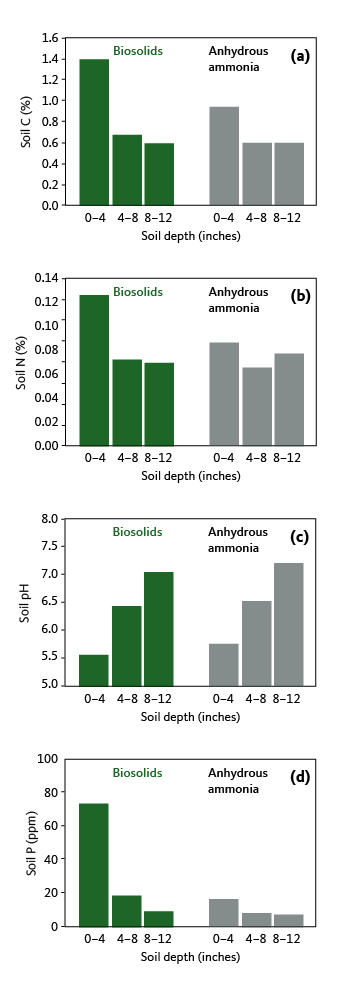
Soil organic carbon and nitrogen increased in the shallow tillage zone (0- to 4-inch depth). The amount of C stored in the soil was approximately 50% of the total biosolids C applied. Soil bulk density was lower following biosolids applications, indicating improved soil aggregation and porosity (data not shown).
Soil pH values were similar with biosolids or anhydrous ammonia fertilization. Soil pH near the soil surface (0- to 4-inch depth) was more acidic (pH 5.5 to 5.7) than in soil below 4 inches (pH 6.4+). The effect of biosolids on soil pH observed here was similar to that observed in other field trials comparing biosolids to commercial N fertilizers. In general, soil acidification accompanying biosolids application is similar to that observed when plant-available N is supplied by anhydrous ammonia or urea.
Biosolids application increased soil test P (Olsen method) from less than 20 ppm (below agronomic need) to more than 70 ppm (above agronomic need). Excess soil test P from biosolids application is not a problem for crop production, but it is a potential environmental risk if soil erodes from the field and is deposited in a P-sensitive water body. Data collected from this site demonstrated that lateral transport (downhill movement) of biosolids P was not apparent (see Appendix B).
Discussion
There are other benefits resulting from the increased organic matter following a biosolids application.
- Organic matter reduces cation leaching from the soil surface. Thus, soils become more resistant to the acidification caused by N fertilizers.
- Greater resistance to wind and water erosion is a result of the increased soil aggregation and porosity (reduced bulk density) accompanying biosolids application.
- Increased soil organic matter not only benefits soil health and crop production, but it also sequesters carbon, and thus is a tool for mitigating greenhouse gas emissions.
Biosolids increase soil organic matter in dryland wheat for two reasons: The biosolids themselves increase the resistant humic fractions in soil organic matter (Pan et al., 2017); and, even more importantly, they increase production of wheat straw, which adds organic matter to the soil after each harvest and protects soil from wind and water erosion.
Conclusion
This research clearly demonstrates that biosolids applications at agronomic rates for N build soil organic matter, sequester carbon and improve the health of soils in a dryland wheat-fallow rotation. Agronomic biosolids applications should be considered a key conservation practice for dryland cereal cropping systems.
Appendix B: The potential for phosphorus movement away from biosolids application sites
Douglas County, Washington
Situation
When biosolids are applied to crops at agronomic rates for N, they supply more phosphorus than the crops need. Repeated biosolids applications will result in an accumulation of P in the soil. Excess P is not a problem for plants, but it could be a problem for water quality if the P reaches sensitive surface waters such as a lake or slow-moving stream. Phosphorus bonds to soil particles; most P movement occurs with the movement of eroded particles. The sloping lands often seen in dryland wheat-fallow systems, left bare for half of the rotation, increase the potential for erosion and P movement.
Methods
Phosphorus movement was measured at a WSU long-term dryland wheat experiment in Douglas County, Washington, where cumulative biosolids applications over 18 years ranged from 10 to 20 dry tons per acre, and total P applications ranged from 560 to 1,120 pounds per acre (Cogger et al., 2013; same field site discussed in Appendix A). A chisel plow was used for primary tillage in the summer fallow year, followed twice by shallow cultivation during fallow.
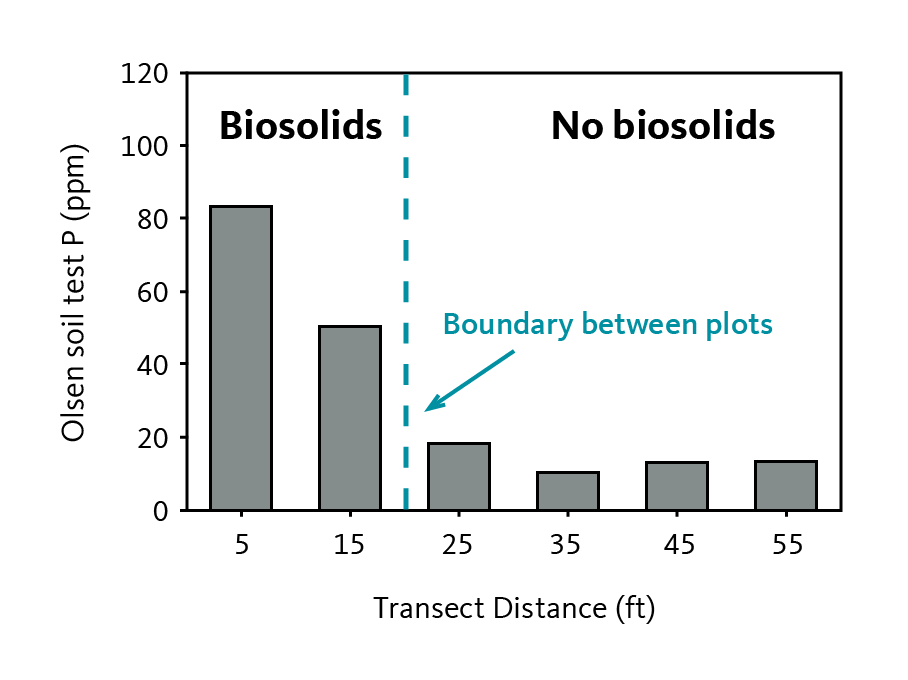
Lateral movement of P across the surface of the soil was assessed in 2014. Transects across three pairs of plots were sampled; each pair had a biosolids plot uphill from a plot that did not receive biosolids. Each transect began in the uphill biosolids plot (15 feet from the downhill edge of the biosolids plot) and continued in the downhill direction into the adjacent control (no-biosolids) plot. Soil samples were collected at 10-foot intervals across each transect.
Results
Following five biosolids applications over the 18-year period, soil test P had increased in the surface 4 inches of soil (left side of figure B-1). Soil test P decreased outside the biosolids application area, with the lowest levels in the middle of the control plot (right side of figure B-1). Thus, little or no transport of P from the uphill, biosolids plot to the adjacent, downhill control plot was observed.
Conclusion
This data shows increased soil-test P levels following repeated biosolids applications, but little transport of P from the biosolids plots to the adjacent, downhill, no-biosolids control plots at this central Washington site.
Appendix C: Biosolids increase dryland pasture forage yield and quality
Madison Farms, Echo, Oregon
Situation
On dryland-pasture application sites east of the Cascades, soils are dry and firm enough to support biosolids application equipment during most of the year. Thus, these sites can be of interest to cities in western Oregon that lack winter biosolids storage. OSU Extension does not have a fertilizer or nutrient management guide that recommends fertilization practices for Eastern Oregon dryland pasture.
The data presented here were collected at a field site managed by Madison Farms near Echo, Oregon. The objective of this long-term monitoring effort was to document changes in forage quantity and quality and in soil nutrient status in response to repeated biosolids applications to dryland pasture in an environment receiving 6 to 8 inches annual precipitation.
Biosolids application began at Madison Farms in 1990. At that time, it was unclear whether biosolids application would be of much benefit, given the scarcity of precipitation to support forage production. Most soils receiving biosolids at Madison Farms have a cemented caliche layer at 24 to 48 inches below the soil surface. Dryland pasture at the farm is dominated by annual grasses, primarily Bromus tectorum (cheatgrass). Pastures at the farm are grazed in early spring when cheatgrass is palatable.
Methods
Forage and soil data were collected annually in the spring (April or May) from paired sites: a control site receiving no biosolids application and a nearby site receiving biosolids application. Forage at the monitoring sites was not heavily grazed. Dr. Don Horneck, an agronomist at OSU-Hermiston, collected the monitoring samples. Plant residue and residual biosolids were removed from the soil surface before collecting soil samples. Laboratory analysis was performed at AgriCheck Inc. (now AgSource), a commercial laboratory in Umatilla, Oregon, using standard methodology for soil testing in the western United States (Gavlak et al., 2005). A more complete monitoring report for this site for the period between 1999 and 2007 is available from OSU (Sullivan et al., 2008).
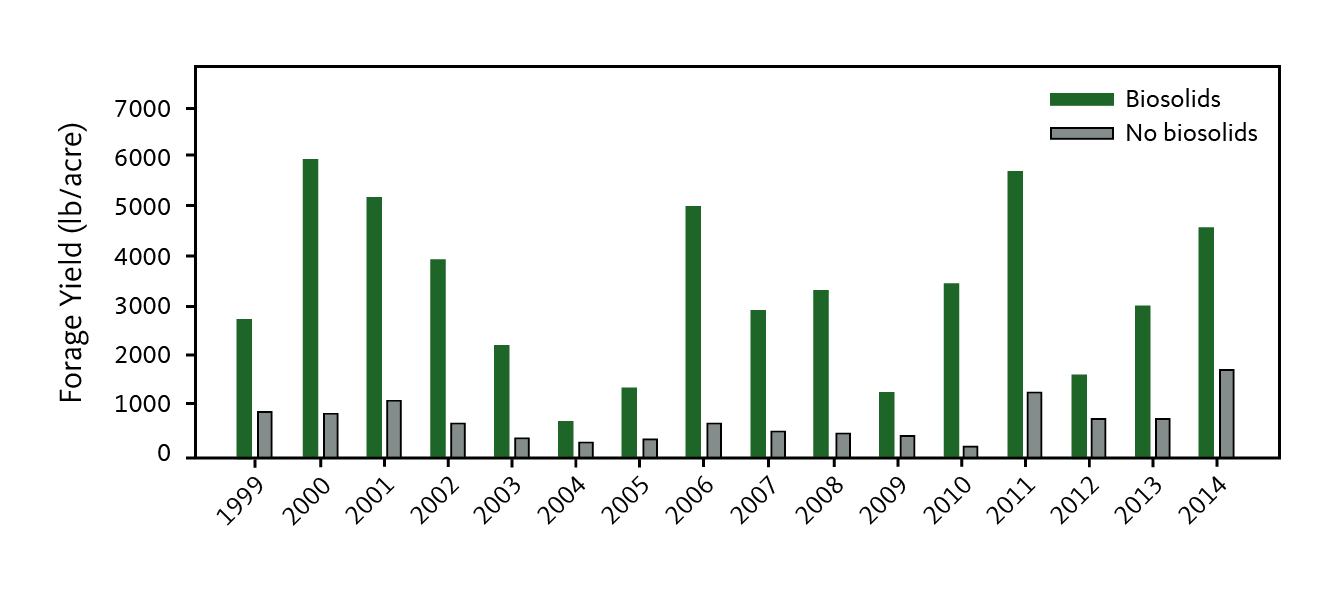
Table C-1 shows soil test data (0- to 6-inch depth) from 1996 to 1999, following repeated annual applications of biosolids (cumulative application of 30 to 40 dry tons per acre). See figure C-1 for annual forage yield (1999–2014). See table C-2 for forage quality (2008–2014). Forage quality data for earlier years (1999–2007) is reported in Sullivan et al. (2008).
|
Soil test |
Soil test extract/ method |
Unit |
No biosolidsy |
Biosolidsy |
|---|---|---|---|---|
| Calcium | exchangeable | meq/100g | 8.7 | 9.5 |
| Potassium | exchangeable | mg/kg | 332 | 442 |
| Magnesium | exchangeable | meq/100g | 1.8 | 3.1 |
| Boron | hot water extract | mg/kg | 0.3 | 0.4 |
| Organic matter | loss on ignition | % | 1.2 | 2.2 |
| Sulfate-S | calcium phosphate | mg/kg | 3.7 | 8.2 |
| Iron | DTPA | mg/kg | 10.1 | 27.2 |
| Manganese | DTPA | mg/kg | 4.0 | 16.6 |
| Phosphorus | Olsen | mg/kg | 14 | 71 |
| Copper | DTPA | mg/kg | 0.8 | 7.4 |
| Zinc | DTPA | mg/kg | 0.5 | 9.6 |
| Total bases | sum: Ca, Mg, K | meq/100g | 11.4 | 13.8 |
| pH | 1:2 soil:water | 7.5 | 6.7 | |
| Electrical conductivity (EC) | 1:2 soil:water | mmhos/cm | 0.2 | 0.3 |
yAverage of annual soil samples collected from 1996 to 1999. Soil samples were collected approximately 6 to 12 months following a biosolids application (minimum of one growing season after application). Source: table 2.1 In: Sullivan, D.M. (2008) Biosolids increase grass yield, grass quality and soil fertility in dryland pasture.
Results: Forage yield and quality
Grass forage production varied from year to year at Madison Farms, likely related to variable timing and amounts of winter and early spring precipitation (figure C-1). Forage yields increased with biosolids application, especially in wet years. Forage yields averaged 3,310 pounds per acre with biosolids versus 740 pounds per acre without biosolids.
Forage fertilized with biosolids produced more leaves and fewer stems, as reflected in higher plant N and crude protein, and lower fiber concentrations. Concentrations of other nutrients in forage increased after biosolids application (see table C-2).
Conclusion
The monitoring data highlighted here show increased grass yield and improved grass quality from biosolids applications, even for dryland pasture with annual precipitation of 6 to 8 inches. Increased nitrogen availability is likely the major factor responsible.
Because biosolids applications promote annual grass growth, heavy grazing in early spring is necessary to make use of the increased forage production. Increased growth of some annual grasses (such as cheatgrass, Bromus tectorum) is undesirable on most “native” rangeland sites, so biosolids managers must choose dryland application sites thoughtfully.
|
Forage analysisz |
No biosolids |
Biosolids |
|---|---|---|
|
Forage yield (lb DM/acre) |
||
| Biomass | 740 | 3,310 |
|
Feed quality (%) |
||
| Crude Protein (%N × 6.25) | 8 | 19 |
| Neutral Detergent Fiber | 56 | 50 |
| Acid Detergent Fiber | 34 | 27 |
|
Macronutrients (%) |
||
| Sulfur | 0.11 | 0.29 |
| Calcium | 0.57 | 0.71 |
| Phosphorus | 0.19 | 0.37 |
| Magnesium | 0.18 | 0.26 |
| Potassium | 1.2 | 3.0 |
| Sodium | 0.02 | 0.03 |
|
Micronutrients (ppm) |
||
| Zinc | 19 | 33 |
| Copper | 5 | 11 |
| Molybdenum | 0.5 | 1.1 |
| Manganese | 56 | 132 |
zReported on a dry matter (DM) basis. Values are the mean of seven grass harvests, 2008–2014. Forage quality for 1999–2007 is reported in Sullivan et al. (2008).
Appendix D: Soil carbon sequestration in dryland agriculture by biosolids versus other organic amendments
Pendleton, Oregon
Situation
Degradation of soils and organic matter loss in dryland grain production has been well documented. Soil amendment with biosolids is one way of slowing or reversing organic matter loss.
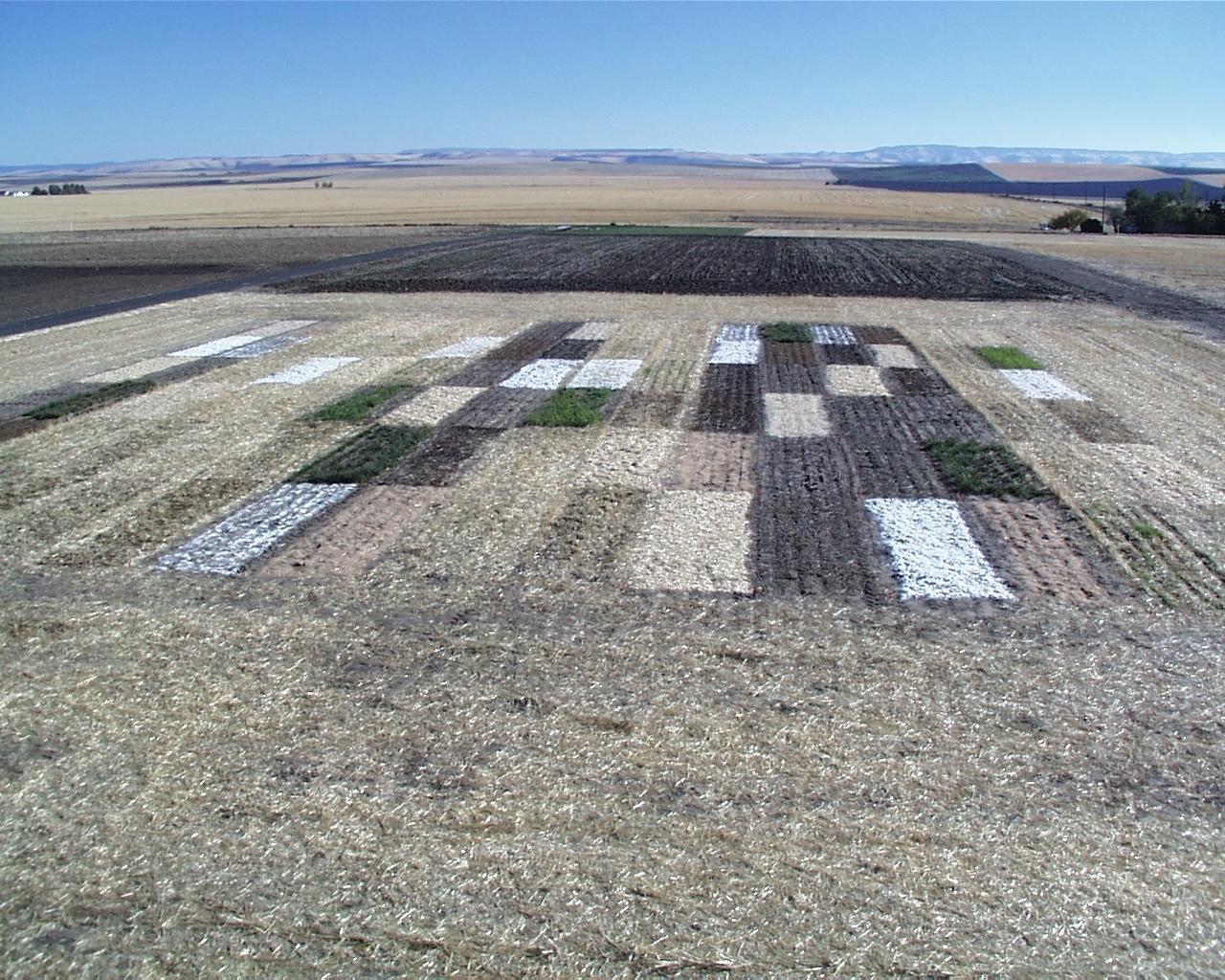
This 10-year experiment in Pendleton, Oregon (16.5 inches annual precipitation) compared the effects of biosolids and other organic amendments on soil organic carbon levels in a minimum-till, annual winter wheat system and in a continuous fallow.
Method
Amendments included municipal biosolids (anaerobically digested, dewatered and air-dried), fresh cattle manure, softwood sawdust, wheat residue, brassica residue and alfalfa foliage (feed pellets), each applied at a rate of 1.2 tons of organic carbon per acre per year for five years. The sawdust, wheat residue and brassica residue treatments also received nitrogen fertilization, while the other treatments received no additional N.
Amendment applications ceased after five years. The entire experiment was placed in fallow for an additional three years, and then cropped to winter wheat for two years and fallowed again. Soil organic C was measured at the end of the three year fallow and again at the end of the experiment. During the entire experiment, soil disturbance was minimal. Tillage with a harrow mixed soil to a depth of 1 to 2 inches.
Results
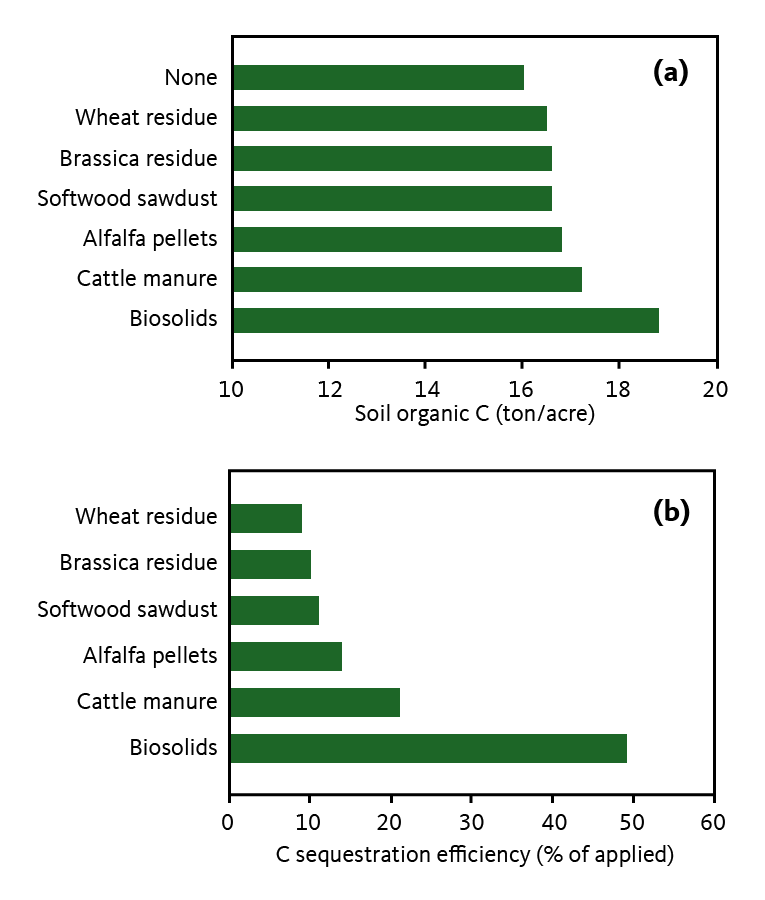
Biosolids applications produced the greatest change in soil carbon at the end of the experiment (figure D-1). The accumulation of soil C in the biosolids plots was equivalent to nearly half of the biosolids C applied (figure D-1). This compares with 21% equivalent accumulation for manure C and an average of 11% for the other treatments. The biosolids treatment also had the greatest accumulation of soil N. The larger amounts of N and S supplied by the biosolids, along with its relatively high stability compared with the other amendments, could account in part for the greater accumulation of soil organic matter.
Conclusion
These results confirm the high rate of C sequestration seen in the Douglas County, Washington experiment (Appendix A), and indicate that biosolids are more effective than other amendments at retaining C in the soil. This is additional evidence of the positive role that biosolids can play in soil conservation in dryland agriculture.
About the authors


© 2023 Published and distributed in furtherance of the Acts of Congress of May 8 and June 30, 1914, by the Oregon State University Extension Service, Washington State University Extension, University of Idaho Extension and the U.S. Department of Agriculture cooperating. The three participating Extension services offer educational programs, activities and materials without discrimination on the basis of race, color, national origin, religion, sex, gender identity (including gender expression), sexual orientation, disability, age, marital status, familial/ parental status, income derived from a public assistance program, political beliefs, genetic information, veteran’s status, reprisal or retaliation for prior civil rights activity. (Not all prohibited bases apply to all programs.)
