Transcript
In the Woods Podcast – Episode 74 Transcripts – Public Burn Associations (or PBA’s)
This transcript is generated by Ai and edited by humans for correctness, punctuation, spelling, and syntax.
Oregon State University’s In the Woods podcast host Jacob Putney interviews OSU Extension regional fire specialists Chris Adlam (southwest Oregon) and Micah Schmidt (northeast Oregon) about Prescribed Burn Associations (PBAs) and their role in expanding prescribed fire on non-federal lands. they describe how fire suppression became dominant over the past century despite long Indigenous burning traditions, and how PBAs re-emerged in the 1990s in the Great Plains and later spread to California and Oregon. PBAs are community networks where neighbors and partner organizations share labor, equipment, planning, and training to conduct safe burns, often with volunteers and sometimes paid coordination. Guests discuss Oregon PBAs’ growth and accomplishments, benefits like changing public attitudes and building social license, and barriers including capacity, permitting, funding, liability concerns, and limited region-specific research. they share ways to get involved via OSU’s Extension Fire Program resources, trainings, and documentaries.
02:22 Micah Prescribed Fire Work
37:20 Parting Thoughts and Tribal Roots
[00:00:00] Podcast Intro
[00:00:00] Lauren Grand: From the Oregon State University's Extension Service, you are listening to In the Woods with the Forestry and Natural Resources Program. This podcast brings the forest to listeners by sharing the stories and voices of forest scientists, land managers, and enthusiastic members of the public. Each episode, we will bring you research and science-based information that aims to offer some insight into what we know and are still learning about forest science and management.
Stick around to discover a new topic related to forests on each episode.
[00:00:30] Jacob Putney: All right.
[00:00:32] Meet the Hosts
[00:00:32] Jacob Putney: Welcome back everyone to In the Woods Podcast, presented by the Forestry and Natural Resource Extension Program at Oregon State University. I'm Jacob Putney, extension agent in Baker and Grant Counties, and your host for today's episode. I'm very happy to be joined today by two of my FNR extension colleagues, Micah Schmidt and Chris Adla.
Micah is the regional fire specialist for the Northeast, and Chris is the regional fire specialist for the Southwest. Michael holds a master's in force management from Oregon State and a bachelor's in Environmental science and policy from Southern Oregon. Chris holds a PhD in ecology from uc, Davis, a master's in entomology from Concordia, and a bachelor's in Biology from Claude Bernard University in Leon, France.
Micah, Chris, really great to have you both join us today. I wanna give you both the chance to introduce yourself. So why don't we start with you, Chris. Could you tell us a little bit about your background and your work as the regional fire specialist in southwest Oregon?
[00:01:21] Chris Fire Ecology Path
[00:01:21] Chris Adlam: Sure Jake. I grew up in France . My parents are British, grew up in France, moved to Canada. So I've been all over the place. Really out here in the west is where I feel at home.
the landscapes of southwest Oregon are just a paradise for me because I'm an ecologist and, I just went hiking yesterday with my kids in the spot when Oregon, that has the most rare and endangered plant species. Which is about 15 minutes from where I live. It's pretty fantastic.
and of course the fire thing here is very intertwined with our landscapes and our communities, cultures, indigenous cultures as well. and it's really a fascinating thing to be working on now. and the thing that is, it brings a lot of people together, and that's a little bit what we'll be talking about today.
That's what keeps me going, what gives me passion.
[00:02:11] Jacob Putney: Yeah, definitely. That's great. Okay, Micah, your turn. Could you tell us a little bit more about some of the things you've been working on? You were last on a podcast episode a few episodes ago, so what have you been up to since then?
[00:02:22] Micah Prescribed Fire Work
[00:02:22] Micah Schmidt: Yeah, I've been up to all kinds of stuff. Feels like too much sometimes, but all really fun, good stuff. a lot of stuff on prescribed fire. We'll talk about prescribed burn associations today and that is really where a lot of my time's been supporting our local PBAs out here in Northeast Oregon. One of the things I really enjoy to do, and I feel like I get a lot of impact too, with every piece of energy I put into that. Our Northern Blues partnership hosted the Fire and Landscape Conference here in Pendleton last month, and Jake, you were part of that, brought together a bunch of landowners, agency folks, nonprofit folks, students pretty much everybody that has interest in fire to talk about prescribed fire, managed wildfire and all that kind of stuff.
That's been really fun. and then kind of continual thing with me is just helping to educate people about the positive roles that fire plays on the landscape and how those have differed from historical, fire, few hundred years into few through a thousand years ago to what we're experiencing today.
So always try to use that tree ring stuff that I talked about in the last time on the podcast, help inform that. But. Also just trying to help better coordination in the region between our federal, state and private, folks to see if we can get some cross boundary work done, particularly in the prescribed fire realm.
But yeah, running around like crazy and now with the spring, putting the gear been out in the field a lot. So been really happy about that.
[00:03:30] Jacob Putney: Yeah. Good. Yeah, that was a great conference.
[00:03:32] What PBAs Are
[00:03:32] Jacob Putney: As Micah mentioned we're gonna talk about some community-based networks today called Prescribed Burn Associations or PBAs, and how they're helping to increase our capacity to get more beneficial fire on the ground not only in Oregon, but across the nation.
To kick us off, so why don't we start with what a prescribed burn association is and some of the history on how they came to be.
[00:03:52] Prescribed Fire History
[00:03:52] Chris Adlam: Well, I think we can take a step back a little bit from that too and say, why are we talking about prescribed fire and what is the history of that, the prescribed fire? It's something that for the last a hundred years or so has been increasingly difficult for a time for people to use.
there was a really big debate a hundred years ago in the early 19 hundreds about how to live with fire, and there was on one side people who said that we should be burning the forest frequently, and that was in line with what Native Americans have done in these places for a long time.
then there was the other side which said, no, we should get rid of fire. We should put it all out and be done with it. and over time, that's the perspective that won and that prevailed over the 20th century. Still a lot of people continued using fire in some parts of the United States particularly the southeast.
and some of the ranchers in California ranchers were still burning 200,000 acres a year in the mid 20th century in the 1950s, so private landowners kept burning, private, communities kept using fire, but again, with challenges of increasing wildfire and regulations over the course of the 20th century, the late part of the 20th century, a lot of that was starting to die out.
[00:05:11] PBA Origins and Growth
[00:05:11] Chris Adlam: So the PBAs originated in the nineties with, mostly in the Great Plains. It was a model that was inspired by those ranches I mentioned in California who cooperated to do these really large burns. they started doing that more and more in the Great Plains where they were seeing these landscapes altered by the lack of fire, right?
Prairie is disappearing, with a lot of vegetation growing up, and they realized they needed to be able to put fire back on that landscape for ranching purposes, for conservation purposes. That's where that model really was born again in the recent decades. Now that's then spread to California in 2017.
the first one was started there, the Humboldt County PBA, and then over the next few years, now we have up to 30, I think now in California we have nine in Oregon. We have some in Washington as well. and the idea of a PBA is basically very simple. It's just in line with rural traditions of branding, haying, barn raising, just people come together and help each other to do this thing because you can't really do much prescribed burning by yourself, but if you get together with your neighbors, with your friends, your family, you have some people who have equipment, you have some people who bring new knowledge. Now all of a sudden you can start doing these burns. they're a lot more accessible than it might be imagined. Once you have those pieces of the puzzle, and that's what's making it really exciting for people to be able to come together and do this thing that otherwise would be very difficult to do by yourself.
[00:06:46] Jacob Putney: Yeah. Yeah, definitely.
[00:06:47] How PBAs Form Operate
[00:06:47] Jacob Putney: So you alluded to it a little bit. So how are they formed? You can think of it more informally, but more, maybe more in a formal sense as well. and then how do they operate once they're formed.
[00:06:57] Micah Schmidt: Yeah, so I could jump in on this one here. the first PBA forum was down the Road Valley, PBA, Chris and Partners down there I think about five years ago or so. and now we're to a point where we got quite a few of 'em across Oregon and, from my perspective to form one of these really what it takes, it's one or a few individuals that, kinda gets the idea in their head that, gosh, we do all this forest management range management, whatever it may be, but we're really missing that key piece, which is fire.
That thing that is. Useful for so many different management objectives. It's useful for getting people familiar with fires. they can live better with wildfire. A lot of different reasons there. But, taking a person saying, we really need fire in our landscape and we really don't have the avenues to do it.
and then, these PBAs usually form out of those individuals starting to build some partnerships. So one thing I'll say is, working for OSU Extension, we're really lucky that we can support these PBAs. We're often helping these folks form, do some outreach. If it's just a landowner wanting to put a PBA together, they obviously are pretty limited on, putting together a meeting to find other interested people or connecting with the different organizations that can help them.
So really it looks different everywhere, but it really takes a few people who are like, we really wanna do something good for the land, do something good for our people, rebuild our culture of fire and have this, be something accessible for us. and as far as, how they operate really varies, across the state.
Some of these PBAs have paid coordinators who are actually paid to coordinate volunteers, sometimes to write burn plans, to collect resources, be on the burn, all that kind of stuff. Some are fully volunteer organizations. I would say most are probably somewhere in the middle where they have a lot of volunteers and they might have some members of the PBA who are nonprofit organizations or other organizations that use some paid staff time to support them.
So someone on their staff, uses 10, 15, 20, whatever percent of their job to, to actually help support that PBA. I think in Oregon, like they all operate a little similarly in that like there's no PBA that's paying everybody to come out on a burn and doing it as a full contract thing very much relies on volunteers, people that really wanna do something good together.
Fire is just a great way to build community, and, you put out a message that you're lighting a fire a lot of people end up, showing up in most cases. Looks very different across the state. I think there's definitely something to be said for having somebody getting paid to help coordinate, because that's a lot of work.
Putting fire down on the ground's the fun part, but it's also probably the part that takes the least amount of time and energy, all the burn planning, coordinating. Permitting, all that kind of stuff is a step that nobody wants to do, but is so crucial to meet all the regulations you need to and get a good, safe and effective burn, on the ground there.
Really different out here. and I think we'll see more models start to pop up too. Some operate over really big regions, like Jake, our PBAs out here cover four and five counties where there's some PBAs across the state that just cover, smaller communities. Something like that too.
So really look different. and I think with these still being pretty new in Oregon, most of these come onto the scene the last year or two. I think we'll see a lot of different innovative ways to see these kind of start to stretch and take different forms. and I bet 10 years down the road we'll have a lot of different really well formed models that PBAs to look.
[00:09:49] Who Can Participate
[00:09:49] Jacob Putney: So you alluded to already is some folks like OSU Extension being involved, some folks have paid coordinators, nonprofits, landowners, but who else typically joins these PBAs? and for those folks that do join, do they have to have a certain level of experience with fire or land management?
[00:10:05] Chris Adlam: One of the things that's really neat about PBAs is that they're really demonstrating that anybody can participate, and that's very counterintuitive. Like most of us grew up thinking that fire's very complicated and you need to be a career wildland firefighter to be involved, or you need to have some kind of certification or special status to be able to be involved in fire.
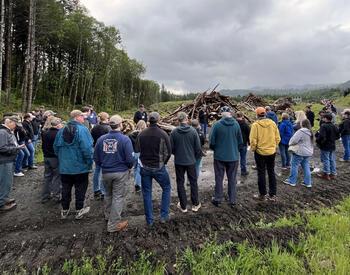
But really we have people coming to PBAs from all walks of life. I mean, we have PBA burners, we have kids at PBA burns. We've had high schoolers come out, we have people of all ages and abilities, because really it is a community event like Micah was saying. and so not everybody needs to be out there doing really hard labor, right?
there's probably gonna be a component of that. But there also people who come out to these burns who will be making sure that everybody's got water, and baking cookies, right? I mean, it is an event for the community to come together and get to know each other and also feel like you're doing something really positive for the environment and with the wildfire situation being what it is, it's one of the few ways that we can really feel like we're getting some traction.
and I think that's what brings a lot of people out to these PBA Burns, honestly, is that sense of community, that sense of being able to do something positive and so everybody can participate. there's no requirement for particular kind of qualification or anything like that. We have HPBA, of course HPBA burn will happen under the leadership of a few people who have experience, maybe have prior wild land fire experience.
A lot of times we'll have firefighters, they see the worst of fire in the summer and in the off season, they are very happy to come and contribute their knowledge to help make their community safer, right? So with everybody coming together like that, all walks of life are welcome in these PPAs.
and then we also have organizations like you mentioned, that can be members of these PBAs, watershed councils, soil water conservation districts OSU, extension, nonprofit organizations, because a lot of times these organizations can contribute to these types of community based events, but they can also gain a lot from it, right?
It's an opportunity to meet people in the community. It's an opportunity to get the word out about their programs. and it's an opportunity to get positive and successful land management outcomes that would be very difficult for any of these organizations to do by themselves.
[00:12:38] Jacob Putney: Yeah, definitely. That's great. No, I think snacks are important as well, and a big motivator for me, speaking for myself, but.
[00:12:45] Chris Adlam: they have the best food at some our PBA burns, I'm just gonna say that, I don't know. We should start a, we should start a PBA food, sort of a reality TV thing. We got some really good food in the Rogue Valley PBA.
[00:12:58] Oregon PBAs Impact
[00:12:58] Jacob Putney: You mentioned that there are nine PBAs in Oregon currently. Chris, the one in your region being one of the first. and then Micah, you mentioned the Northern Blues and then there's also the Southern Blues. But where are some of these other PBAs in Oregon and, what are some of the things that they have accomplished so far?
[00:13:14] Micah Schmidt: Yeah quite a few now. So yeah, nine or nine or 10 to there, like Chris was saying. and, yeah, I got 'em in the Rogue Valley. the guys PBA in Douglas County got one Mount Adams PBA is on the Washington side, but a lot of folks from the Oregon side of the gorge go up and hang out with them.
Central Oregon's got their prescribed burn co-op. there's a couple or three of 'em in Willamette Valley now for in the South, mid and North Valley PBAs. Chris has been working with some folks that have started Wild Rivers, cultural Prescribed Burn Association down in Curry County, and then out of course in our neck of the woods, Jake, like you said, we've got the Northeast Oregon and Southern Blues PBAs, so they're all over the place. and it's really interesting because when I first got my job, you know about a little over two years ago, you'd look at it and there was the Rogue Valley PBA and then there were some conversations happening with other PBAs, maybe doing a little bit of stuff.
But really, I mean, most people out here, including me, were like, what's a prescribed burn association? and then, now you look two years later and they're everywhere. and so they're really catching steam. What this whole PBA movement, it's given legitimacy to community-based burning in Oregon. This is something that hasn't had a lot of support, from our state and federal fire agencies and such. People nervous about, non-fire fighters burning, just anybody coming out like Chris was saying and helping out like that, but suddenly, these are everywhere. Every meeting I talk about PBAs now, I was like, raise your hand if you've heard of prescribed burn association. Almost everybody raises their hand even in some of these really rural areas in eastern Oregon.
So it's really cool that there's so much awareness and I think people are looking and saying, Hey, this is the way of the future. I know there's some recent research that came out and said around the world, if you look globally, community-based burning is, where the vast majority of prescribed fire is happening.
In the west here it's just historically been, burns on federal lands. It's been firefighters putting fire down, that kind of stuff. But there's enough people realizing, especially with wildfires getting worse and worse, we've gotta start getting fire on the ground proactively as much as possible and get people familiar with fire because wildfire burning, in good conditions, that's gonna be doing a lot of the work on the landscape.
We're not gonna be suddenly burning a million acres next year, but wildfire- it may. so we wanna get people familiar with that, let them be more comfortable [with] smoke being in the air. Understand the pros and cons, of wildfire burning and different conditions, all that kind of stuff.
But as far as what they've accomplished, it's pretty cool. the Rogue Valley PBA, I know they do a few burns each year. That's where I got a lot of my inspiration to help, push PBA's forward out in Northeast Oregon.
Was super glad that, both PBAs out here, they formed last late summer fall and we were able to, put fire down the ground during fire season. For both those PBAs. We just built some good partnerships. and, really these just came from landowners that I just happened to run into and said.
"Hey, I've been trying to put prescribed fire down for a long time, but I just can't find the avenue to do it. I can't get a burn permit," this and that and such. and so suddenly, we start putting something a little bit more formal together. People start paying attention and gosh, we had 45 people out on both those burns last year, so really cool.
and the land owners are just talking about," gosh. Even if I wanted to put fire down on my own or if I do it, having all these folks here to help with holding the fire in, having some experienced people around it, just really lowers that risk for me as a landowner" and makes it so they can feel more confident putting fire down.
and also they can start creating a model so if their neighbors start burning too, we all know that wildfire doesn't respect property boundaries. So if we start getting burning across land ownerships, I think a lot more people are seeing that after our big wildfires "What my neighbors do, what my community does. That's also gonna impact me personally as well." Being in Oregon too, we're lucky people wanna help each other, they wanna work together and all that. and so we just got a real good environment for PBAs to to take off. But yeah, I will say just the success that happened down there in the southwest really helped amp up the interest and the motivation to, to go ahead and do something and feel like it's within our control to manage the land with fire.
[00:16:46] Jacob Putney: and coincidentally the Northeast PBA just did a burn yesterday, right Micah?
[00:16:50] Micah Schmidt: Yeah, we did actually we burned some grassland, which is easier than the forest land that ODF protects 'cause the grassland out here, in this particular area doesn't require burn permits and all that kind of stuff. and the landowner has this little oasis of grass within all this grazed landscape. Where people run a cattle a lot. So we had great control lanes and on a day's notice we ended up only getting six people out, but it's still pretty good. and we burned 50 or 60 acres. It was a lot of fun, burning up there with the eagle cap wilderness in the background.
It was just, it was a pretty special day.
[00:17:19] Jacob Putney: Yeah, no, definitely. No, I'm sad to miss it.
[00:17:22] Changing Fire Relationships
[00:17:22] Chris Adlam: the achievements, that's a really good question. What are PBAs achieving? and I think you can hear in Micah's voice, just the excitement, the fun that it represents, to be able to do this stuff with friends and with neighbors. and that's really a big part of it is people being able to come together.
and a lot of people I notice have had very negative experiences with fire or have a lot of fear of fire. and a lot of people, those people come to our burns, right? and 'cause they want a different relationship with fire, they know that they live in a landscape that has always burned, will always burn.
there will always be fire in these landscapes. We are not gonna get rid of it. We tried that. We got the opposite result. and a lot of these people want to transform that relationship. they wanna be able to be around fire and feel good, feel safe, and that's really what we see happen. I love the feedback that I get from participants in our burns because they'll say, I thought this was gonna feel more dangerous.
and instead they feel calm and they feel, they say, "wow, it's so beautiful, and calm." and I'm like, "yeah, it's very calm." there's a method. It's very organized. and we have a plan, and it goes according to the plan 99- plus percent of the time. and then it's just such a beautiful thing for these people to be able to do that.
We focus on really making it approachable, and I think that's just really changing people's attitudes towards fire. the fear of fire is not doing us any good. It's really not serving us, not serving our community. Because it leads to us, honestly taking some pretty irrational decisions when it comes to how we interact with wildfire.
A lot of our societal approaches to wildfire are counterproductive. We keep putting fires out. You know the easy ones, we always put the ones that are easy to put out, and then when weather's extreme, we can't do anything and we watch our communities burn. It's really not a good situation that we're in.
It's gonna take a lot to turn all of that around. Right. and like. It's like we were just talking at our recent PBA burn this weekend. Some people said, well, how are we ever gonna fix everything with prescribed fire? We're not gonna fix everything just like that. It's taken us a hundred years to get to where we are now with this imbalance of fire on the landscape and it usually takes longer to fix things than it does to break things.
So a little bit of perspective there that, when we think about what are the achievements of the PBAs and prescribed fire in general even. It's gonna take a long time to get back to a place of balance, but for me, why I see that reward mostly right away in the way that people's relationship is changed to fire and what that means to them to be able to feel good around fire and to heal a little bit, that relationship.
[00:20:06] Jacob Putney: Yeah,
[00:20:07] Micah Schmidt: Yeah. and that, on that note too, Chris, it was funny yesterday, the landowner, we burned out. He had done some burn in the past, but you know, not this kind of acreage, and he drove up. Mean his UTV and he looked at me, he is like, it's almost scary how safe this feels. He's like, something gonna go wrong, and it is like, and he was having a great time, like you're saying. It's just it's such a educational, fun experience for folks. Yeah.
[00:20:25] Jacob Putney: No, those are good points. and I just think about being on one of the PBA Burns last fall and just how inspiring it was just to see how many community members came out and were so excited to be there. I mean, even having the Joseph Fire Science class out there really great day, had way more people than we would've ever needed to accomplish that burn, but everybody was so excited and so happy just to be there and to be a part of it.
[00:20:47] Micah Schmidt: Yeah, that was a good time.
[00:20:48] Extension Role In PBAs
[00:20:48] Jacob Putney: So I know you both are super involved in the PBAs that you work with, but thinking as OSU extension what do you see as your role with these PBAs and what is that gonna look like, moving forward?
[00:20:58] Chris Adlam: Well, for us at Extension, I think that we're obviously all about education. and we are all about trying to bring people together. and we are all about trying to get different people talking to each other, agencies and organizations and community members, and all of these things happen on a prescribed burn, right?
and so for me, that's one of the best things about the prescribed burns is that. It's one thing to teach people how to use prescribed fire, that's fine, but all these other things are happening, right? We are teaching also about fire ecology, about the history of indigenous burning, about the permitting and the rules and where they came from and how they may or may not be serving us, and what we can do to change things and make things better, and connecting that to policy and, all of these things.
So I think that's something that is a wonderful opportunity for us as extension educators and, working with PBAs, we can provide training we can help plan events, classes, burn planning, workshops, we can help with grant writing, all of these things that Extension does across the board.
It is really a perfect fit, and I should say that nationally too. When we look at prescribed burn associations extension professionals have been really a key part of that movement. Whether it's John Weir in Oklahoma, or Laia Quinn Davidson in California, or Jen Faucet in North Carolina.
We have extension professionals all across the country who've been very key to this movement. So it's a really good match.
[00:22:34] Jacob Putney: Yeah.
[00:22:35] Micah Schmidt: Yeah and it's super nice too at Extension, 'cause I've heard several people say "we're so happy we have someone who's in a job where they're paid to build all these connections, partnerships and stuff", like Chris was saying. and of course, I view myself as a help in my professional role, but also I'm a community member, so I volunteer my time as well.
'Cause I to remind people, "Hey, you're not just working for an agency. You live in this place. and you can be a part of this movement,". It used to be education was we just give people a skill, they'll go and take action. But we realized just doing, that's not enough. Especially a prescribed fire, like, with what Chris was saying, it's hard to burn on your own. So building those partnerships, making those connections, getting people in touch with resources, I find myself a lot of times reminding people like, "Hey, these are the steps."
Permitting all this stuff that you should go through to maintain our agency support, for giving us burn permits and that kind of stuff. We can also help with building social license or prescribed fire, going out. I give a lot of talks, outreach events to say "this is why prescribed fire is great."
"and here's some, issues you might be concerned about. Let's talk about that kind of stuff too." But. Yeah, just feel so lucky to be in a job where OSU and our supervisor in the fire program have understood the benefits for us really supporting these community organizations and, we do it all across extension.
Jake, I know you're heavily involved with the Small Woodlands Association. It's just what we do. We build those connections. We build ways for landowners to learn, to get resources, and to be able to do the work that they want to do.
[00:23:49] Jacob Putney: Yeah, certainly. and speaking for myself at least, it's such a rewarding position to be in. I work more in the forestry side, obviously northeast Oregon, that's not mutually exclusive from fires. We find ourselves collaborating really across the board.
[00:24:01] Barriers and Challenges
[00:24:01] Jacob Putney: On the flip side, what about some of the challenges or barriers that prescribed burn associations face? Could you talk a little bit about some of the things that might impede some of the work that they want to accomplish?
[00:24:12] Micah Schmidt: Yeah, absolutely. Like any organization that's run by mostly volunteers, capacity is a big issue. A lot of people got day jobs, they've got family to attend to. they've got so many different responsibilities, and especially now. So much happening, in the world and all that.
there's just, people are stretched very thin. So I would say that's one of the number one things. If nobody had a day job and everybody would come out and burn, we'd be able to burn tons of acres, but we just don't have that. there's all the stuff that, I won't go into detail on this, but just the typical stuff of prescribed fire on narrow burn windows liability concerns.
Not getting the resources, all that kind of stuff. But another thing that's just challenging is just like, finding those folks that can help with all the technical sides of prescribe fire. ' when we look at like the private land burn templates, it's not rocket science to write one of those, but when you get into modeling fire behavior and writing out your prescription and that kind of stuff, it can be challenging there as well.
Funding's also a big one too. Prescribed fire is always a challenging thing to fund because say, "Hey, gimme this much money and I'll burn this many acres." Well, you never know how many acres you're gonna be able to burn each year. 'cause we got narrow burn windows and that kind of stuff too.
It's also, challenging too, people have varying different ways of communicating. Some people like email, some people in our, region Jake, a lot of folks don't use email. they use phones and you gotta make a lot of phone calls, that kind of stuff. So getting people together, coordinating is a big part of it.
Doing the outreach, all that kind of stuff. and then also, while we know what we need to do the permitting for prescribed fires, can be challenging. Until you do it five or six times you're gonna feel like you're missing a step, all that kind of thing. So we're actually working on putting together some guides for that as well.
But there's, it is just with anything that's fairly new too. there's a lot of unknowns, a lot of people haven't burned before, but one, two some people who have burned, maybe haven't done it on their appropriate avenues, all that kind of stuff. So similar to a lot of community-based volunteer program challenges, but adding in the thing that you're playing in with fire.
and if fire escapes and causes damages, then you know, things could, could get a little interesting with that too. But and then also just public perception too, with some of the landowners I work with take some time to talk with their neighbors and say, "Hey, just know we're let, we're burning over here. Not gonna, we're not gonna let it get on your property." This and that.
[00:26:14] Prescribed Fire Roadblocks
[00:26:21] Micah Schmidt: Or with communities that are getting wildfire smoke all year long, and then they're seeing smoke in the spring and fall. Get a little upset about that too. So there's a whole variety of things, but I think just the capacity is probably gonna be the biggest thing in my mind.
[00:26:26] Jacob Putney: Yeah.
[00:26:27] Landowner Research Gaps
[00:26:27] Chris Adlam: I'd also throw out there that prescribed fire has really been. Understood as a mostly federal agency issue for a long time, and this has led to a few consequences. One is that we don't have a lot of research on the things that landowners care about and the scale that landowners work on and the tools that would be beneficial for them.
I know that in my region, a lot of people ask questions about "how is fire gonna affect... the understory plants. How is fire gonna affect wildlife? How does it differ if you burn in the fall versus the spring?" and I have to tell them, nobody's really looked at that because in our region, at least, there are studies in other places and we can glean some information, but there's often gaps because that's just not been a practice in a long time, and it's not an economic driver. It's not something that gets that kind of attention. and so a lot of times we have these gaps and we're trying to work through that. I think that as more people embrace prescribed fire, we'll have more and more of an incentive to start working on that kind of research, answering those types of questions, building tools that make sense for landowners.
[00:27:39] Permits and Capacity Fixes
[00:27:39] Chris Adlam: Streamlining the permitting process, which is byzantine in many places. Many steps that landowners have to go through. Many of those steps are not designed for prescribed fire, they're designed for industrial logging or other things, and it goes through the same process to get a simple burn permit to do, three acres.
So some of these things just we're working that out, but... that's the thing. We're working it all out right now and that's what PBAs are helpful for. We have a lot of opportunities. and I'm actually pretty optimistic. We just went through a whole list of obstacles because that's what we run into and we think about it a lot.
But the reality is it's not that hard. Right? We should get back to that. It's not that hard. It's not as hard as most people think to do a prescribed burn. If you can get the right people together. and so that's where we're seeing some real successes is people doing just that working together, getting it done, and all of these other things will sort themselves out in time.
[00:28:35] Jacob Putney: Yeah.
[00:28:36] Future Of PBAs
[00:28:36] Jacob Putney: and so on that note then, what do you think the the future looks like? Not only for the prescribed burn associations, but for prescribed fire in general on non-federal lands?
[00:28:45] Chris Adlam: Well, one thing we haven't emphasized enough, I think, is that each PBA in each region is different, right? and so I think that's one of the things we'll see. Is that things are gonna evolve more and more into a place-based direction. Obviously what makes sense for the Willamette Valley is gonna be different from what makes sense for the Wallowa’s or the Rogue valley, right?
and so how these PBAs operate is probably gonna look different and the scale and the purpose for people using prescribed fire. Prescribed fire, some people, it's all about fuels reduction. It's all about wildfire risk. But for many people it, there's conservation involved, right? Rare species rare habitats that have declined from the lack of fire, like oak savannas in the Willamette Valley.
You've got indigenous people who in their communities are using fire for a whole range of purposes. We've got ranchers using fire for pasture improvement. That diversity, I think is where we're gonna see more and more things developing in their own direction. and I think that's one of the things that, that we want to encourage too, is this is not a cookie cutter approach. Just 'cause something works a certain way in the rogue valley doesn't mean we need to transpose that to Northeast Oregon and vice versa. Right? I think that it's gonna be very difficult to generalize that question actually. Probably some places more and more people are gonna go to towards large acreage as they gain skills, and that's important.
But in other places, there's just gonna be obstacles to that. and we're gonna, instead of work on refining our ecological outcomes and benefit on smaller scales or doing outreach to different groups of people, bringing different people together. So that diversity, I think is a big part of the exciting part of prescribed burn associations.
[00:30:32] Jacob Putney: Yeah,
[00:30:33] Micah Schmidt: Yeah, and add on to that.
[00:30:34] More Fire and Youth Training
[00:30:38] Micah Schmidt: the one thing I think for sure we're gonna see is more fire. We'll continue to see more and more, and that's, that feels pretty good.
[00:30:40] Chris Adlam: I'd like to see more workforce development too. I'd like to see more high school programs with sending students out to prescribe burns. Again, I think that experiential value for young people, especially being able to see fire in this way is really an unusual time in the history of our species where many people don't have this experience of being around fire.
But fire is something that we've used for, centuries, millennia, and so I think that's something that I really look forward to. I know that it really makes an impact, especially like I said, for our young people to be able to see that fire is. Something they can work with, right? they have a whole future ahead of them of sorting out wildfire impacts, many of which will be the product of decisions that we're making today and have made for a couple generations.
So they're gonna be living with that, and I think that we need to empower them with the tools to be able to make the choices that will make sense for them.
[00:31:38] Jacob Putney: Yeah.
[00:31:39] How To Join Or Start
[00:31:39] Jacob Putney: As these prescribed burn associations continued to grow and evolve, if someone was interested in being involved or if they wanted to say form their own, where would they start?
[00:31:49] Micah Schmidt: Yeah, well, the easy part is just getting involved. 'cause if you go to our OSU Extension Fire program webpage, you can just put that in Google. We have a prescribed burn associations tab in there. and with that, all the PBAs and Oregon are en listed in there. and most, if not all, have a signup sheet or a webpage, something to get on the email list to get involved in the burns.
Me personally, I'm on email list for most of 'em around Oregon just because I like to hear what's going on and if you're someone that's willing to travel, and you can get some cool experiences burner with different communities of people. As far as, forming a new PBA you always have the the option of joining existing one or some of 'em, like I, I know out here we're encouraging people, "Hey, if you wanna start a local chapter of our PBA, so you don't have to go through different agreements and all that, like, do it," you know, "that's great."
and you can be part of this as long as you're, following our agreements and all that. But really, forming A PBA it's not a cookie cutter approach. A PBA could be as simple as, "Hey, me and my neighbors are gonna just say on a handshake, we're gonna go out and start burning together."
and, or maybe you've already been burned together and you're gonna call yourselves A PBA now, whatever it may be. But I would say that most of the ones in Oregon have gone to a little bit more formalized approach. We have a template memorandum of agreement that was developed in California, then adapted to Oregon.
That helps lay out some of the liability stuff. We don't really have hardly any case law on what happens if prescribed fires escape, that speaks to the safety of prescribed fire, our under burns and broadcast burns, they're not getting outta control. We burn safely on private lands.
But, just to cover folks, we, we have risk liability waivers and that stuff, just so someone comes out into burn, they can say, "Hey, I'm taking on my own. If I sprained my ankle, I'm not gonna have, try to get the landowner to pay for me, to go to the doctor" or whatever it may be like that.
and it also, helps kinda lay out like, hey, if you're the landowner hosting the burn, that if something were to go wrong on fire escaping, it's probably gonna come back on you as the landowner. there's a lot of unknown stuff in that space, and that's not really so much what we should be focusing on as much as managing our risk by good burn planning, getting good resources and just making sure we're burning safely is the main thing.
But I would say if someone said, "Hey, I wanna start a new PBA in my area and I don't know what to do", our fire program can be a good initial resource. So on that same fire program website, you can find your local regional specialist. All of us cover between. Two in nine counties. and they can give us a call and we'll either help you personally or put you into contact with some other folks who may be thinking about starting PBAs.
I know that I don't cover Wasco County, but I've had a couple people from there come out to our PBA Burns. and then suddenly somebody else emailed and said, "Hey, we're starting A PBA". and it's like, oh, these people also wanna start one. and then suddenly they got this critical mass. and now our our counterpart Kayla up there is working working with those folks to actually start one too. So I would say, don't be like nervous about starting one. there's no commitment at the beginning. and I bet you'll find when you start getting the word out, other people are interested. and I'll say now too, I think we're to the point where 20 something, maybe 25 out of the 36 counties in Oregon are covered by A PBA. Good first step is just, go to your local one, go out to a few burns or get involved. and if you feel like you need a new one locally or whatever it may be, start to explore that with some folks in your local area too. Don't be stuck on. " Oh, it's gonna be so hard to form a new organization," all that. A lot of these PBAs just start with a few people coming around, having a few drinks, having a meeting, that kind of stuff. then maybe they sit around a bonfire or a, a pile burn or something like that, and then eventually a year later they're putting some fire on the ground.
Other ones you also might find someone who's been burning in your area and they're like, "gosh, I do a lot of burning, but I I could use some help." That happened with the Southern Blues pBA, we had a landowner who, I mean, he burned 200 acres with him and one other guy once, but he said, "yeah, it would've been a little nicer with more folks."
so we started that PBA and next thing you know, there are 45 of us burning 120 acres doing something that he probably would've done on his own, but he sure felt a lot better, having us all, all there too. A lot of different avenues. But if you're really unsure, reach out to us, extension fire specialists and we will definitely help get you in touch with the right people and help you along this path because this is a core part of a lot of our programming to, to help people find avenues to, to get good fire on the ground and have some accessibility with that.
[00:35:39] Volunteer Skills Needed
[00:35:39] Chris Adlam: One thing I wanna add too is if you have a PBA in your area and you want that PBA to be able to do more don't hesitate to reach out because these are volunteer-based organizations, community-based organizations, and oftentimes they have one or two people who do all the planning, all the outreach.
they maintain the email list, the website. That's a lot. Right? and if you feel passionate about this or just interested in volunteering your skills a lot of PBAs could really use a little support and, maybe you have some tech skills or you like organizing events, right?
It doesn't have to be that you are yourself a prescribed fire expert, right? there's a lot to this that would go a lot smoother with a little bit more of those types of skills. I see that happening with some of our PBAs. they max out at some point, right? they do a few burns and that's their capacity.
Right, until more people come on board and say, "actually, I want to help my neighbors too," and then contribute those types of skills. Some of those PBAs, I imagine, will start to also split up and we'll have, instead of one big PBA that covers, a county or two counties or multiple counties, it'll start being more sort of neighborhood based.
That's really the dream, I think, for some of these PBAs, is that once people get connected and they burnt together a little bit, then they'll just go off and do their little neighborhood thing. So that then the organizers of that PBA can move on to other objectives and focusing on other areas, and that's how we're gonna build that capacity.
So yeah, don't hesitate to reach out.
[00:37:19] Jacob Putney: No, that's great.
[00:37:20] Parting Thoughts and Tribal Roots
[00:37:20] Jacob Putney: Well, we're nearing the end here, but I just wanna make sure that we don't miss anything. So do either you have any parting thoughts on prescribed burn associations or prescribed fire in general?
[00:37:31] Micah Schmidt: I'll say a couple things. Number one: it's a ton of fun. Actually had a guy call me yesterday and say, "I'm looking to just get more involved in local things happening around natural resources. I heard about this prescribed burn thing," and he's gonna join us.
I always have a lot of fun out there if you wanna have fun and get to know people with similar interests. If you're interested in, helping our natural resources out, putting fire on the ground, building community around fire. It's really great. and the other thing I'll add too, which we hadn't talked about, Chris touched on it, but the whole reason we burn and the whole reason our, ecosystems are so fire-adaptive because the, indigenous people that came before us burned for thousands of years and we've learned so much from them. and I'll say too, it's been really cool, seeing we've got a couple tribes that have signed on to our PBAs in northeast Oregon. I know we have tribes involved in different PBAs across the state.
and it was really cool last year when that burn, you were talking about Jake, we had the forest fire program director from the Nez Pėrce tribe and he was just like, "this is the first time we've been able to put fire down our historic homelands and Wallowa County in so many years." I just wanna, kinda pay respect to them and, bringing that cultural component, helping also people understand the beneficial plants that they burn for and all that. It's just been a really cool mutual learning opportunity for our landowners and PBA members as well, and really looking forward to our Wallowa land trust landowner session where they're getting folks together to talk about where, what private lands, they can gather some of their traditional foods and such on too.
So she wanted to make that connection. I think it goes hand in hand and hope to see, more tribal involvement with our PBAs as well, that's about all I got.
[00:38:52] Chris Adlam: Yeah, thanks for bringing that up, Micah. That's definitely a huge part of prescribed burn association movement.
[00:38:57] Training and Broad Support
[00:38:57] Chris Adlam: Also, we have a lot of trainings. OSU extension, we have the Ignite: Prescribed Fire Skills trainings. I do have one of those in the Rogue Valley and Micah has one in Northeast Oregon.
and that's a training that's welcoming to people of any level of experience. If you want to get a taste of what it's like to go on a burn, that's an option. there are t Trex programs, prescribed Fire Training Exchange, that's a more in depth two week program where you get to burn a lot every day.
Those opportunities that exist for people who wanna gain that kind of experience. One of the things that I wanna leave on is just the neat thing about prescribed burns is that it's a really positive thing. It's a really positive movement. A lot of people come into it with a lot of hope and also just energy, right, around restoring our connection to these landscapes around helping, the forests, forest health, various species, rekindling these connections
the indigenous knowledge aspect. In natural resource management, many topics get controversial very quickly, right? Especially when we talk about forest management, but the really fun and fortunate thing I think at this point is that prescribed fire is not really controversial. We have surveys. Many, the vast majority of people support the use of prescribed fire, 80% plus in all of the surveys that we see across the country.
It's not really that controversial. We have people who come to our burns from all sorts of walks of life, all sorts of different backgrounds. Different political views and they get to work together. and have discussions about the place of fire and the land and how we relate to our landscapes.
That's one of the things I enjoy the most. It feels like one of rare place in our society nowadays, where people are having these really vibrant and respectful conversations with all sorts of different perspectives that all have a place. So that's something that in our rural communities, it really means something to have that kind of dialogue going on.
and that's really exciting to me to see all sorts of different people burning side by side, who probably would never talk to each other on the street, it really brings people together and it really gives me a lot of energy and hope for the future in our rural communities.
[00:41:13] Jacob Putney: Yeah, that's a really great point, Chris. Yeah, I thank you for bringing that up. Well, Micah, Chris I want to say thank you so much for being here today and sharing your expertise with us. I mean, I'm really fortunate to be involved with the two PBAs in my region both in the Northeast and the Southern Blues.
But it was really great to hear more about your involvement and some of the different PBAs across the state. So , thank you for sharing your perspectives and your experiences with the PBAs that, that you work with. I know we discussed a lot today, so if any questions came up while you're listening or if you'd like to learn more please drop us a comment or send us a message on our website.
[00:41:45] Lightning Round Micah
[00:41:45] Jacob Putney: and before we wrap up here, as always, we like to conclude each episode with what we call our lightning round, or just a few questions that we ask each of our guests.Micah, why don't we start with you first. the first question is, what is your favorite tree?
[00:42:08] Micah Schmidt: All right, so I think I said last time that it used to be sugar pine, which it still used to be that. 'cause growing up southwest Oregon, those are just iconic trees. But we don't cut those out in eastern Oregon. So I had to switch to Western Larch, the beautiful only deciduous conifer, in Oregon.
Really love Larch. and I've also gained a deep appreciation for Mountain Mahogany as I've spent more time, especially in the Southern Blue Mountains, some really nice big mountain mahogany. and we've also had to learn they're not always super happy about prescribed fire. So, We gotta learn. We actually started doing pre ignitions around 'em in the morning doing different stuff there, so I've gained experience there, but I, I love western large. they grow so big, so old, and, just have so many different growth forms. It's just a very very cool tree.
[00:42:48] Jacob Putney: Now Mount Mahogany is a great way. It's actually in the Rose family, but really fantastic species that great winter forage for wildlife. I really appreciate where they grow and yeah, great species. Second question is, what is the most interesting thing that you bring with you in the field?
[00:43:05] Micah Schmidt: Okay, so I got a couple new toys since last time, and those are increment bores, so you guys are probably familiar with those. Drilling 'em into trees, taking out the tree core. and one thing I love about those is they're the best way to find out about the history on a site if that site has trees. and so it, it was just cool.
the other day I was hiking up in the woods with some friends and we were up on a ridge line. We cord this 10-inch diameter tree and it was like 130 years old. then we went down and corded this like, 30-inch diameter tree. It was the same age, 130 years old. and so it was really cool. and they were like, whoa, I didn't realize those would be the same.
and then also the other thing, what was happening 130 years ago, people were removing fire from the landscape, putting indigenous people on reservations. So those trees are probably there because they didn't have fire to, keep 'em down. and so I love the incar on bo tell you so much about what's going up there, tell you about the bigger the trees and, they can also give you a little, some hints of fire scars, although you might need to cut the tree down to really get a good idea of those.
So I love taking those out in the field with me.
[00:43:57] Jacob Putney: Anchorman Bore is great. It's probably one of my favorite tools as. Well, and I do a number of classes for kids throughout the year and talk about a crowd favorite is the increment bore. If they get tired of listening to me talk about different trees, I just bust that thing out and I can keep 'em entertained for a while with that.
[00:44:13] Micah Schmidt: there you go. Yep.
[00:44:14] Jacob Putney: and then lastly what resources might you recommend to our listeners if they're interested in learning more about prescribed fire, about prescribed burn associations or getting involved. I know we mentioned some already, but anything else you want to add?
[00:44:26] Micah Schmidt: So I'll say that on the Extension Fire Program web page, like I said, we got quite a bit on there, but outside of that, if you go on YouTube and type in prescribed fire, you can find a lot of really cool videos out there. I love watching some of those. Some of 'em have just aerial shots of prescribed fires happening. You can see exactly how it's happening. You can learn about fuels, you can learn about smoke, all that kind of stuff. and then I'm also really excited too, 'cause Chris, me and a handful of other folks are in the hopefully final stages of publishing a prescribed fire guidebook for Pacific Northwest.
So that'll be a 200 something page book with like almost everything you need to know about prescribed fire. and then we're also turning that into an interactive online course that we're hoping to release probably at the end of this year or early next year. So trying to build these resources. 'cause I know it's hard to get out on a burn and feel like you can learn effectively in your first time.
So we're trying to build that pathway so we can give people a good foundation. When they get on a prescribed burn, they don't feel like they have no idea what's going on, although that's okay too. If you can get on a burn regardless of what you learn, do it, I would say. But yeah, so we got some cool resources that way, but Nature Conservancy's got good stuff.
there's a bunch of different organizations, so just start doing some Googling if you're interested, and you'll find a lot of really cool stuff out there.
[00:45:32] Jacob Putney: Well, thank you, Micah.
[00:45:33] Lightning Round Chris
[00:45:34] Jacob Putney: All right, Chris turn it over to you, starting with our first question is, what is your favorite tree?
[00:45:38] Chris Adlam: Yeah, well my favorite tree is the California Black Oak for sure. That is a tree that comes up through its range through California into southwest Oregon, and it peters out right about. Just a little bit north of Eugene and a massive California black oak. An old one that's hundreds of years old is so impressive.
they can be really big around the trunk and just tall. and they make all these acorns that are so important for wildlife and they're also really important for a lot of tribes that use California Black Oak acorns for food and also use many other parts of the tree for different purposes.
and it's really an important tree because in our region in southwest Oregon, one of the special things that I think is underappreciated is the diversity of broadleaf trees. We often talk about conifers. This is the center of diversity of conifers. We have the most species of conifers of anywhere in the world.
Well, let's not forget about all of our broadleaf trees that play such an important role in the ecosystem that are really important for a lot of wildlife species and birds. and also they respond very interestingly after fire. they. Even after a high severity fire, they can come back from the roots unlike our conifers.
and that's a really an important part of the resilience of the landscapes here in southwest Oregon and Northern Californias those broadleaf trees. So I really want to put that out there 'cause they don't get enough attention. I think they're
[00:47:06] Jacob Putney: No, that's a great point.
[00:47:07] Chris Adlam: of their, they're very important species.
[00:47:10] Jacob Putney: All right. and what is the most interesting thing you bring with you in the field?
[00:47:16] Chris Adlam: So it's not an interesting thing, it's just binoculars. I bring binoculars with me everywhere because I love watching birds. But one thing that your listeners might not be aware of, and unless they're a naturalist, maybe you turn those binoculars around and you put them up close to something and you can use them as a magnifying lens.
So
[00:47:35] Jacob Putney: Oh yeah.
[00:47:37] Chris Adlam: that's a little trick. That's really good when you're tired of looking at birds. You can flip it around and look at wild flowers and stuff like that.
[00:47:45] Jacob Putney: Yeah, no, that's it. That's a good idea. I usually carry one of those little 10 x hand lenses.
[00:47:50] Chris Adlam: I always need those. I'm no good with that, so that's why it's just binoculars for me. I can't lose them as
[00:47:56] Jacob Putney: Well I have mine on a lanyard 'cause Yeah, those things you could lose super easily. But yeah, Dave Shaw taught me that a long time ago, and I always carry one now just to look at things when I'm out and about. But no, that's a good idea. and then lastly any resources that maybe we haven't mentioned yet that you would like to share with our listeners?
[00:48:11] Chris Adlam: Yeah, no Micah spoke to a lot of them, but I'd say there's a documentary that was about the rogue Valley prescribed Burn Association called Burning to Heal. and if you look that up, it's in a couple of different places. You could go to rogue Valley pba.com and it's on there burning to He, and it's a 13 minute documentary.
and it's really good at, the landowners interviewed and and the fire department and a lot of different people talking about what that, what the Prescribed Burn Association is all about and why they're doing what they're doing. Like Micah said, lots of research and lot, lots of interesting resources.
California has a website also calpba.org or .com I'm not sure if it's which one it is, but they have a ton of videos as well and resources.
[00:48:59] Jacob Putney: That's great. We'll make sure and get all of those. Linked on this episode's page on our website.
[00:49:04] Chris Adlam: and there are a ton of books too. I would also say that for those particularly who are interested in learning about indigenous history and the use of fire by indigenous people, that is a topic that is really fascinating. and we have various books on that. Attending the Wild by Ca anderson is a good one.
Indians fire in the land, in the Pacific Northwest by Robert Boyd is a good one too. That's really, it's really fascinating because you get a little glimpse in reading those books about how complex that knowledge is really, it's multifaceted. there are many different plants and people use fire in different ways, in different places.
Down to burning single trees, at certain times of year. Different. Just it's something that really is humbling to know how much knowledge there is of fire in some of these communities. and a little glimpse at what hopefully will be possible in the future as we learn to work with fire.
[00:49:58] Jacob Putney: Yeah, definitely.
[00:50:00] Wrap Up and Credits
[00:50:00] Jacob Putney: Again thank you both for being here today. I always learn something new with each of these episodes that even being so involved with the ones at least here in, in northeast Oregon. So I really appreciate again your perspectives and your experiences with these prescribed burn associations.
Well, this concludes another episode of In the Woods. Thank you all so much for listening. Don't forget to subscribe and we will see you all next time. Bye everyone.
[00:50:23] Lauren Grand: the In the Woods Podcast is produced by Lauren Grand, Jacob Putney, and Scott Lood, who are all members of the Oregon State University Forestry and Natural Resources Extension team. Other members of the team who've been involved in the podcast include Carrie Berger, Jason O'Brien and Steven Fitzgerald episodes are edited and produced by Carrie Cantrell.
Music for In the Woods was composed by Jeffrey Heino and graphic design was created by Christina Friehauf. Funding for in the Woods is provided by Oregon State University Forestry Natural Resources Extension, the Oregon Forest Resources Institute and the USDA Renewable Resources Extension Act funding.
We hope you enjoyed the episode and we can't wait to talk to you again next month. Until then, what's in your woods?
Resources mentioned:
Prescribed Burn Associations, OSU Extension Fire Program
https://extension.oregonstate.edu/fire-program/prescribed-burn-associations
Rogue Valley PBA
https://www.roguevalleypba.com/
Burning to Heal Documentary, Rogue Valley PBA
https://www.roguevalleypba.com/video
California Prescribed Burn Associations
Tending the Wild: Native American Knowledge and the Management of California’s Natural Resources (Book). M. Kat Anderson. 2013. University of California Press. 560p.
In this episode of Oregon State University Extension’s In the Woods podcast, host Jacob Putney talks with regional fire specialists Chris Adlam (Southwest Oregon) and Micah Schmidt (Northeast Oregon) about Prescribed Burn Associations (PBAs) and how they’re increasing capacity for beneficial prescribed fire on non-federal lands. They explain the history of prescribed fire and how PBAs emerged as community-based networks that share labor, equipment, planning, and knowledge to conduct burns safely. The discussion covers how PBAs form and operate, who participates (including landowners, agencies, nonprofits, and tribes), accomplishments and growth of PBAs across Oregon, common barriers such as capacity, funding, permitting, and liability concerns, and the role of OSU Extension in training, coordination, outreach, and resource development. They close with ways to get involved and recommended resources.