Transcript
Episode 73 - Post Wildfire Recovery, pt. 2
Post-Fire Recovery & Reforestation Support: Inside the Western Oregon Cascades Recovery Effort (WOCRE)
This transcript is generated by Ai and edited by humans for correctness, accuracy, spelling, and syntax.
OSU Extension forester Jake Barker interviews Becca Shively of Sustainable Northwest about post-fire recovery and restoration after Oregon’s 2020 wildfires, focusing on the Western Oregon Cascades Recovery Effort (WOCRE). Shively explains Sustainable Northwest’s forestry work and describes WOCRE’s landowner assistance program, which provides intensive technical support and financial help to small family forest landowners facing barriers such as limited seedling access, lack of capacity after trauma, contractor shortages, and cost-share requirements. She outlines how the program aggregates bulk seedling orders and bundled contractor bids, pays contractors directly, and coordinates with conservation districts, USDA NRCS RCPP funding, a Forest Service grant funded through the Inflation Reduction Act, and American Forests for seedlings. The program will serve 40 landowners across Clackamas, Marion, Lane, and Jackson counties, treating about 2,000 acres, and has faced federal funding disruptions and staffing constraints.
- 00:00 Podcast Intro
- 00:41 Why Post Fire Recovery
- 01:58 Meet Becca Shively
- 02:48 Sustainable Northwest Overview
- 04:04 Recovery Work Categories;
- 06:24 Behind The Scenes Work
- 07:52 Landowner Assistance Barriers
- 12:13 Enrollment Status And Reach
- 13:17 Partners Funding Seedlings
- 16:59 Aggregation And Contracts
- 21:29 Planning And Eligibility
- 23:16 Scaling The Model
- 26:20 Federal Funding Curveballs
- 29:08 Why Reforestation Matters
- 34:56 Fit In Regional Recovery
- 38:09 Lightning Round
- 39:40 Wrap Up And Credits
[00:00:00] Podcast Intro
[00:00:00] Lauren Grand: From the Oregon State University's Extension Service, you are listening to In the Woods with the Forestry and Natural Resources Program. This podcast brings the forest to listeners by sharing the stories and voices of forest scientists, land managers, and enthusiastic members of the public. Each episode, we will bring you research and science-based information that aims to offer some insight into what we know and are still learning about forest science and management.
Stick around to discover a new topic related to forests on each episode.
[00:00:31] Jake Barker: Thank you for joining us on another episode of In the Woods. I'm Jake Barker, Oregon State University, extension Forester and Associate Professor of Practice, and I'll be your host for today's episode.
[00:00:41] Why Post Fire Recovery
[00:00:41] Jake Barker: Today's episode is all about post-fire recovery and restoration, including reforestation and landowner assistance.
Forests around the world are shaped by fire dynamics in the Pacific Northwest. Large wildfires in recent years amplified by climate change, extreme weather and dense forests have had significant impacts on air quality, forest composition and watersheds. Landowners big and small have had to radically alter their approaches to management to ensure forest recovery and to set the stage for the next generation of vegetation.
Small landowners impacted by severe wildfire may not have the resources or land base to hire contractors, purchase seedings, or make a plan for recovery. In our first episode on post-fire Recovery, we discussed results and findings from the landowner experience after fire survey. The leaf survey discussed barriers and opportunities to support forest landowners recovering from wildfire.
Today we're gonna talk about a program that strives to reconfigure pathways to forest recovery and address some of the barriers landowners face post-fire. Following the 2020 wildfire season in Oregon, sustainable Northwest and partners identified a need to provide technical and financial assistance to small forest land owners in Western Oregon.
The partnership pursued multiple funding sources to establish the Western Oregon Cascades Recovery effort or, WOCRE.
[00:01:58] Meet Becca Shively
[00:01:58] Jake Barker: Joining us on the podcast today is Becca Shively. Becca is the Senior Wildfire Program manager for Sustainable Northwest. Her team manages post wildfire recovery initiatives across the Pacific Northwest, including a large scale landowner assistance program offering comprehensive technical and financial services to family forest landowners.
She also serves on the Family Forest Land Committee for Oregon Department of Forestry. Prior to joining the Sustainable Northwest, Becca held positions with several agencies in the US Department of Agriculture, as well as with Rural Voices for Conservation Coalition and Portland Parks and Rec. She holds a BA in Political Science and International Studies from the University of Oregon and a Master's in Environmental Management from the Yale School of the Environment.
So thank you so much for joining us today, Becca.
[00:02:46] Becca Shively: Thanks for having me. I'm excited to be here.
[00:02:48] Sustainable Northwest Overview
[00:02:48] Jake Barker: So first off, I was wondering if you could describe sustainable Northwest's Forestry program for our listeners.
[00:02:54] Becca Shively: Yeah. For folks that aren't familiar with Sustainable Northwest, we call ourselves SNW for short. We are an Oregon based nonprofit. We work to promote healthy, vibrant rural communities through their stewardship of natural resources. And we do that through five teams. The forest team is the team that I'm on.
We also have regenerative branching, wood markets, water, and clean energy. Okay. Our forestry team is focused on promoting resilient, healthy forests in the Pacific Northwest on both federal and private land. We do a lot of collaboration with the Forest Service, tribes, communities, and individual landowners to promote things like large scale restoration, tribally led land management, beneficial fire and post-fire restoration. We also have a community forest program. I think you talked to my colleague recently about that program that partners with communities to protect their local source water. And my particular focus, as you mentioned within the forest team, is on post-fire restoration.
[00:03:55] Jake Barker: Great. Thank you for that overview. And yeah, we had a great conversation with Daniel Weir a few weeks ago, learning more about the community forests in our area.
[00:04:04] Recovery Work Categories
[00:04:04] Jake Barker: So what are the main categories of work for fire recovery and restoration?
[00:04:10] Becca Shively: Yeah, the biggest component is what we're gonna talk about today, which is the Landowner Assistance Program. That's probably 90% of what I do, but not necessarily 90% of what my team does. We have also done a few other projects or are doing a few other projects related to this and stemming from the lessons learned. Of this program. One is that we've recently published a couple of guidebooks for private forest landowners. One focused on eastern Washington and one focused on Western Oregon, so I encourage folks to check those out. But that is meant to be a primer for landowners that don't really know where to start to give them an overview.
Of what the process might look like to do that initial few years of post-fire recovery and potentially active replanting and reforestation, if that's needed for their property, so that they can have better conversations with their technical assistance providers. Most folks are still gonna need to work with an OSU extension agent, for instance.
This isn't meant to replace that, but just to help landowners be conversant in the language of recovery and what to ask for and what resources are available. So that was a big push of the last year. We are also partnering with American Forests and Washington Department of Natural Resources to stand up a regional reforestation network that includes Washington and Oregon. The idea of this is to bring together a network of partners across public and private spheres to coordinate a more kind of resourced, sophisticated response to wildfire recovery across the region. There's a lot of things that kind of span the boundary between Washington and Oregon, the workforce, the nursery supply chain, a lot of common shared policy and funding challenges we feel like can be addressed at scale through partnerships across these two states. So we are hoping to do some of that initial launch work this year to really cultivate all the parts of what we call the reforestation pipeline so that we have a more coordinated response to recovery in future fire years.
[00:06:18] Jake Barker: Yeah, that's great. It seems like you have a very robust and well-rounded suite of things that you're focused on.
[00:06:24] Behind The Scenes Work
[00:06:24] Jake Barker: What were you doing yesterday? Give an example of something you might be doing that's like supporting landowners specifically or working with contractors.
[00:06:33] Becca Shively: Yesterday was a very boring day, so I won't tell you about yesterday. But yeah, so at SNW, our kind of niche in our project is that we are the administrative hub between our local partners and our federal funders. We hold the agreements with USDA, we modify the agreements, we do the reporting, we submit the invoicing. We figure out how to interpret and how to apply their policies to on the ground realities. And then we try to disseminate that as best we can to our local partners. They are doing all of the kind of important boots on the ground landowner work. A lot of my job is kind of office work, but last week I did get out in the field.
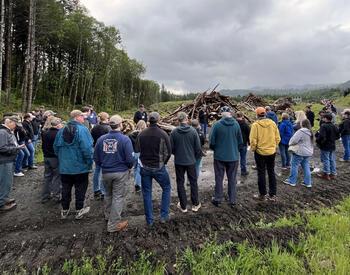
It was very exciting. We did all of our replanting for this season. In the last couple of weeks and Clackamas County is where all of those plantings happened to take place. So we had a really great field day where we went out to a landowner's property and just got to chat with the contractor and the crews.
And we actually even had a local news crew from Portland, KGW come out and interview the landowner and hear their story and see what it's like to put seedlings in the ground. So that's a really fun part of it. And, hearing landowner stories is, is really what makes it all feel meaningful.
[00:07:51] Jake Barker: That's great.
[00:07:52] Landowner Assistance Barriers
[00:07:52] Jake Barker: So it's been a few years, but there are many places that are still in the process of recovering, in terms of trying to get seedlings into the ground and establish successfully. So I was wondering if you could just talk a bit more about how the Landowner Assistance program specifically responds to those challenges and those barriers.
[00:08:12] Becca Shively: After the 2020 wildfire season, which folks will remember at the time was the most historic wildfire season in Oregon's history. And it was a little bit unique in that there were all these mega fires west of the Cascades, where we haven't typically historically seen such dramatic mega fires. And those fires affected a lot of small family forest land owners because that's the ownership composition of this part of the state. And so in partnership with ODF and USDA and local partners, we determined that the biggest unmet need was the need for greater technical and financial assistance for landowners. Just more money, more horsepower, more capacity 'cause we just don't have the muscle memory and the standing resources to respond to fire at that scale in this part of the state. So we applied for federal funding to supplement all the other programs that were being made available to landowners to stand up a new program. That funding took quite a while to launch and get off the ground. So yeah, as you noted, six years post-fire, and it is shocking that we are still just doing site prep and not even getting trees in the ground for many of these properties, which has pros and cons. But one of the pros is that it means that we're catching some of the landowners that just weren't served by other programs or that didn't have success with the other programs. So, we're kind of the sweeper that's coming in at the end trying to offer, you know, one last kind of comprehensive program for folks and some of the key barriers. That we know small forest landowners face, you kind of alluded to, access to seedlings is a problem. A small forest landowner might have a challenge buying the small kind of scale of seedlings that they would need directly from a nursery. They might not know the appropriate genetics or native species or the stock type to be successful on their property. Landowner capacity is kind of an obvious one. If you've experienced catastrophic fire, you might've lost your home, you might've lost a lot of assets and had a traumatizing experience, you might've been displaced. So simply having the capacity to come up with a recovery plan and implement it is really overwhelming. Access to contractors can be tough because contractors are in high demand after a fire. And if you only have 10 acres of forest land, the scale of your project may not be super enticing to a contractor. Then just having the financial resources to actually implement the full suite of post-fire practices can be tough.
Most financial assistance programs do require a cost share. It might be 50 50, it might be 75%, 25%. It varies, but usually there's no just blanket "we will pay for this" kind of arrangement which in a disaster situation is simply not accessible to many folks who have already been stretched so thin.
So technically our program is a cost share program, but so far we have been able to avoid requiring a cost share of anyone because of some of the strategies that we're using, like aggregation and economies of scale and securing really competitive contract pricing. And then also. We're creatively deploying multiple grant sources to try to cover the full cost of implementation for folks. So our program is designed to address all four of those key barriers by providing a pretty customer service heavy program where we do a lot of intensive technical assistance with the landowners. We see them all the way through contracting. We help them identify contractors. In some cases we pay contractors directly. Then we pay, as I was saying, we pay for a pretty generous portion of their project. And we also pay for a larger suite of conservation practices than a lot of programs will pay for. So we're able to do some things that maybe if you went to NRCS for equip, you may not be able to include in your plan.
So we have a lot of flexibility in what practices we incorporate.
[00:12:13] Enrollment Status And Reach
[00:12:13] Jake Barker: So if let's say I was a landowner in Clackamas County and I was impacted by the fires and I have, you know, part of my property, I still need help getting seeds into the ground. Can I call you and get some help right now?
[00:12:26] Becca Shively: I'm glad you flagged that. Unfortunately, we are not enrolling anymore. We did finally cut off enrollment this fall. We've been accepting applications since 2020, so it's been kind of a rolling enrollment process. And we are at the point where we don't have enough funds really to accept more landowners, and we also don't have enough runway in our programs to make sure we can do the whole suite of treatments we would need to do with the landowner if they got started any later than now. So in total, we will be able to work with 40 different landowners across Clackamas County, Marion County, lane County, and Jackson County, and treat about 2000 acres. However, people are still welcome to reach out to us if they need referrals to other programs or service providers that can help them, because at this point we have a pretty good network of partners now.
[00:13:17] Partners Funding Seedlings
[00:13:17] Jake Barker: Yeah, who are some of the key partners that SNW works with and that WOCRE relies on to deliver the actual assistance?
[00:13:26] Becca Shively: Great question. Our key planning partners are our conservation districts. They are doing all of the site visits, the landowner planning and eligibility determinations. They are really the boots on the ground advising on the project and working closely with the landowners and the contractors. Our funders are critical.
I need to mention the programs that are making this possible. They're both through USDA, they're both federal programs. One is through NRCS, Natural Resources Conservation Service, and it's called the RCPP program, the Regional Conservation Partnership Program. And then we also, through the Forest Service, have a Forest Landowner Support grant, which was funded through the Inflation Reduction Act. And together those two programs are really complimenting each other really well and allowing us to be pretty flexible in what we can fund. American Forests is also supplying most of the seedlings for this project. So we're working closely with them, the Oregon Seed Bank and local nurseries. For the most part, we are growing out all of the seedlings for these projects so that they're really specific to the site where they will be planted.
[00:14:35] Jake Barker: Does SNW actually purchase and own the seedling orders or does the SWCD manage that, or how does that work?
[00:14:45] Becca Shively: We do that, the SWCD to determines what they want the trees per acre to be and what the best species are, and bake that into their planning documents. And then we are making bulk purchases directly from nurseries; and then coordinating the delivery pickup and coordinating with the contractors that will be doing the planting to get them the seedlings on the right day. That's part of the economies of scale of the project too, is that we are basically bundling a full order, for instance, for Clackamas County, and just placing one big order with the nursery.
[00:15:19] Jake Barker: Do you do any work with the Oregon Small Woodlands Association?
[00:15:23] Becca Shively: Oh, that's a great question. We are connected to them through OFRI, Oregon Forest Resources Institute and some of their committees, but we aren't directly coordinating with them right now on reforestation. I know that they do, I think they do ceiling giveaways and plant material sales and things like that
on a local chapter basis.
So I think we will be trying to coordinate with them more in the future because one thing that we're finding is that the reality on the ground when you start planting is different than what you plan for. And so we are ending up with some surplus seedlings that we need to make sure to get planted by and used by people who need them.
So we would like to work through OWA if we can, to utilize some of those surplus seedlings.
[00:16:03] Jake Barker: Yeah, that seems like one of the hardest parts is that. When you're thinking about seedling orders and prepping for future planting, you have to plan several years in advance. And it's really hard to guess or understand what the demand is gonna be for that year. And then specifically, even if you have your known impacted area that was affected by wildfire the demand still might be different in 2025 compared to 2026.
Trying to get those levels right is really tricky.
[00:16:32] Becca Shively: That's been really hard. The reason we are planting this year only in Clackamas is because our, partners at Clackamas Soil and water just hit the ground running first and they got their projects planned earlier than the other areas, but we didn't have those landowners under contract.
So that's been a challenge as well that we ordered some seedlings for landowners that are no longer in the program. And so I think that these are just the aches and pains of running a landowner cost share program is there's just a lot of unpredictable variables to plan for.
[00:16:59] Aggregation And Contracts
[00:16:59] Jake Barker: One of the other terms you used earlier was 'aggregating', can you describe what you mean by that?
[00:17:05] Becca Shively: Yeah. I guess we're using aggregation in two ways. The first is through those seedling orders that I talked about where we're just basically taking on that challenge for landowners on their behalf. Usually a landowner would have to procure their own seedlings, or their contractor would do it for them. But we are coordinating that across the whole project area for several reasons. Both for cost reasons, but also because we want a little bit more oversight of the quality of the ceilings that we're getting. One kind of notorious result of the 2020 fires was that some of the folks who replanted right away had widespread seedling die off. It was pretty sad. There were heat domes that occurred in 2021 and I think in 2022. And so for small forest landowners, it was very common for them to lose all of their replantings. Some of that was also because of the timing of when they replanted. I think there were some, a lot of seedling giveaways from folks that had surplus and by the time. They identified that surplus and got rid of their seedlings. It was outside of the optimal window for planting. So those were kind of moisture deprived seedlings. They weren't planted in the ideal conditions. Maybe they weren't planted in the ideal location for their genetics. So anyway, we are aggregating for all of those reasons just to try to prevent some of those things that happened previously. We are also offering aggregated contracts to landowners, which. If you went to the typical cost share program, I don't think you would be able to do, usually programs like these are reimbursement based, so you get technical assistance, maybe a force management plan or sylvicultural prescriptions written for you. You know what is authorized for you to implement that You can then get paid for, but you have to go get your own contractor. You have to negotiate your own rates. You oversee their work yourself. Someone comes out and does a compliance check and makes sure that your contractor did what was prescribed, but you have to pay the contractor first, usually, and wait potentially months to get paid back. So there's a lot of downsides to that reimbursement based model. So one way around that is that we are aggregating any landowner that would like to be bundled into a group project. We are signing individual landowner agreements with them kind of committing to a certain value of services, but the money is bypassing them.
We're taking these projects out for bid directly to contractors. We are identifying local, credible contractors, making sure the landowners are comfortable with who we choose, but for the most part, choosing people based on reputation and quality of work and cost. And then we are directly signing a contract with the contractors.
We are, for the most part, consulting with them pretty closely on any questions they have about the work. So we're more involved in the implementation side of it, and then we pay them directly so the money doesn't flow through the landowner.
[00:20:04] Jake Barker: The money does not flow through the landowner. Who holds the liability?
[00:20:08] Becca Shively: In terms of if there were an accident or what kind of liability?
[00:20:11] Jake Barker: If there was an issue with a contract or, it didn't quite meet the specifications. If you own the contract it's all on SNW owning that larger aggregate contract, which could relieve the burden on small landowners who maybe they were not expecting to have to do this type of work but were impacted by a big fire.
[00:20:32] Becca Shively: I'm sure there's release of liability between us and the landowner, but in terms of us and the contractor, it's very clear that if their work cannot be complied, that they will not be paid and they will be the, they will be given the opportunity to come into compliance if it's an oversight or an undertreatment that can be remedied. If it's an overtreatment, you know, let's say they took down trees that we didn't want taken down. That just wouldn't be a reimbursable practice.
Yeah. And so that, and that has happened just a tiny bit and luckily not in, in super significant ways, but we have had to deal with some of that.
Usually it's undertreatment where we feel like, this brush management wasn't sufficient, or, these hardwood sprouts weren't treated as extensively as we wanted, and so it's easy to go back and fix, but we just don't pay out a practice that hasn't met the specs.
[00:21:28] Jake Barker: Gotcha. Okay.
[00:21:29] Planning And Eligibility
[00:21:29] Jake Barker: So what are the planning requirements like, what does a landowner need to have in order to qualify for the WOCRE program?
[00:21:37] Becca Shively: Good question. We provide everything that the landowner would need. So they don't need to have a forest management plan. If they had an existing FMP, it needs to be updated to post-fire conditions and usually people don't have that. So a fundable practice in our program is to have a full FMP written.
We use NRCS practice code, so I think that would be NRCS practice 1 0 6, if they wanted a full long-term forest management plan, that could be paid for. We haven't had anyone opt to do that. I think part of the special dispensations that we're getting through our program is that we have a somewhat abbreviated planning process and requirement. Instead of writing full FMPs, we are using the basic forest management plan template that NRCS uses. And it is able to reference and rely on the prescriptions that we also write. So if there's any kind of redundancy in writing, desired future conditions or history of the property, we can skip over that in the plan if it's covered in a different planning document. So we've got some shortcuts baked in to try to make the planning process a little bit more streamlined. So basically we're considering the plans that people are getting somewhat of just like a basic replanting plan.
We're not doing super comprehensive planning.
[00:22:56] Jake Barker: At this point we've talked about the funding sources. We've got these two federal funding sources that you've pulled together in order to provide a suite of services for folks. At a larger scale beyond just landowner to landowner.
And right now you're covering a couple counties and focusing on those for this iteration, the four counties.
[00:23:16] Scaling The Model
[00:23:16] Jake Barker: What's the vision or how does Sustainable Northwest imagine expanding this to other parts of the state?
[00:23:22] Becca Shively: Yeah, that's a great question. I think we have learned a lot from this process, and we're a nonprofit, so we're really, we're not designed to run a cost share program. Ideally, this would be a service provided by a federal or a state agency, but applying for this RCPP was an opportunity to bring in $5 million that wouldn't have otherwise been invested in Oregon.
And so in a way, this is a one-off for us because the circumstances really require that somebody step up and try to attract more money to the region. But I do think we are trying to pilot and test some service delivery models that we hope could be replicated by. Organizations with more capacity to run these sorts of programs in the future. Aggregation is certainly something that other people have done. We did not invent that, but it is, it is not a widespread practice as far as I know, and so that is. Something that we are trying to prove out is what can the cost savings be and what do these practices actually cost to implement. And so we actually have a lot of partners asking us for some kind of anonymized data about how much we're spending on certain types of work so that they can get a sense of what is the true cost of restoration in this area so that they can bake that into. You know, their carbon modeling or, or whatever it may be. So there's definitely some proving out of strategies that we're trying to do. Kind of just testing some approaches to accessibility and equity that we hope will also be adopted, like higher reimbursement rates, longer enrollment periods, batch seedling orders, things like that. So looking forward we hope that we are not going to do past-year programs in perpetuity at SNW. But I think we would like to move to supporting other locally based partners in running programs like this, in a post-fire context where they are leading recovery in their region and, you know, providing some of those lessons learned, providing some of that administrative support and just helping to attract federal dollars when they're available to to address local needs.
[00:25:37] Jake Barker: Right, because sometimes I imagine that even if say, a soil water conservation district is interested in pursuing that funding, maybe they don't have the capacity to. That is the vision for the future would be in a, in another situation in which there's a sequence of severe wildfire, there's novel funding sources coming from federal agencies or state agencies someone like Sustainable Northwest could essentially step in and.
Provide the sort of administrative component to securing those funds, which requires, writing grants and all that stuff, and then deploying that out to the places that are impacted. Well, we'll see what happens in the future.
[00:26:20] Federal Funding Curveballs
[00:26:20] Jake Barker: So, one of the questions I have is, you know, you are relying on these two federal funding buckets, and there's been a lot of back and forth with federal shutdowns in the past several months, and I'm curious how that's impacted the program that you're running, how it's impacted WOCRE, how it's impacted, sort of the timing of all the work.
[00:26:42] Becca Shively: Yeah, it's been a very challenging year with kind of constant curve balls because of the change in administration. I think some of this happens with any administration changeover where agreements might be frozen or spending might be frozen while new leadership kind of gets a handle on, okay, what, what grants are out there? What's the current status of things? So some of that maybe would've happened no matter what, but we've, we've had funding freezes and we've had government a, a government shut down. That was pretty impactful. So that has been tough. We have been lucky, though, in that we we have two different grants that strangely have been impacted differently by those interruptions. So one of the grants. Is pretty vulnerable to getting frozen or kind of assessed. And then the other is for whatever reason, is not. So we've been able to move payments from one program that we thought we might charge to one grant, we'll just charge to the other grant. And that's allowed landowners for the most part to keep moving ahead with our project.
That's the tricky thing. You know, as you know, if you've done site prep work and the site is ready, you can't just wait a year and, you know, plant next year instead of this year. The seedlings are ready, the site is ready, and you have to stay on track. So that can be a bit stressful. But so far we are weathering it okay. Our landowners and our contractors have been extremely patient and understanding. So we are really grateful to them. The other major impact I would say is staffing. Particularly at NRCS, they've just lost a lot of really great people mainly that probably have taken the voluntary early retirements.
But there's just staffing reductions in the headquarters office and in the state office, in the local service centers that that mean that the remaining folks are stretched really, really thin. So. We appreciate everyone that works in partnership with us to get these dollars on the ground, and I know they are working really hard. it's A large scale of money too. I don't think I've mentioned what the budget is, but we have a $5 million RCPP, less than half of that is technical assistance. And then the other part is financial assistance. We have a $5 million grant through the Forest Service that I mentioned about half of which is for our project. And the other half is being sub awarded to a different partner. So all tolds, you know, it's about $7 million that three of us at SNW are trying to wrangle.
[00:29:08] Why Reforestation Matters
[00:29:08] Jake Barker: What are some of the benefits beyond specific property? So beyond that footprint of the fire? We all know how important it is to get seedlings in the ground and reestablish forests post disturbance. What are the impacts to the larger community or to the state beyond that specific property?
[00:29:25] Becca Shively: Yeah, well, I think. Just the benefit to clean water, clean air, the aesthetic benefit to communities of continuing to have forested ecosystems where we're used to seeing forested ecosystems. I think there's just an intrinsic benefit to that. You know, Oregon really identifies as being a green forested state, and it's pretty chilling to think about what the effect of year after year of catastrophic fires could have on the forest cover in our state.
You know, if we lost a million acres of forest land every year, if we had a 2020 labor day fire kind of scenario every year, we really cannot keep pace with that. We cannot reforest at that pace. And there's all sorts of parameters and variables that might prevent natural regeneration from happening. We have a lot of weed pressure in some of these areas, you know, like invasive species and scotch broom and blackberry and various things colonize these sites really, really quickly. So if you're not able to replant right away it's pretty unlikely that these places will naturally regenerate and then we're gonna see widespread forest conversion. So, you know, as somebody who was born and raised in Oregon, that feels pretty scary to me. And so, even though I live in Portland in an urban area it's really important to me to keep our rural spaces, you know, looking the way that we love to see them look and also just supporting the viability of being a small family forest landowner is really important. We know that the bigger industrial landowners have the resources and the capacity and the expertise to reforest pretty quickly and pretty successfully after a fire. Because they know how to reforest after disturbance. That is literally what they do. So they're really good at it, but the smaller forest landowner don't have those same resources.
[00:31:17] Jake Barker: Yeah. Or like they have the ability to do it on a smaller part of their property as part of their, longer term management plan. But when you've got such a significant impact, completely changing the composition and age class of your forest, and to then be able to restart requires a lot of time and work.
And especially if these are parcels that also have homes on it and the own homes have been impacted or damaged or even destroyed yeah, it's a, it's a big project. So I'm really hopeful to learn more about this project and, and look forward to this framework that SNW is helping build. And even if it, this is a one time program, I think we've learned a lot, right?
[00:31:55] Becca Shively: One thing I haven't mentioned is that our project and others hopefully are also helping our federal funders learn because the way that their funding programs are structured- the ones that we're tapping into- they're not disaster recovery programs.
They are designed to be truly cost share incentive programs for landowners that maybe would already have done this sort of work or could afford to pay for it or just need a little bit of a nudge. They just are structured as we're finding we're, they are structured in a way that has a lot of barriers to the sorts of folks that we're working with, who they might be on a fixed income, they might have lost a lot of assets. They are facing some headwinds that are not factored for in the design of the typical cost share program. And so there's kind of a two-way directional flow of learning happening where we're learning how to work with these federal agencies and how to deploy that money, but we're also feeding back to them how their policies are restricting what we can do and just don't fit within the paradigm of reforestation.
Like the timeline of reimbursement is just not working for some contractors, for instance, they're not reflecting. Like business reality. And they really need to be designed in a way that does. The way that they're. IR's are written, so those are implementation requirements. We write our Silva cultural prescriptions using these NRCS templates, and the templates aren't designed for a post-disaster scenario, so we kind of have to go off script a little bit.
And ideally they would write and they're okay with that. We have their blessing, but ideally they would have a whole suite of practices that are written for post-fire conditions and they don't. So we are kind of tweaking and adapting kind of general forest health related practices to try to fit a post-fire scenario. So, I think there's also ways that our federal partners hopefully will learn through the project how to directly better serve landowners through their existing programs.
[00:33:57] Jake Barker: That's great to hear. Yeah. I, I feel like that, that flow of learning in both directions is, is super critical. So, is there anything else that we missed or is there anything else that you wanted to include?
[00:34:09] Becca Shively: Yeah, I guess I'll just give a shout out to everybody else who works in this space other than us. We are just one party in the state that's trying to assist these sorts of landowners. But OSU extension does a ton of wonderful work. ODF stewardship foresters are incredible and they provide a lot of direct assistance to landowners. So, we are. In good company and a lot of what we are doing is informed by the guidance of those sorts of partners. So it is exciting to see all of the collective action that's happening in the state around post-fire recovery. And I, I think we're gonna see some exciting initiatives and strategies and solutions to how we respond to catastrophic fire in the future because of that.
[00:34:55] Jake Barker: Great.
[00:34:56] Fit In Regional Recovery
[00:34:56] Jake Barker: So how does the WOCRE program fit more broadly into the post-fire recovery and restoration effort In our region?
[00:35:02] Becca Shively: Good question. Well, we are just one of many organizations that are working in this space. OSU extension agents do a lot of landowner engagement. ODS stewardship foresters do really wonderful work individually with landowners to help them troubleshoot and plan out their recovery on their property. Conservation districts do incredible work. Watershed councils, there's long-term recovery groups that have been formed after different disaster events to help their communities recover over the long-term. This is all kind of part of this broader constellation of recovery entities that are working in tandem with each other or in complimentary ways to try to build the resources that Oregon has to recover from fire. So we are really grateful to all those entities. We're learning a lot from them. And the design of our program was definitely informed by the feedback we got from those partners. And I'll also just add that each of our, the planning partners that we work with, the conservation districts. They are doing a lot of work to tailor our services to their region, to what is climatically adapted and appropriate in their area, and to do a lot of education with landowners about what they can expect on their property. For many folks it will not look the same that it looked before fire, and that's a really hard message to hear, but to plan for a climate adapted forest, that will be resilient in future fire years, you know, might mean that you are not reforesting everywhere, that you are putting in native understory species and shrubs instead of trees et cetera.
So I particularly our partner in Jackson County, is having to have some of those difficult conversations. And, and this is not a blanket reforestation program, you know, we are not always reforesting and particularly down there in southwest Oregon. It's more of a restoration program and however that might look on any individual property is kind of determined by the landowner and our local planner.
We are taking every effort to make our restoration treatments climate informed and climate adapted.
[00:37:11] Jake Barker: I think that's a really important part to keep in mind. 'cause we talk a lot about site specific planting, choosing the right species, the right seed source for the right site. But it's beyond that too. It's about how does a specific place or a different region need to recover?
Or what, what does recovery look like? Right. Who, what are the parameters? How do we think about changing conditions? How do we think about resilience and adaptation?
And this includes management, planning, the replanting, and working with contractors. So. Becca, you know, you and your team are, are leaders in the efforts and we are hopeful and we look forward to seeing the outcomes of the Western Oregon Cascades recovery effort as it gets underway and completed across the four counties of Clackamas, Marion, Lane, and Jackson.
So, thank you so much. As you were listening today, if any questions came up or we didn't cover a specific topic related to today's episode that you were interested in, please drop us a comment or send us a message on our website inthewoodspodast.org.
[00:38:09] Lightning Round
[00:38:09] Jake Barker: But don't leave us yet for next up is our lightning round.
[00:38:19] Jake Barker: Alright, Becca, as usual, we have a few final questions for you that we ask all of our guests. First off, what is your favorite tree?
[00:38:27] Becca Shively: My favorite tree is probably the Coastal Redwood. I have some family roots in Humboldt County, Northern Cal. California and love that part of the world. So if I had to choose, that would be my favorite child.
[00:38:41] Jake Barker: Great tree. We just, OSU just put out a nice publication on Redwood.
[00:38:45] Becca Shively: Oh, cool.
[00:38:46] Jake Barker: All right. Second question. What is the most interesting thing that you bring with you in the field?
[00:38:52] Becca Shively: This isn't that interesting, but I am a constant snacker. I am always eating something. I'm, I'm eating something right now on this interview. And I usually always keep pistachios and chocolate chips with me in my backpack.
[00:39:06] Jake Barker: A classic combo. Classic combo. And then I think we talked about it today, but are there any resources that you would recommend to our listeners if they're interested in learning more about today's topic?
[00:39:17] Becca Shively: Yeah. I would point
folks to the two guidebooks that I mentioned. Those are on our website and I think you're gonna link to them. And I think that OFRI, Oregon Forest Resources Institute also just updated their resource guide for small forest landowners, and that's probably not the right title, but it's a really great guide.
So I would also suggest that people check that out and be aware of that resource.
[00:39:40] Wrap Up And Credits
[00:39:40] Jake Barker: Well, thank you so much, Becca. I feel like I've learned a lot. I hope our listeners learned a lot. Something I learned specifically was the innovative approach that SNW is taking to pool together multiple funding streams from USDA in order to have redundancy and flexibility in order to actually get projects done on the ground.
So it gives me a lot of hope. It seems like everyone's learning a lot about how to better support small forest landowners post-fire, especially post catastrophic fire. I look forward to hearing the, the successes and the outcomes of this, this this program. And I recommend folks to check out the guides and the resources that will in attach to the website. So thank you so much for joining. Thank you again, Becca, for your time. We appreciate all the work you do.
And this concludes another episode of In The Woods. So join us in a couple weeks to explore another topic on Oregon's amazing Forests. But until then, what's in your woods?
[00:40:36] Lauren Grand: The In The Woods Podcast is produced by Lauren Grand, Jacob Putney, and Scott Lood, who are all members of the Oregon State University Forestry and Natural Resources Extension team. Other members of the team who've been involved in the podcast include Carrie Berger, Jason O'Brien and Steven Fitzgerald. Episodes are edited and produced by Carrie Cantrell.
Music for In the Woods was composed by Jeffrey Heino and graphic design was created by Christina Friedhauf. Funding for in the Woods is provided by Oregon State University Forestry Natural Resources Extension, the Oregon Forest Resources Institute and the USDA Renewable Resources Extension Act funding.
We hope you enjoyed the episode and we can't wait to talk to you again next month. Until then, what's in your woods?
[00:41:24] Jake Barker: Cool.
[00:41:25] Becca Shively: We did it.
[00:41:25] Jake Barker: We did it.
Episode 73 - Post Wildfire Recovery, pt. 2
Post-Fire Recovery & Reforestation Support: Inside the Western Oregon Cascades Recovery Effort (WOCRE)
OSU Extension forester Jake Barker interviews Becca Shively of Sustainable Northwest about post-fire recovery and restoration after Oregon’s 2020 wildfires, focusing on the Western Oregon Cascades Recovery Effort (WOCRE). Shively explains Sustainable Northwest’s forestry work and describes WOCRE’s landowner assistance program, which provides intensive technical support and financial help to small family forest landowners facing barriers such as limited seedling access, lack of capacity after trauma, contractor shortages, and cost-share requirements. She outlines how the program aggregates bulk seedling orders and bundled contractor bids, pays contractors directly, and coordinates with conservation districts, USDA NRCS RCPP funding, a Forest Service grant funded through the Inflation Reduction Act, and American Forests for seedlings. The program will serve 40 landowners across Clackamas, Marion, Lane, and Jackson counties, treating about 2,000 acres, and has faced federal funding disruptions and staffing constraints.
- 00:00 Podcast Intro
- 00:41 Why Post Fire Recovery
- 01:58 Meet Becca Shively
- 02:48 Sustainable Northwest Overview
- 04:04 Recovery Work Categories;
- 06:24 Behind The Scenes Work
- 07:52 Landowner Assistance Barriers
- 12:13 Enrollment Status And Reach
- 13:17 Partners Funding Seedlings
- 16:59 Aggregation And Contracts
- 21:29 Planning And Eligibility
- 23:16 Scaling The Model
- 26:20 Federal Funding Curveballs
- 29:08 Why Reforestation Matters
- 34:56 Fit In Regional Recovery
- 38:09 Lightning Round
- 39:40 Wrap Up And Credits