
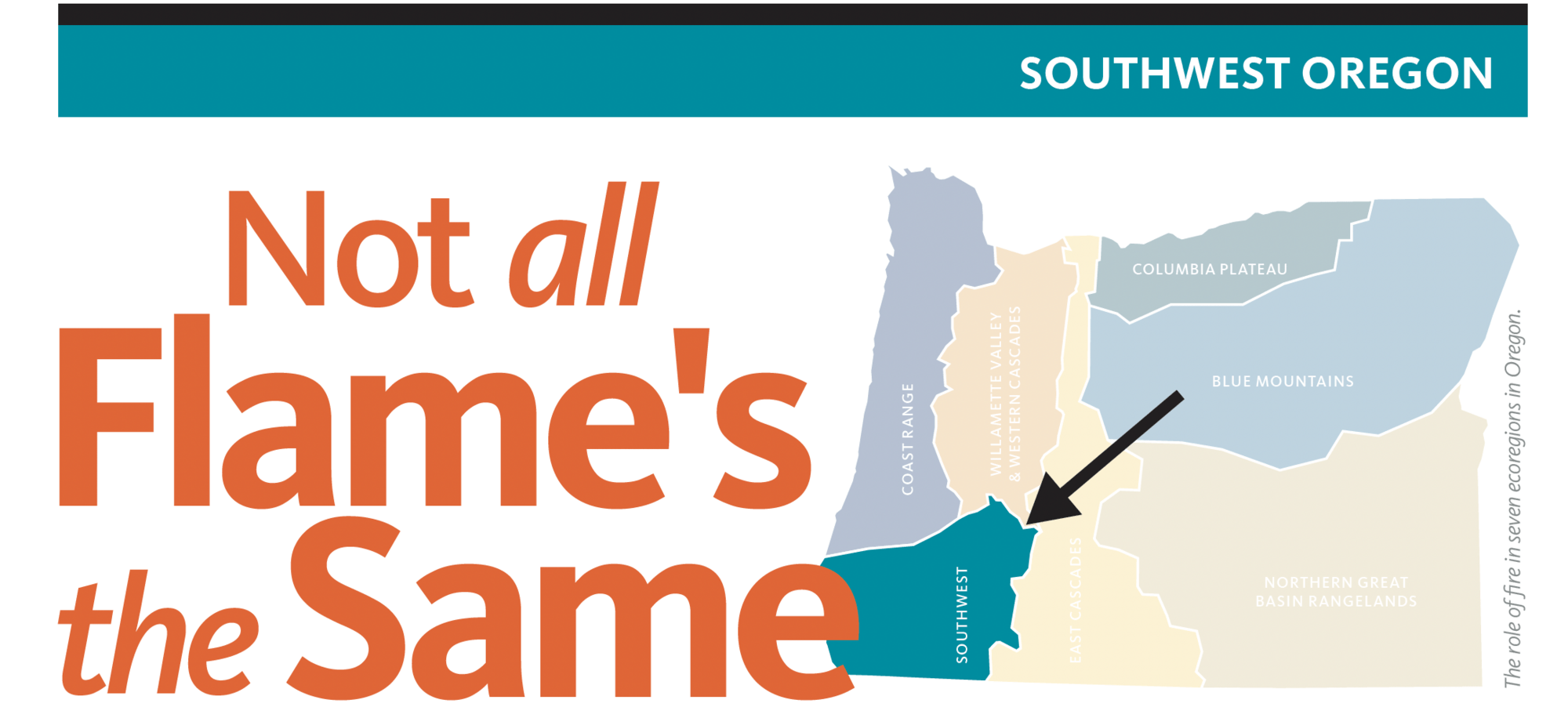
Explore how fire and people’s relationship with it have shaped diverse ecosystems across Oregon.
How fire historically shaped Southwest Oregon
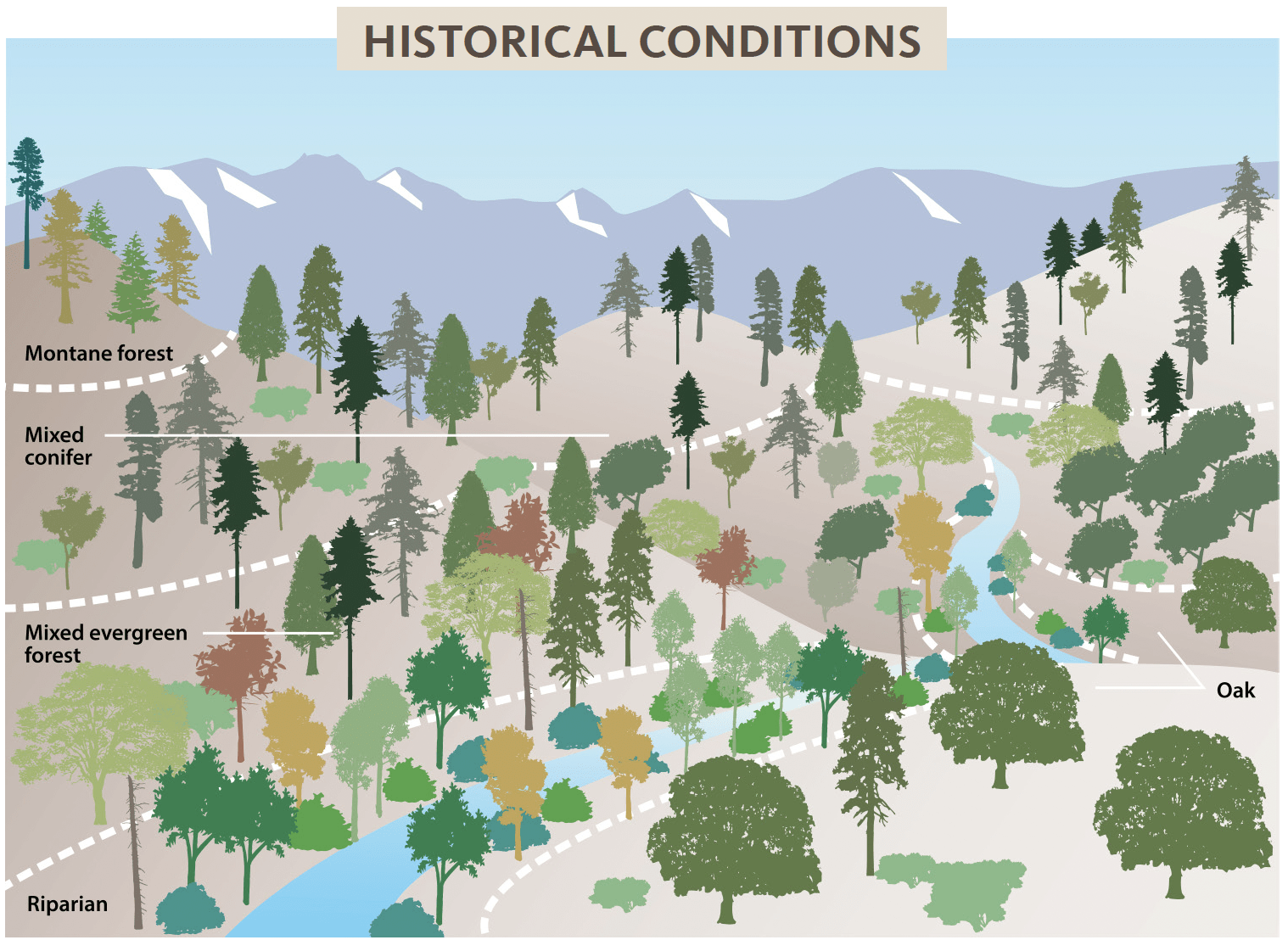
Fire in the Rogue and Umpqua Valleys was once very common, burning through these areas roughly every eight to 12 years. The landscape was a mosaic of burned patches of varying ages, but most trees lived through these low-severity fires. Fire patterns in this region were once very diverse, making it difficult to generalize. At lower elevations, fires started by Indigenous peoples maintained oak savannas and woodlands in open conditions. These fires allowed oaks to thrive, reduced competing understory vegetation and produced healthy, spacious forests. There was very little on the ground to burn in most places. Lightning fires and traditional burns also reached upriver valleys and ridgelines to higher elevations where they maintained a complex mix of habitats, including open forests, meadows and huckleberry fields. Moving north into the moister Douglas-fir forests of the Coast Range and West Cascades, fires used to be more variable and were more likely to include larger high-severity patches.
Fire also sometimes missed some areas for various reasons. For example, patches of chaparral were mixed with oak woodlands and conifer forests and went decades between fires. To this day, south-facing and north-facing-slopes often have very different vegetation, affecting how fire burns. Fire typically burns at higher severity in the top part than the lower part of a slope, or on steeper slopes compared to flat areas. Fire is less common in all ecosystems in this region today, but the impacts are different because there is so much natural diversity.
Changes to Southwest Oregon fire patterns
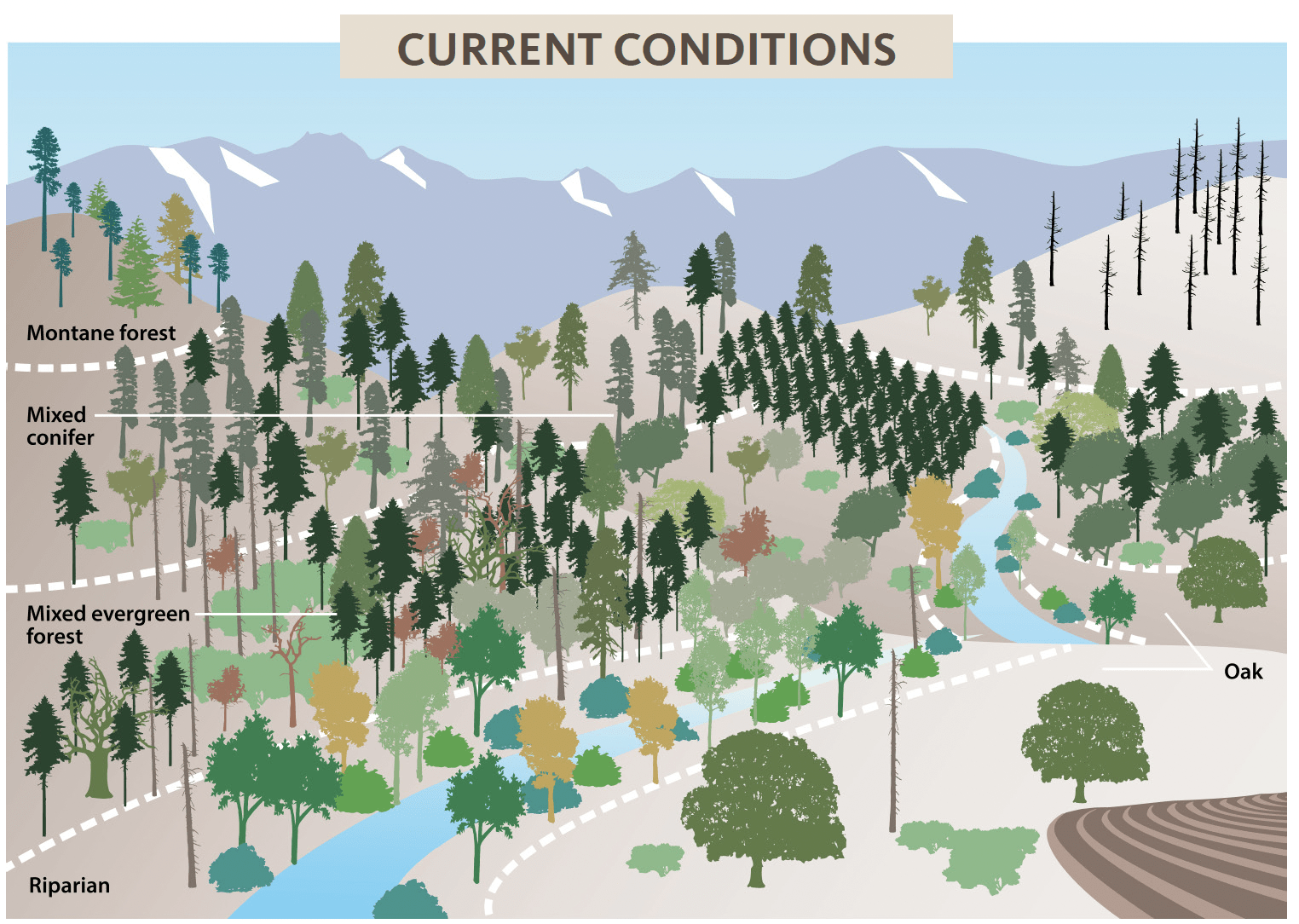
The landscapes of Southwest Oregon have changed since European settlement and so have fire patterns. Urbanization and agricultural development caused a significant loss of grassland and oak savannas in the fertile valley bottoms, where fire is now typically very rare because it is put out quickly. Where ecosystems have not been developed, removing fire from the landscape has allowed conifers and shrubs to grow and sometimes shade out and kill oak trees. This reduces oak habitats and grasslands.
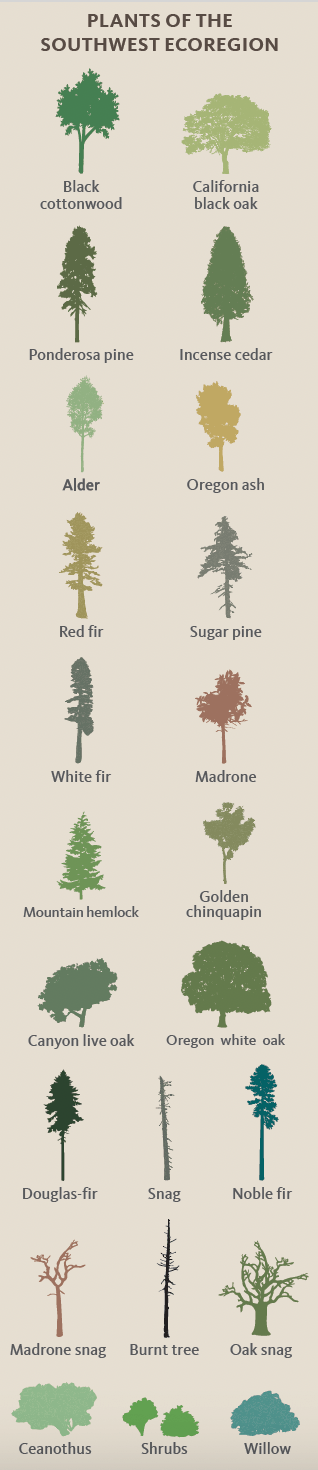
In the mixed evergreen and mixed conifer forests further up in elevation, timber harvests have removed large fire-resistant trees, often replacing them with dense plantations. At the same time, preventing fires from burning has allowed trees to grow more densely, especially Douglas-fir trees. In many areas, this common tree is outcompeting sun-loving species like sugar and ponderosa pines, oaks and madrones, which require more space and don’t reproduce in the shade of dense forests. This once-varied landscape of many species and forest types is losing its diversity due to the absence of fire.
Meanwhile, climate change is stressing all vegetation as landscapes become drier. Many species are more vulnerable to insects and diseases because they are crowded and suffer from drought. This especially affects conifers, and large areas of Douglas-fir and white fir are dying. This change may add to the potential for high-intensity fire behavior because of the amounts of dead wood and thick vegetation regrowth in the understory. If a large area of forest is killed by a high-severity fire, it may take many decades for trees to recover, assuming the area does not burn again before trees have time to mature.
How fire shapes Southwest Oregon today
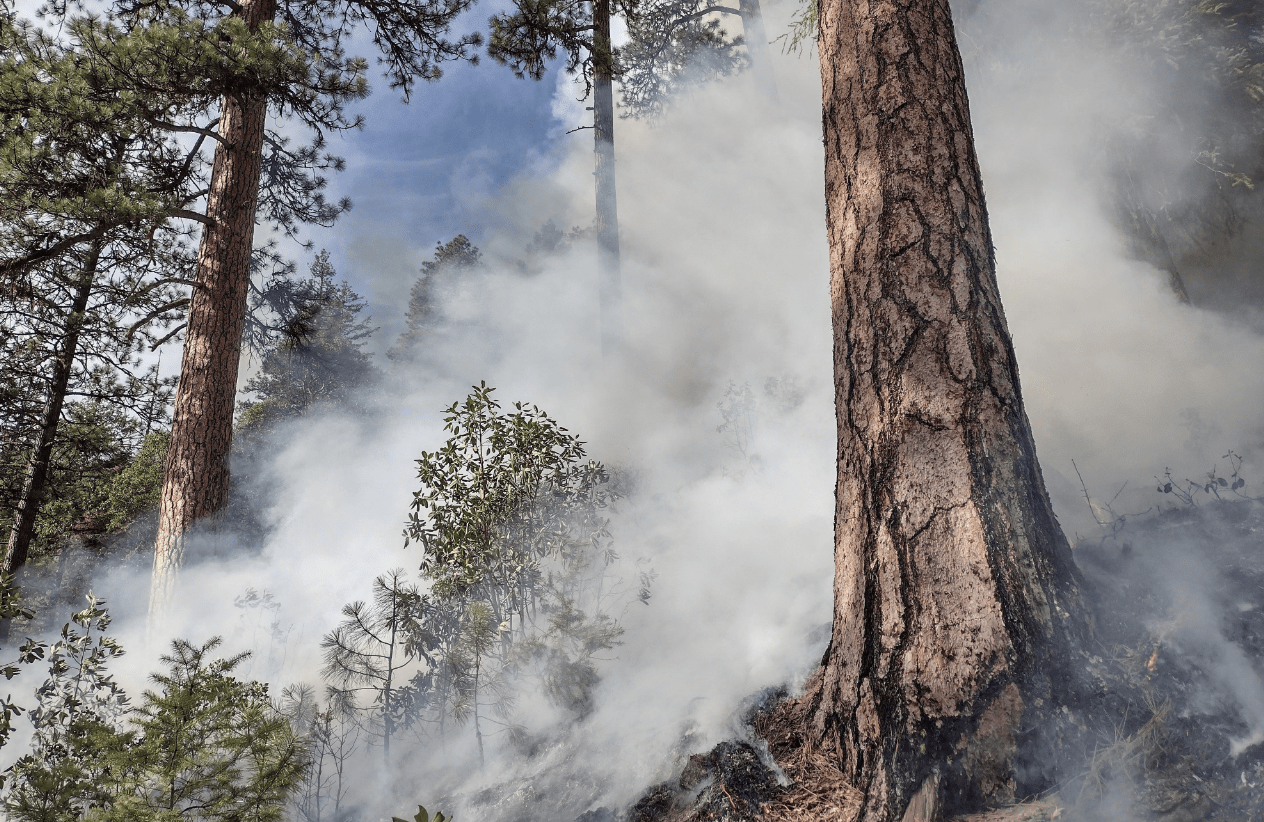
Today, fire is much less common than it used to be. Many fires are suppressed quickly. This “fire drought,” combined with shifts in land use, logging and climate change, has caused fuel build-up, which includes small trees and dead vegetation. Because of this, wildfires are getting larger and burning more intensely on average, and patches of highseverity fire are much larger than they would have been historically. This is because fuels are now continuous and abundant across large swaths of landscapes, not broken up by many small fires like in the past. Still, wildfires are often ecologically beneficial, except when they burn under extreme conditions. Many species need low- to moderate-severity fire. Most of the tree species in this region are resistant to low-severity fire because of their thick bark and other adaptations.
After a large, high-severity burn, it can be difficult for some trees to grow back. If these areas burn again too soon, it may prevent forests from regenerating. However, where multiple fires have burned at low to moderate severity, those ecosystems generally start to look more like they used to, with wider tree spacing and less fuel. In addition, conservation practices such as ecological thinning and prescribed burning can help restore these landscapes to their prior, fire-resilient state. Fire has always been part of the landscapes of Southwest Oregon and will always be, but it doesn’t have to be catastrophic. The land and fire management decisions that we make will shape the outcomes of this important natural process.
Not all flame’s the same
Fire has played a significant role in shaping landscapes throughout history, sparked by both lightning and the intentional use of fire by Indigenous peoples. Fire enabled people to manage and adapt to their local ecosystems, helping them produce food, tools, materials and medicines, as well as maintain prairies, clearings and travel routes. It also helped reduce the risk of larger, more destructive fires by preventing the accumulation of excess fuel. Beyond human use, fire serves vital ecological functions, such as clearing dead vegetation, recycling nutrients, creating habitats for plants and animals, promoting germination and new growth and controlling insects and diseases.
Oregon is a very diverse state from the coast to the Cascade Mountains and the Great Basin. Because of this, it makes sense that the way fire behaves also varies across the state. In other words, fire happens in different patterns and has different effects. This resource explains the role of fire in seven ecoregions of Oregon.
Ready to learn more? https://beav.es/NAFTS.
This publication was made possible with funding from the Oregon Forest Resources Institute in cooperation with the Forestry and Natural Resources Extension Program at Oregon State University.
About the authors


