
What is salvage harvesting?
Salvage logging after wildfire is a complex decision that involves ecological, economic and logistical considerations. Here's a structured guide to help you evaluate your options.
Objectives of salvage harvest
- Recover the economic value of trees killed or damaged by insects, wildfire, weather events and other natural disasters.
- Reduce heavy fuels.
- Create strategic fuel breaks.
- Improve safety around homes, roads and other infrastructure.
- Prepare the site for reforestation.
- Reduce the potential for insect infestations.
What are your management objectives?

The role of salvage harvesting depends on where your goals fall on this management spectrum. Other factors that could influence your position after a fire include:
- The location of your property.
- Acreage burned.
- The proximity of your property to other burned properties.
- Your economic situation.
Factors to consider
Is there enough volume to justify a harvest?
Estimate the average volume per acre—5 MBF, 10 MBF, 15 MBF or more. A consulting forester can help assess this accurately.
Economics of salvage
Log prices
Monitor current and projected log prices. A surge of salvage wood entering the market in the coming months and years may depress prices.
Harvesting costs
- Ground-based systems: $110–$200/MBF
- Cable systems: $185–$300+/MBF
- Costs vary with terrain, access and volume removed.
- Consider equipment availability and labor constraints.
Trucking costs
Typically around $50/MBF, depending on haul distance and fuel prices.

|
Wood change |
Year 1 |
Year 2 |
Year 3 |
Year 4 |
Year 5 |
|---|---|---|---|---|---|
|
Stain |
3.1 | 9.0 | 22.4 | Not calculable due to decay | Not calculable due to decay |
|
Cracks |
6.5 | 19.0 | 28.8 | 30.9 | 40.3 |
|
Decay |
0.0 | 1.1 | 3.3 | 6.4 | 16.4 |
Can you act quickly?
Trees lose value rapidly after fire due to decay, insect damage, and checking. Timely action is critical to capture tree value before decay begins to affect log quality.
Are operators available?
Demand for logging contractors may be high, and securing one can take time — especially after large-scale fires.
What are the risks of waiting?
Delays in salvage increase the risk of:
- Insect damage (e.g., bark beetles, wood borers).
- Weather checking (cracks from drying).
- Staining and discoloration.
- Fungal decay.
- Breakage and structural loss.
- Loss of timber value.
Wildlife and habitat considerations
Post-fire landscapes often support valuable habitats:
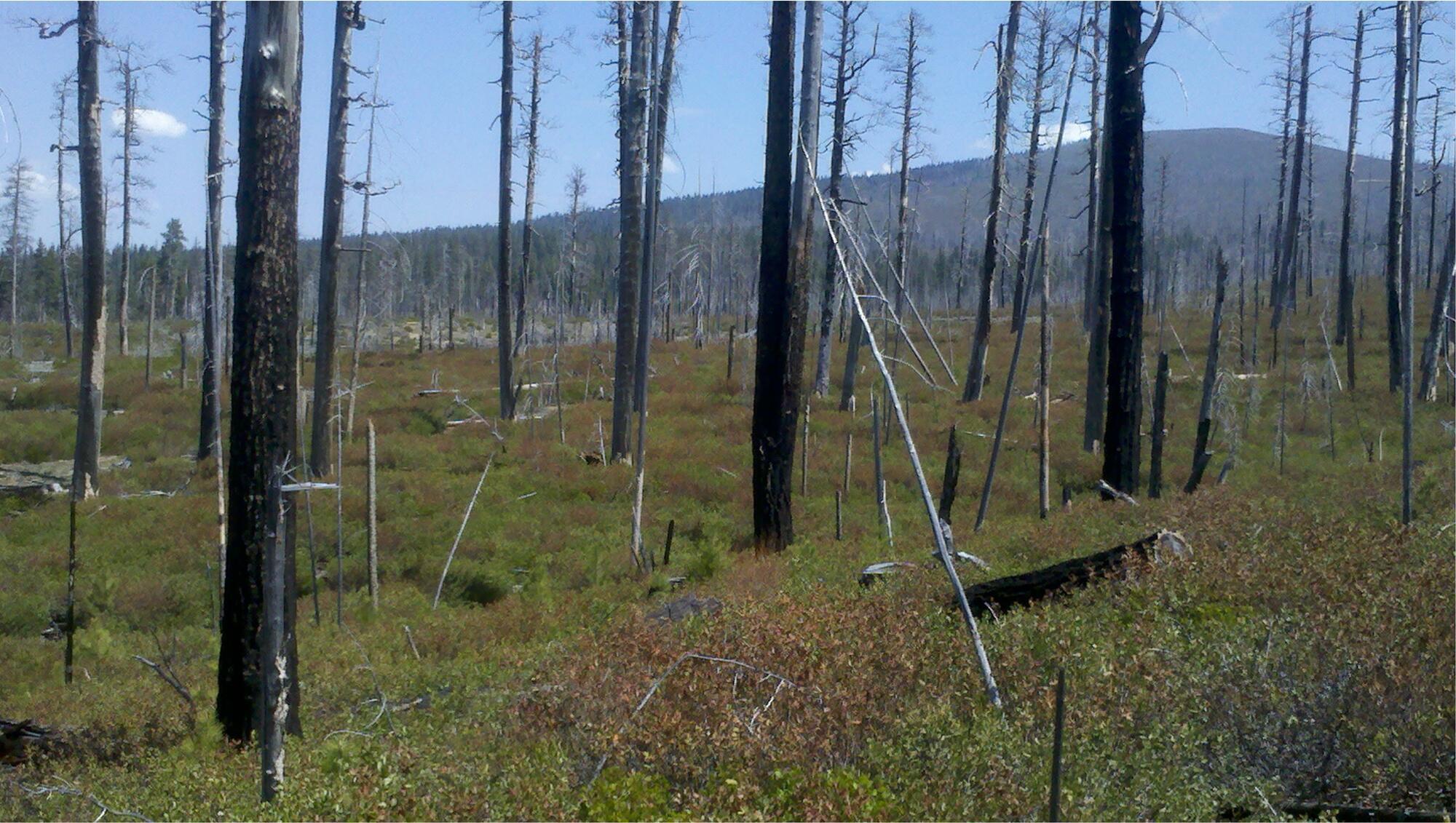
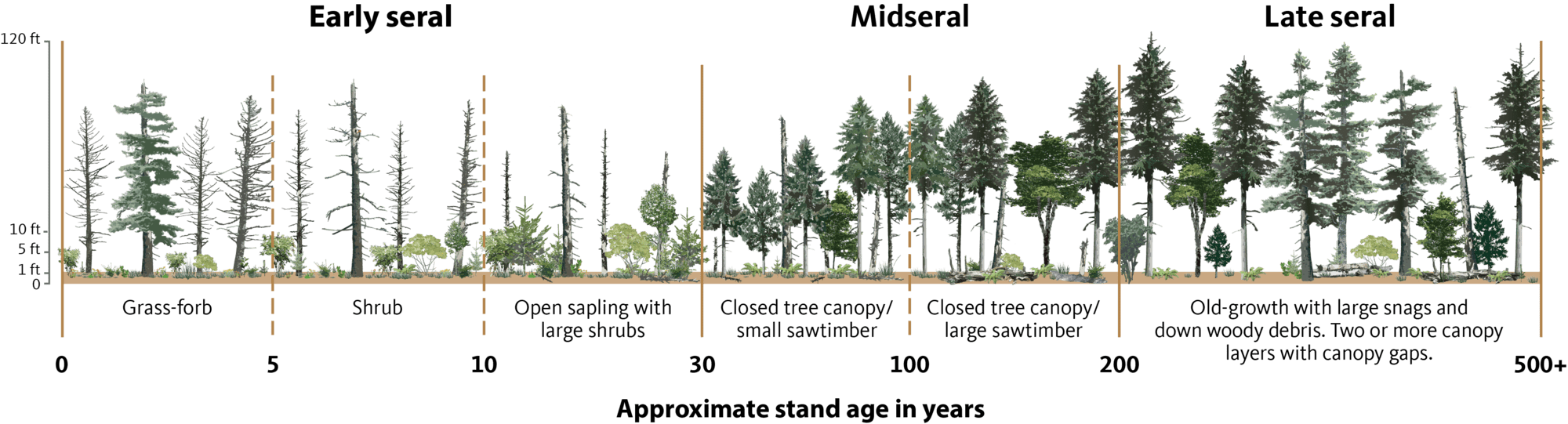
- Early-seral habitat for wildlife (Figure 2).
- Snag habitat for cavity-nesting species.
- Sensitive areas like seeps, springs, riparian zones and legacy trees may warrant protection.
- If wildlife is an important objective, you can design salvage harvest to leave individual snags and snags in groups or islands (Figures 1 and 3). Leave snags in areas where they are not a hazard to roads, trails, buildings or other infrastructure on your property.

Reforestation after salvage
- Natural regeneration: Is there sufficient seed source from surviving trees?
- Planting: It is often necessary because natural regeneration can be inadequate.
- Vegetation control: Often required to ensure seedling survival and growth.
Refer to the checklist
Fill out OSU Extension's After the fire checklist. Refine the amount and burn severity of vegetation and trees.
- Fill in the percent area of low-, medium- and high-severity vegetation burn.
- This will provide roughly the amount of area and potential tree volume for salvage harvesting.
Is salvage logging right for you?
In summary, salvage logging after a wildfire can help recover some economic value and support long-term forest recovery, but it’s not always the right choice for every property. Timing is critical, as burned timber loses value quickly, and costs can vary based on terrain and available contractors.
At the same time, it’s important to balance financial considerations with ecological values, such as wildlife habitat and future regeneration. Work with a professional forester to weigh your options and make a decision that fits both your goals and your land.
About the author

