
Contents
- Introduction to dry farming
- Dry farming and dryland farming: What’s the difference?
- Why dry-farm tomatoes?
- OSU dry-farm tomato project: Description, outcomes and recommendations
- Dry-farmed and irrigated tomato comparison
- Dry-farmed tomato system management recommendations
- Dry-farmed tomato management
- References and resources
- About the authors
Introduction to dry farming
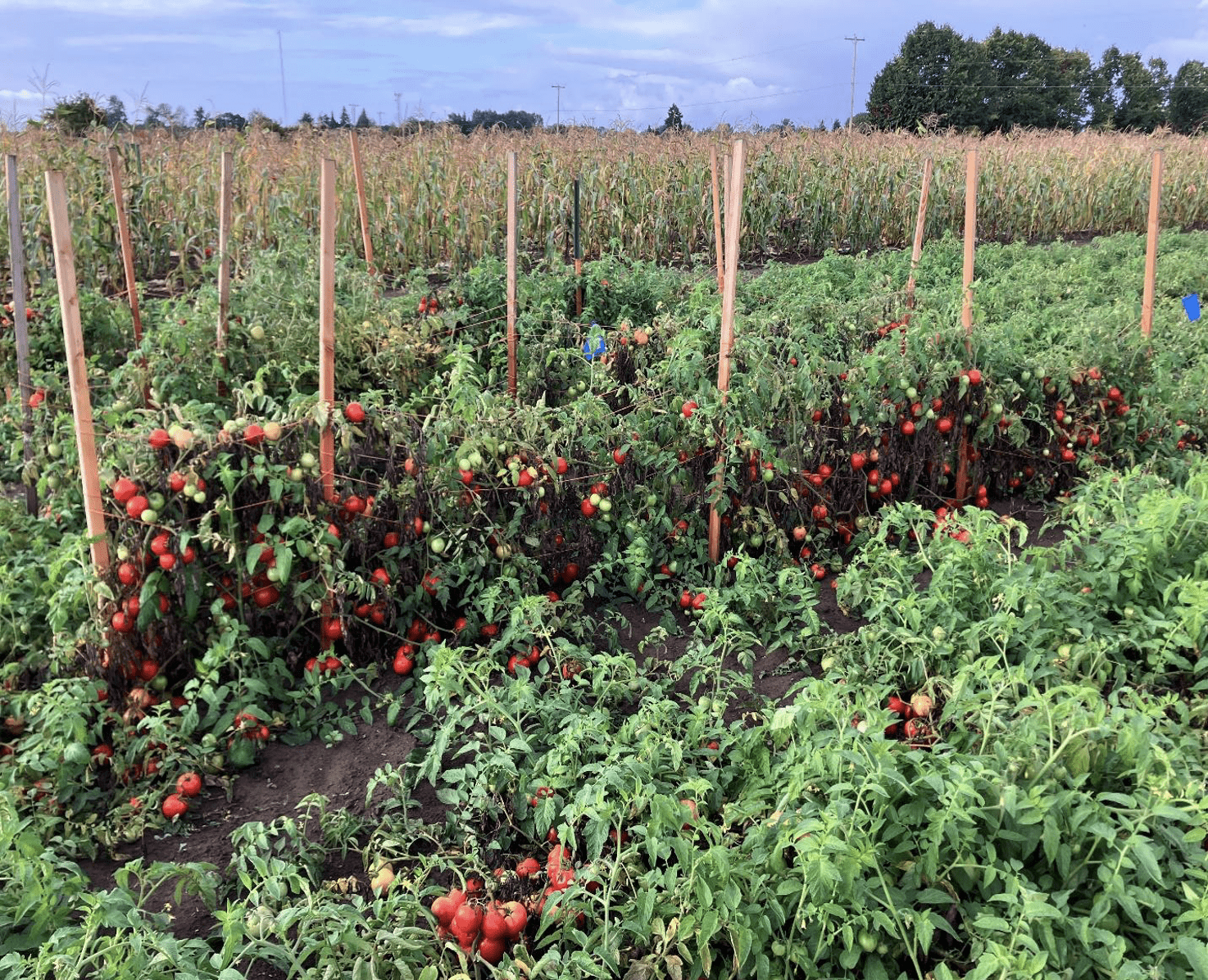
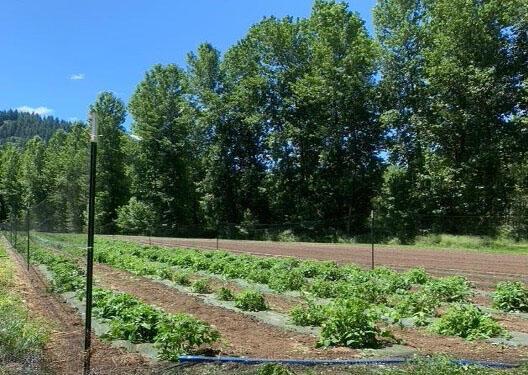
Dry farming is the production of crops without irrigation in regions that receive more than 20 inches of annual rainfall during the winter months but little to no rainfall during the summer growing season. Winter rainfall recharges soils with moisture, and dry-farmed summer crops rely almost entirely on this stored soil moisture. Western Oregon and Washington and coastal California are Mediterranean climates with cool, wet winters and warm, dry summers. Tomatoes can be successfully dry-farmed in some locations in this region (Figure 1), but yields are lower than those of irrigated tomatoes and there are many challenges.
Temperature and humidity vary considerably across this region. Some locations are too hot and dry during the summer to produce dry-farmed tomatoes, as too much stored soil water is lost to evapotranspiration. Other locations are too cool to mature a tomato crop. Additionally, some soils do not have sufficient plant-available water-holding capacity to supply the water required to produce a dry-farmed tomato crop.
Successful dry-farmed tomato production requires an understanding of the site’s soil, climate and microclimate. In addition, growers need to put together a dry-farm cropping system that conserves soil moisture, minimizes evapotranspiration, and supports yield and fruit quality. They must terminate cover crops early and manage weeds to reduce losses of stored soil water to transpiration. Growers should also select tomato varieties for resistance to drought and heat, as well as blossom-end rot and other physiological disorders. Grafting firm-fruited varieties onto drought resistant rootstocks can improve dry-farm tomato yield and quality.
Dry farming and dryland farming: What’s the difference?
The terms “dry farming” and “dryland farming” are often used interchangeably by growers and researchers. However, the term “dryland farming” technically refers to the production of crops without irrigation in semi-arid regions, such as the interior west of the United States. In the interior west, precipitation is often not sufficient to produce a crop every year, so farmers often fallow fields for multiple years to store moisture before growing a crop. Additionally, in some dryland farming regions, the summer growing season is the wettest season. For example, in the southwest United States, summer monsoons have for millennia provided moisture to unirrigated corn and bean crops grown by members of the Hopi community (see Enhancing integration of Indigenous agricultural knowledge into USDA Natural Resources Conservation Service cost-share initiatives.)
Dry farm tomato system examples
Farming without irrigation in dry summer climates isn’t a new practice. Tomatoes have been successfully dry-farmed in the Mediterranean for hundreds of years, and farmers in coastal California have been dry-farming for decades. Here are some examples that informed the work of the OSU dry-farm tomato project.
Example: Naples, Italy
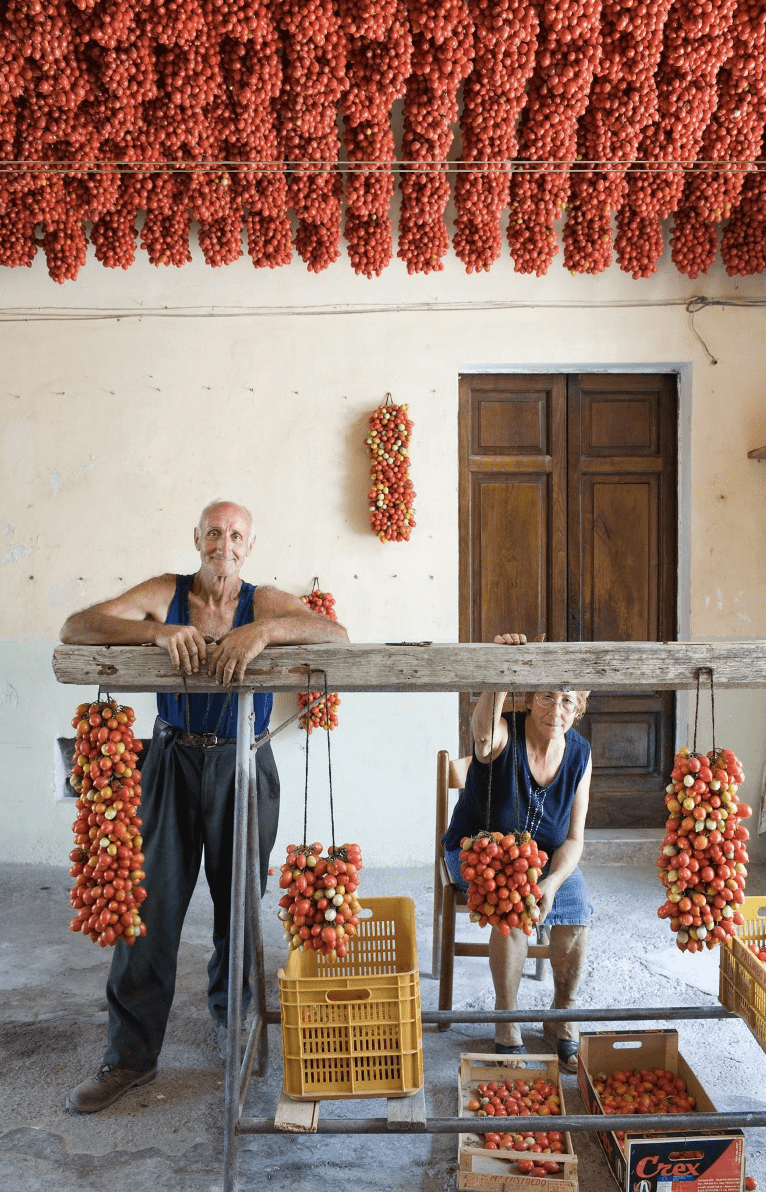
The world-famous Piennolo del Vesuvio tomato has been grown in fields on the slopes of Mount Vesuvius near Naples, Italy, for centuries. Naples has a Mediterranean climate with sunny, hot, dry summers and mild, wet winters, with an average total winter rainfall of 40 inches. Tomatoes are planted in March and harvested in July and August, and then stored for consumption starting in December. Piennolo del Vesuvio is a pear-shaped, thick-skinned and firm-fleshed tomato that grows in clusters. The clusters are tied together into ristras and hung for storage. The tomatoes maintain quality for up to eight months, with the tomato flavor and aroma intensifying over time.
Example: Coastal California, United States
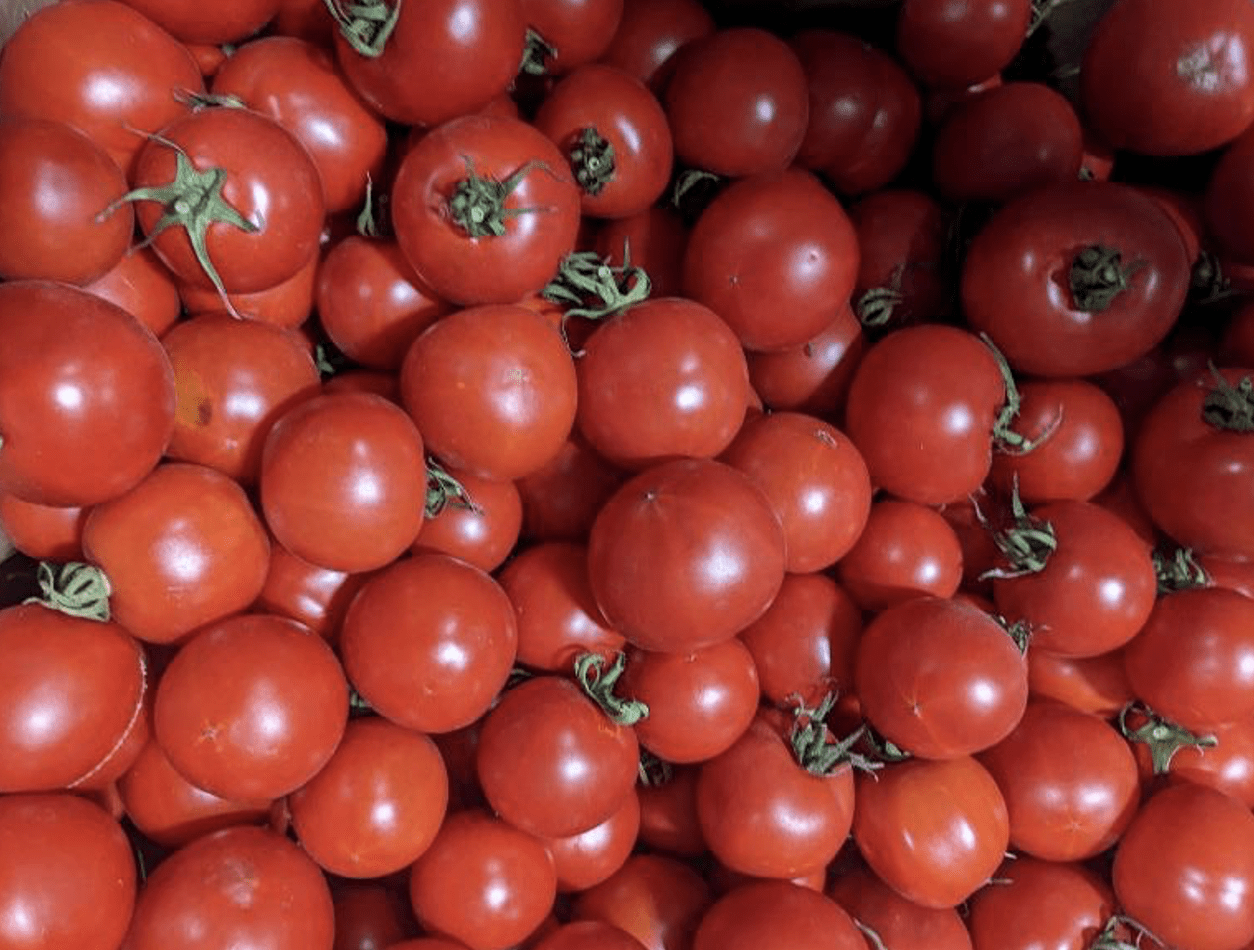
Dry-farmed Early Girl tomatoes are a specialty crop on California’s central coast, which is a dry summer climate heavily influenced by its proximity to the ocean. Winters are mild and wet, averaging approximately 30 inches of rainfall. Summers are warm, but early morning fog increases humidity and moderates afternoon temperatures, so daytime highs typically do not exceed the mid-80s. Early Girl tomatoes are widely dry-farmed in that environment and are prized by consumers for their intense flavor despite their relatively small fruit size.
Example: Greenfield Farm, Veneta, Oregon
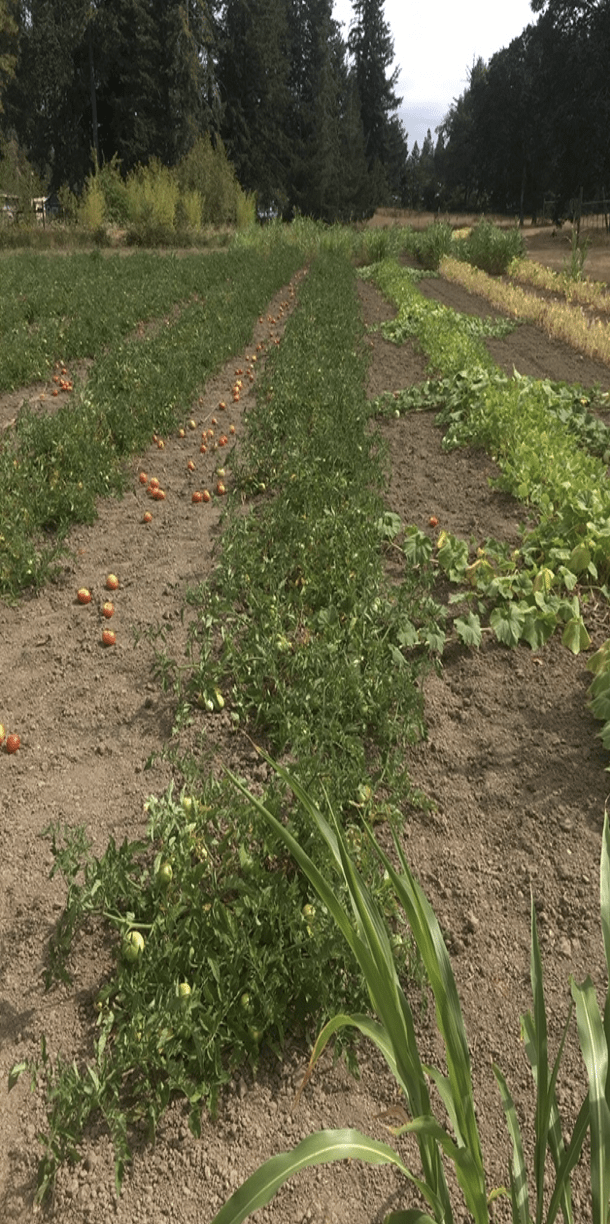
Dick Wadsworth grew dry-farmed tomatoes in California for decades before moving to Oregon. With more than 30 years of dry-farming experience, he is the most experienced dry-farmed tomato grower in the region. He chose to farm in the foothills of Oregon’s Coast Range, where average annual rainfall is 47 inches and historic average high temperatures in July and August are 83o F and 84o F, respectively.
His farm in the foothills is cooler and wetter than sites on the floor of the Willamette Valley, where the OSU research farm is located. He recommends dry-farming on soils with a high water-holding capacity, preparing the soil when at the appropriate moisture content (at or near field capacity), spacing plants at 9 feet between rows and 18 inches between plants and allowing the plants to sprawl (no pruning or staking). He cultivates between the rows using a rototiller after early summer rains to control weeds and produce a dust mulch (see "Mulching").
Why dry-farm tomatoes?
Farmers are interested in dry farming for a variety of reasons. For farmers with limited or no access to irrigation water, dry farming can allow them to produce a tomato crop without supplemental irrigation. Many farmers in Western Oregon have land with no water rights or with junior water rights. Farmers with junior water rights are the first to have their water shut off in times of drought and low streamflows. Farmers without water rights cannot use water to irrigate commercial crops. These farmers are looking for crops that can be grown without irrigation.
There are also potential economic benefits to dry farming. New weeds stop emerging as the soil surface dries in dry-farmed fields, so later-season weed management expenses can be significantly lower than in irrigated fields. Some organic growers with irrigation are interested in dry-farming some fields in their rotation cycle to suppress weed growth. Dry farmers do not need expensive wells, drip tape, or irrigation pumps and pipes. They also avoid labor costs for installing and removing drip tape or pipe (Table 7).
The environmental benefits of dry farming include water and energy conservation. Dry-farmed tomatoes can be grown using less water, reducing impacts on water quality and supply, and aquatic and terrestrial organisms. Dry-farmed tomatoes can be grown using less energy (for irrigation and weed management) and plastic (for drip tape and mulch).
OSU dry-farm tomato project: Description, outcomes and recommendations
Project description
The OSU dry farm tomato project explored the feasibility of dry-farmed tomato production in Western Oregon from 2018 to 2023. The goals of the project were to:
- Identify high-performing varieties and rootstocks (in terms of both yield and quality).
- Help farmers understand how site selection, planting density, mulching and grafting affect yield and quality.
- Evaluate dry-farm tomato production profitability.
The project home site was the OSU Vegetable Research Farm (VRF) in Corvallis, Oregon. The farm is located on the floor of the Willamette Valley. The 30-year normal high temperature for July–August high is 83°F. Annual rainfall is 42.4 inches (see PRISM Weather Data).
The OSU VRF soil is a Chehalis silt loam with more than 12 inches of plant-available water-holding capacity in the first five feet — one of the best soils for dry farming in the Willamette Valley. Site suitability trials were conducted in 2018–2019, grafting trials in 2019–2022, the soil management trial in 2020, variety trials in 2020–2022 and the profitability study in 2022–2023.
Dry-farmed and irrigated tomato comparison
Yield and physiological disorders
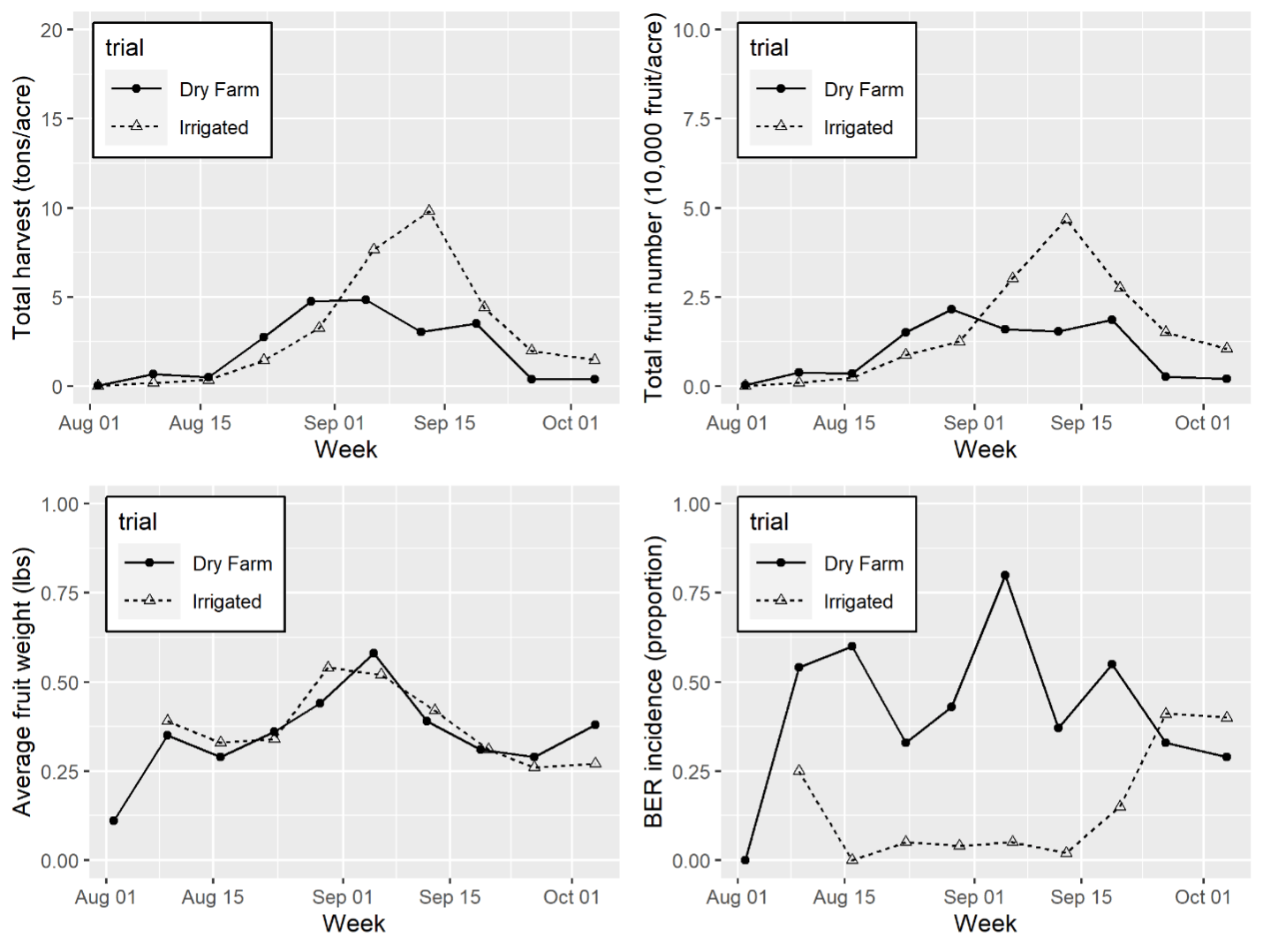
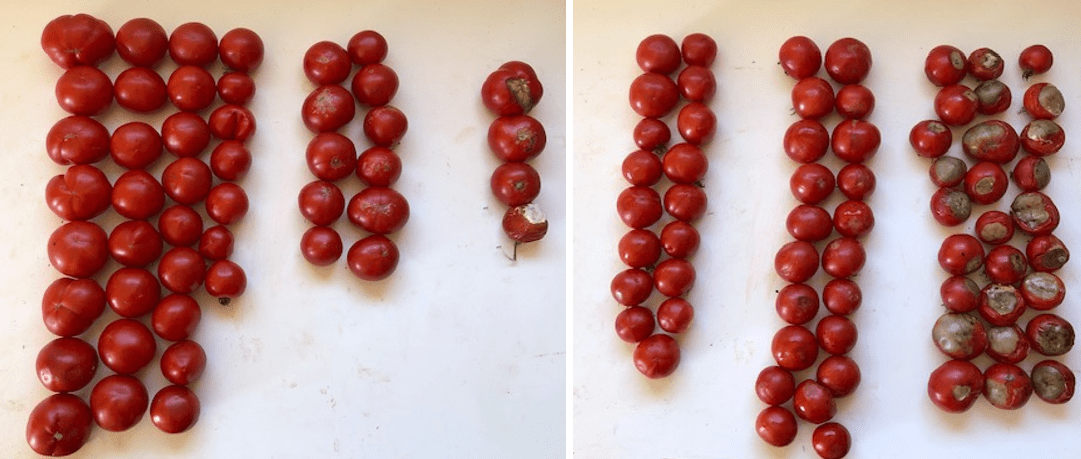
Dry-farmed tomatoes typically yield less than irrigated tomatoes because fewer fruit are set later in the growing season when the plants are drought-stressed, and dry-farmed tomatoes are typically more susceptible to the physiological disorder blossom end rot (Figure 5, Table 1). Blossom end rot dramatically reduces fruit quality and marketable yield, and is the most important problem facing dry-farmed tomato growers in Western Oregon and other hot, dry summer environments. In addition to blossom end rot, dry-farmed tomatoes are more susceptible to gold top, sunscald, and cracking or splitting.
|
Total yield (tons/acre) |
Estimated marketable yield (tons/acre)1 |
Average fruit weight (lbs) |
Blossom end rot (Incidence %) |
Heavy blossom end rot (Incidence %) |
Sunscald (Incidence %) |
Splitting/cracking (Incidence %) |
Catfacing (Incidence %) |
Gold top (Incidence %) |
|
|---|---|---|---|---|---|---|---|---|---|
|
Dry-farmed |
|||||||||
|
Susceptible to blossom end rot |
20.9 | 9.7 | 0.42 | 44 | 15 | 8 | 8 | 4 | 18 |
|
Resistant to blossom end rot |
21 | 8.3 | 0.34 | 7 | 1 | 9 | 27 | 17 | 26 |
|
Irrigated |
|||||||||
|
Susceptible to blossom end rot |
30.5 | 19.1 | 0.4 | 9 | 2 | 9 | 1 | 0 | 10 |
|
Resistant to blossom end rot |
25.6 | 14.4 | 0.3 | 3 | 1 | 12 | 12 | 18 | 15 |
1 Marketable fruit free from blossom end rot, gold top, sunburn, splitting, cracking and catfacing.
Physiological disorders
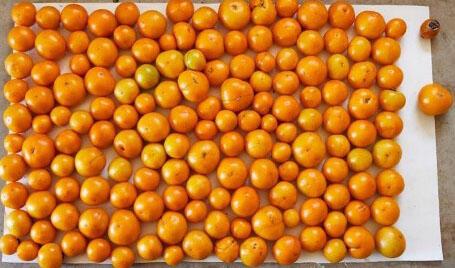
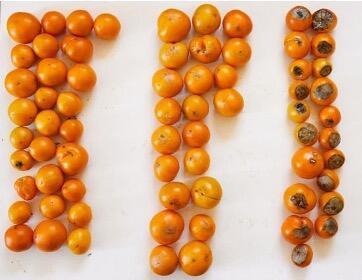
Blossom end rot is one of the most common physiological disorders in dry-farmed tomatoes and is related to drought stress. Blossom end rot incidence is typically much higher in Western Oregon than in coastal California, as inland Western Oregon (Willamette Valley) is much hotter and drier. In fruit of susceptible varieties, the blossom end of the fruit breaks down and rots.
Factors associated with blossom end rot in dry-farmed tomatoes are high wind speeds and excess soil nutrients, particularly nitrogen. High blossom end rot incidence in dry-farmed tomatoes can be mitigated by:
- Growing blossom end rot-resistant cultivars.
- Grafting onto an appropriate rootstock.
- Choosing a site with late-afternoon shade and wind protection.
- Reducing fertilizer nitrogen application rates.
Gold top, which is sometimes called yellow shoulder or green shoulder, is characterized by a raised hard green or gold shoulder on tomato fruit. Gold top has been associated with high temperatures, low levels of potassium and direct sunlight on the tomato fruits. Dry-farmed tomatoes may be more susceptible to gold top than irrigated tomatoes because the plants have less foliage to shade fruit, drought stress reduces transpiration in the fruit, and low soil moisture decreases the availability of potassium in the soil. Gold top can be prevented by growing resistant cultivars, increasing soil potassium concentrations and increasing planting density. Sprawling tomatoes are more prone to branch-cracking, exposing fruits to direct sunlight, so trellising tomatoes may help control this disorder.
Internal whitening is difficult to observe without cutting tomatoes open. The tomato might look healthy on the outside, but areas of white or green tissue can be observed internally. Internal whitening has been associated with many of the same conditions as gold top (such as high temperature, low potassium and direct sunlight).
Sunscald can be identified as a yellow patch on the side of fruits, but in extreme instances tissue can appear white and sunken. Sunscald results from direct sunlight hitting the fruit. Trellising, shading, planting at a higher density and increasing soil fertility may reduce its frequency and severity.
Cracking and splitting are important physiological disorders in dry-farmed tomatoes; in a 2022 field trial, splitting incidence was twice as high in dry-farmed tomatoes as in irrigated ones. Cracking is associated with fluctuations in water availability.
Flavor
Dry-farmed Early Girl tomatoes grown in coastal California are known for their intense flavor, which is accompanied by a relatively small fruit size and 15% average blossom end rot incidence (see Organic Dry-Farmed Tomato Production on California’s Central Coast: A Guide for Beginning Specialty Crop Growers). Because of this example, many farmers and consumers think that dry-farmed tomatoes are inherently more intensely flavored than irrigated tomatoes. However, in taste trials of Early Girl and other high-performing dry-farmed tomato varieties grown with and without irrigation in Western Oregon, consumers described dry-farmed and irrigated tomatoes as similarly flavorful. It is likely that intensely flavored dry-farmed Early Girl tomatoes can be grown in Western Oregon, but it is also likely that the extreme drought stress that contributes to their intense flavor will result in small fruit and high blossom end rot incidence, particularly later in the harvest season (Figure 5).
Dry-farmed tomato system management recommendations
Variety and rootstock selection
Genetic resistance to blossom end rot and other physiological disorders is an important tool in any dry-farmed tomato system. Selecting resistant types and varieties or grafting onto suitable rootstocks is critical to dry-farmed tomato production success.
Fruit size and shape, and blossom end rot susceptibility
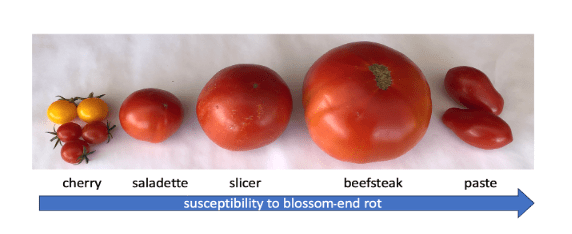
Tomato varieties for dry-farm production systems must be blossom end rot resistant. Tomato types vary in their general susceptibility to blossom end rot. Small-fruited and round tomatoes are less susceptible, while large-fruited and elongated tomatoes tend to be more susceptible. Cherry and saladette tomatoes with small round fruit perform well when grown under dry-farm conditions, as their small size and round shape make them resistant to blossom end rot.
It is likely that most small-fruited round tomatoes (including cherry tomatoes) will exhibit little to no blossom end rot when dry-farmed. Pear and paste tomatoes are typically unsuited to dry-farmed production; they are very susceptible to blossom end rot due to their elongated shape. However, some paste tomatoes, such as Baylor Paste, are resistant to blossom end rot, in part due to their less-elongated, rounder shape (Table 2). Larger round tomatoes are typically susceptible to blossom end rot.
High-performing varieties for dry-farmed tomato production
Tomato varieties and market classes differ in potential yield, average fruit size, and susceptibility to physiological disorders like blossom end rot, gold top and cracking when dry-farmed. The OSU project trialed more than 146 slicer and beefsteak varieties and 45 paste varieties for dry-farm performance over three years. Cherry tomatoes were not trialed after the first year because all were resistant to blossom end rot. Tomatoes were evaluated each year for yield, fruit number and fruit weight, as well as the most important factor reducing fruit quality – blossom end rot incidence. In general, varieties were considered high performing if they yielded at least 20 tons per acre and incurred less than 15% blossom end rot on average.
However, many varieties that passed this initial screening had other fruit quality problems, including soft fruit when ripening in temperatures over 95° F or susceptibility to other physiological disorders. The three trial years varied in the number and degree of very high temperature days (> 95° F). The year 2020 was a summer of historically typical temperatures, and many varieties across tomato types were high performing (high yields and low blossom end rot incidence). In contrast, 2021 and 2022 were hotter, and few varieties were high performing.
High-performing 2020 varieties are described in Table 2. While these were exceptional in 2020, they all had unacceptably soft fruit in the much hotter 2021 summer, so these varieties are not recommended for dry-farm production in hot and unsheltered locations such as the floor of the Willamette Valley (including Corvallis, Oregon, where the trial was located). However, they can likely be successfully dry-farmed on the coast and in the foothills of the Cascades, where temperatures are cooler, or in locations with manipulated microclimates.
|
Variety and seed source |
Total Yield (tons per acre)1 |
Estimated Marketable Yield (t/a)2 |
Fruit weight (lbs)1 |
Blossom end rot (%)1 |
Gold top (%) |
Splitting and cracking (%) |
Sunburn (%) |
|---|---|---|---|---|---|---|---|
|
Red beefsteak/slicing tomatoes |
|||||||
|
Atta Girl (SRN) |
25 | 19 | 0.38 | 5 | 0 | 14 | 6 |
|
Cosmonaut Volkov (HM) |
17 | 9 | 0.33 | 6 | 30 | 15 | 6 |
|
Spring King (AD) |
26 | 15 | 0.31 | 6 | 27 | 13 | 11 |
|
Starfire (AD) |
24 | 15 | 0.30 | 8 | 3 | 16 | 6 |
|
Red paste tomatoes |
|||||||
|
Baylor Paste (AD) |
18 | 13 | 0.12 | 12 | 27 | 14 | 0 |
|
Fakel (AD) |
22 | 19 | 0.11 | 10 | 6 | 0 | 3 |
|
Nistru plum (EFN) |
39 | 32 | 0.08 | 20 | 1 | 2 | 1 |
|
Quadro (AD) |
18 | 10 | 0.10 | 6 | 33 | 3 | 0 |
|
Pink beefsteak/slicing tomatoes |
|||||||
|
Eva purple ball (EFN) |
24 | 13 | 0.24 | 17 | 1 | 16 | 14 |
|
Tiffen Mennonite (AD) |
32 | 12 | 0.57 | 8 | 43 | 26 | 5 |
|
Yellow beefsteak/slicing tomatoes |
|||||||
|
Azoychka (AD) |
29 | 17 | 0.34 | 6 | 29 | 27 | 5 |
|
Manyel (UP) |
31 | 23 | 0.27 | 4 | 1 | 17 | 5 |
|
Native Sun (AD) |
26 | 24 | 0.2 | 6 | 2 | 1 | 5 |
1 Numbers represent averages across three production seasons for Azoychka, Cosmonaut Volkov, Manyel, Spring King and Tiffen Mennonite; two production seasons for Baylor Paste, Eva Purple Ball, Fakel, Native Sun, Quadro, Starfire and Teardrop; and one production season for Atta Girl and Nistru Plum.
2 Marketable fruit free from blossom end rot, gold top, sunburn, splitting or cracking and catfacing.
Grafting tomatoes to increase yield and fruit weight and reduce blossom end rot incidence
Western Oregon farmers have long grown grafted tomatoes in high tunnels to increase yield and reduce losses to soilborne diseases. Grafting with high-performing rootstocks can dramatically improve dry-farmed tomato performance by increasing fruit weight and yield and decreasing blossom end rot incidence (Table 2, Figure 8). Rootstocks that significantly improved performance for dry-farmed tomato were DRO141TX, Emperador RZ, Fortamino and Maxifort. The rootstock Shincheonggang did not improve performance compared to ungrafted materials (see Grafting onto tomato rootstocks improves outcomes for dry-farmed tomato).
Because grafting reduces blossom end rot incidence, farmers can use grafting to successfully dry-farm a wider diversity of tomatoes, including firmer hybrid cultivars that are too susceptible to blossom end rot to be successfully dry-farmed when not grafted.
|
Average improvement over ungrafted scion |
||||||
|---|---|---|---|---|---|---|
|
Rootstock cultivar |
Source |
Number of plots |
Yield (t/a) |
Average fruit weight (lbs) |
Blossom end rot incidence |
Notes |
|
DRO141TX |
De Ruiter (Bayer) |
2020: 12 2021: 27 2022: 16 |
+16 | +0.08 | 69% decrease | |
|
Emperador RZ F1 |
Rijk Zwaan |
2020: 2 2021: 5 2022: 2 |
+13 | +0.06 | 72% decrease | Grafted plants available at Log House Plants |
|
Fortamino |
Enza Zaden |
2020: 9 2021: 17 2022: 33 |
+11 | +0.05 | 74% decrease | |
|
Maxifort |
De Ruiter (Bayer) | 2020: 4 | +17 | Insufficient data | 60% decrease | Only studied in 2020 |
|
Shincheonggang |
Banner Greenhouses | 2020: 12 | No effect | No effect | No effect | Only studied in 2020 |
For more information, see Grafting onto tomato rootstocks improves outcomes for dry-farmed tomato.
|
Yield (t/a), fruit weight (lbs), blossom end rot incidence (%) |
||||
|---|---|---|---|---|
|
Cultivar |
Source |
2020 |
2021 |
2022 |
|
Big Beef, red |
JSS1 | 50, 0.78, 2%2 | 31, 0.41, 3% | 32, 0.40, 22% |
|
BHN-871, orange |
JSS | 45, 0.43, 5% | 62, 0.44, 3% | 36, 0.42, 26% |
|
Damsel, pink |
JSS | not grown | not grown | 22, 0.39, 6% |
1 JSS: Johnny’s Selected Seeds
2 Yield 50 tons per acre, fruit weight 0.78 pounds, blossom end rot incidence 2%
For more information, see Grafting onto tomato rootstocks improves outcomes for dry-farmed tomato.
|
Scion (variety) |
Yield (t/a) |
Estimated marketable yield (t/a)1 |
Average fruit weight (lbs) |
BER (%) |
Heavy BER (%) |
Gold top (%) |
Splitting/ cracking (%) |
Sunscald (%) |
|---|---|---|---|---|---|---|---|---|
|
Red beefsteak/slicing tomatoes |
||||||||
|
BHN-589 × Fortamino |
17.3 | 12.3 | 0.41 | 9 | 2 | 0 | 12 | 8 |
|
Big Beef × Fortamino |
16.4 | 7.6 | 0.42 | 14 | 4 | 29 | 6 | 8 |
|
Bigdena × Fortamino |
20.2 | 14.2 | 0.45 | 5 | 1 | 0 | 13 | 15 |
|
Caiman × DRO141TX |
23.5 | 14.3 | 0.42 | 11 | 2 | 2 | 23 | 5 |
|
Celebrity × Fortamino |
35.1 | 17.4 | 0.41 | 5 | 1 | 31 | 15 | 5 |
|
Early Girl Bush × Fortamino |
24.9 | 17.7 | 0.29 | 3 | 1 | 5 | 6 | 11 |
|
Genuwine × Fortamino |
17.7 | 6.2 | 0.46 | 10 | 5 | 15 | 8 | 3 |
|
Geronimo × Fortamino |
24.8 | 14.8 | 0.36 | 1 | 0 | 4 | 14 | 13 |
|
Rebelski × Fortamino |
18.1 | 18.1 | 0.35 | 2 | 1 | 0 | 3 | 16 |
|
Ruby Dawn × Fortamino |
24.2 | 16 | 0.35 | 7 | 1 | 13 | 13 | 5 |
|
Siletz × Fortamino |
11.6 | 4.8 | 0.3 | 2 | 0 | 46 | 16 | 4 |
|
Spring King × DRO141TX |
17.9 | 5.5 | 0.32 | 7 | 4 | 39 | 15 | 13 |
|
Spring King × Fortamino |
26.7 | 12.3 | 0.31 | 2 | 1 | 28 | 9 | 9 |
|
Tomimaru Muchoo × Fortamino |
16.3 | 9.9 | 0.26 | 1 | 0 | 17 | 15 | 11 |
|
Red paste tomato |
||||||||
|
San Marzano × Fortamino |
16 | 11.4 | 0.09 | 14 | 6 | 10 | 1 | 6 |
|
Pink beefsteak/slicing tomatoes |
||||||||
|
Abigail × DRO141TX |
30.7 | 8.3 | 0.65 | 9 | 0 | 36 | 30 | 14 |
|
Abigail × Fortamino |
19.9 | 8.5 | 0.46 | 13 | 3 | 25 | 15 | 9 |
|
Damsel × Fortamino |
21.5 | 12.8 | 0.39 | 6 | 1 | 12 | 25 | 3 |
|
Momotaro × Fortamino |
18.6 | 6.4 | 0.29 | 15 | 3 | 19 | 30 | 9 |
|
Tiffen Mennonite × DRO141TX |
33.8 | 5.1 | 0.86 | 1 | 0 | 28 | 49 | 7 |
|
Tiffen Mennonite × Fortamino |
22.4 | 3.4 | 0.58 | 3 | 1 | 31 | 35 | 12 |
|
Orange beefsteak/slicing tomatoes |
||||||||
|
Beorange × Fortamino |
19.7 | 11.9 | 0.39 | 4 | 1 | 0 | 24 | 8 |
|
BHN-871 × Emperador |
30.5 | 20.9 | 0.51 | 5 | 1 | 0 | 11 | 5 |
|
Yellow beefsteak/slicing tomatoes |
||||||||
|
Lemon Boy Plus × Fortamino |
22.7 | 11.7 | 0.3 | 5 | 3 | 6 | 30 | 3 |
|
Manyel × DRO141TX |
36.5 | 15.6 | 0.32 | 5 | 3 | 0 | 49 | 8 |
|
Manyel × Fortamino |
25 | 11.8 | 0.27 | 0 | 0 | 0 | 43 | 12 |
|
Purple beefsteak/slicing tomatoes |
||||||||
|
Cherokee Carbon × Fortamino |
17.6 | 8.2 | 0.5 | 5 | 2 | 2 | 24 | 11 |
|
Cubalibre × Fortamino |
14.1 | 10 | 0.31 | 8 | 3 | 6 | 8 | 10 |
1 Marketable fruit are free from BER, gold top, sunburn, splitting, cracking and catfacing.
For more information, see Grafting onto tomato rootstocks improves outcomes for dry-farmed tomato.
Dry-farmed Early Girl in the Willamette Valley
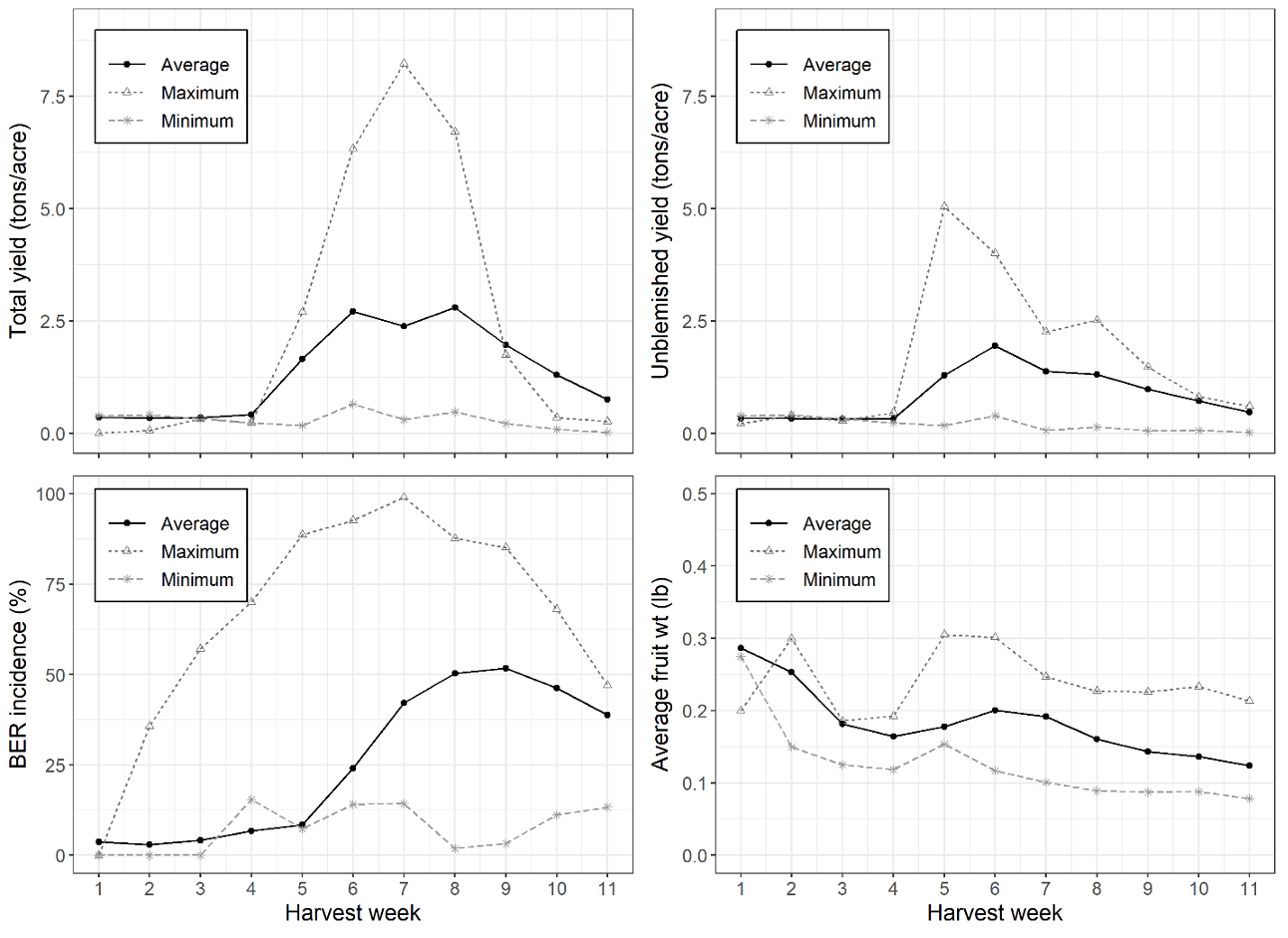
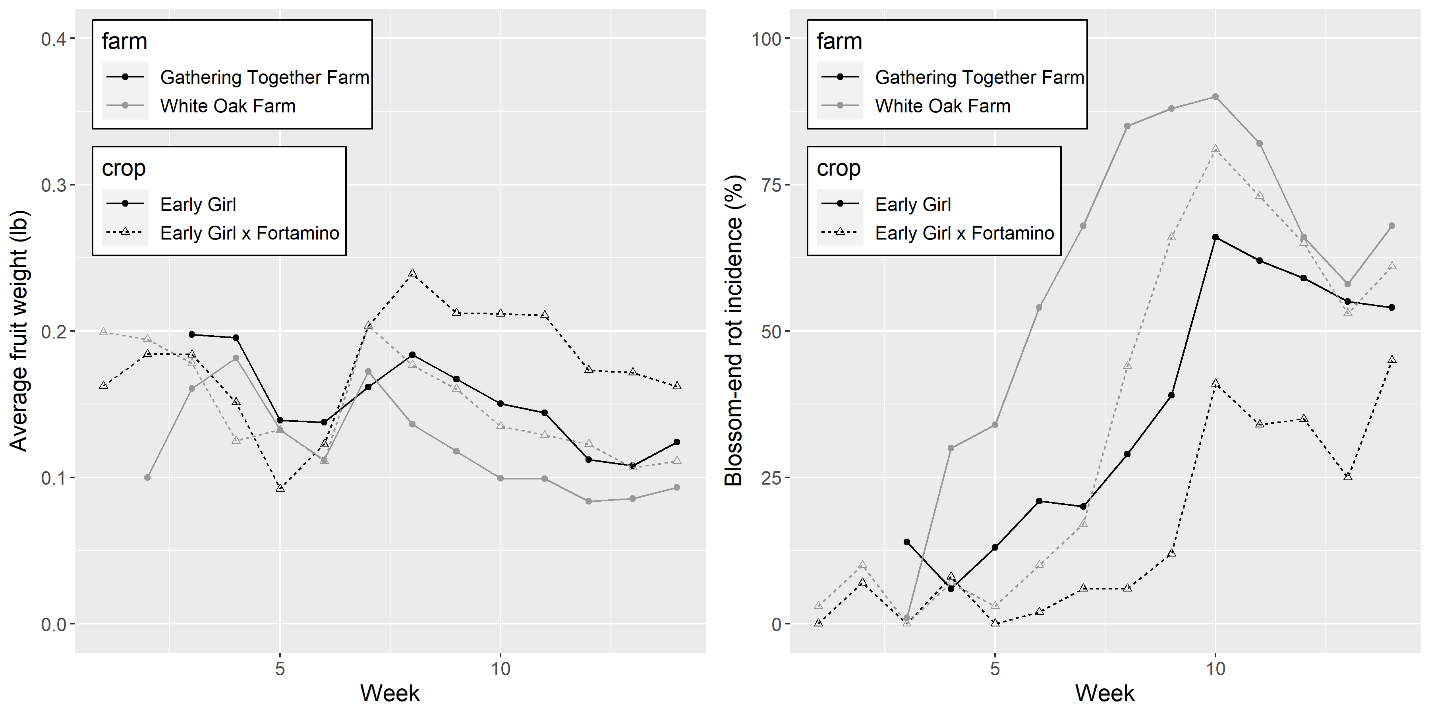
Early Girl is the variety dry-farmed widely in California and prized by chefs and consumers for its intense flavor. However, Early Girl did not typically perform well in our Oregon trials, as on hot, dry exposed Western Oregon sites it has a high incidence of blossom end rot and an unacceptably small fruit size later in the season. Figure 9 shows the average (and worst and best) values across 10 farm field sites of total and unblemished yield, fruit weight and blossom end rot incidence (Figure 9). The dramatic variation in performance is due to differences in soil type, soil nutrient contents and pH, sheltering from wind, planting date and other site factors. Grafting Early Girl onto Fortamino increased fruit size and reduced blossom end rot incidence (Figures 10 and 11), but blossom end rot incidence was still unacceptably high. Early Girl could perform well in lower temperature and higher relative humidity sites such as the coast or foothills, or sites that have been environmentally modified (see “A systems approach to successful dry-farming of Early Girl in the Willamette Valley”).
Dry-farmed tomato management
Dry-farmed tomato management is in many ways similar to irrigated tomato management, but some management factors are more critical in dry-farmed than in irrigated production systems.
Site selection
Site factors including soil-available water-holding capacity, weather and microclimate affect yield and fruit quality in dry-farmed tomato. It is important to site the field on a deep soil with high available water-holding capacity so the crop has access to stored soil water throughout the growing season. It is also important to protect the crop from strong winds, which accelerate crop transpiration. If possible, site the field in a climate or microclimate in which summer temperatures do not exceed 90° F. For more assessment factors, see How to assess a site’s suitability for dry farming in Western Oregon.
Field preparation
Conserve soil moisture during field preparation by mowing and incorporating cover crops early to prevent cover crop transpiration losses. Early incorporation also ensures that the residue has time to decompose sufficiently. Minimize tillage depth and prevent overtillage as moisture is lost to the depth of tillage. Manage weeds, as they transpire stored soil water. It is important to facilitate deep rooting, so crops have access to stored water throughout the soil profile. Do not work the soil when too wet. Remediate plow pans by ripping or growing deep-rooted cover crops in the fall before tomato planting to improve soil structure and permeability.
Nutrient management
Roots of dry-farmed tomatoes extend deeply into the soil as the crops grow over the course of the season. Some dry farmers speculate that dry-farmed crops can make use of nutrients in deep soil layers, so it isn’t necessary to fertilize the tilled layer of the soil. However, OSU research showed that fertilized dry-farmed tomato crops were higher-yielding than unfertilized dry-farm crops in soils with nutrient deficiencies. For example, one farm in 2023 developed a former pasture into a dry-farmed tomato plot. This plot was deficient in soil nutrients, with a recorded 1 part per million of weak Bray phosphorus. Researchers applied granular composted chicken manure (4-3-2; Nutririch) at rates of 0, 50 and 100 pounds, and at 50 pounds total yields tripled and marketable yields doubled.
Take representative soil samples each year before applying fertilizer the spring and send them to a soil analysis lab. Supplement the soil with nutrients reported to be insufficient for tomato production and incorporate before planting. Insufficient soil nutrients may result in lower yields and increased incidence of sunscald. Do not overfertilize with nitrogen; dry-farmed tomatoes are more susceptible to blossom end rot than irrigated tomatoes, and high N availability may increase blossom end rot incidence.
The optimum soil nutrient concentrations for dry-farmed tomatoes in Oregon have not been determined. Tomatoes are not a large acreage crop in Oregon, so there are no Oregon-specific nutrient recommendations for irrigated tomato production. Table 6 aggregates regionally relevant tomato nutrient management information for pH and macronutrients. For more comprehensive coverage of tomato fertilizer recommendations, see Nutrient Management for Commercial Fruit & Vegetable Crops in Minnesota.
Dry farmers in coastal California have recommended using fall-applied compost applications as a nutrient supply, as these applications may leach nutrients into the subsoil during the winter rains.
At the OSU vegetable research trial, a single application of granular composted chicken manure (4-3-2 Nutri-Rich) and pelletized feather meal (12-0-0; Pro-Pellet) were applied and incorporated before planting to achieve a total rate of 156 pound per acre nitrogen (1500 pounds per acre of granular chicken manure and 800 pounds per acre of pelletized feather meal) in 2020 and 2021. In 2022, this decreased to 120 pounds per acre nitrogen (1100 pounds per acre of granular chicken manure and 630 pounds per acre of pelletized feather meal).
|
pH or nutrient |
Tomato crop pH and nutrient recommendations |
|---|---|
| Soil pH | ≥6.5 1, 2 |
| Nitrogen | Tomato crop requires 100-180 lbs/acre 3 |
| Phosphorus | Apply 60-120 lbs/A if Bray test <15 ppm 3 |
| Potassium | Apply up to 120 lbs/A if extractable K <150ppm 3 |
1 See Applying lime to raise soil ph for crop production in Western Oregon, EM 9057.
2 To determine how much lime to apply, refer to Updated lime requirement recommendations for Oregon, EM 9585.
3 See Fresh-market tomato production in California and Nutrient management for commercial fruit & vegetable crops in Minnesota.
Transplant production
Produce high-quality seedlings of high-performing dry-farmed tomato varieties that can withstand planting as soon as the soil can be worked. Do not plant rootbound plants, as they may not be able to grow rapidly into moist soil. If grafting, seed scion and rootstocks for grafted plants seven to 10 days earlier than ungrafted plants, as grafting delays growth.
Transplanting
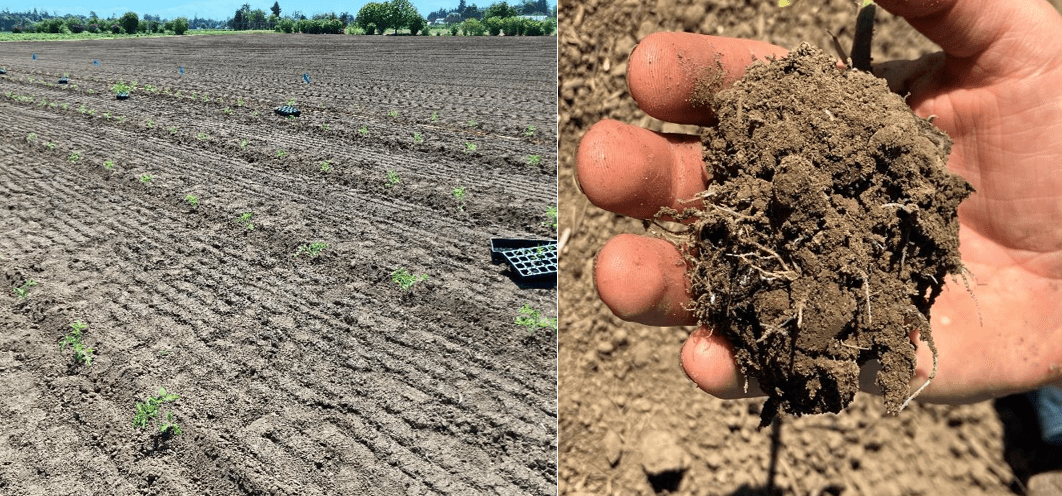
Water transplants thoroughly before planting. Transplant into the field as early as possible to capture stored soil moisture and allow the crop to establish during cooler humid weather when plant water-use efficiency is high. OSU research showed that on average, earlier-planted tomato crops outyielded later-planted crops. Plant when soil temperatures reach 60o F. In the mid-Willamette Valley of Oregon, soil temperatures generally reach this temperature in early May. Plant as deeply as possible, as stem segments will root when in contact with moist soil. Plant as deeply as necessary to ensure root ball is in contact with moist soil; firm moist soil around the root ball.
Watering in
Plants must be watered in if soil moisture is insufficient for plant establishment. Provide as much water at planting as necessary to ensure that the transplants root into moist soil and become established. Plants can be watered in with buckets, pull-tank, or drip or overhead irrigation. For farmers with irrigation capacity, irrigating to field capacity at planting has the potential to increase total yield, especially in the absence of subsequent rainfall events.
Planting density
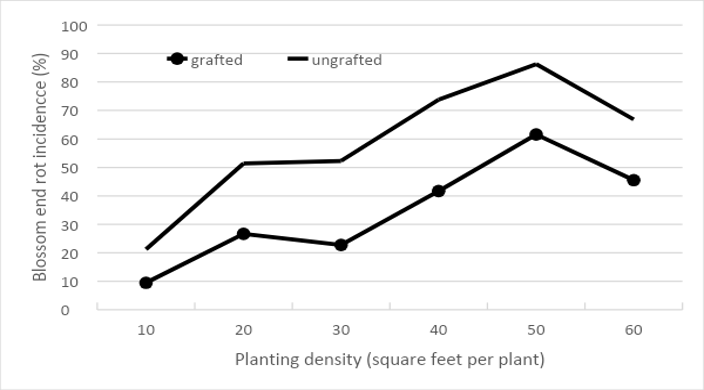
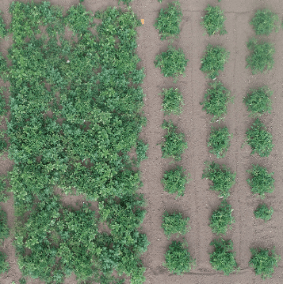
Dry-farm tomato growers in California initially grew tomatoes at low planting densities (approximately 100 square feet per plant). However, commercial dry-farm tomato growers in California now grow staked tomatoes at a much higher planting density (12 square feet per plant; six feet between rows and two feet in-row). Late-season blossom end rot incidence decreased as planting density increased in an OSU on-farm planting density experiment (Figure 12). Unstaked dry-farmed tomatoes were grown in OSU field trials at approximately 15 square feet per plant (2,900 plants per acre) with a spacing of 5 feet between rows and 3 feet within the row (see Organic Dry-Farmed Tomato Production on California’s Central Coast: A Guide for Beginning Specialty Crop Growers).
Pruning or staking
Dry-farmed tomato producers have historically grown tomatoes without support. This works because plants typically have limited aboveground foliage, making harvest easier. In addition, the soil is dry so fruit sitting on the soil surface are less likely to blemish or rot. However, most dry-farmed tomato growers in coastal California now prune and trellis their tomatoes. Pruning and staking increase average fruit size and may reduce the incidence of cracking, sunscald and gold top.. It can also facilitate harvest. The Florida weave is a commonly used and simple method for trellising field tomatoes in the field (see Organic Dry-Farmed Tomato Production on California’s Central Coast: A Guide for Beginning Specialty Crop Growers).
Windbreaks
Sheltering tomatoes from the wind and late afternoon sunlight may increase average fruit size and decrease BER incidence. Trees, shrubs or tall field crops (corn, rye) can act as windbreaks or shade structures. The effectiveness of a windbreak relates to its height, distance from the crop and porosity. As a general rule of thumb, a windbreak will protect crops for a distance of about 13 times its height. So, a 6-foot-tall corn windbreak will reduce wind speeds up to 78 feet away, though the effect diminishes with distance from the windbreak (see Effects of tree windbreak on microclimate and wheat productivity in a Mediterranean environment).
Weed management
Weeds transpire stored soil water into the atmosphere. Weeding is the most important system management strategy to conserve soil moisture. Control weeds using shallow cultivation with minimal soil disturbance. Typically, dry-farming reduces later-season weed problems as there is no irrigation applied to the soil surface to stimulate later-season weed germination.
Mulching
Both organic and plastic mulches have the potential to reduce soil evaporation, although soil evaporative losses are minor compared to transpiration losses from crops and weeds. One of the primary reasons to mulch dry-farmed tomatoes is to control weeds and thereby reduce transpiration losses. Organic mulches are diverse, and their impacts on soil physical, chemical and biological properties and crop yield will vary.
Dry-farmed tomato producers in California have used “dust mulching” to control weeds and protect soil moisture. Farmers believe that a thick dust mulch (created by tilling between the rows to a depth of 6-8 inches after rain events) reduces soil evaporation. However, in OSU research trials, there were no significant differences in tomato yield and the rate of drying of the soil profile between the dust-mulched plots and those that were clean cultivated to 1-2 inches with a wheel hoe (see How to assess a site’s suitability for dry farming in Western Oregon).
Diseases and their management
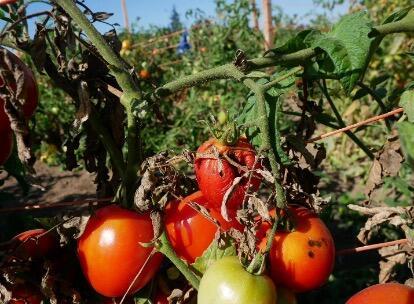
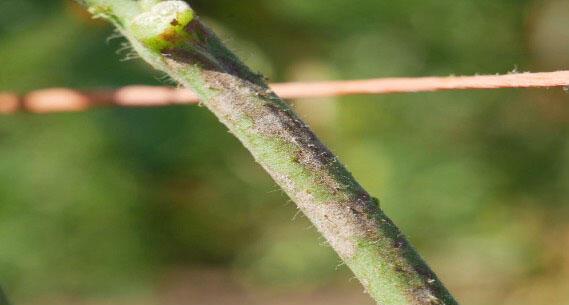
Powdery mildew (Leveillula taurica and Oidium neolycopersici) can reduce yields and fruit quality in dry-farmed tomatoes. Temperatures less than 86° F are associated with powdery mildew disease development.
Powdery mildew symptoms include light green or yellow blotches on the upper leaf surfaces that can become necrotic. Individual leaves will die but remain on the plant (Figure 14A). Areas of white spores can also occur on the stem (Figure 14B). Powdery mildew can be controlled by planting resistant tomato varieties (including grafted Geronimo F1, grafted Rebelski F1 and grafted Granadero F1), fungicides, or other management practices like controlled temperatures in greenhouse production. For more information on powdery mildew, see the PNW Pest Management Handbook.
Harvest or handling
Dry-farmed tomatoes can be harvested in the same manner as irrigated tomatoes. Gently harvest the fruit into picking totes. Do not layer ripe tomatoes. Store tomatoes in the shade after harvest. Storage duration varies by variety, temperature and ripeness at harvest.
Profitability
Table 7 (Cost and revenue analysis) shows the comparative costs associated with growing dry-farmed and irrigated tomatoes. The table uses data from the OSU 2022 and 2023 growing seasons. An important consideration in dry-farmed tomato production is low marketable yield. Dry-farmed total yields are lower than irrigated yields, and a high incidence of physiological disorders (blossom end rot, gold top) further reduce marketable yields. Fortunately, production costs can be lower in dry-farm systems. For example, in 2022, dry-farm weeding costs were half those of irrigated weeding, and in dry-farm production, there are no costs associated with irrigation. Dry-farmed tomatoes grown on suitable sites can be profitable. Harvest assumptions and time data are from actual data from the 2022 and 2023 growing seasons.
|
Dry-farmed tomato |
Irrigated tomato |
||||||
|---|---|---|---|---|---|---|---|
|
Activity |
Time |
Rate |
Cost (0.2 acres) |
Activity |
Time |
Rate |
Cost (0.2 acres) |
|
Field prep |
|||||||
| Flail mow | 0.5 hr/acre | $79/hr | $7.90 | Flail mow | 0.5 hr/acre | 79$/hr | $7.90 |
| Disk (x2) | 1 hr/acre | $79/hr | $15.80 | Disk (x2) | 1 hr/acre | 79$/hr | $15.80 |
| Power harrow | 1.75 hr/acre | $79/hr | $27.65 | Power harrow | 1.75 hr/acre | 79$/hr | $27.65 |
| Fertilizer application | 1 hr/acre | $79/hr | $15.80 | Fertilizer application | 1 hr/acre | 79$/hr | $15.80 |
| Power harrow | 1.75 hr/acre | $79/hr | $27.65 | Power harrow | 1.75 hr/acre | 79$/hr | $27.65 |
|
Planting and management |
|||||||
| Planting | 30 hr/acre | $22/hr | $132.00 | Planting | 30 hr/acre | 22$/hr | $132.00 |
| Irrigation | n/a | n/a | n/a | Irrigation setup | 1 hr/acre | 22$/hr | $4.40 |
| Weeding | 25 hr/acre | $22/hr | $110.00 | Weeding | 47 hr/acre | 22$/hr | $206.80 |
| Trellising | 24 hr/acre | $22/hr | $105.60 | Trellising | 24 hr/acre | 22$/hr | $105.60 |
|
Harvests |
|||||||
| Harvest 6 t/a | 120 lbs/hr | $22/hr | $440.00 | Harvest 32 t/a | 120 lbs/hr | 22$/hr | $2,346.67 |
| Harvest 12 t/a | 120 lbs/hr | $22/hr | $880.00 | Harvest 36 t/a | 120 lbs/hr | 22$/hr | $2,640.00 |
| Harvest 18 t/a | 120 lbs/hr | $22/hr | $1,320.00 | Harvest 40 t/a | 120 lbs/hr | 22$/hr | $2,933.33 |
|
Materials |
|||||||
|
Materials |
Quantity |
Cost per unit |
Cost (0.2 acres) |
Materials |
Quantity |
Cost per unit |
Cost (0.2 acres) |
| Transplants | 2,904 plants/acre | $1.50/plant | $871.20 | Transplants | 2,904 plants/acre | $1.50/plant | $871.20 |
| Composted chicken manure 4-3-2 | 1,100 lbs/acre | $0.21/lb | $46.20 | Composted chicken manure 4-3-2 | 1,100 lbs/acre | $0.21/lb | $46.20 |
| Feathermeal 12-0-0 | 630 lbs/acre | $0.85/lb | $107.10 | Feathermeal 12-0-0 | 630 lbs/acre | $0.85/lb | $107.10 |
| Trellising (posts and twine) | 7,260 ft/acre | $0.46/ft | $667.92 | Trellising (posts and twine) | 7,260 ft/acre | $0.46/ft | $667.92 |
|
Cost |
|||||||
|
Harvest assumption |
Cost/0.2 acre |
Yield (lbs/0.2 acre) |
Cost/lb |
Harvest assumption |
Cost/0.2 acre |
Yield (lbs/0.2 acre) |
Cost/lb |
| Harvest 6 t/a | $2,574.82 | 2,400 | $1.07 | Harvest 32 t/a | $4,582.69 | 12,800 | $0.36 |
| Harvest 12 t/a | $3,014.82 | 4,800 | $0.63 | Harvest 36 t/a | $4,876.02 | 14,400 | $0.34 |
| Harvest 18 t/a | $3,454.82 | 7,200 | $0.48 | Harvest 40 t/a | $5,169.35 | 16,000 | $0.32 |
Putting it all together: A systems approach to successful production of Early Girl in the Willamette Valley — Gathering Together Farm, Philomath, Oregon
Gathering Together Farm in Philomath, Oregon, developed a productive multi-component dry-farm tomato system during 2018-2022. Their location in west Philomath is in the foothills of the Coast Range, which is cooler and wetter than the floor of the valley. The 30-year normal for July–August high temperature is 82oF , and annual rainfall is 46.4 inches. Each year, the crops were planted in different locations in the same field. The field is protected on three sides by tall trees which shielded the crop from wind and provided either morning or afternoon shade, generating a microclimate that reduced crop transpiration losses. Overhead irrigation applied to other crops in this field raised relative humidity intermittently throughout the season, further reducing transpiration losses. The soil series is Redbell, which with 11.8 inches of plant available water (available water-holding capacity) is considered one of the best soils in the area for dry farm production. The field has a long history of organic production and high-rate compost applications. The soil pH was 6.4 and nutrient contents were at or above sufficiency, so nutrients were not limiting.
The 2020 planting (Figure 16) was planted near the treeline to the west, which shaded the crop in late afternoon. Vigorous grafted Early Girl (on Fortamino rootstock) tomato transplants were planted into black plastic with drip tape, and drip irrigation was applied once after planting to completely fill the soil profile with water. The black plastic suppressed weeds to prevent soil moisture loss through weed transpiration. Plants were allowed to sprawl. Early Girl has a thick skin and fruit can be left on the plant all season while retaining fruit quality.
To save on labor costs, the entire tomato crop was picked in a single September harvest. In grafted Early Girl research plots adjacent to the commercial field, blossom end rot incidence was 9%, which is low for dry-farmed Early Girl production in the Willlamette Valley.
References and resources
Dry farming
Garrett, A., 2019. Dry farming in the maritime Pacific Northwest: Intro to dry farming organic vegetables, EM 9229
California Ag Water Stewardship Initiative. Dry farming.
Campi, P., A.D. Palumbo, M. Mastrorilli. 2009. Effects of tree windbreak on microclimate and wheat productivity in a Mediterranean environment. European Journal of Agronomy. 30(3):220–227.
Davis, M., A. Stone, A. Gallagher, A. Garrett, L. Nebert, 2025. How to assess a site’s suitability for dry farming in Western Oregon. Oregon State University Extension Publication
Davis, M., A. Stone, A. Gallagher, A. Garrett. 2023. Site Factors Related to Dry Farm Vegetable Productivity and Quality in the Willamette Valley of Oregon. HortTechnology. 33(6):587–600.
The Water Stewardship Project, Ecological Farming Association. Dry farming at Molino Creek Farming Collective.
Leap, J. 2016. Overview of dry farming on the Central California Coast. Supplement 4, Unit 1.5: Irrigation, principles and practices in Teaching organic farming and gardening: Resources for instructors. Santa Cruz, CA: Center for Agroecology and Sustainable Food Systems.
Leap, J., D. Wong, and K. Yogg-Comerchero, 2017. Organic Dry-Farmed Tomato Production on California’s Central Coast: A Guide for Beginning Specialty Crop Growers. Center for Agroecology and Sustainable Food Systems Grower Guide. UC Santa Cruz.
Tomato production
CasaBarone, 2014. Il pomodorino del Piennolo del Vesuvio DOP. Video. Turn on translation for closed captions in English.
Davis, M., 2023. The blossom end rot toolkit – 2023 season report. Oregon State University Department of Horticulture.
Diver, S., 2012. Organic tomato production. NCAT.
Le Strange, M., W.L. Schrader and T.K. Hartz. 2000. Fresh market tomato production in California. University of California Division of Agricultural and Natural Resources Publication 8017.
PNW Pest Management Handbooks, 2025. Tomato – powdery mildew.
Riboldi LB, Araújo SH da C, Freitas ST de, Castro PRC. 2020. Fruit shape regulates susceptibility of tomato to blossom-end rot. Acta Scientarium, Agronomy 42:e42487.
Nutrient management
Anderson, N., J.M. Hart, D.M. Sullivan, N.W. Christensen, D.A. Horneck and G. Pirelli. 2013, reviewed 2021. Applying lime to raise soil ph for crop production in Western Oregon, EM 9057.
Collins, D., C. Miles, C. Cogger and R. Koenig, 2013. Soil fertility in organic systems: A guide for gardeners and small acreage farmers, PNW 646.
Davis, M., A. Gallagher, A. Garrett. In press. Floor management and amendment applications affected dry-farmed tomato production in a 2020 experiment in the Willamette Valley of Oregon, USA. HortTechnology.
Gaskell, M., R. Smith, J. Mitchell, S.T. Koike, C. Fouche, T. Hartz, W. Horwath, L. Jackson. 2007. Soil Fertility Management for Organic Crops. University of California Division of Agriculture and Natural Resources Publication 7249.
Le Strange, M., W.L. Schrader and T.K. Hartz. 2000. Fresh Market Tomato Production in California. Pub. 8017. University of California Division of Agriculture and Natural Resources.
Moore, A. 2024. Updated lime requirement recommendations for Oregon, EM 9585. Oregon State University Extension.
Rosen, C.J., and R. Eliason. 2005. Nutrient Management for Commercial Fruit & Vegetable Crops in Minnesota. University of Minnesota Extension Service.
Sullivan, D.M., E. Peachey, A.L. Heinrich, L.J. Brewer. 2017. Nutrient management for sustainable vegetable cropping systems in Western Oregon, EM 9165. Oregon State University Extension Service.
Tomato grafting
Davis, M., A. Stone, L. Selman, P. Merscher, A. Garrett. 2024. Grafting onto tomato rootstocks improves outcomes for dry-farmed tomato. HortTechnology. 34(3):313–321.
Waterman, C., and M. Davis. 2022. The principles of tomato grafting. Oregon State University.
Vegetable grafting. USDA.
