CORVALLIS, Ore. — There’s a coffee shop in downtown Albany that is known for its sweet treats in addition to its specialty brews.
The cookies at Margin Coffee Roasters had a lot to do with a recent $8.7 million wildfire risk reduction grant awarded to the Sweet Home Fire and Ambulance District, according to Kayla Bordelon, Oregon State University Extension Service regional fire specialist for the Willamette Valley and north Cascades.
Bordelon and Shannon Richardson, director of the South Santiam Watershed Council, who were among the primary writers of the grant proposal, scheduled their caffeine- and chocolate-fueled “write-ins” at Margin.
“They have the best chocolate chip cookies,” Bordelon said.
As they stared down the proposal deadline in early March, Bordelon and Richardson were joined by fellow grant writers Kate Bentz, associate planner for the Linn County Planning Department; Christian Whitfield, division chief of wildland operations for the Sweet Home Fire District; and Stephanie Stafford, fire risk reduction specialist for the Oregon Department of the State Fire Marshal.
A five-year plan rooted in local priorities
The $8.7 million federal Community Wildfire Defense Grant (CWDG) will fund a five-year project to reduce wildfire risk in eight eastern Linn County communities — Cascadia, Sweet Home, Lacomb, Holley, South Lebanon, Crawfordsville, Sodaville and Waterloo. It is the second multimillion-dollar award Bordelon has helped secure in her service area, following a $6 million grant to Wasco County in 2024, also through the CWDG Program.
The work will bring together fire districts, local and state agencies, watershed councils and community groups to create defensible space around more than 325 homes, offer free chipper days for debris removal, conduct 850 home wildfire risk assessments and deliver fire education to nearly 1,000 students each year.
Bordelon said the approach to successful grant-writing is straightforward — follow the application directions, connect local projects to state and national strategies, and replace “wish lists” with strategic and coordinated plans.
As a regional fire specialist serving nine counties, she helps align partners so the proposal reflects shared priorities across the landscape.
“This proposal really came together because everyone brought their piece to the table,” Whitfield said. “Kayla helped keep the group focused and connected. Her coordination made it possible to turn a lot of good local ideas into one strong, unified proposal.”
Previous success in Wasco County
Before the Linn County effort, Bordelon helped local partners in Wasco County secure nearly $6 million through a CWDG grant to address one of the state’s most wildfire-prone areas. CWDG grants were created by the 2021 Bipartisan Infrastructure Law.
That project funded a full-time county wildfire coordinator, fuels-reduction work and a forest health assessment across private, non-industrial lands.
The experience reinforced the value of building local capacity and using clear data to guide decisions. Those lessons — invest in people, engage communities early and base projects on an adopted plan — helped inform the Linn County proposal, according to Bordelon.
Turning a planning update into action
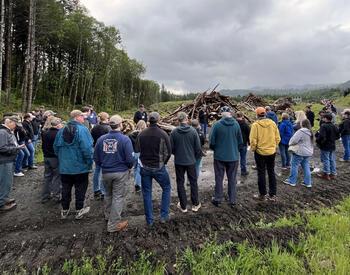
When Bordelon began working with Linn County, officials were updating their Community Wildfire Protection Plan. She helped coordinate a robust stakeholder process led through the planning department and, once the plan was adopted, hosted monthly stakeholder meetings at the Oregon State Extension office in Tangent to move from plan to action through the development of this funding proposal.
The team focused on high-risk areas and emerging local capacity, such as the Sweet Home Fire District’s fuels-reduction crew. Partners mapped overlapping needs on a whiteboard, streamlined requests to avoid duplication and played to each organization’s strengths.
Bentz, at the Linn County Planning Department, led the risk assessment and plan update that served as the roadmap for the grant.
After nine months of meetings, drafting and revisions, the application was submitted in March.
Collaboration at the core
With the grant awarded, Bordelon’s role centers on facilitation and education. OSU Extension didn’t request funding but will help coordinate public engagement through the Linn Wildfire Mitigation Group. Plans call for six public events each year, ongoing one-on-one support for residents and continued coordination among agencies.
Much of the work will focus on vegetation management — one of the most effective ways to reduce community wildfire risk. The Sweet Home Fire and Ambulance District is the primary recipient. Sub-awards will support the Oregon Department of Forestry, Lebanon Fire District, the South Santiam and Calapooia watershed councils, and the Linn County Juvenile Department.
Bordelon said the grant proposal process might seem tedious from the outside, but the attention to detail and collaboration pay off.
“It’s not glamorous work,” she said. “But it’s the work that gets real things done.”