
Pruning involves removing the lower branches of trees. Increasing the distance between the ground and the lowest tree branches reduces the likelihood that a fire on the ground will use the branches as a ladder to move into tree crowns. A crown fire is more difficult to control and can advance much more rapidly than a surface fire under certain weather conditions.
Pruning is a particularly effective fuels-reduction technique when combined with other forms of treatment such as thinning.
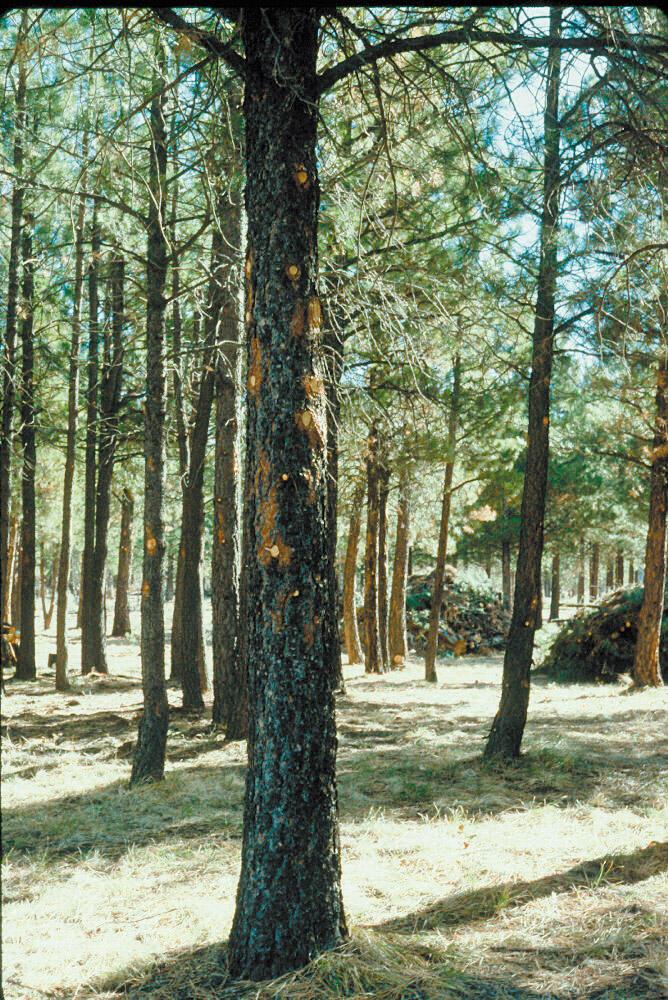
Dead and live branches are removed with a handheld pruning saw or with loppers. A pole saw allows you to remove branches up to 10 feet from the ground (Figure 1). Pruning can be done on sapling-size and larger trees. To maintain tree vigor, pruning should remove no more than 50% of the live crown.
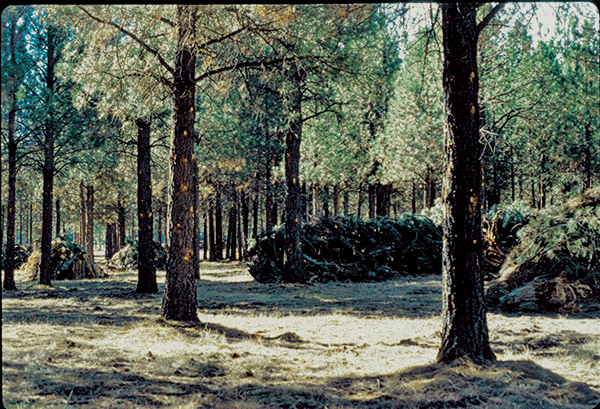
Pruning adds fuel to the forest floor. To reduce the risk of this added fuel, chip and scatter the branches, or pile and burn them (Figure 2). Make burn piles in openings away from trees to avoid scorching tree crowns.
Commercial pruning costs range from $50 to $250 per acre, depending on pruning height and the number of trees per acre to be pruned. Pruning is particularly cost-effective around structures, where other forms of fuels reduction might be too dangerous or otherwise impractical.
Pruning guidelines
- To remove ladder fuels, prune limbs up to 8 to 10 feet from the ground.
- Avoid pruning more than 50% of the live crown at any one time. Be sure to leave the tree with at least a one-third live-crown ratio (that is, with a live, green crown that is at least one-third of the tree’s total height).
- Use a sharp tool and make clean cuts.
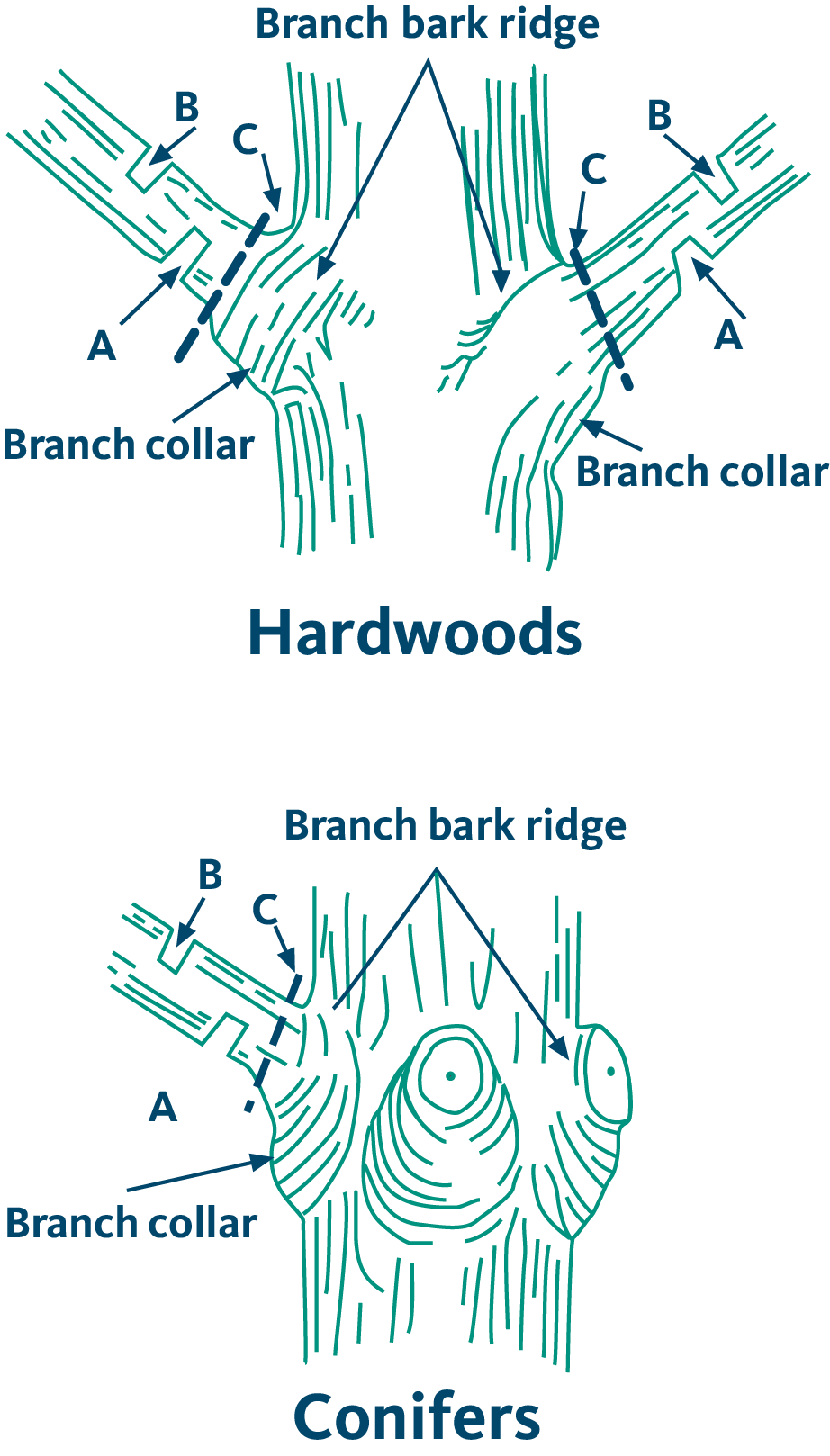
- Use proper pruning techniques; avoid flush cuts and “coat hangers” (Figure 4).
- In hardwoods, prune during the dormant season.
- In conifers, avoid pruning in spring and early summer, when the sap is flowing, to reduce the potential for pitch moth attack.
- Don’t paint pruning wounds with dressing. It’s not effective and might even seal in decay organisms.
- Dispose of pruning slash to reduce fire risk.
Considerations in pruning
- Objective and effectiveness: Remove ladder fuels. This is particularly effective around structures and in young stands where live branches are low.
- Whether other treatment is required: You may want to chip pruned branches or pile and burn them.
- Proximity to a home
- Equipment needed: Loppers, pruning saw or pole saw
- Suitable vegetation types: All conifer and broadleaf trees
- Topography limit: None
- Suitability in riparian zone: Suitable
- Production potential (number of trees per day): Depends on pruning height and number of trees per acre
- Cost range: $50–$250 per acre
- Site disturbance: Minimal
- Insects and diseases: Best done October–February when pitch flow, which can attract harmful insects, is minimal.
- Maintenance: Repeat every three to five years until the lowest branch is above the reach of the pole saw
Related publications


