Contents
Potato tubers are susceptible to damage from environmental conditions, insect pests, and pathogens. This publication will help you diagnose common abnormalities of potatoes grown in western Oregon and Washington. In this region, potatoes exhibit abnormalities not typically found elsewhere.
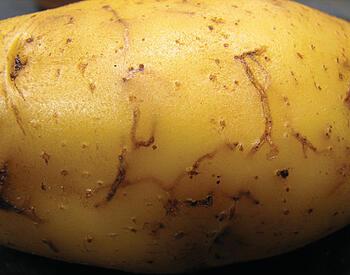
For example, tuber flea beetle larvae can cause extensive damage to potato tubers—in extreme cases rendering almost the entire crop unmarketable. This pest is not important in many other production regions, and the damage can be difficult to distinguish from wireworm injury. In addition, potatoes grown on heavier textured soils in our area exhibit moisture-related abnormalities such as elephant hide and enlarged lenticels, both of which can be confused with scab. For these reasons, tuber diagnosis is more difficult for farmers here. If you don’t find the abnormality you are observing in your crop in this publication, see “Additional information”.
Seed type and quality, environmental conditions, and production practices affect the incidence and severity of many tuber abnormalities. Appropriate seed selection and good management practices can improve tuber quality. For information on how to prevent or minimize the occurrence of abnormalities described in this publication, see the “More Information” resources suggested throughout this publication.
How to diagnose tuber problems
When diagnosing abnormalities, it is important to know what a normal, healthy tuber of the same variety looks like. The appearance of normal tubers can vary significantly by variety. Some specialty varieties normally have knobs, flaky or rough skin, or large lenticels.
It is important to determine whether the cause of a problem is living (biotic) or nonliving (physiological). Generally, biotic causes of plant problems develop gradually, progressively spreading to other plants or tubers. These problems exhibit nonuniform patterns both in the field and on the plant foliage or tuber. Examples of biotic problems are tuber flea beetles, wireworms, and late blight. In contrast, physiological causes often develop more rapidly, and symptoms exhibit more uniform patterns. Examples of physiological tuber problems are cracking, hollow heart, and elephant hide.
Diagnosis of plant problems during the season provides some insight into likely causes of tuber damage. For example, tuber flea beetle foliar damage is an indication of possible tuber flea beetle damage in the tubers from that field. If foliage dies from late blight, the tubers in that field are at increased risk for tuber late blight. Foliar damage monitoring, diagnostics, and record-keeping can help you diagnose tuber damage.
Use this publication as a first step in identifying abnormalities. If you cannot make a diagnosis after consulting this publication and the recommended resources, submit a tuber sample to your plant pest diagnostic clinic or local Extension agent for diagnosis (Clinic contact information in "Additional information" section).
Insects
Flea beetles
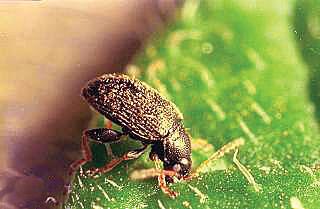
Organism: Several species of flea beetles can be found on potato vines, but the tuber flea beetle (Epitrix tuberis) is the most common species that damages tubers in the Pacific Northwest (Figure 1). Flea beetle adults are about 1/16 inches long and jump relatively large distances when disturbed. Tuber flea beetles are common pests of potatoes and other Solanaceous crops in western Oregon.
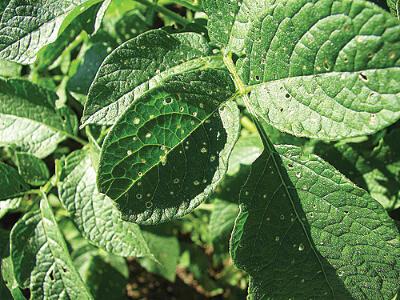
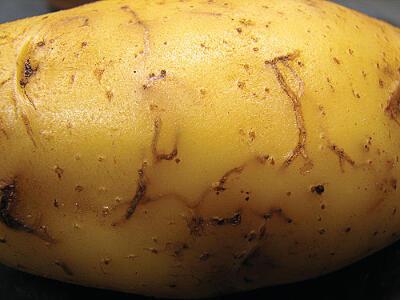
Symptoms: Adults feed on the foliage, giving leaves a characteristic shot-hole appearance (Figure 2). Eggs are laid near plant stems, and larvae feed on tubers. Flea beetle larvae generally cause thin tracks on the surface of tubers and do not burrow deep into the flesh (Figure 3). Damage often is worse at the edge of a field since adults migrate in from field margins. Damage also progresses during the season as larvae grow and feeding intensifies.
More information: Flea beetle identification, life history, monitoring, and management strategies are described in Flea Beetle Pest Management for Organic Potatoes (EM 8947), a companion publication in this series.
Wireworms
Organism: Wireworms are the larval stage of “click” beetles in the family Elateridae. Several species can damage potato tubers in Western Oregon. Limonius species, the Pacific Coast wireworm (L. californicus) and the sugar beet wireworm (L. canus), are often important in this area.
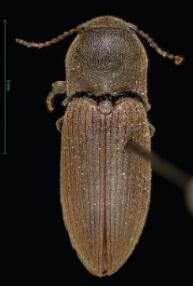
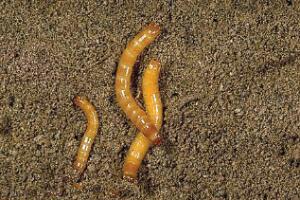
In 2006, invasive European wireworm species (Agriotes spp.) were found at several sites in the Portland area. These introduced species have been moving south from British Columbia and may become more important over time. Adult “click” beetles have a slender, black body about 1/3 to 3/4 inches long (8–20 mm) (Figure 4). Larvae are about 1/16 inches long after hatching and 11/2 inches long or more at maturity (2 mm– 4 cm). They are slender and shiny yellow to light brown with a hard cuticle and three pairs of small legs near the head (Figure 5). Larvae live from two to five years in the soil.
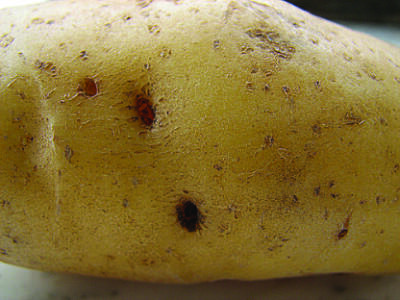
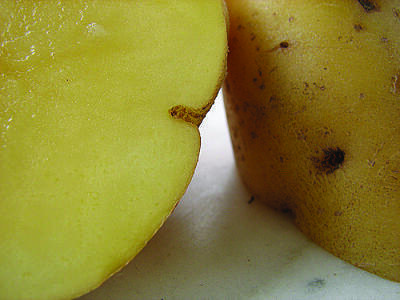
Symptoms: Tuber damage is caused by wireworm larvae. Damaged tubers appear in irregular patterns in the field, depending on the distribution of larvae. Wireworms tunnel into tubers, producing holes about 3 mm in diameter (Figures 6 and 7). The tunnels can be fairly shallow or extend through the entire tuber.
Diseases
Early blight
Organism: Early blight is caused by the fungus Alternaria solani.
Symptoms:
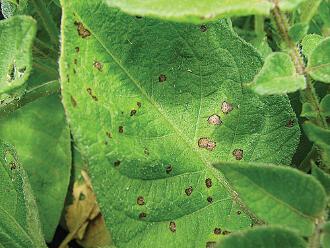
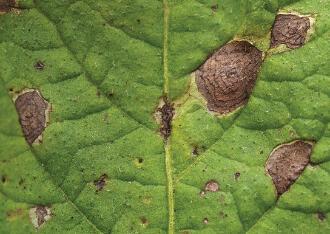
- Foliar: Early blight often develops on aging or nitrogendeficient vines. On leaves and stems, the lesions first appear as small black or brown spots 1 to 2 mm in diameter (Figure 8). As lesions develop, they form concentric black and brown rings (“target spot”) with yellow halos. The lesions typically are bordered by leaf veins (Figure 9).
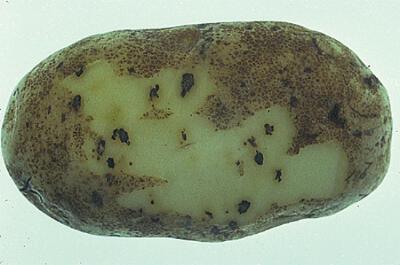
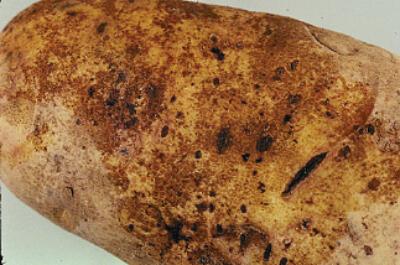
- Tuber: Tuber damage is less common than leaf infection, but can develop over time in storage. Tuber lesions begin as sunken brown or black spots that penetrate the flesh of the tuber, developing into dry, brown, corky tissue (Figures 10–12).
More information: Michigan State University Extension Bulletin E-2991.
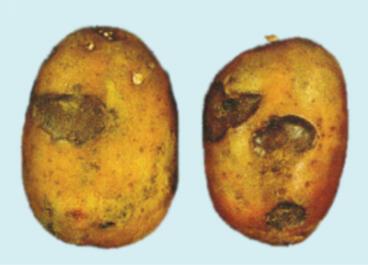
Late blight
Organism: Late blight is caused by the fungus-like organism Phytophthora infestans.
Symptoms:
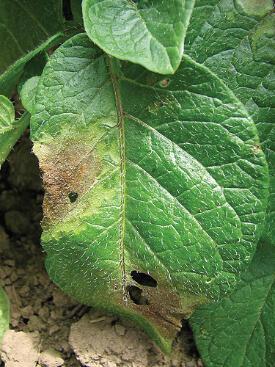
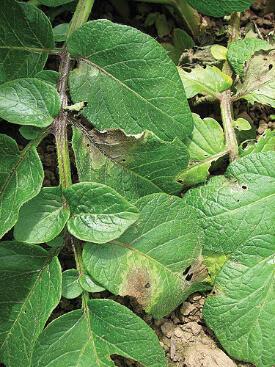
- Foliar: Late blight appears on leaves as pale green, water-soaked spots surrounded by a yellowish-green border (Figure 13). Lesions, which are not delimited by leaf veins, become dark brown to purplish-black. During periods of high humidity and leaf wetness (for example, early in the morning), a cottony, white mold usually is visible on the edge of lesions on lower leaf surfaces. Infected stems are brown to black (Figure 14), and entire vines may be killed rapidly under cool, wet conditions.
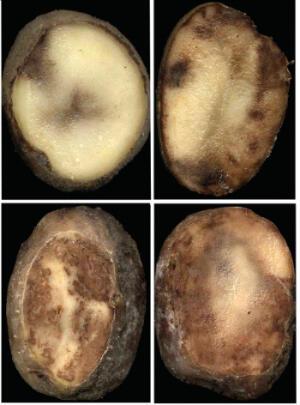
- Tuber: Late blight appears as a copper-brown dry rot in tuber tissue. On the surface, the rot is brown, dry, and sunken. Beneath the skin, decay is granular and copper-brown (Figure 15). Late blight tuber infection frequently is followed by other invasive organisms, especially soft rot bacteria.
See also Managing late blight on irrigated potatoes in the Pacific Northwest (PNW 555).
Fusarium dry rot
Organism: Dry rot is caused by several Fusarium species, including F. sambucinum, F. solani, and F. avenaceum.
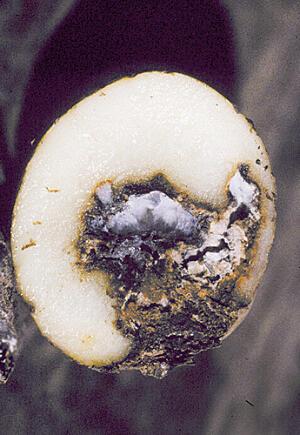
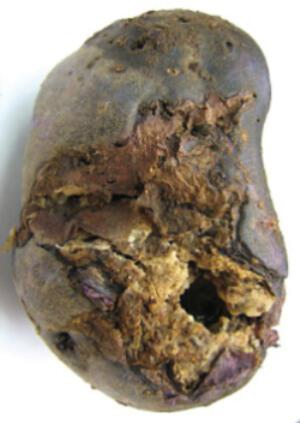
Symptoms: Dry rot pathogens typically gain entry to tubers when tubers are damaged during harvest or storage. Infections start as small, brown discolorations at a bruise or other wound. Fusarium dry rot is easily identified in storage by the dry, crumbly decay of the tuber and the presence of reddish, white, yellow, or tan fungal mycelium (Figures 16 and 17). Dry rot may be associated with wet Erwinia (soft rot) bacterial infections.
More information: See also Fusarium Dry Rot. Michigan State University Extension bulletin E-2992.
Black scurf
Organism: Black scurf is caused by the fungus Rhizoctonia solani.
Symptoms:
- Tuber: Black scurf appears as brown or black, durable, raised masses on the surface of the tuber (Figure 18). These masses are the resting structures of the pathogen, called “sclerotia.” The sclerotia may look like small clumps of soil, but, unlike soil, they are very difficult to remove. Rhizoctonia often is described as “the dirt that won’t wash off.”
- Foliar: This pathogen causes another disease, Rhizoctonia stem canker, which affects potato sprouts as they begin to grow from the seed piece through the soil. For diagnostics and management of this disease, see Rhizoctonia Stem Canker and Black Scurf of Potato. Michigan State University Extension bulletin E-2994.
Silver scurf
Organism: Silver scurf is caused by Helminthosporium solani.
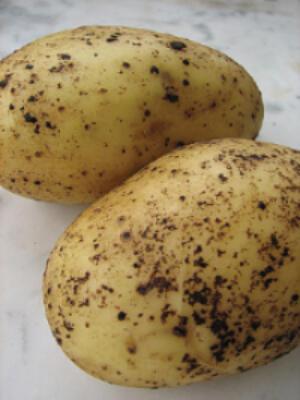
Symptoms: When infection occurs in the field, silver scurf appears as silvery irregular lesions, or as a silvery “sheen” on smooth-skinned potatoes (Figure 19). The silvery appearance is more visible on wet tubers. Silver scurf also can spread and infect tubers in storage; storage lesions typically are smaller and individual (Figure 20).
More information: Silver Scurf Management in Potatoes. PNW 596.
Common scab
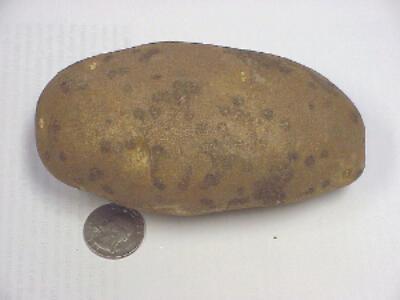
Organism: Scab is caused by Streptomyces scabies, a fungus-like bacterium.
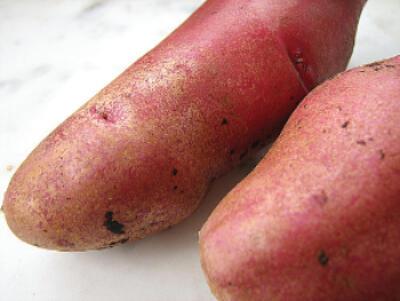
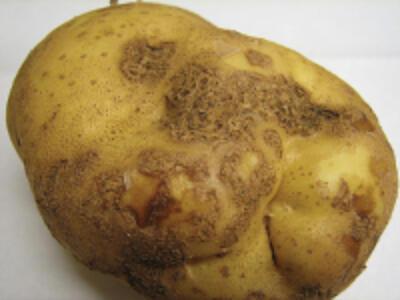
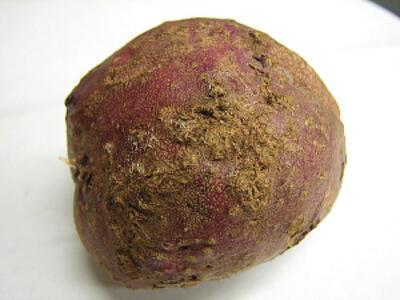
Symptoms: Scab appears on tubers as corky-appearing surface lesions (Figure 21), raised lesions (Figure 22), or pitted lesions (not shown). Sometimes scab lesions are difficult to distinguish from russeting and elephant hide.
More information: Michigan State University Extension bulletin E-2990.
Physiological disorders
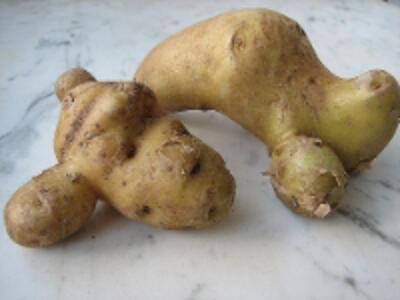
Growth cracks and secondary growth
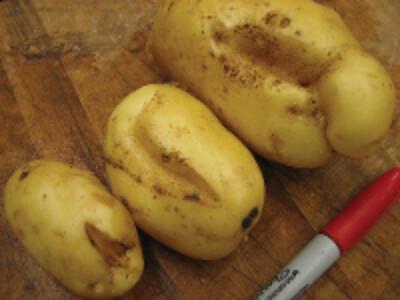
Tuber cracking (Figure 23) occurs when the potato splits while still growing. These cracks generally start at the bud or apical end of the potato and extend lengthwise. Unlike cracks from mechanical injury, growth cracks typically are well-healed with intact skins. Secondary growth (Figure 24) refers to knobs that grow from lateral buds.
Cause: Both of these physiological problems are related to fluctuations in soil moisture and rapid, uneven uptake of water. Dry periods or periods of high temperature followed by rain can also cause growth malformations. Maintaining proper soil moisture during the season can reduce the incidence of growth problems. This is especially important during the bulking stage, when plants are large and tubers are expanding rapidly.
Hollow heart
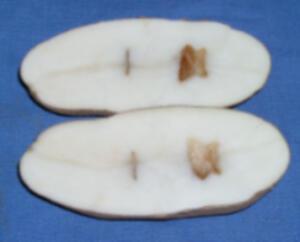
Hollow heart (Figure 25, with growth cracks) is a discolored lens- or star-shaped cavity found in the center of an otherwise healthy tuber.
Cause: Hollow heart is associated with rapid tuber growth after cool temperatures and moisture stress (too much or too little water). Large tubers usually, but not always, are more susceptible than small tubers.
Elephant hide
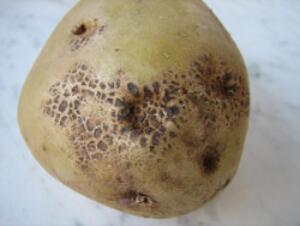
A rough, irregular surface of the tuber skin is referred to as elephant or alligator hide (Figure 26). The disorder is shallow and appears scaly or crackled.
Cause: The primary cause of this condition is unknown, but contributing factors may include high temperature, variety, high soil organic matter content, and excessive soil moisture and fertilization. Some researchers speculate that elephant hide is caused by uneven growth of the tuber.
Enlarged lenticels
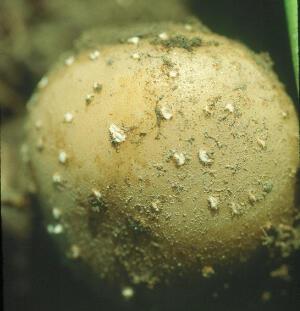
Lenticels are openings (ruptured stomates from tuber skin expansion) on the potato that allow for air exchange. They can become enlarged when exposed to waterlogged soils or prolonged wet conditions. Enlarged lenticels look like small, white bumps on the surface of the tuber (Figure 27).
Cause: Oxygen availability drops in saturated soils or when tuber surfaces remain wet for extended periods of time in storage; in response, lenticels open and become enlarged. This disorder is not merely superficial, as it increases susceptibility to the entry of disease organisms, especially soft rot.
Greening
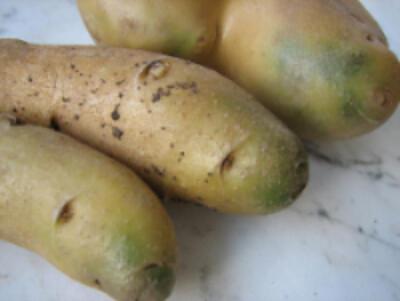
A green hue on the tuber surface is referred to as “greening” and indicates the accumulation of chlorophyll (Figure 28).
Cause: Potato tuber exposure to light in the field causes the formation of a green pigmentation on the potato. This occurs when sunlight directly contacts tubers growing at or near the soil surface or reaches tubers through cracks in the soil surface. Greening typically affects a limited part of the tuber. The same effect can be caused by extended exposure to low light levels in storage or on store shelves. In this case, the result typically is a lighter, more diffuse coloration on the entire tuber.
Additional information
- University of California-Davis IPM Online Statewide Integrated Pest Management Program.
- Oregon State University’s comprehensive website on potato production.
- J.C. Stark and S.L Love. 2006. Potato Production Systems. University of Idaho.
- PNW Plant Disease Management Handbook.
- PNW Insect Management Handbook.
Western Oregon and Washington plant diagnostic clinics
Acknowledgment
This bulletin was developed by OSPUD, a collaboration among Oregon State University and 11 farmers operating diversified organic vegetable farms. The first two years of OSPUD were supported by Western SARE Grant SW05-091.
About the authors

Related publications