Introduction
Farmers in the Willamette Valley of Oregon are growing and selling dry-farmed melons (Cucumis melo) and watermelons (Citrullus lanatus). Dry farming is the production of summer crops without irrigation during a dry summer growing season.
Farmers, retailers, wholesalers and consumers are increasingly interested in dry-farmed melons because some perceive them as sweeter and more flavorful than irrigated melons. Additionally, dry farming decreases weed seed germination, and this has made some organic growers interested in using dry-farmed melons as a rotation to help reduce weed pressure in their fields.
Finally, many farmers in Western Oregon have land with junior water rights or with no water rights. Water rights in Oregon are based on the doctrine of prior appropriation, meaning that those farmers with junior water rights will be the first to have their water shut off in times of low stream flows. Farmers without water rights cannot use water for irrigation. Therefore, some farmers are interested in developing crops that can be grown without irrigation.
The Oregon State University Vegetable Group conducted dry-farmed melon trials in 2022 and 2023. The goals of these trials were to identify high-performing varieties (in terms of both yield and quality) and to help farmers understand how site selection, planting density and grafting affect yield and quality. The trial in 2022 was a simple variety trial with 36 different varieties and two grafted varieties. In 2023, trials included:
- An expanded variety trial with 70 different varieties (including 22 from the previous year).
- A trial of 10 grafted varieties.
- Four on-farm trials of 10 varieties.
- A planting density trial.
- A serial planting trial.
The first section of this publication will cover melon market classes and recommended varieties, the second section will cover the effect of grafting, the third section will cover site suitability for dry-farmed melon production, and the fourth section will cover practices necessary for the production of dry-farmed melons.
Based on two years of OSU trialing, the 21 melon and watermelon varieties listed in Table 1 are recommended for Western Oregon dry farm production. These melons were selected based on yield, flavor, quality at harvest, farmer recommendation or some combination of those four factors.
Section 1: Market classes
and recommended varieties
Melon varieties can be sweet or bland, aromatic or odorless, ephemeral or highly storable. Market class is a common way of categorizing the diversity of melons and is, in part, a reflection of genetics and horticultural properties. Market classes often share similar traits. For example, some, like cantaloupe, are easy to judge as ripe, while others, like honeydew and watermelons, are more challenging. An understanding of how these market classes differ can help farmers select, grow, harvest and market varieties for their dry farm system.
Melon market class: reticulatus — American cantaloupes
American cantaloupes are reliably found at Pacific Northwest farmers markets towards the end of summer. This market class produces climacteric fruit, which are characterized by their strong fragrance (abundant VOCs), netted rind, high sugar content and medium to short shelf life.
Ripeness: It is easy to tell if an American cantaloupe is ripe. Many varieties slip or fall off the vine when they are ripe and must be sold soon after to prevent spoilage. However, this is not true for every variety, and some must be clipped from the vine. Additional signs of ripeness in the field include a change in color and strong fragrance.
Off-flavors: Some of the varieties of cantaloupe and charentais melons developed off-flavors/aromas in these trials, including Sugar Cube (F1) and Anna’s Charentais (F1), though these were noticeable only at the end of the growing season in 2022. Sugar Cube (F1) was reevaluated in 2023, and none of the fruit had off-flavors.
Recommended varieties:
- True Love (F1) was a standout variety in both years of trials, with good storage, flavor and high yields (photo in Figure 1). It was the highest-yielding cantaloupe in on-farm trials and the best-ranked melon at a retailer and wholesaler focus group.
- Sarah’s Choice (F1) yielded 8.3 tons per acre in 2023 and was popular in taste tests with OSU staff.
- Melonade (F1) looks like a cantaloupe but may not technically be a cantaloupe as it has little aroma. Its sweet and sour flavor made it a hit at tastings (photo in Figure 1). It yielded 14.2 tons per acre in 2023 without any blemishes.
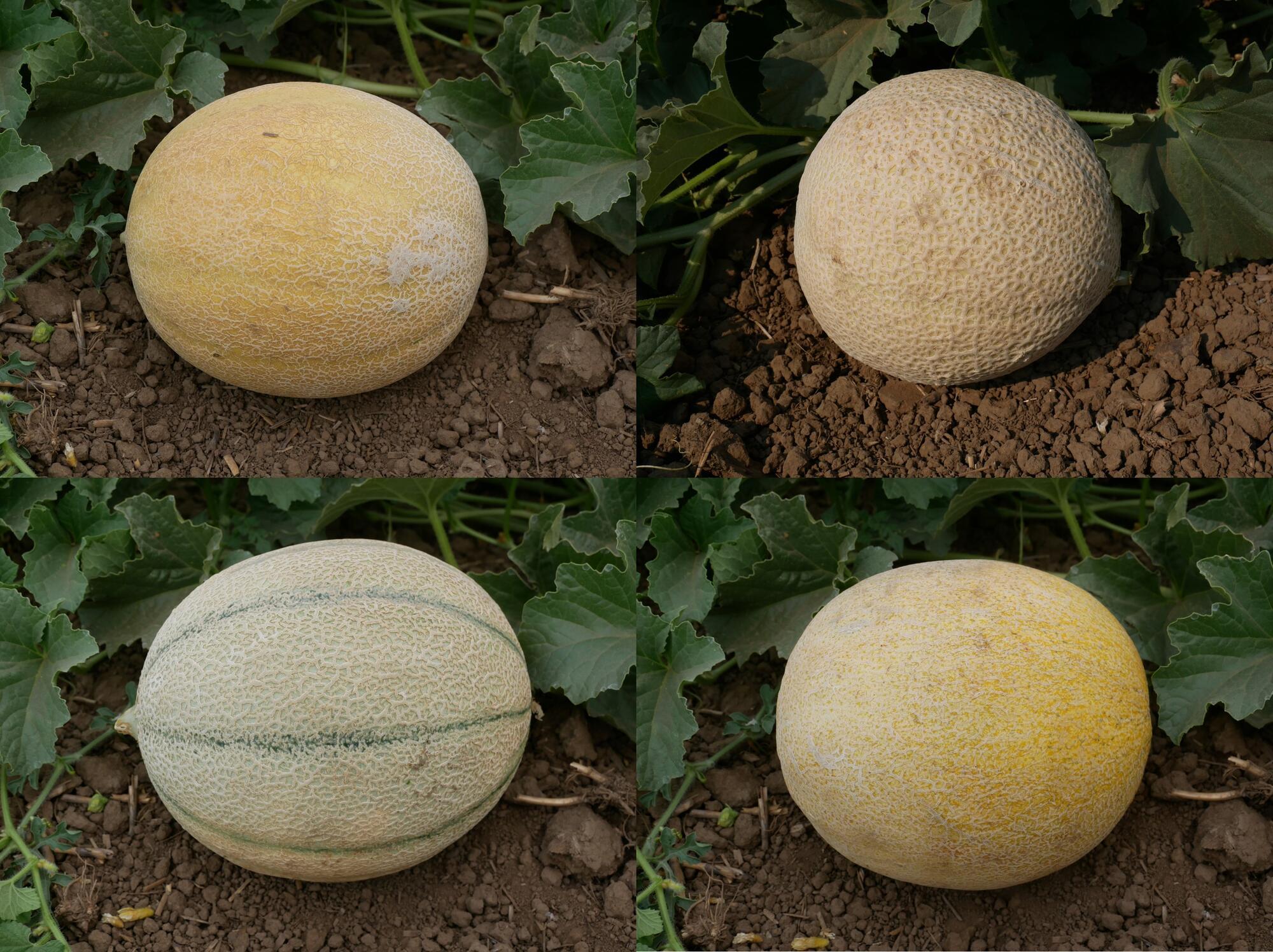
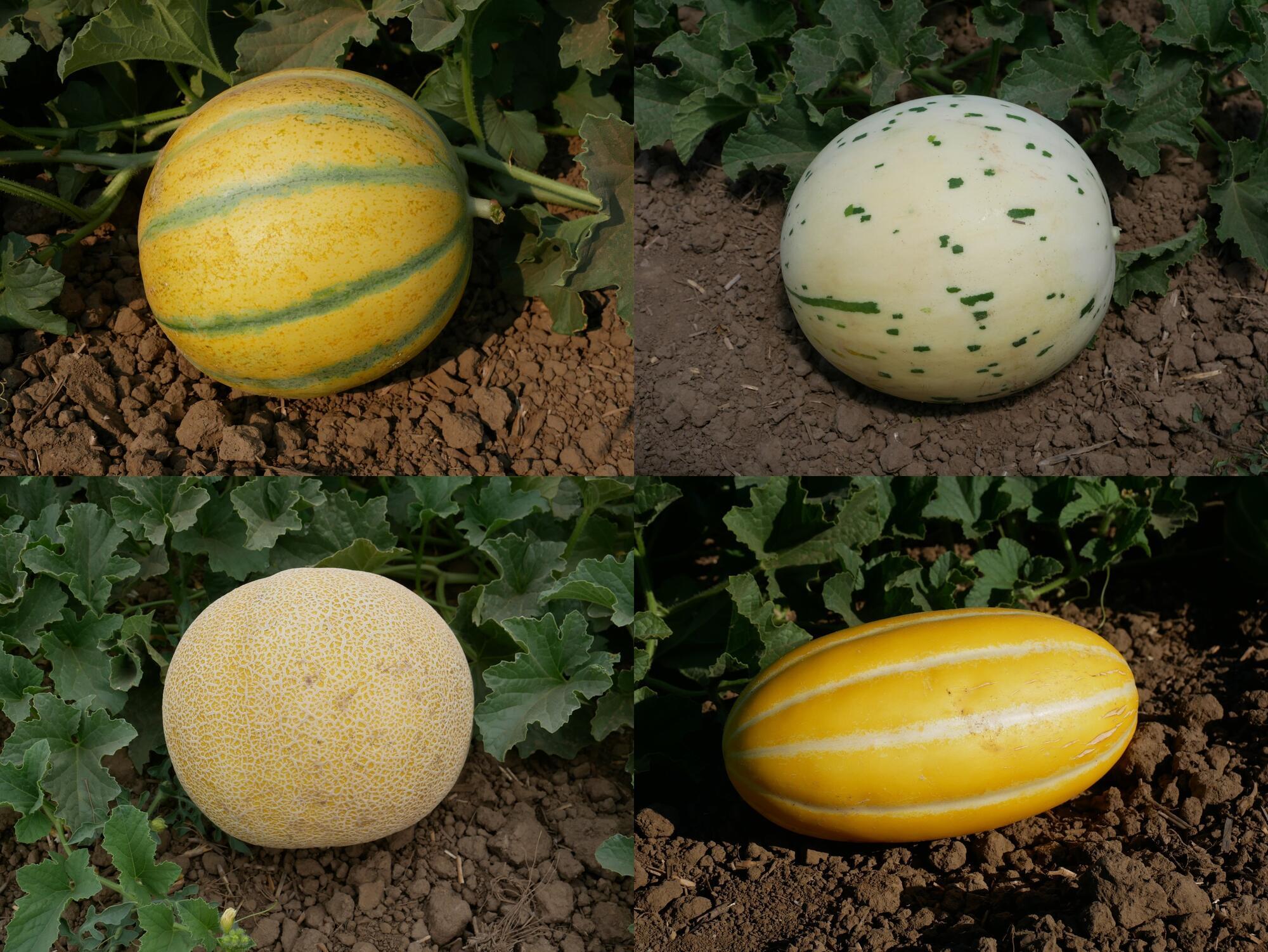
- Ambrosia (F1) is a familiar cantaloupe that yielded 15.9 tons per acre in 2022 (photo in Figure 1).
- Accolade (F1) was the second-highest-yielding cantaloupe variety in 2023 with 13.6 tons of marketable fruit per acre.
- Da Vinci (F1) is a Tuscan cantaloupe variety that yielded 12.6 tons per acre of marketable fruit in 2023.
- Sugar Rush (F1) yielded 12.5 tons per acre of smaller (2.7 pounds) cantaloupe in 2023.
|
Name |
Market class |
Seed company |
Number of years; number of farms |
Description |
|---|---|---|---|---|
|
Accolade (F1) |
cantaloupe | Osborne | 1; 1 | The second-highest yielding cantaloupe variety in 2023 with 13.6 tons of marketable fruit per acre |
|
Ambrosia (F1) |
cantaloupe | Osborne | 2; 1 | A familiar cantaloupe that yielded 15.9 tons per acre in 2022 |
|
Da Vinci (F1) |
cantaloupe | Osborne | 1; 1 | A Tuscan cantaloupe variety that yielded 12.6 tons per acre of marketable fruit in 2023 |
|
Melonade (F1) |
cantaloupe | JSS | 1; 1 | A popular “sweet and sour” melon that yielded 14.2 tons per acre in 2023 without any blemishes |
|
Sarah’s Choice (F1) |
cantaloupe | JSS | 1; 1 | This cantaloupe yielded 8.3 tons per acre in 2023 and was popular in taste tests with OSU staff |
|
Sugar Rush (F1) |
cantaloupe | Territorial | 1; 1 | Yielded 12.5 tons per acre of smaller (2.7 pounds) cantaloupe in 2023 |
|
True Love (F1) |
cantaloupe | High Mowing | 2; 5 | The highest yielding cantaloupe in on-farm trials that was also the best ranked melon at a retailer and wholesaler focus group |
|
Ha’Ogen (OP) |
charentais | SSE | 1; 1 | This was the highest yielding charentais melon in 2023, and is also grown by one commercial dry farm in Willow Creek, CA |
|
Arava (F1) |
galia | Osborne | 2; 5 | The highest yielding galia melon in 2023 and also very popular in crew taste tests |
|
Honey Orange (F1) |
honeydew | JSS | 1; 1 | A small fruited (3.7 pounds) honeydew that was very popular in crew taste tests |
|
Snow Leopard (F1) |
gaya | JSS | 2; 4 | A high yielding gaya melon with small fruit (~2 pounds per fruit) |
|
Amy (F1) |
canary | Osborne | 2; 4 | A melon with a long shelf life that is also popular in tastings |
|
Giallo d’Inverno (OP) |
canary | Uprising | 1; 1 | A melon with a long shelf life that is also popular in tastings |
|
Lambkin (F1) |
piel de sapo | JSS | 2; 4 | This piel de sapo melon had the highest yields of any melon in on-farm trials |
|
Lilly (F1) |
crenshaw | JSS | 2; 4 | This was the best performing crenshaw melon, doing well in multiple years and at multiple sites |
|
Bella (F1) |
ananas | H.E.D. Seed | 2; 1 | An ananas melon that is popular at the Corvallis Farmers Market |
|
Sharlyn (OP) |
ananas | Fruition | 1; 1 | A flavorful ananas melon that is popular at California farmers markets |
|
Golden Giant (F1) |
makuwa | JSS | 1; 1 | The better performing of the two makuwa melons trialed, with a yield of 11.3 tons per acre in 2023 |
|
Blacktail Mountain (OP) |
watermelon | Territorial | 1; 1 | This early watermelon is recommended by the Dry Farming Institute |
|
Christmas Watermelon (OP) |
watermelon | SRN | 1; 1 | This watermelon had yields of 38.2 tons per acre in 2023. The melons store well but are not as flavorful as other varieties |
|
Sugar Baby (OP) |
watermelon | JSS | 1; 1 | A classic red watermelon that yielded 24.5 tons per acre in 2023 |
|
Yellow Doll (F1) |
watermelon | Osborne | 2; 4 | A yellow watermelon that consistently had high yields across multiple years and sites |
Melons were trialed for only two years and at five locations.
Fruition = Fruition Seeds (Naples, NY), H.E.D. Seed = H.E.D. Seed Productions (Salida, CA) High Mowing = High Mowing Organic Seeds (Wolcott, VT), JSS = Johnny’s Selected Seeds (Winslow, ME), Osborne = Osborne Quality Seeds (Mount Vernon, WA), SSE = Seed Savers Exchange (Decorah, IA), SRN = Seed rEvolution Now (Pescadero, CA), Territorial = Territorial Seed Company (Cottage Grove, OR), Uprising = Uprising Seeds (Bellingham, WA).
Melon market class: cantalupensis — European cantaloupes
In the 15th century, missionaries returning from Armenia introduced what would become known to the world as cantaloupes to the town of Cantalupo in Sabina, Italy. The most common European cantaloupe varieties found in American seed catalogs are the charentais melons of French origin. Charentais melons can be either smooth or netted and are lightly ribbed with green vein tracts. They have a high sugar content and a strong aroma. Charentais melons have a short shelf life and can develop off-flavors, similar to American-style cantaloupes like Sugar Cube (F1). The fruits of charentais melons are often quite small.
Ripeness: Charentais melons can be identified as ripe based on the color change of the rind and aroma. In addition, the tendril and leaf closest to where the fruit stem attaches to the vine will senesce and turn brown.
Recommended varieties: Several charentais melons were trialed in 2022 and 2023. In 2022, these melons were not very high-yielding, so none of the varieties were continued to 2023. In 2023, many of the varieties tested were susceptible to splitting.
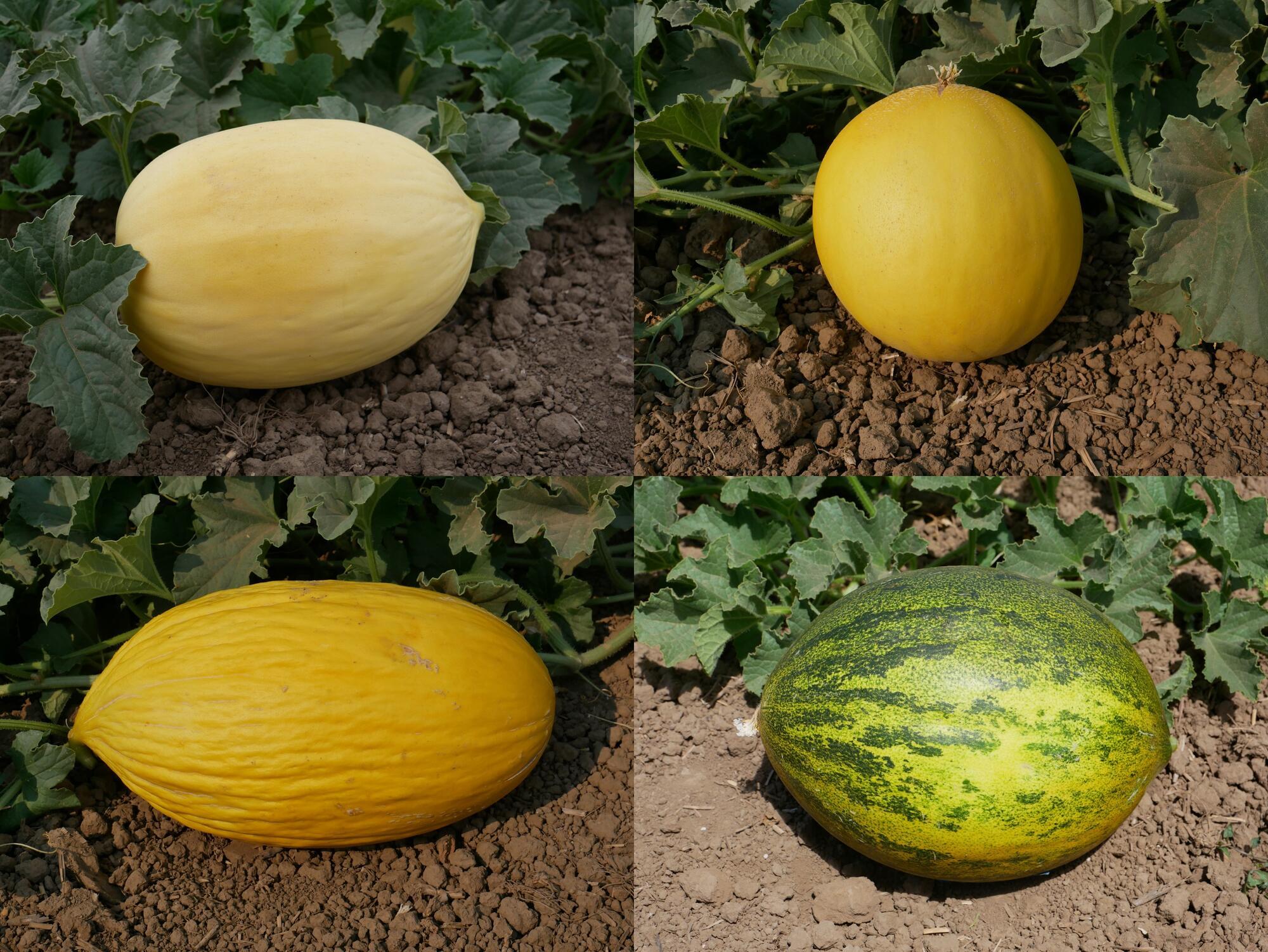
- A commercial dry farm in Willow Creek, California, grows Ha’Ogen (OP). This was also the highest-yielding charentais melon in 2023 (Figure 2).
Melon market class: galia melons
Galia melons are Israeli melons that are bred by crossing cantalupensis (Ha’Ogen) with other melon varieties. Therefore, they do not neatly fit into either the reticulatus or the cantalupensis market class. Galia melons are strongly aromatic, green-fleshed and have a yellow-netted rind. They can be identified as ripe by color change and strong aroma. Aromas can include tropical fruit and bubble gum.
Recommended varieties:
- Arava (F1) is a popular galia variety that performed well in these trials (photo in Figure 2). It was the highest-yielding galia melon in 2023 and also popular in crew taste tests.
Melon market class: inodorus — honeydew, gaya, piel de sapo, canary and crenshaw melons
Inodorus melons are characterized as being non-climacteric, meaning they do not ripen after harvest. Non-climacteric melons are less aromatic than climacteric melons like cantaloupes, thus the name “inodorus.” However, they can still express some interesting aromas, including pear, rose and pineapple.
Some call inodorus melons “winter melons” because of their long shelf life, with some winter melons lasting well into December if stored properly. This long shelf life may be an important trait when dry farming, as the harvest window is compressed.
Honeydews are perhaps the most recognizable members of the inodorus market class for American consumers; however, this is a diverse market class with many different subclasses to grow and enjoy, including gaya, piel de sapo, canary and crenshaw melons.
Ripeness: Because most inodorus melons produce little fragrance and do not slip, it can be trickier to assess them for ripeness. Common ripening traits include color change and softening of the blossom end. However, for some, like honeydew melons, this color change can be quite subtle. For honeydew, other ripening traits include a yellowing of the leaf closest to the fruit and a more waxy rind (as opposed to a fuzzy rind).
- Honeydew melons hail from Algeria and southern France. They are very familiar to American consumers and have a very sweet flavor and a light aroma.
- Gaya melons are Japanese melons with a white rind speckled with green. They are similar to honeydews in flavor. One variety trialed, Snow Leopard (F1), was incredibly prolific. In 2022, an average of 10 fruit per plant were picked on their peak harvest day. They are sometimes called “dinosaur melons” and may appeal to children due to their small size and simple flavor profile.
- Piel de sapo (Santa Claus) and canary (amarillo) are two popular Spanish melons. They have a long shelf life, a sweet flavor, a silky texture when ripe and light aroma. When ripe, the colors change, with the rind of piel de sapo becoming yellow with green splotches, while canary’s rind becomes golden. These melons should be harvested after they change color but while they are still firm, and then should be kept at room temperature until they are ready to eat, when the blossom end has softened.
- Crenshaw melons are large, teardrop-shaped melons with good aroma and sweet and velvety flesh. One crenshaw melon in particular, the Crane (OP) melon, has a long history of being dry-farmed in Sonoma County, California. Because Crane (OP) has already received a great deal of public attention, dry-farmed crenshaw melons may be an easy sales pitch at the farmers’ market. However, we found that Crane (OP) is susceptible to cracking when dry-farmed in Western Oregon. Crenshaw melons can be identified as ripe by color change and softening at the blossom end.
Recommended varieties:
- Lilly (F1) is a frequent favorite among the OSU Melon Project team. This crenshaw melon variety produces two flushes of large fruit (8 pounds), and the second flush stores well if picked and stored properly. Lilly’s aromas are floral, tending towards rose as the fruit matures (Figure 3).
- Amy (F1) is a canary melon with very little aromatics but high storability and sugar content (photo in Figure 3). It was popular in tastings.
- Lambkin (F1) is a piel de sapo melon that was the highest-yielding melon in on-farm trials (Figure 3).
- The Giallo d’Inverno (OP) melon (Italian for “winter yellow” melon) resembles a canary melon, but the blossom end does not get softer as it ripens. This melon has aromas reminiscent of pineapple (photo in Figure 3).
- Honey Orange (F1) was a taste test favorite during the 2023 growing season. It produces smaller (3.7 pounds) honeydew melons.
- Snow Leopard (F1) was a high yielder of small (about 2 pounds per fruit) gaya melons (Figure 2).
Melon market class: ameri
Ameri melons may have potential as a dry-farmed crop. They are reportedly tolerant of drought and heat. Ameri melons originate in Uzbekistan and Turkmenistan.
Ripeness: Ameri melons are a diverse group with four recognized subgroups. Melons in the subgroup ananas, including Bella (F1), Sharlyn (OP), San Juan (F1) and Dove (F1), are easy to identify as ripe by color change. Batkeeh Samara (OP), in the subgroup maculate, can be identified as ripe by a softening of the blossom end.
Recommended varieties:
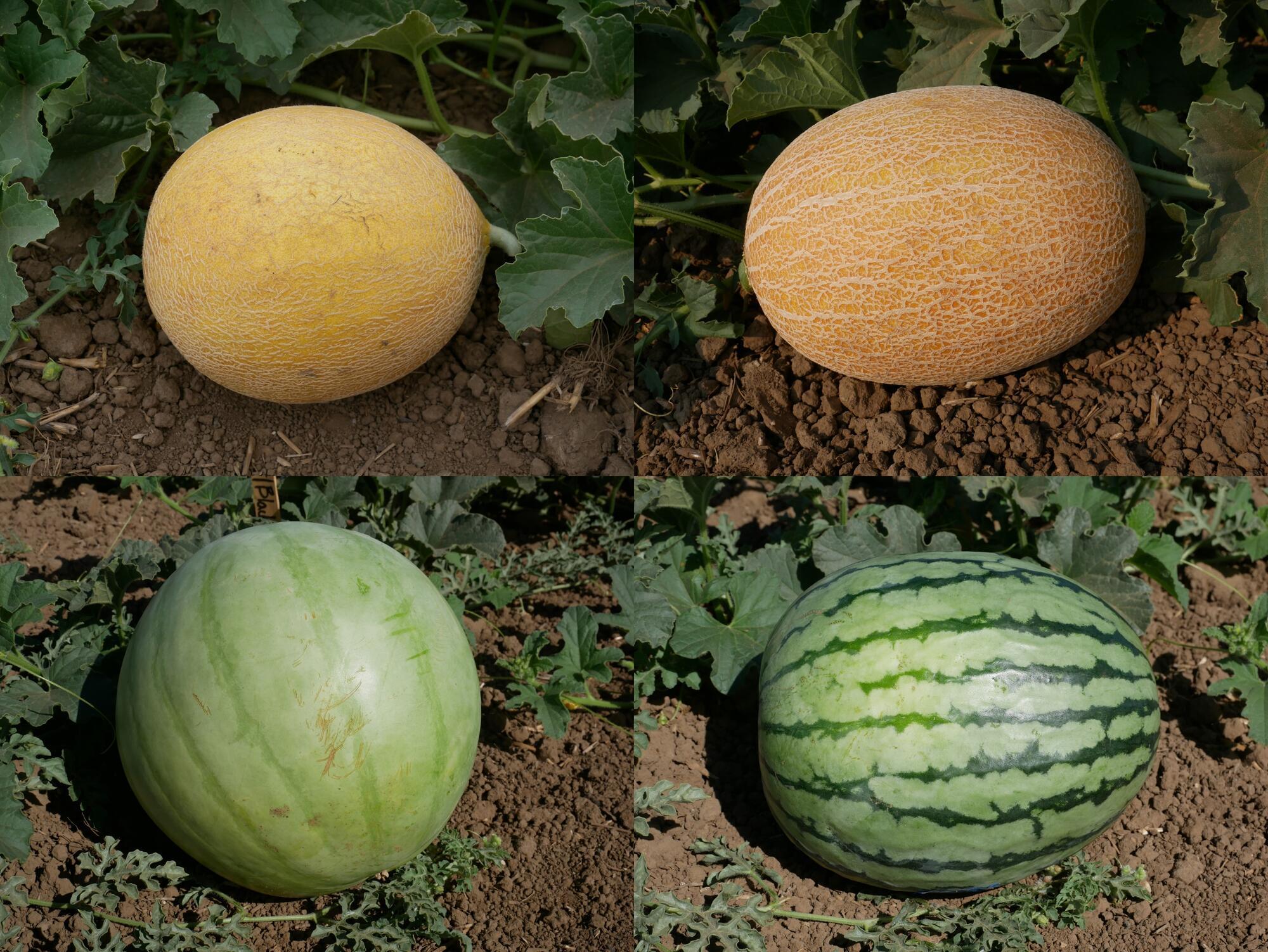
- Bella (F1) is a favorite of a partner farmer (Figure 4). It performed well in 2022 but performed poorly during the 2023 growing season (Appendix 1, Table 14).
- Sharlyn (OP) is a popular melon at California farmers markets (Figure 4).
Melon market class: makuwa – Korean melons
Korean melons are small, sweet crisp melons from East Asia and are sometimes found in Asian supermarkets. Torpedo (F1) was trialed in 2022, and Golden Giant (F1) in 2023. Melons change from green to bright yellow as they ripen. They have a sweet flavor, crisp texture and little to no aroma.
Recommended varieties:
- Of the two trialed here, Golden Giant (F1) had larger fruit and slightly higher marketable yields (11.3 tons per acre; photo in Figure 2).
Melon market class: watermelons
Seeded watermelons were trialed in 2022 with success. Watermelon fruit size tended to decrease over the course of the 2022 harvest season, and many of the plants produced tiny watermelons after their first set. Fruit size was more consistent in 2023.
Ripeness: Several methods can be used to determine if a watermelon is ripe, and the most reliable method may depend in part on the variety.
- Sound: Knock on the watermelon with your knuckles. If it responds with a resonant sound, it is unripe. If it responds with a dull thud, it is ripe.
- Inspect the tendril: The browning and dying of the tendril closest to the fruit stem can sometimes indicate that the watermelon is ripe.
- Check the field spot: The field spot is the side of the watermelon that rests on the ground as it grows. Visually inspect the watermelon for a change in color of the field spot from white to yellow.
- Press your thumb on the blossom end: An unripe watermelon will feel firm, but for a ripe watermelon, there will be a tiny bit of give at the blossom end if pressure is applied.
- Inspect the rind: The rind will often be dull rather than shiny when the watermelon is ripe.
Pollination: For melons or watermelons to set fruit, an insect must pollinate them. Farmers will often bring in honeybee hives to pollinate their crops. One hive of 30,000 to 50,000 bees will usually be able to pollinate one to two acres. Seedless watermelons are popular with consumers but are more difficult to grow because they do not produce pollen. This is because they are triploid, meaning they have three sets of chromosomes. If growing seedless watermelon, it will be necessary to plant pollenizer watermelons in your crop to ensure that they are able to set fruit. A pollenizer variety can be any seeded watermelon, and pollenizer varieties are often included by seed companies with the purchase of seedless watermelon seeds. One row of pollenizer variety is recommended for every two rows of seedless watermelon. Mike Hessel of Red Hat Melons recommends Yellow Doll (F1) as a good pollenizer variety.
Recommended varieties:
- Yellow Doll (F1) consistently yielded many sweet and tasty watermelons (Figure 4).
- Christmas Watermelon (OP) was one of the best yielders (38.2 tons per acre in 2023), and reportedly can be stored until Christmas (Figure 4).
- Sugar Baby (OP) is a classic open-pollinated seeded watermelon variety that yielded 24.5 tons per acre in 2023.
- The Dry Farming Institute recommends Blacktail Mountain (OP), as it is a reliable early watermelon.
Section 2: Grafting
Melons and watermelons can be grafted onto appropriate rootstocks for improved disease resistance and increased yields.
In 2023, the rootstock Flexifort (F1; available from Enza Zaden, Salinas, California) was trialed using 10 different scions (Table 2). Grafting increased total yields, marketable yields and average fruit weight, while also decreasing the incidence of splitting. However, fruit from grafted plants also had higher titratable acidity and a lower ratio of soluble solids concentration to titratable acidity, indicating that the grafted dry-farmed melons are likely to be perceived as less sweet than their ungrafted counterparts are.
Information on how to graft melons can be found at vegetablegrafting.org.
|
Scion Market class |
Marketable yield (tons per acre) |
Marketable count (1,000 fruit per acre) |
Average fruit weight (pounds per fruit) |
Percent cracking (%) |
Soluble solids concentration (%) |
Titratable acidity (%) |
Soluble solids concentration to titratable acidity ratio |
|---|---|---|---|---|---|---|---|
|
|
|||||||
|
Athena (F1)cantaloupe |
15.4 | 6.8 | 4.5 | 4 | |||
|
Hannah’s Choice (F1) cantaloupe |
15.5 | 5.9 | 5.3 | 5 | 13.1 | 0.73 | 17.9 |
|
True Love (F1) cantaloupe |
23.6 | 11.5 | 4.1 | 0 | 15.3 | 1.03 | 14.9 |
|
Arava (F1) galia |
13.0 | 6.8 | 3.8 | 0 | 13.9 | 0.88 | 15.8 |
|
Amy (F1) canary |
24.8 | 13.1 | 3.8 | 11 | 15.0 | 0.79 | 19.0 |
|
Lambkin (F1) piel de sapo |
23.5 | 11.8 | 4.0 | 0 | 12.5 | 0.63 | 19.8 |
|
Lilly (F1) crenshaw |
22.2 | 6.8 | 6.5 | 0 | 15.3 | 0.75 | 20.4 |
|
Cal Sweet Bush (OP) watermelon |
14.2 | 1.9 | 14.6 | 0 | |||
|
Sugar Baby (OP) watermelon |
32.1 | 6.5 | 9.8 | 0 | 11.1 | 0.45 | 24.7 |
|
Yellow Doll (OP) watermelon |
17.6 | 9.0 | 3.9 | 0 | 11.4 | 0.37 | 30.8 |
|
|
|||||||
|
Athena (F1) cantaloupe |
7.7 | 4.7 | 3.3 | 6 | 15.0 | 0.68 | 22.1 |
|
Hannah’s Choice (F1) cantaloupe |
5.2 | 3.4 | 3.1 | 12 | 14.1 | 0.77 | 18.3 |
|
True Love (F1) cantaloupe |
12.4 | 6.6 | 3.8 | 0 | 15.8 | 0.94 | 16.8 |
|
Arava (F1) galia |
13.6 | 8.1 | 3.4 | 0 | 13.9 | 0.81 | 17.2 |
|
Amy (F1) canary |
8.6 | 5.0 | 3.5 | 36 | 13.4 | 0.6 | 22.3 |
|
Lambkin (F1) piel de sapo |
18.1 | 10.9 | 3.3 | 0 | 11.9 | 0.46 | 25.9 |
|
Lilly (F1) crenshaw |
16.1 | 5.9 | 5.5 | 0 | 13.8 | 0.62 | 22.3 |
|
Cal Sweet Bush (OP) watermelon |
13.1 | 2.5 | 10.6 | 0 | 8.9 | 0.24 | 37.1 |
|
Sugar Baby (OP) watermelon |
24.5 | 5.9 | 8.3 | 0 | 9.2 | 0.33 | 27.9 |
|
Yellow Doll (OP) watermelon |
20.2 | 9.3 | 4.3 | 3 | 11.0 | 0.34 | 32.4 |
Section 3: Site suitability
Site factors, including soil available water holding capacity, soil pH and nutrition and weather and microclimate affect yield and fruit quality in tomato and winter squash. We assume that this is also true for dry-farmed melon and watermelon.
To determine whether site influences melon yields, 10 different melon and watermelon varieties were trialed at four different farms in 2023, in addition to the trials at the Oregon State University Vegetable Research Farm outside Corvallis, Oregon. The Vegetable Research Farm soil is a Chehalis silt loam with more than 12 inches of available water-holding capacity in the first five feet – one of the best soils for dry farming in the Willamette Valley. We wanted to test whether the yields and fruit quality at the Vegetable Research Farm were consistent across multiple farms. However, when averaged across all farm sites, yields and fruit weights were lower than crops grown at the Vegetable Research Farm (see Table 3).
|
Variety Market class |
Trial |
Marketable yield (tons per acre) |
Marketable count (fruit per acre) |
Average marketable fruit weight (pounds per fruit) |
|---|---|---|---|---|
|
Amy (F1) canary |
Average of five trials |
9.3 | 6,600 | 2.9 |
|
OSU VRF |
8.6 | 4,978 | 3.5 | |
|
Arava (F1) galia |
Average of five trials |
8.6 | 5,500 | 3.0 |
|
OSU VRF |
13.6 | 8,090 | 3.4 | |
|
Athena (F1) cantaloupe |
Average of five trials |
4.3 | 2,900 | 3.0 |
|
OSU VRF |
7.7 | 4,667 | 3.3 | |
|
Cal Sweet Bush (OP) watermelon |
Average of five trials |
10.7 | 1,500 | 10.5 |
|
OSU VRF |
13.1 | 2,489 | 10.6 | |
|
Hannah’s Choice (F1) cantaloupe |
Average of five trials |
5.0 | 3,700 | 2.9 |
|
OSU VRF |
5.2 | 3,423 | 3.1 | |
|
Lambkin (F1) piel de sapo |
Average of five trials |
12.8 | 8,600 | 3.0 |
|
OSU VRF |
18.1 | 10,890 | 3.3 | |
|
Lilly (F1) crenshaw |
Average of five trials |
9.1 | 3,500 | 5.2 |
|
OSU VRF |
16.1 | 5,912 | 5.4 | |
|
Snow Leopard (F1) gaya |
Average of five trials |
7.8 | 8,400 | 1.9 |
|
OSU VRF |
10.6 | 9,023 | 2.3 | |
|
True Love (F1) cantaloupe |
Average of five trials |
7.4 | 5,000 | 3.0 |
|
OSU VRF |
12.4 | 6,612 | 3.7 | |
|
Yellow Doll (F1) watermelon |
Average of five trials |
12.7 | 6,700 | 3.4 |
|
OSU VRF |
20.2 | 9,334 | 4.3 |
Section 4: Melon production practices
Soil preparation
Dry farmers should manage soil to conserve soil moisture. Fall-planted cover crops should be mowed and terminated as soon as the ground is workable. However, farmers should not work the soil when the soil moisture content is too high, as this can result in soil compaction.
When terminating the cover crop, work the ground to a shallow depth, as soil moisture is lost to the depth of tillage. OSU farm managers chisel plow to a depth of 8-9 inches to break the soil surface and then follow that with multiple passes with a power harrow (at a depth of 4–5 inches) to kill the cover crop and prepare the planting bed.
After the cover crop is terminated, the soil will retain moisture until it is time to plant. Keep the field clean of weeds as needed using shallow cultivation until planting.
Nutrient management
The optimum soil nutrient concentrations for dry-farmed melons and watermelons in Oregon have not been determined. Table 4 includes recommendations for irrigated melon and watermelon production.
Do not apply fertilizer in excess, as fertilizer applications increase soil salt concentrations, which can be lethal to seedlings.
Farmers often mitigate this risk in irrigated melon production by applying a portion of the nitrogen fertilizer as a side dress later in the growing season. Side-dressing nitrogen fertilizer during the growing season in a dry farm system may not be effective, as the upper levels of the soil are dry, preventing nutrient mineralization and movement into lower soil layers.
Dry farmers in coastal California have recommended using fall-applied compost, as these applications may allow for nutrients to leach into the subsoil during the winter rains. This may be a way that dry-farmed melon growers can increase nutrient availability on their farms. Additionally, lime should be applied at least three to four months before planting.
In the OSU trials, a single application of composted chicken manure and feather meal was applied prior to planting each year. In 2022, this was 1,100 pounds per acre of Nutririch (4-3-2; Stutzmans) and 600 pounds per acre of feather meal (12-0-0; pro-pellet) applied on May 24. In 2023, this was increased to 1,431 pounds per acre of Nutririch and 738 pounds per acre of feather meal, applied on May 2.
|
pH or nutrient |
Melon and watermelon crop requirements |
Recommendations from the Oregon State University Vegetable Production Guides |
|---|---|---|
|
Soil pH |
≥5.8. To determine how much lime to apply to correct soil pH, we recommend “Updated Lime Requirement Recommendations for Oregon.” | Lime applications are recommended if soil pH is 5.6 or below or if calcium levels are below 5 meq per 100 grams of soil. |
|
Nitrogen |
Melon crop requires 120–200 pounds per acre | Apply 80–150 pounds of nitrogen per acre; use the lower rate if legumes were grown as a fall planted cover crop or as a crop in the previous year. |
|
Phosphorus |
50 ppm |
If soil test for phosphorus concentration reads 0–15 ppm, apply 120–150 pounds of phosphate (P2O5) per acre. If soil test for phosphorus concentration reads 15–60 ppm, apply 90–120 pounds of phosphate per acre. If soil test for phosphorus concentration reads over 60 ppm, apply 60–90 pounds of phosphate per acre. |
|
Potassium |
150–200 ppm |
If soil test for potassium reads 0–75 ppm, apply 100–150 pounds of potash (K2O) per acre. If soil test reads 75–150 ppm, apply 60–100 pounds of potash per acre. If the soil test reads 150–200 ppm, apply 40–60 pounds of potash per acre. If the soil test reads 200 ppm, no additional potash is necessary. |
|
Sulfur |
20 ppm | Apply 20–30 pounds of sulfur per acre each year. Applications of foliar sulfur can damage plants. |
|
Calcium |
5 meq per 100 grams of soil | Apply lime if calcium levels are below 5 meq per 100 grams of soil. |
|
Magnesium |
1.0–2.5 meq per 100 grams of soil | If soil tests are below 1.5 meq per 100 grams of soil or if calcium concentrations are 10 times that of magnesium, apply 10–15 pounds of magnesium per acre. |
|
Boron |
0.2-1.0 ppm |
If soil boron concentrations are below 1.0 ppm, applying 3 pounds of boron per acre is recommended. Boron fertilizer should be applied uniformly across the field by either spraying or broadcasting, and should never be banded. |
|
Zinc |
0.8–1.5 ppm | If soil tests show zinc to be below 1.0 ppm, 4 pounds of zinc per acre should be applied. |
Transplant production
Dry-farmed melons can be produced by planting transplants or by direct seeding. Transplanting may allow for an earlier crop, but melons are sensitive to root disturbance, so improper transplanting may cause the plants to become stunted. Direct seeding works well with dry farming as long as the soil temperatures are warm enough and the soil is moist enough for the seeds to germinate. While farmers may consider whether to use transplants or to direct seed, seedless watermelons must be started indoors and grown as transplants. This is because they require high temperatures to germinate (between 85°F and 95°F), and the seeds are expensive. Grafted plants also need to be grown as transplants.
Melons can be started indoors and planted out about a month later. Sow multiple successions to ensure that healthy transplants are ready to be planted at the optimum time. Keep the temperature of the germination area warm, between 75°F and 80oF (higher for seedless watermelons). Subirrigating (watering from below) trays prevents splashing and keeps seedlings growing upright. Mike Hessel of Red Hat Melons recommends that melon seeds be planted with the pointed end upright, as this ensures that the cotyledons can easily break free from the seed coat. However, many commercial farms probably do not consider this when seeding.
Transplanting and direct seeding
Whether planting transplants or direct-seeding, farmers should minimize soil disturbance while also planting into moist soil.
If planting transplants, subirrigate the flats before planting so that the transplant media is saturated with water. Plant into moist soil by furrowing or scraping back dry soil. Plant deeply. Cover moist soil with dry soil as a soil mulch to reduce soil moisture evaporation. When trial melons were transplanted in 2022 and 2023, they were watered in with about a liter of water for each plant.
If direct-seeding, seed melons when soil temperatures are 65oF or above, though melons germinate best between 70°F and 90°F. In Western Oregon, soil temperatures generally reach 65oF in mid-May or early June.
For watermelon seeds, the soil temperatures should be above 70oF. For irrigated melons, plant seeds 1 inch deep. However, one additional factor must be considered when direct-seeding dry-farmed melons: Seeds should be planted into moist soil.
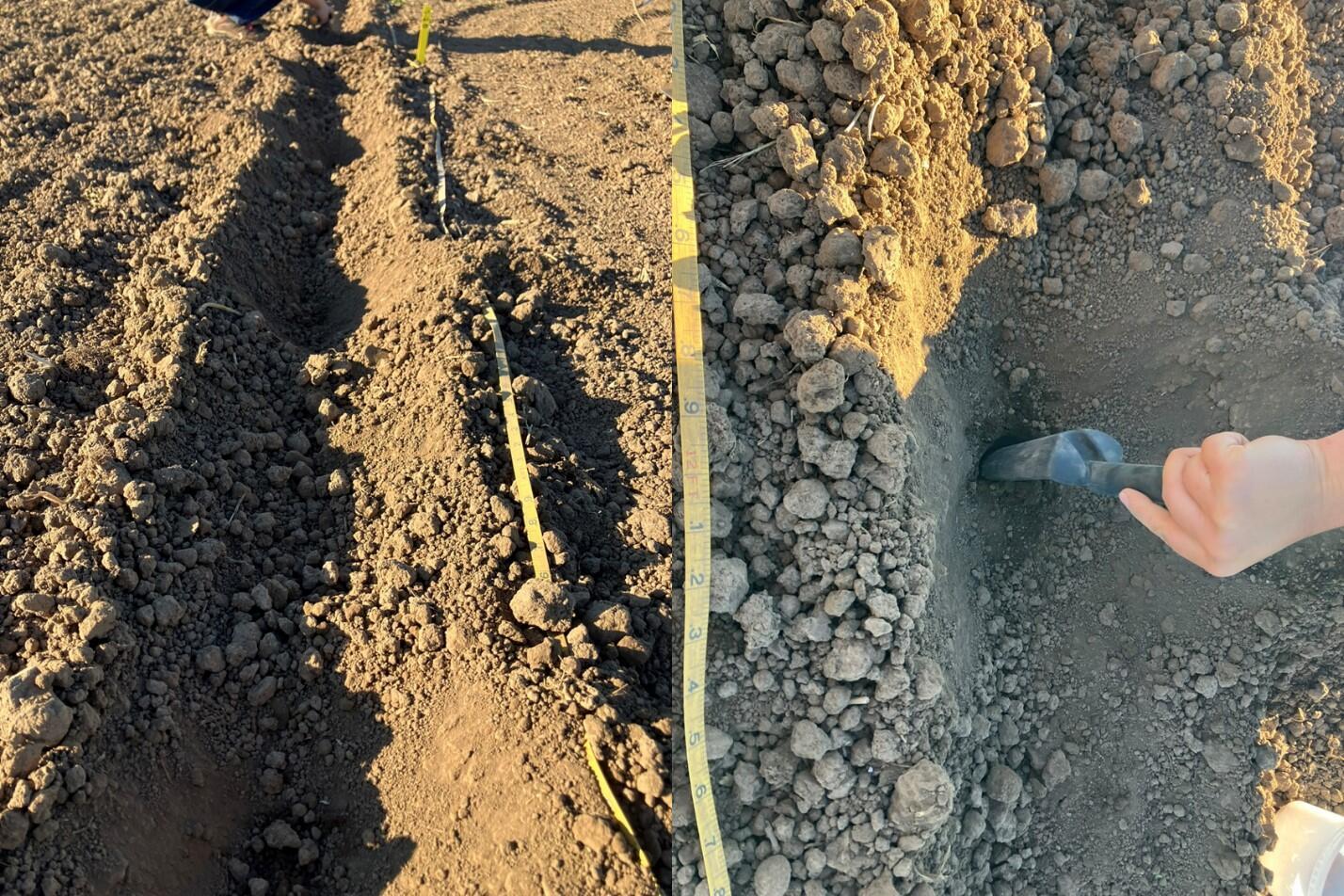
We recommend that farmers furrow or scrape back the dry soil to expose moist soil prior to direct-seeding, and then plant seeds between 0.5 and 1.5 inches deep (Figure 5).
Planting density
Dry-farmed melons and watermelons grown at the Oregon State University Vegetable Research Farm have performed well when grown at a 7-foot between-row and 4-foot in-row spacing. The 7-foot between-row spacing is an appropriate spacing to apply a 12-foot row cover over two rows (to protect the crop from striped and spotted cucumber beetle).
In a 2023 planting density trial (four varieties, two replications), there was no statistically significant effect on yield, fruit number or fruit weight difference for melons planted at 3-foot, 4-foot, and 5-foot in-row spacing (all at 7-foot between-row spacing, Table 5).
|
Plants per acre |
In-row spacing (ft) |
Marketable yield (tons per acre) |
Marketable fruit number (fruit per acre) |
Average marketable fruit weight (pounds) |
|---|---|---|---|---|
|
1,245 |
5 | 18.3 | 8,113 | 4.7 |
|
1,556 |
4 | 19.3 | 8,479 | 4.8 |
|
2,074 |
3 | 20.4 | 9,114 | 4.7 |
Mike Hessel of Red Hat Melons stresses that growers need to give melons plenty of space and that they should not step on the vines.
Planting successions
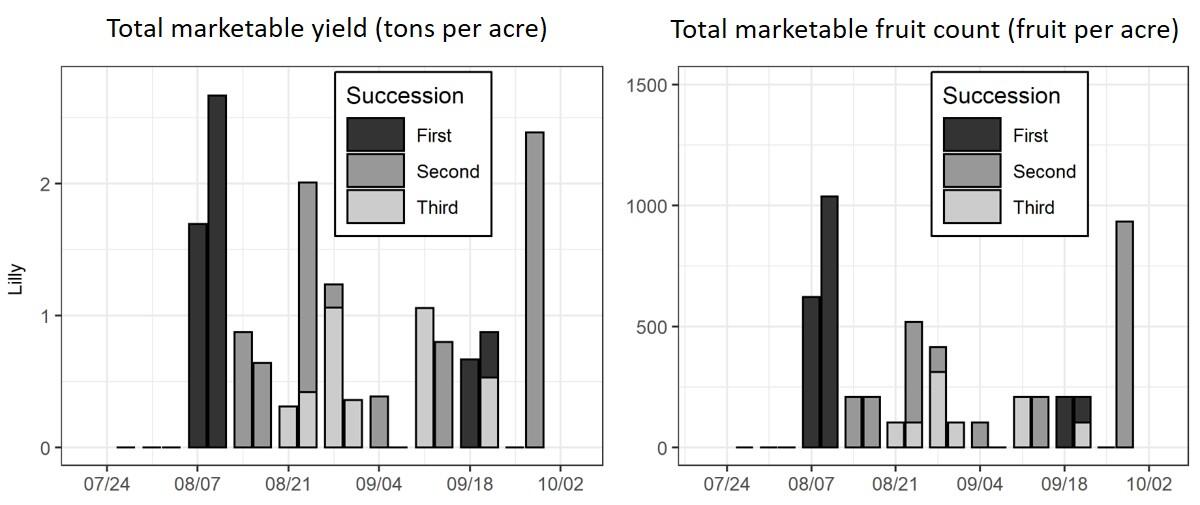
Yields are lower and the duration of harvest is shorter in dry farm production than in irrigated production. Farmers may want to consider planting multiple successions of melons to ensure a continuous supply of fruit throughout the season.
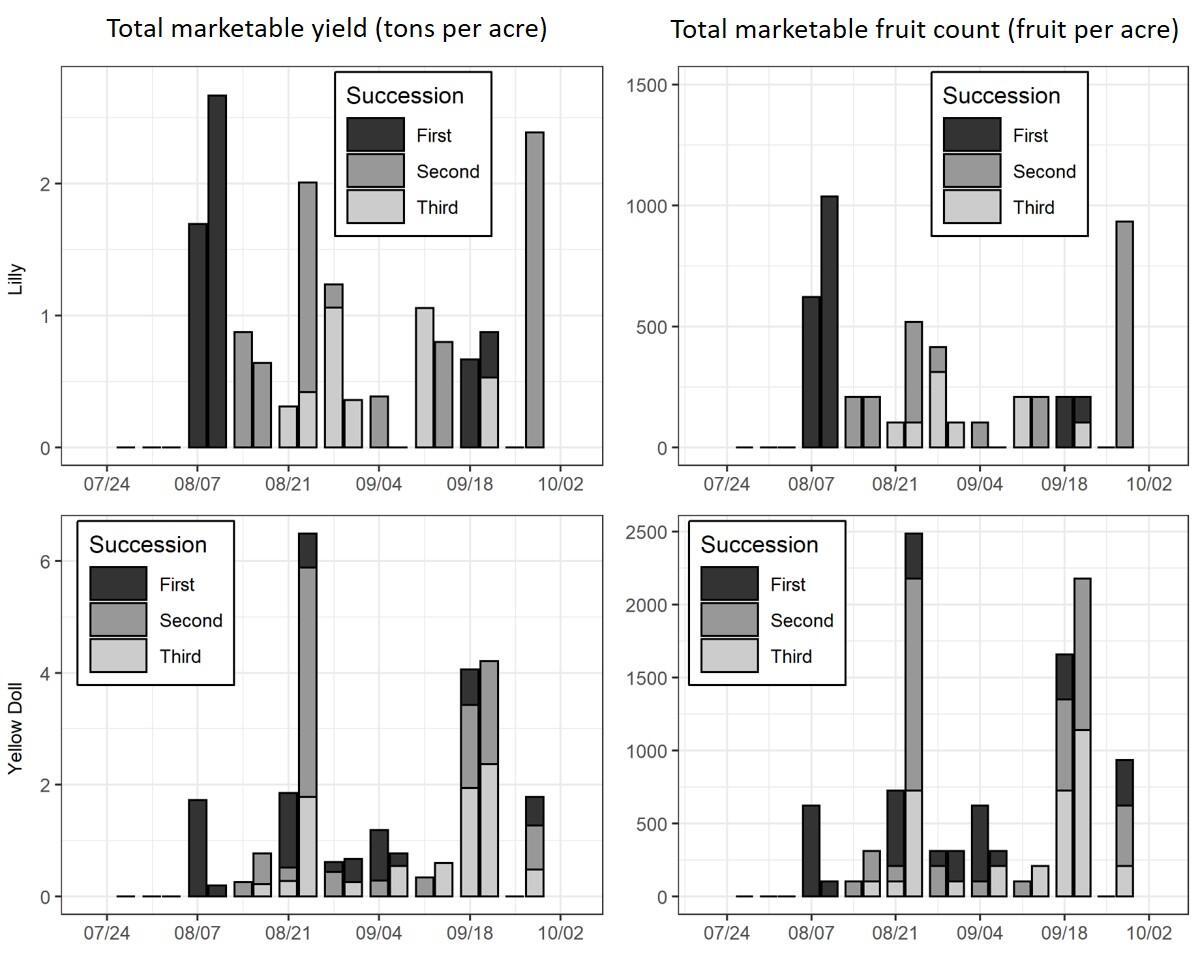
For example, planting Lilly (F1) on three dates (May 18, June 2 and June 12), instead of one (May 18), increased the number of harvests from four to 14 (Figure 6). Continuous yield data for all eight varieties is presented in Appendix 2.
Table 6 shows how different varieties perform depending on planting date. The field was kept free of weeds prior to planting, and seedlings were watered in with approximately 1 liter of water per plant.
|
Marketable yield (tons per acre) |
Total number of harvests |
|||||||
|---|---|---|---|---|---|---|---|---|
|
Variety |
Planted May 18 |
Planted June 2 |
Planted June 12 |
Averaged across planting days |
Planted May 18 |
Planted June 2 |
Planted June 12 |
Sum of all harvests* |
|
Ambrosia (F1) |
8.4 | 11.4 | 6.1 | 8.6 | 7 | 5 | 6 | 12 |
|
Athena (F1) |
7.7 | 13.0 | 9.6 | 10.1 | 8 | 8 | 7 | 13 |
|
Hannah’s Choice (F1) |
5.2 | 9.8 | 8.4 | 7.8 | 5 | 7 | 6 | 12 |
|
True Love (F1) |
12.4 | 7.9 | 8.3 | 9.6 | 9 | 8 | 7 | 14 |
|
Arava (F1) |
13.6 | 18.9 | 6.9 | 13.1 | 6 | 10 | 4 | 12 |
|
Lambkin (F1) |
18.1 | 14.2 | 9.3 | 13.9 | 9 | 8 | 5 | 13 |
|
Lilly (F1) |
16.1 | 20.5 | 11.2 | 15.9 | 4 | 7 | 7 | 14 |
|
Yellow Doll (F1) |
20.2 | 30.9 | 25.4 | 25.5 | 11 | 10 | 9 | 15 |
* Over the course of the trial, plots were harvested twice a week for a total of 19 harvests spread over 10 weeks. The sum of all harvests is the total number of harvests that were collected across all three planting dates not including duplicates.
Weed management
Controlling weeds is one of the most important activities that a farmer can do to conserve soil moisture and improve yields. Weed management should occur soon after weed emergence, when the weeds are small, and farmers should minimize soil disturbance. The book Steel in the Field has lots of great information on tools that can be used for shallow cultivation. It may be necessary to cultivate prior to planting on soils that will be used for later successions in serial planting.
Weeds at the OSU research farm were managed by clean cultivation using an Allis-Chalmers Model G tractor equipped with cultivating knives, accompanied by hand hoeing and wheel hoeing. The total time spent weeding in 2023 was 8.5 hours per acre. This does not include time spent managing the row cover, which had to be moved prior to weeding.
Harvesting, handling and storage
Determining when melons are ready for harvest depends on the variety. After harvest, melons should be moved into coolers for storage. Cantaloupes can be stored at 36oF–41oF once they have ripened. Inodorus melons should not be stored at temperatures below 45oF. Watermelons should not be stored below 50oF.
Food safety
Because of their high pH, low levels of bacterial pathogens can quickly multiply on melons.
The Guide to Minimize Microbial Food Safety Hazards for Fresh Fruits and Vegetables offers guidance on good agriculture practices. This guide should be used to identify and implement best practices to ensure that melons are safe for human consumption. It is easier and more effective to prevent contamination than it is to correct it.
The major source of microbial contamination of fresh produce is associated with human or animal feces. Fecal contamination can come from water sources, which may be contaminated with bacterial pathogens from feces; incompletely composted organic fertilizers, animal manure or municipal biosolid wastes; or poor worker hygiene. Growers must follow all applicable local, state and federal laws and regulations.
Sensory evaluations
During the 2022 growing season, two panels were convened to evaluate melons: one made up of retailers and marketers and the other of farmers. Both groups were impressed by the flavor of the dry-farmed melons (Table 7).
|
Event |
Variety |
Appearance |
Flavor |
Texture |
Willingness to buy |
|---|---|---|---|---|---|
|
Corvallis Farmer’s Field Day (Sept. 7) |
Ambrosia (F1) |
1.3* | 1.7 | 1.7 | 1.7 |
|
Amy Canary (F1) |
1.4 | 1.3* | 1.5 | 1.4* | |
|
Bella (F1) |
1.3* | 1.4 | 1.3* | 1.4* | |
|
Summer Dew (F1) |
1.6 | 1.6 | 1.8 | 1.5 | |
|
True Love (F1) |
1.6 | 2.0 | 1.6 | 1.8 | |
|
Portland Marketer’s Field Day (Aug. 31) |
Arava (F1) |
Display melons not available, but marketers agreed that they generally want a smaller melon | 1.5 | 1.2 | 1.4 |
|
Bella (F1) |
1.7 | 1.4 | 1.6 | ||
|
Sugar Cube (F1) |
1.4 | 1.5 | 1.4 | ||
|
True Love (F1) |
1.2* | 1.1* | 1.1* |
*Highest performing variety.
Funding provided by Western Sustainable Agriculture Research and Education, project number OW22-369. We thank Charlie Bruder, Willa Davies, Lena Randall, Lars Romsos and Margot Schwarz for assisting in data collection. We thank Mike Hessel for advising the project.
References and resources
Bowman, G. 2002. Steel in the Field: A Farmer’s Guide to Weed Management Tools. Beltsville, MD: Sustainable Agriculture Network.
Davis, M., A. Stone, A. Gallagher, and A. Garrett. 2023. Site Factors Related to Dry Farm Vegetable Productivity and Quality in the Willamette Valley of Oregon. HortTechnology. 33(6):587–600.
Food Safety Initiative Staff, HFS-32, U.S. Food and Drug Administration, Center for Food Safety and Applied Nutrition. Guide to minimize microbial food safety hazards for fresh fruits and vegetables.
Gaskell, M., R. Smith, J. Mitchell, S.T. Koike, C. Fouche, T. Hartz, W. Horwath and L. Jackson. 2007. Soil Fertility Management for Organic Crops. UC ANR Publication 7249, Davis, CA: University of California Division of Agriculture and Natural Resources.
Goldman, A. 2019. The Melon. Westport, CT: City Point Press.
Leap, J., D. Wong, K. Yogg Comerchero, A. Baier and D. O’Brien. 2017. Organic dry-farmed tomato production on California’s central coast: A guide for beginning specialty crop growers. CASFS Grower Guide, Santa Cruz, CA: University of California, Santa Cruz, Center for Agroecology & Sustainable Food Systems.
Lukas, S., L. Clark, K. Frost, and L. Brewer. 2020. Pacific Northwest watermelon production east of the Cascades. PNW 741. Corvallis, OR: Oregon State University Extension Service.
McAvoy, T., T. Coolong. 2017. Commercial Watermelon Production. Extension Report No. 996, , Athens, Georgia: University of Georgia Cooperative Extension.
Moore, A. 2022. Updated lime requirement recommendations for Oregon. Fact Sheet, Corvallis, OR: Oregon State University Extension.
Oregon State University vegetable production guides. 2010. Melons: Cantaloupe, muskmelon, honeydew, crenshaw, casaba, etc.
Schuh, M., K. Foord, J. MacKenzie. 2022. Growing melons in the home garden. St. Paul, MN: University of Minnesota Extension.
Sullivan, D.M., E. Peachey, A.L. Heinrich and L.J. Brewer. 2017. Nutrient management for sustainable vegetable cropping systems in Western Oregon. EM 9165, Corvallis, OR: Oregon State University Extension.
Appendix 1: Yield and fruit quality data from trials conducted at OSU Vegetable Research Farm: 2022 and 2023
|
Variety |
Seed source |
Total yield (tons per acre) |
Marketable yield (tons per acre) |
Marketable count (fruit per acre) |
Average weight (pounds per marketable fruit) |
Percent split |
Notes |
|---|---|---|---|---|---|---|---|
|
|
|||||||
|
Ambrosia (F1)* |
Osborne | 15.9 | 15.9 | 9,023 | 3.5 | 0 | A familiar cantaloupe that yielded 15.9 tons per acre in 2022 |
|
Athena (F1) |
JSS | 12.1 | 11.9 | 5,912 | 4.0 | 0 | |
|
Divergent (F1) |
High Mowing | 11.2 | 10.9 | 6,534 | 3.3 | 5 | |
|
Halona (F1) |
JSS | 6.6 | 6.1 | 5,601 | 2.2 | 5 | |
|
Hannah’s Choice (F1) |
JSS | 13.1 | 13.1 | 8,712 | 3.0 | 0 | |
|
Milan (F1) |
JSS | 11.1 | 10.1 | 7,779 | 2.6 | 7 | |
|
Oregon Delicious (OP) |
Adaptive | 9.9 | 9.9 | 4,978 | 4.0 | 0 | |
|
Sugar Cube (F1) |
JSS | 8.1 | 8.1 | 8,712 | 1.9 | 0 | |
|
Thunderstruck (F1) |
Osborne | 18.3 | 16.5 | 9,334 | 3.5 | 9 | The highest marketable yields in 2022 and the lowest in 2023 |
|
Tirreno (F1) |
Osborne | 12.2 | 11.8 | 7,467 | 3.2 | 4 | |
|
True Love (F1)* |
High Mowing | 15.3 | 15.3 | 7,156 | 4.3 | 0 | The highest yielding cantaloupe in on-farm trials that was also the best ranked melon at a retailer and wholesaler focus group |
|
|
|||||||
|
Accolade (F1)* |
Osborne | 14.2 | 13.6 | 7,156 | 3.8 | 0 | The second-highest yielding cantaloupe variety in 2023 with 13.6 tons of marketable fruit per acre |
|
Ambrosia (F1)* |
Osborne | 13.2 | 8.4 | 3,734 | 4.5 | 5 | A familiar cantaloupe that yielded 15.9 tons per acre in 2022 |
|
Athena (F1) |
Territorial | 8.0 | 7.7 | 4,667 | 3.3 | 6 | |
|
Da Vinci (F1)* |
Osborne | 13.1 | 12.6 | 10,268 | 2.5 | 0 | A Tuscan cantaloupe variety that yielded 12.6 tons per acre of marketable fruit in 2023 |
|
Damaris (F1) |
Osborne | 11.7 | 10.3 | 5,601 | 3.7 | 0 | |
|
Goddess (F1) |
Osborne | 5.1 | 5.1 | 3,423 | 3.0 | 0 | |
|
Hannah’s Choice (F1) |
JSS | 8.6 | 5.2 | 3,423 | 3.1 | 12 | |
|
Heart of Gold (OP) |
Fedco | 5.8 | 4.0 | 4,149 | 1.9 | 0 | |
|
Melonade (F1)* |
JSS | 14.2 | 14.2 | 8,401 | 3.4 | 0 | A popular “sweet and sour” melon that yielded 14.2 tons per acre in 2023 without any blemishes |
|
Minnesota Midget (OP) |
Territorial | 6.9 | 5.1 | 8,712 | 1.2 | 9 | |
|
Sarah Choice (F1)* |
JSS | 10.9 | 8.3 | 4,978 | 3.4 | 24 | This cantaloupe yielded 8.3 tons per acre in 2023 and was popular in taste tests with OSU staff |
|
Sugar Cube (F1) |
JSS | 7.9 | 7.9 | 7,467 | 2.1 | 0 | |
|
Sugar Rush (F1)* |
Territorial | 12.5 | 12.5 | 9,334 | 2.7 | 0 | Yielded 12.5 tons per acre of smaller (2.7 pounds) cantaloupe in 2023 |
|
Thunderstruck (F1) |
Osborne | 5.2 | 2.8 | 1,867 | 3.0 | 0 | |
|
Tirreno (F1) |
Osborne | 9.1 | 6.3 | 4,356 | 2.9 | 26 | |
|
Triton (F1) |
JSS | 12.5 | 10.8 | 6,845 | 3.2 | 4 | |
|
True Love (F1)* |
High Mowing | 13.1 | 12.4 | 6,612 | 3.7 | 0 | The highest yielding cantaloupe in on-farm trials that was also the best ranked melon at a retailer and wholesaler focus group |
*Varieties with stars next to them are recommended for dry farming due to yield, fruit quality, flavor, farmer recommendation or some combination of these qualities.
Adaptive = Adaptive Seeds (Sweet Home, OR), Fedco = Fedco Seeds (Clinton, ME), High Mowing = High Mowing Organic Seeds (Wolcott, VT), JSS = Johnny’s Selected Seeds (Winslow, ME), Osborne = Osborne Quality Seeds (Mount Vernon, WA), Territorial = Territorial Seed Company (Cottage Grove, OR).
|
Variety |
Seed source |
Total yield (tons per acre) |
Marketable yield (tons per acre) |
Marketable count (fruit per acre) |
Average weight (pounds per marketable fruit) |
Percent split |
Notes |
|---|---|---|---|---|---|---|---|
|
|
|||||||
|
Anna’s Charentais (F1) |
JSS | 6.3 | 4.9 | 4,356 | 2.3 | 22 | Many fruit had off-flavors |
|
D'Artagnan (F1) |
JSS | 7.2 | 6.1 | 5,289 | 2.3 | 15 | |
|
Siven (F1) |
High Mowing | 11.8 | 11.1 | 11,201 | 2.0 | 5 | |
|
|
|||||||
|
Arancino (OP) |
Adaptive | 8.2 | 2.5 | 3,111 | 1.6 | 26 | |
|
Haogen (OP)* |
SSE | 8.1 | 5.3 | 3,111 | 3.4 | 6 | This was the highest yielding charentais melon in 2023, and is also grown by one commercial dry farm in Willow Creek, CA |
|
Petit Gris de Rennes (OP) |
Fruition | 6.2 | 0.2 | 311 | 1.5 | 76 | |
|
Prescott Fond Blanc (OP) |
Uprising | 8.9 | 1.3 | 933 | 2.7 | 71 | |
* Varieties with stars next to them are recommended for dry farming due to yield, fruit quality, flavor, farmer recommendation, or some combination of these qualities.
Adaptive = Adaptive Seeds (Sweet Home, OR), Fruition = Fruition Seeds (Naples, NY), High Mowing = High Mowing Organic Seeds (Wolcott, VT), JSS = Johnny’s Selected Seeds (Winslow, ME), SSE = Seed Savers Exchange (Decorah, IA), Uprising = Uprising Seeds (Bellingham, WA).
|
Variety |
Seed source |
Total yield (tons per acre) |
Marketable yield (tons per acre) |
Marketable count (fruit per acre) |
Average weight (pounds per marketable fruit) |
Percent split |
Notes |
|---|---|---|---|---|---|---|---|
|
|
|||||||
|
Arava (F1)* |
Osborne | 9.6 | 9.6 | 6,223 | 3.1 | 0 | The highest yielding galia melon in 2023 and also very popular in crew taste tests |
|
Visa (F1) |
Osborne | 14.4 | 12.7 | 10,268 | 2.5 | 8 | |
|
|
|||||||
|
Arava (F1)* |
Osborne | 13.6 | 13.6 | 8,090 | 3.4 | 0 | The highest yielding galia melon in 2023 and also very popular in crew taste tests |
|
Brimos (F1) |
Osborne | 14.6 | 12.9 | 6,845 | 3.8 | 12 | |
|
Courier (F1) |
Fedco | 11.8 | 11.8 | 6,223 | 3.8 | 0 | |
|
Diplomat (F1) |
JSS | 12.5 | 8.3 | 5,601 | 3.0 | 31 | |
|
Visa (F1) |
Osborne | 11.5 | 4.4 | 3,423 | 2.6 | 58 | |
*Varieties with stars next to them are recommended for dry farming due to yield, fruit quality, flavor, farmer recommendation, or some combination of these qualities.
Fedco = Fedco Seeds (Clinton, ME), JSS = Johnny’s Selected Seeds (Winslow, ME), Osborne = Osborne Quality Seeds (Mount Vernon, WA).
|
Variety |
Seed source |
Total yield (tons per acre) |
Marketable yield (tons per acre) |
Marketable count (fruit per acre) |
Average weight (pounds per marketable fruit) |
Percent split |
Notes |
|---|---|---|---|---|---|---|---|
|
|
|||||||
|
Double Dew (F1) |
Osborne | 17.6 | 17.6 | 9,957 | 3.5 | 0 | |
|
HD093 (F1) |
Osborne | 9.4 | 7.7 | 6,534 | 2.4 | 16 | |
|
Kazakh (OP) |
Adaptive | 7.8 | 7.8 | 8,401 | 1.9 | 0 | |
|
Orange Sugar (F1) |
JSS | 17.5 | 13.4 | 16,491 | 1.6 | 17 | |
|
Snow Leopard (F1)* |
JSS | 18.3 | 15.4 | 17,424 | 1.8 | 15 | A high yielding gaya melon with small fruit (~2 pounds per fruit) |
|
Summer Dew (F1) |
Osborne | 15.0 | 14.0 | 6,223 | 4.5 | 5 | |
|
|
|||||||
|
Double Dew (F1) |
Osborne | 18.2 | 15.0 | 6,223 | 4.8 | 8 | |
|
Honey Orange (F1)* |
JSS | 10.9 | 10.3 | 5,601 | 3.7 | 0 | A small fruited (3.7 pounds) honeydew that was very popular in crew taste tests |
|
Honeycomb (F1) |
Territorial | 18.1 | 14.7 | 5,912 | 5.0 | 13 | |
|
Huerfano Bliss (OP) |
Fedco | 11.5 | 8.9 | 6,223 | 2.8 | 14 | |
|
Orange Silverware (F1) |
Territorial | 15.5 | 14.7 | 5,912 | 5.0 | 5 | |
|
Orange Sugar (F1) |
Osborne | 8.6 | 6.5 | 6,845 | 1.9 | 24 | |
|
Snow Leopard (F1)* |
JSS | 17.4 | 10.6 | 9,023 | 2.3 | 33 | A high yielding gaya melon with small fruit (~2 pounds per fruit) |
|
Summer Dew (F1) |
Osborne | 11.5 | 9.7 | 4,978 | 3.9 | 6 | |
|
Uncle Paul (F1) |
Fedco | 14.2 | 12.4 | 6,223 | 4.0 | 9 | |
* Varieties with stars next to them are recommended for dry farming due to yield, fruit quality, flavor, farmer recommendation, or some combination of these qualities.
Adaptive = Adaptive Seeds (Sweet Home, OR), Fedco = Fedco Seeds (Clinton, ME), JSS = Johnny’s Selected Seeds (Winslow, ME), Osborne = Osborne Quality Seeds (Mount Vernon, WA), Territorial = Territorial Seed Company (Cottage Grove, OR).
|
Variety |
Seed source |
Total yield (tons per acre) |
Marketable yield (tons per acre) |
Marketable count (fruit per acre) |
Average weight (pounds per marketable fruit) |
Percent split |
Notes |
|---|---|---|---|---|---|---|---|
|
|
|||||||
|
Amy (F1)* |
Osborne | 17.3 | 13.4 | 9,334 | 2.9 | 21 | A melon with a long shelf life that is also popular in tastings |
|
Lambkin (F1)* |
JSS | 12.1 | 12.1 | 8,401 | 2.9 | 0 | This piel de sapo melon had the highest yields of any melon in on-farm trials |
|
|
|||||||
|
Amy (F1)* |
Osborne | 13.8 | 8.6 | 4,978 | 3.5 | 36 | A melon with a long shelf life that is also popular in tastings |
|
Boule d’Or (OP) |
Baker Creek | 16.6 | 15.8 | 6,845 | 4.6 | 4 | |
|
Brilliant (F1) |
Osborne | 14.3 | 14.3 | 7,467 | 3.8 | 0 | |
|
Canary Yellow (OP) |
Victory | 12.8 | 12.8 | 5,601 | 4.6 | 0 | |
|
Giallo d’Inverno (OP)* |
Uprising | 14.3 | 14.3 | 6,534 | 4.4 | 0 | A melon with a long shelf life that is also popular in tastings |
|
Lambkin (F1)* |
JSS | 18.1 | 18.1 | 10,890 | 3.3 | 0 | This piel de sapo melon had the highest yields of any melon in on-farm trials |
|
Mayor (F1) |
Fedco | 13.8 | 12.1 | 4,045 | 6.0 | 13 | |
* Varieties with stars next to them are recommended for dry farming due to yield, fruit quality, flavor, farmer recommendation, or some combination of these qualities.
Baker Creek = Baker Creek Heirloom Seed Company (Mansfield, MO), Fedco = Fedco Seeds (Clinton, ME), JSS = Johnny’s Selected Seeds (Winslow, ME), Osborne = Osborne Quality Seeds (Mount Vernon, WA), Uprising = Uprising Seeds (Bellingham, WA), Victory = Victory Seeds (Irving, TX).
|
Variety |
Seed source |
Total yield (tons per acre) |
Marketable yield (tons per acre) |
Marketable count (fruit per acre) |
Average weight (pounds per marketable fruit) |
Percent split |
Notes |
|---|---|---|---|---|---|---|---|
|
|
|||||||
|
Lilly (F1)* |
JSS | 18.1 | 18.1 | 6,223 | 5.8 | 0 | This was the best performing crenshaw melon, doing well in multiple years and at multiple sites |
|
|
|||||||
|
Crane (OP) |
Baker Creek | 17.5 | 8.7 | 4,045 | 4.3 | 38 | |
|
Crenshaw (OP) |
Victory | 21.4 | 13.2 | 2,489 | 10.6 | 0 | |
|
Eel River (OP) |
Uprising | 13.5 | 5.3 | 1,867 | 5.7 | 63 | |
|
Lilly (F1)* |
JSS | 16.1 | 16.1 | 5,912 | 5.4 | 0 | This was the best performing crenshaw melon, doing well in multiple years and at multiple sites |
|
Sweet Freckles (OP) |
Adaptive | 11.4 | 3.3 | 1,867 | 3.6 | 59 | |
|
Tularosa Market (OP) |
Victory | 17.4 | 5.8 | 2,489 | 4.6 | 59 | |
* Varieties with stars next to them are recommended for dry farming due to yield, fruit quality, flavor, farmer recommendation, or some combination of these qualities.
Adaptive = Adaptive Seeds (Sweet Home, OR), Baker Creek = Baker Creek Heirloom Seed Company (Mansfield, MO), JSS = Johnny’s Selected Seeds (Winslow, ME), Uprising = Uprising Seeds (Bellingham, WA), Victory = Victory Seeds (Irving, TX).
|
Variety |
Seed source |
Total yield (tons per acre) |
Marketable yield (tons per acre) |
Marketable count (fruit per acre) |
Average weight (pounds per marketable fruit) |
Percent split |
Notes |
|---|---|---|---|---|---|---|---|
|
|
|||||||
|
Bella (F1)* |
H.E.D. Seed | 18.5 | 17.9 | 6,223 | 5.8 | 5 | An ananas melon that is popular at the Corvallis Farmers Market |
|
San Juan (F1) |
Osborne | 10.3 | 10.3 | 5,601 | 3.7 | 0 | |
|
|
|||||||
|
Altaiskaya (OP) |
Victory | 8.9 | 7.7 | 9,334 | 1.6 | 11 | Poor flavor |
|
Bella (F1)* |
H.E.D. Seed | 6.0 | 4.2 | 1,867 | 4.5 | 13 | An ananas melon that is popular at the Corvallis Farmers Market |
|
Dove (F1) |
Fedco | 8.4 | 8.4 | 5,289 | 3.2 | 0 | |
|
San Juan (F1) |
Osborne | 7.0 | 7.0 | 4,045 | 3.5 | 0 | |
|
Sharlyn (OP)* |
Fruition | 9.0 | 8.4 | 4,045 | 4.1 | 7 | A flavorful ananas melon that is popular at farmers markets |
|
Bateekh Samara (OP) |
Baker Creek | 13.8 | 7.0 | 2,800 | 5.0 | 47 | |
* Varieties with stars next to them are recommended for dry farming due to yield, fruit quality, flavor, farmer recommendation, or some combination of these qualities.
Baker Creek = Baker Creek Heirloom Seed Company (Mansfield, MO), Fedco = Fedco Seeds (Clinton, ME), Fruition = Fruition Seeds (Naples, NY), H.E.D. Seed = H.E.D. Seed Productions (Salida, CA), Osborne = Osborne Quality Seeds (Mount Vernon, WA), Victory = Victory Seeds (Irving, TX).
|
Variety |
Seed source |
Total yield (tons per acre) |
Marketable yield (tons per acre) |
Marketable count (fruit per acre) |
Average weight (pounds per marketable fruit) |
Percent split |
Notes |
|---|---|---|---|---|---|---|---|
|
|
|||||||
|
Torpedo (F1) |
JSS | 10.1 | 9.3 | 23,647 | 0.8 | 5 | |
|
|
|||||||
|
Golden Giant (F1)* |
JSS | 11.5 | 11.3 | 13,690 | 1.6 | 2 | The better performing of the two makuwa melons trialed, with a yield of 11.3 tons per acre in 2023 |
* Varieties with stars next to them are recommended for dry farming due to yield, fruit quality, flavor, farmer recommendation, or some combination of these qualities.
JSS = Johnny’s Selected Seeds (Winslow, ME).
|
Variety |
Seed source |
Total yield (tons per acre) |
Marketable yield (tons per acre) |
Marketable count (fruit per acre) |
Average weight (pounds per marketable fruit) |
Percent split |
Notes |
|---|---|---|---|---|---|---|---|
|
|
|||||||
|
Cal Sweet Bush (OP) |
Territorial | 13.9 | 10.7 | 1,167 | 18.3 | 20 | |
|
Cathay Bell (F1) |
Osborne | 10.0 | 9.7 | 3,111 | 6.2 | 0 | |
|
Dark Belle (F1) |
JSS | 11.2 | 11.2 | 3,734 | 6.0 | 0 | |
|
Mini Love (F1) |
JSS | 4.1 | 4.1 | 1,867 | 4.4 | 0 | |
|
New Queen (F1) |
Osborne | 5.1 | 4.2 | 2,800 | 3.0 | 9 | |
|
Tom (F1) |
High Mowing | 6.1 | 6.1 | 2,800 | 4.4 | 0 | |
|
Winter King and Queen (OP) |
Adaptive | 15.0 | 15.0 | 3,111 | 9.7 | 0 | |
|
Yellow Doll (F1)* |
Osborne | 13.6 | 13.6 | 6,845 | 4.0 | 0 | A yellow watermelon that consistently had high yields across multiple years and sites |
|
|
|||||||
|
Baby Doll (F1) |
High Mowing | 23.0 | 20.7 | 3,889 | 10.6 | 0 | |
|
Blacktail Mountain (OP)* |
Territorial | 18.6 | 18.1 | 5,601 | 6.5 | 0 | This early watermelon is recommended by the Dry Farming Institute |
|
Cal Sweet Bush (OP) |
Territorial | 13.1 | 13.1 | 2,489 | 10.6 | 0 | |
|
Christmas (OP)* |
SRN | 38.2 | 38.2 | 8,401 | 9.1 | 0 | This watermelon had yields of 38.2 tons per acre in 2023. The melons store well but are not as flavorful as other varieties |
|
Crimson Sweet (OP) |
Botanical Interests | 24.6 | 24.2 | 3,734 | 13.0 | 0 | |
|
Early Moonbeam (OP) |
Adaptive | 7.8 | 7.2 | 3,734 | 3.8 | 0 | |
|
Natsu Coco (F1) |
JSS | 13.4 | 12.8 | 7,779 | 3.3 | 0 | |
|
New Orchid (F1) |
JSS | 15.1 | 15.1 | 5,289 | 5.7 | 0 | |
|
Petite Yellow (F1) |
Osborne | 18.3 | 16.4 | 8,712 | 3.8 | 6 | |
|
Starlight (F1) |
JSS | 14.2 | 14.2 | 4,667 | 6.1 | 0 | |
|
Sugar Baby (OP)* |
JSS | 24.5 | 24.5 | 5,912 | 8.3 | 0 | A classic red watermelon that yielded 24.5 tons per acre in 2023 |
|
Sureness (F1) |
JSS | 17.7 | 17.7 | 6,845 | 5.2 | 0 | |
|
Tropical Sun (F1) |
JSS | 16.5 | 16.5 | 5,445 | 6.1 | 0 | |
|
Winter King and Queen (OP) |
Adaptive | 21.0 | 21.0 | 4,356 | 9.6 | 0 | |
|
Yellow Doll (F1)* |
Osborne | 21.7 | 20.2 | 9,334 | 4.3 | 3 | A yellow watermelon that consistently had high yields across multiple years and sites |
* Varieties with stars next to them are recommended for dry farming due to yield, fruit quality, flavor, farmer recommendation, or some combination of these qualities.
Adaptive = Adaptive Seeds (Sweet Home, OR), Botanical Interests = Botanical Interests (Broomfield, CO), High Mowing = High Mowing Organic Seeds (Wolcott, VT), JSS = Johnny’s Selected Seeds (Winslow, ME), Osborne = Osborne Quality Seeds (Mount Vernon, WA), SRN = Seed rEvolution Now (Pescadero, CA), Territorial = Territorial Seed Company (Cottage Grove, OR).
Appendix 2
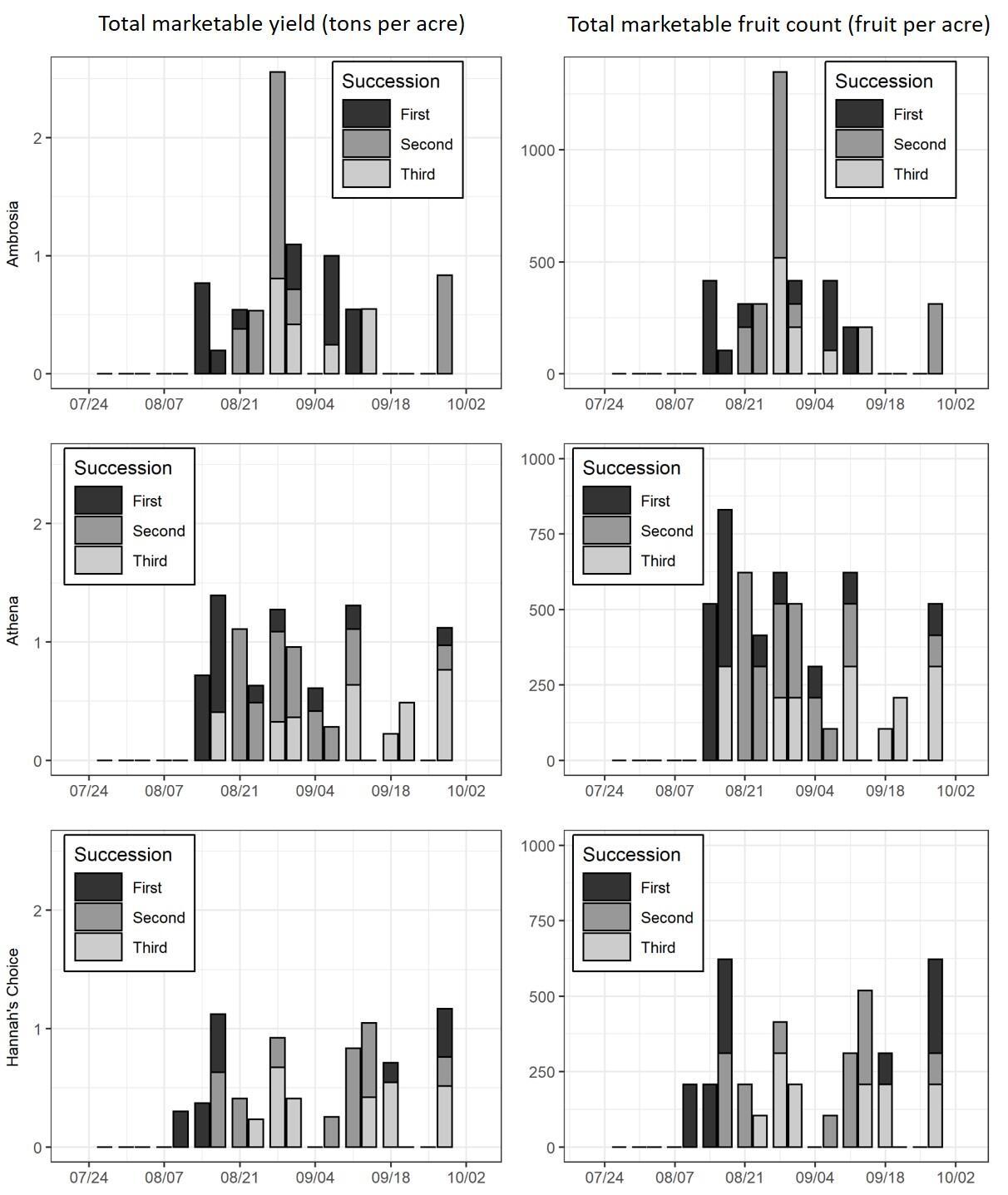
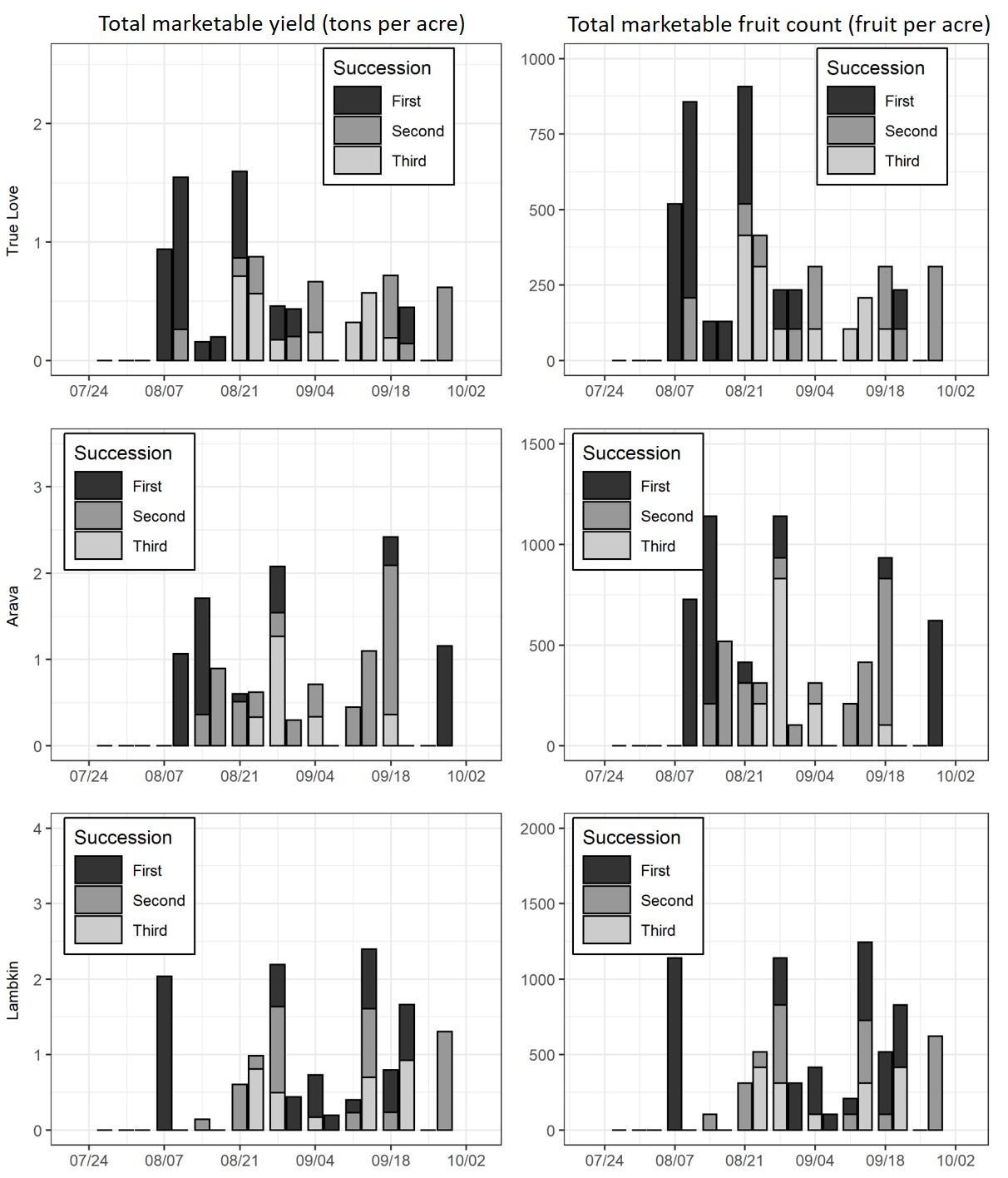
Marketable yield and fruit count over time for three different successions of eight dry-farmed melons (Ambrosia, Athena, Hannah’s Choice, True Love, Arava, Lambkin, Lilly and Yellow Doll). This figure shows total marketable yield and total marketable fruit count for an acre of Lilly melons if the field was planted with a third of the field planted on May 18, a third on June 2 and a third on June 12. Harvests were conducted on Tuesday and Friday of each week. Note that y-axis scales differ by variety.