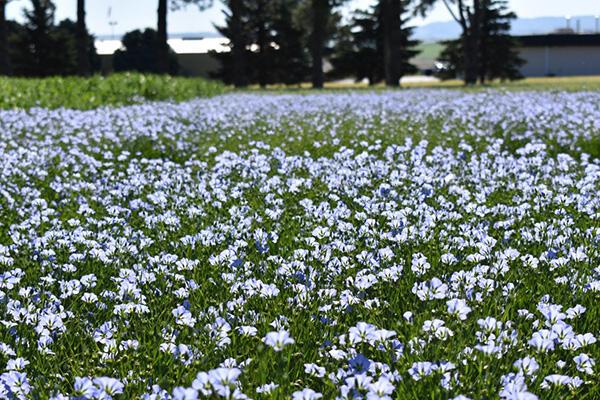
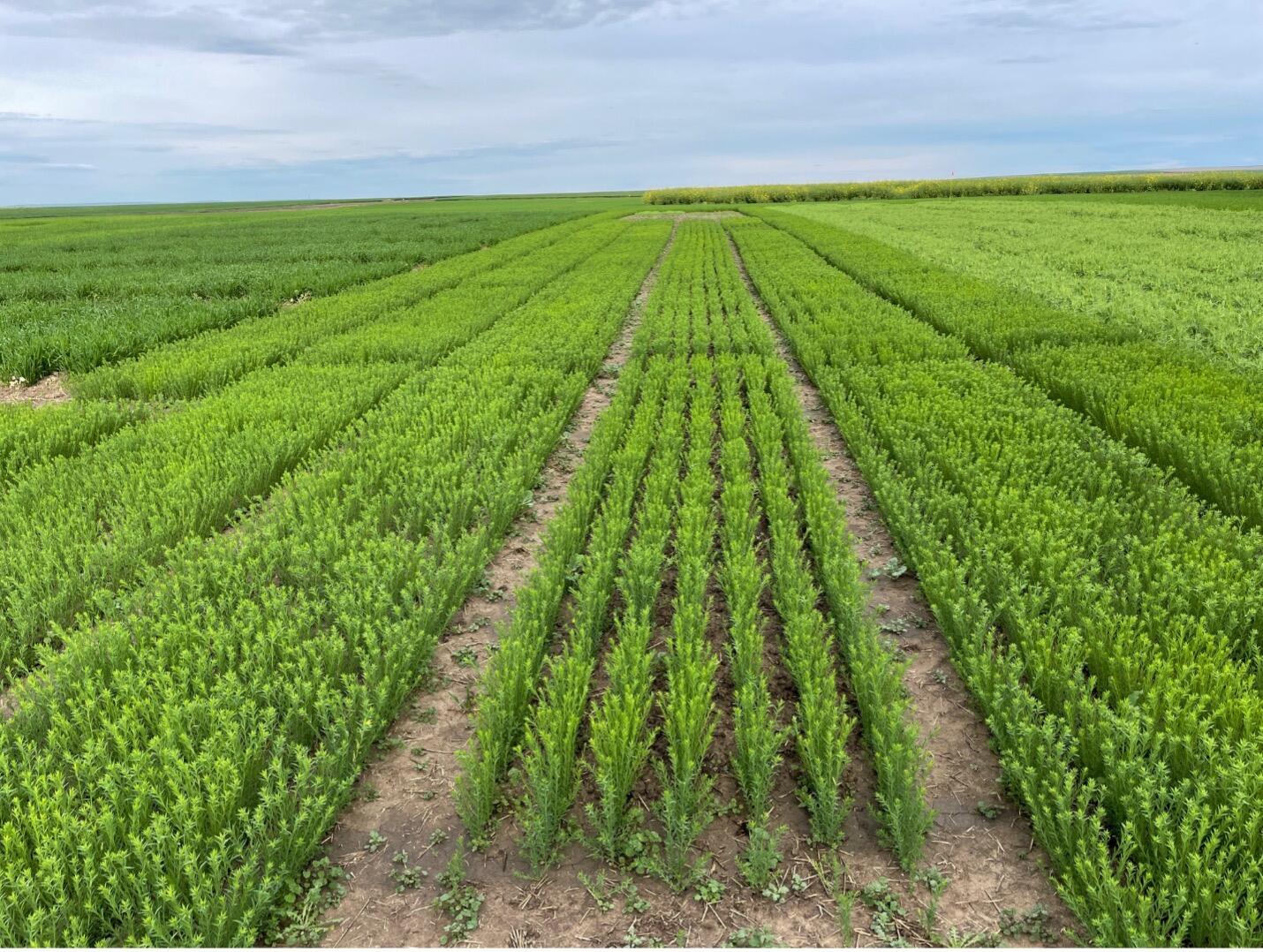
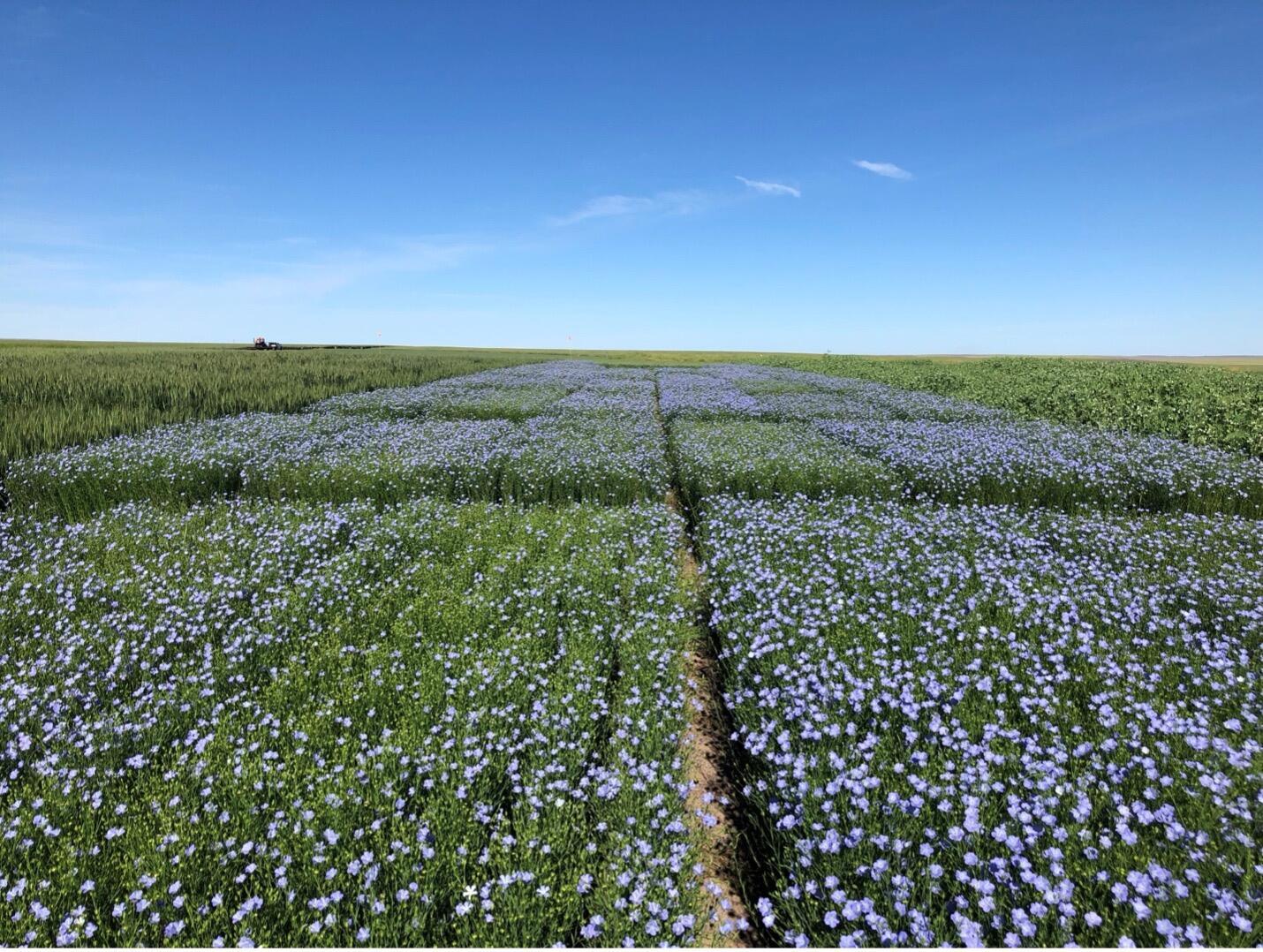
Three years of data from variety trials demonstrated the feasibility of growing flax in Eastern Oregon. Yields fluctuated with spring precipitation, and some varieties outperformed others in yield and oil content.
Flax is an annual crop that can be grown for grain or fiber production. Flax grain can be eaten directly in a range of food products, used as animal feed or pressed to make flax oil (commonly referred to as linseed oil when used for industrial purposes).
In a typical flax crop, seed oil content ranges from 35% to 45%, with the remainder of the seed composed of protein, carbohydrates and fiber. Linseed oil is a drying oil (an oil that hardens when oxidized), making it useful as a clear wood finish, a component of oil-based paints and a component of linoleum.
When harvested for fiber, flax stalks are processed to produce linen. While flax is capable of producing grain under water-limited conditions, environments with long, mild growing seasons are required for high-quality linen production.
Flax is a relatively straightforward crop to establish, requiring the same implements and skill used for establishing spring wheat.
Flax is a relatively straightforward crop to establish, requiring the same implements and skill used for establishing spring wheat. Despite its small seed size (roughly 1/8 the weight of a typical wheat kernel), it can be planted at moderate depths (from 0.5–1.5 inches). Seeding rates should range from 30 to 45 lb per acre, or 30 to 45 plants per square foot. Flax seedlings are sensitive to freeze damage, so flax should be seeded in spring after the danger of hard frosts has passed.
In other regions, flax nitrogen requirements are approximately 80 lb per acre (considering both the applied nitrogen and the nitrogen available in the soil). Flax seedlings are sensitive to damage from excessive nitrogen, so little or no nitrogen should be applied directly with the seed.
Several herbicides are labeled to control grass and broadleaf weeds in flax (Table 1). However, broadleaf weed control options for flax are generally inferior to those available for cereal crops, and several herbicides labeled for flax may cause crop injury in certain conditions. Flax is a poor competitor with weeds relative to cereal crops.
Residue management is a significant consideration for flax production. Flax stalks are very fibrous and capable of forming large mats after tillage operations. In years with high biomass production, producers may need to burn or bale straw before tilling. The guide Growing Flax provides a list of recommendations for managing flax straw. Bailed flax straw may also have value for biofuel production, animal bedding, mulch and paper production.
|
Herbicide group |
Active ingredients |
Example brand names |
Weeds controlled |
Timing |
|---|---|---|---|---|
|
1 |
Quizalofop | Assure® II | Some grass weeds | Postemergent |
| Clethodim | Clethodim 2 E | Some grass weeds | Postemergent | |
|
4 |
Clopyralid | Curtail® M | Some broadleaf weeds | Postemergent |
| MCPA | Curtail® M | Some broadleaf weeds | Postemergent | |
|
6 |
Bromoxynil | Brox® 2EC | Some broadleaf weeds | Postemergent |
|
14 |
Carfentrazone | Spartan® Charge | Some broadleaf weeds | Preemergent |
| Sulfentrazone | Spartan® Charge,Spartan® | Some broadleaf and grass weeds | Preemergent | |
|
15 |
Pyroxasulfone | Pyroxasulfone 85 WG | Some broadleaf and grass weeds | Preemergent and early postemergent |
Globally, Russia was the largest producer of flax seed in 2023, followed by Kazakhstan, Canada, China and India (Table 2).
In the United States, most flax is produced in North Dakota and Montana.
Flax seed production is far below historic production levels due to the introduction of synthetic replacements for flax seed oil. However, recent interest in plant-based materials has renewed interest in flax as an industrial oilseed crop.
|
Rank |
Country |
2023 flax production (tons) |
Proportion of global production |
|---|---|---|---|
|
1 |
Russian Federation | 1,100,000 | 42% |
|
2 |
Kazakhstan | 361,697 | 14% |
|
3 |
Canada | 272,736 | 10% |
|
4 |
China | 260,000 | 10% |
|
5 |
India | 166,753 | 6% |
|
6 |
Ethiopia | 81,000 | 3% |
|
7 |
United States | 75,210 | 3% |
|
8 |
Ukraine | 53,910 | 2% |
|
9 |
France | 51,690 | 2% |
|
10 |
United Kingdom | 36,194 | 1% |
|
World total |
2,604,121 | 100% | |
Methods
Spring flax variety trials were conducted in 2022, 2023 and 2024 at the Columbia Basin Agricultural Research Center near Pendleton, Oregon, following spring wheat without a fallow. The average annual precipitation at CBARC is about 16 inches.
The 2022 spring flax variety trial was planted on April 1. The field was prepared using a chisel plow and a Turbo-Max and fertilized with 100 lb 16-20-0-13S fertilizer prior to planting. Plots were top-dressed with 100 lb 46-0-0 on April 5, 2022. Plots were 5 feet wide and 15 feet long, and planted at a rate of 40 lb/acre using a double disc drill with 7.5-inch row spacing. Each variety was replicated four times in a randomized complete block design. Plots were hand-weeded extensively after emergence to control broadleaf weeds.
The 2023 spring flax variety trial was planted on April 14. The field was prepared using four passes of a Turbo-Max and fertilized with 125 lb of 16-20-0-13S fertilizer prior to planting. Plots were 5 feet wide, 20 feet long and planted at a rate of 30 lb/acre using the same double disc drill. Each variety was replicated six times in a randomized complete block design.
The 2024 spring flax variety trial was planted on March 29. The field was prepared using three passes of a Turbo-Max and fertilized with 150 lb of 46-0-0 fertilizer prior to planting. Plots were 5 feet wide and 20 feet long, and planted at a rate of 30 lb/acre using the same double disc drill. Each variety was replicated six times in a randomized complete block design. On April 1, a pre-emergent application of 5 oz/acre Spartan Charge was applied to control weeds.
Variability of planting date was driven by environmental conditions and annual weather. We planted as soon as soil conditions allowed for field preparations, while also avoiding the risk of frost.
Plots were harvested using a Zürn 110 plot combine, and yield was measured using a WeiSEL system integrated with the plot combine. Samples from the 2023 and 2024 growing seasons were evaluated for oil content using nuclear magnetic resonance spectroscopy. Oil content was not evaluated in 2022 due to resource constraints. Statistics were conducted in R version 4.1.1 “Kick Things.”
Results
Growing conditions
The 2022 growing season was characterized by a long, cool, wet spring that led to unusually strong yields for many spring-planted crops, including spring wheat and flax. In contrast, low springtime precipitation in 2023 resulted in poor yields across spring-planted crops. The 2024 growing season had below-average precipitation in April and June, but above-average precipitation in May.
For comparison in each year, nearby soft spring wheat variety trials averaged 77 bushels/acre in 2022, 28 bushels/acre in 2023, and 58 bushels/acre in 2024.
Yield
The average yield of these varieties ranged from 553 lb/acre in 2023 to 1838 lb/acre in 2022, with an overall average of 1039 lb/acre. In all three years, ‘CDC Neela’ yielded the most, and ‘AAC Marvelous’ was only statistically different in yield in 2024 (Table 3). An analysis including 2022, 2023 and 2024 data indicated that ‘CDC Neela’ was significantly higher yielding than ‘Gold-ND’ and ‘ND Hammond’, and that ‘AAC Marvelou’s was significantly higher yielding than ‘ND Hammond’.
|
Variety |
2022 yield (lb/acre) |
2023 yield (lb/acre) |
2024 yield (lb/acre) |
3-year average yield (lb/acre) |
|---|---|---|---|---|
|
CDC Neela |
1920a | 653a | 867a | 1147a |
|
AAC Marvelous |
1891a | 580ab | 743b | 1071ab |
|
Gold-ND |
1878a | 514b | 634c | 1009bc |
|
ND Hammond |
1661b | 468b | 662bc | 930c |
|
Mean |
1838 | 553 | 726 | 1039 |
|
LSD (0.05) |
111 | 113 | 99 | 111 |
|
CV |
3.8% | 16.6% | 11.1% | 5.3% |
Values within a column followed by the same letter are not significantly different (P < 0.05) 55 based on Fisher’s least significant difference with false discovery rate p-value adjustment.
Oil content
The average oil content of these varieties ranged from 40.3% in 2024 to 42.2% in 2023, with an overall average of 42.1%. Analysis of data from 2023 and 2024 indicated that the oil contents of ‘AAC Marvelous’, ‘Gold-ND’ and ‘CDC Neela’ were not significantly different from each other, but that each of these varieties had a higher oil content than ‘ND Hammond’ (Table 4). Oil content data was not collected on the 2022 spring flax trial due to resource constraints.
|
Variety |
2023 oil content (%) |
2024 oil content (%) |
Two-year average oil content (%) |
|---|---|---|---|
|
AAC Marvelous |
43.1a | 40.9a | 42.0a |
|
Gold-ND |
42.7b | 41.1a | 41.9a |
|
CDC Neela |
42.3b | 40.6b | 41.5a |
|
ND Hammond |
40.5c | 38.7c | 39.6b |
|
Mean |
42.2 | 40.3 | 41.2 |
|
LSD (0.05) |
0.5 | 0.3 | 0.6 |
|
CV |
0.9% | 0.5% | 0.5% |
Values within a column followed by the same letter are not significantly different (P < 0.05) 55 based on Fisher’s least significant difference with false discovery rate p-value adjustment.
Oil yield
In 2023 and 2024, ‘CDC Neela’ had a higher oil yield than ‘AAC Marvelous’, which in turn had a higher oil yield than ‘Gold-ND’ and ‘ND-Hammond’ (Table 5).
|
Variety |
2023 oil yield (lb/acre) |
2024 oil yield (lb/acre) |
2-year average oil yield (lb/acre) |
|---|---|---|---|
|
CDC Neela |
276a | 351a | 313a |
|
AAC Marvelous |
251ab | 304b | 277b |
|
Gold-ND |
219bc | 261c | 240c |
|
ND Hammond |
190c | 256c | 223c |
|
Mean |
234 | 293 | 264 |
|
LSD (0.05) |
49 | 41 | 33 |
|
CV |
16.9% | 11.3% | 3.9% |
Values within a column followed by the same letter are not significantly different (P < 0.05) 55 based on Fisher’s least significant difference with false discovery rate p-value adjustment.
Discussion
‘CDC Neela’ was significantly higher than ‘Gold-ND’ and ‘ND Hammond’ for both total yield and oil yield. The difference between ‘CDC Neela’ and ‘AAC Marvelous’ was close to the least significant difference threshold for both of these traits.
Among these four varieties, year-to-year variability in total yield was larger than the variability in oil content. For total yield, the highest-yielding variety was 23% higher than the lowest-yielding variety. For oil content, the highest-oil-content variety was 6% higher than the variety with the lowest oil content. Total yield was the dominant factor in determining oil yield.
In both 2023 and 2024, seedlings showed early-season stress symptoms, including small leaves and mild chlorosis, possibly due to moisture stress. In both years, these symptoms receded following the first significant rain event. This leads us to believe that later planting could leave seedlings exposed to hot, dry seedbed conditions. However, this needs to be balanced with the tenderness of young flax seedlings to hard frosts. In general, our data and experience suggest that the best time to plant flax near Pendleton, Oregon, is the second half of March or the first week of April. Ideally, flax would be planted prior to a significant rain event, when soil temperatures have reached at least 40°F and the forecast indicates relatively warm conditions for the following week.
While a seed treatment was not used in these trials, applying a suitable seed treatment would likely improve yield in commercial production. No pathogens or insect pests were observed in these trials.
While we did not conduct a formal evaluation of flax yield compared to wheat yield, the three flax trials were grown close to soft white spring variety wheat trials that experienced similar growing conditions. Based on the relative performance of these trials, we would expect flax to yield from 12 to 25 lb/acre for every bu/acre a soft white spring wheat crop would yield. Because flax has fewer broadleaf herbicide options than wheat, broadleaf weed pressure will typically be higher in a spring flax crop relative to a spring wheat crop.
Depending on market volatility, it could be beneficial for flax buyers to consider sourcing seed from Pacific Northwest producers, especially considering that flax requires minimal processing. Marketing alternative crops in the Columbia Basin has been a historical challenge considering most local infrastructure (storage, transportation) is based on wheat.
Conclusion
Based on these trials, growing flax near the Columbia Basin Agricultural Research Center, northeast of Pendleton, Oregon, is feasible but not highly promising. Widespread adoption of flaxseed production in the Columbia Basin may not be viable without a rise in global demand for flaxseed products.
References
Booker, H., R. Bueckert, S. Duguid, J. Gavloski, R. Gulden, R. Dueck, R., K. Banchuk, K. Rashid, D. Tomasiewicz and A. Ulrich. 2015. Growing Flax. Flax Council of Canada.
Ehrensing, D.T. 2008. Flax, EM 8952.
Food and Agriculture Organization of the United Nations. 1997. FAOSTAT statistical database.
Kandel, H., and C. Keene. 2020. Flax Production in North Dakota. North Dakota State University Extension, A-1038.
Martinchik, A.N., A.K. Baturin, V.V. Zubtsov and L.I. Molofeev. 2012. Nutritional Value and functional properties of flaxseed. Voprosy Pitaniia 81, 4-10.
About the authors


Related publications