Transcript
00:00:05 Rick
Welcome to the Farm to School Podcast, where you will hear stories of how youth thrive and farmers prosper when we learn how to grow, cook, and eat delicious, nutritious local foods in schools across the country and the world.
00:00:18 Michelle
Hey, we're your hosts. I'm Michelle Markesteyn.
00:00:21 Rick
And I'm Rick Sherman. How are you guys doing today? Hi, Michelle.
00:00:26 Michelle
Hey, everybody.
00:00:27 Rick
Hey, everybody.
00:00:28 Michelle
I have a question for you. I've never asked you.
00:00:31 Rick
Okay.
00:00:32 Michelle
Have you ever been to Vermont?
00:00:35 Rick
I've been waiting for someone to ask me that question my whole life. No, actually, I was all set to go for a farm to cafeteria conference about 13 years ago, and then I switched jobs. And…
00:00:52 Michelle
You got a better job.
00:00:54 Rick
I did. And my new job, it was like, it was too, I mean, I couldn't, it was like that week when that conference happened. So it just, I had to stay home. So...
00:01:04 Michelle
You had a RFP to write that week. Was this the week that you started at the Department of Education? Oh yeah, and I lived at your office in Portland writing that. I remember like whiteboards forever writing about. We're talking about 2011, right? Kind of like 2012.
00:01:26 Rick
2012. 2012 in the middle of the biennium. And we had to get this thing going because yeah, it was great. It was like drinking from a fire hose because fun fact, The first thing my boss said to me at the time was, hey, you're going to have to do this grant.
00:01:45 Michelle
This is the director of the Child Nutrition Program for the Oregon Department of Education.
00:01:49 Rick
She said, you're going to have to do this grant. And you know what I said to her? I said, what's a grant? I was totally serious. Talk about a learning curve. I mean, I became an expert very fast. Thanks to Michelle. But I mean, that was 13 years ago. So, but my gosh, it was like I had to, it was like drinking from a fire hose. As they say, I had to get indoctrinated really fast. And it was fun. It was a, it was a good project. But anyway, so no, I have not been to Vermont.
00:02:22 Michelle
Is this a spaghetti conversation? I'm just going on here. Okay, well, You are going to meet in this episode amazing students and educators from Brattleboro, Vermont. And I noticed you didn't ask me if I've ever been to Vermont.
00:02:40 Rick
I just already knew you did, but hey, Michelle, have you ever been to Vermont?
00:02:47 Michelle
I wasn't planning on answering that, but yes, oh my gosh, I love Vermont. I had lived in Vermont 2 separate times. One is this amazing farm and forestry land called Merck Forest and Farmland Center in Craftsbury, Vermont. It's A 3,000 acre woodland and farm. And we did, I mean, now we call it farm-based education, but then it was like, hey, kids are coming out to the farm. And we had cheap and all kinds of cool things that we did.And then the other time was I used to be the faculty intern at Sterling College. Have you ever heard of that?
00:03:24 Rick
No, never.
00:03:25 Michelle
No, most people haven't. It was the smallest accredited college in the country. We had 68 students.
00:03:31 Rick
Oh my gosh.
00:03:32 Michelle
And I was the dorm mom.
00:03:34 Rick
Wow. I did not know that and learn something new every day. I did not know that.
00:03:37 Michelle
And we did cool things like making snowshoes.
00:03:42 Rick
She's pointing at snowshoes in her living room. You guys can't see that, but did you make those?
00:03:47 Michelle
I did.
00:03:47 Rick
No way.
00:03:48 Michelle
Yeah, I cut down the tree and I used a draw knife to create about 1 inch
00:03:54 Michelle
I'm putting in the show notes, I'm taking a picture. That's amazing.
00:03:59 Michelle
Yeah, we built a steam box. We built a huge fire. And then you bend them around a steam box. And then I learned all about, I didn't know this before, but the weaving patterns. I was researching Inuit weaving patterns, and you could actually learn a lot about people's family history and marriages and relationships by the way people would weave their snowshoes.
00:04:21 Rick
I bet. Oh, that's really cool. That's amazing. I did not even know you made that. I've seen those laying around. We're not in the studio today, by the way. We're in some that are totally different just because.
00:04:32 Michelle
Part of the Willamette River Valley.
00:04:35 Rick
Well, there is a river.
00:04:36 Michelle
We're floating.
00:04:37 Rick
There is a Willamette River.
00:04:37 Michelle
We haven't done a floating podcast yet.
00:04:40 Rick
No, the electronics and that doesn't mix so well with water.
00:04:43 Michelle
But I'm mentioning all of these things because when I was at the National Farm to Cafeteria Conference in Albuquerque, New Mexico, I was so drawn to this group of students because there were not many students there, high school students.
00:05:01 Rick
I guess we should say that, we're going to lead into that. This is part of that ongoing series of the Farm to Cafeteria Conference in Albuquerque where you and Christy Sheridan co-hosted.
00:05:14 Michelle
Yeah, and we're going to hear from that group of folks. And yeah, just seeing educators as facilitators of experiential education around food and entrepreneurship. And who we're going to hear from today is amazing. They basically do seed to sale experiences with the students through the culinary, agriculture, vocational and education cave kitchen.
00:05:42 Rick
Yeah, you're going to hear about wonderful things about like a pickle factory and an emu farm. and a farm club and what they call CAVE, which is Culinary Ag Voc Ed. That's the little, the initials for that. But they have what they call the Daily Bear, which we'll have links to in the show notes, but a little student store. And just, and a lot of things about Vermont. Vermont is, if you don't know, they're also, they're a real hotbed for all things farm to school. So a lot of good things happening up there.
00:06:16 Michelle
Right, and like the whole concept of farm to institute was born in Shelburne Farms and a whole bunch of different things. And I would say too, what's different about maybe other students that we've had is it's a lot for youth to be pulled in the middle of a conference. And recall, we were in a big hallway where, hundreds of people are walking by us. And it's really neat that they were willing to share their thoughts on this podcast. So thank you in advance team.
00:06:45 Rick
Yeah, so a shout out to Haley, Jazz, and Alex, who are going to be guests, the students that talk. They're hilarious at times. Yeah, you'll hear it. But yeah, we're anxious for you guys to listen to it. And please let us know what you think. Drop us a comment about these things and give us an idea for another podcast too. Just my little two cents.
00:07:11 Michelle
We're at the 2025 National Farm to Cafeteria Conference. And here in the hallway, we just ran into a whole group of amazing folks. And I would love everyone to introduce themselves. Let's start there.
00:07:26 Bianca Fernandez
Hi, I'm Bianca Fernandez, and I am a social worker and farm to school person in Brattleboro, Vermont. I'm here with a crew of my folks.
00:07:38 Hayley
My name is Haley Lockabee. I am a senior student at Brattleboro Union High School and a member of our school's farm club.
00:07:51 Alex
Hello, my name is Alex Chaffee. I am a junior student and a member of the Farm Club.
00:07:59 Jazz
Hello, I'm Jazz. I am a senior student at the Brattleboro Union High School, and you will not be hearing me talk A lot.
00:08:08 Camille Kaufman
Hi, I'm Camille Kaufman. I am a 4-H educator from University of Vermont, and I work at the Brattleboro Union High School with the Farm Club and a couple of other classes there.
00:08:24 Michelle
And in the three minutes we met, we have so much in common. I mean, Bianca and I have never met, and we cared for the same person's llamas up in Craspberry Common, Vermont.
00:08:36 Christy Sherding
What? That's amazing.
00:08:39 Michelle
It's really true.
00:08:40 Christy Sherding
I love that. Llamas.
00:08:42 Michelle
Yeah, Ned's llamas actually inspired me to write a children's book called Silly Llama, I Can See You. Never saw the light of day, but anyway.
00:08:52 Christy Sherding
I kind of want a copy.
00:08:55 Michelle
So what are you all doing? Tell us about what's happening in Vermont.
00:09:00 Bianca Fernandez
Where do we even start? Well, we got incredibly lucky a couple years ago. I was in conversation with my good friend, Liz Kenton, who's another UVM Extension educator. And she was telling me about this grant that This national grant that they had received, they were sub-awarded through the University of Maine and in our region that there were supposed to be 5 sites and that the first four sites had been identified, three in Maine and one in Burlington, Vermont. And they really wanted to find a site in the Brattleboro area. And basically the deliverable was working with oppressed and marginalized communities, delivering and exploring food systems.
And I said, I don't understand what is so hard about, wouldn't anyone just jump at this opportunity?
And she explained that the other four sites were all new American agencies and that they had approached all the new American agencies in the Southeast Vermont area and nobody felt really like it was aligned with their mission or had the staffing to pick it up. So I said, what about the disability community? Because I, with my non-farmer hat on, I'm a social worker at Brattleboro Union High School. I work in special education and behavioral services and work with neurodivergent students. And Liz was like, oh, We never thought of that. Let's look into it and the rest is history. We basically have just won the lottery and get to do all the things that lots of people dream about doing their whole lives and don't have the funding or the resources to be able to do. So dream come true over here. And Haley is stealing the microphone from me.
00:10:42 Hayley
I'd say Farm Club really started up around 2024, where we started integrating into our after lunch stuff. So like our ACE schedule, students could have like 40 minutes to get extra work done. It's called ACE. And we started having farm club meetings with a lot of our other C students because they were interested. And then on every Friday at the end of the month, we would have field trips to explore different local farms in the Vermont area. And that was really, really cool because, a lot of the students didn't like get to do that stuff.
00:11:25 Bianca Fernandez
What was your favorite field trip?
00:11:30 Hayley
I kind of like the pickle factory.
00:11:32 Christy Sherding
What? I've never heard farm to pickle factory before.
00:11:37 Hayley
It was such a cool place, like the animal place that we went to? Which one? The one with the birds.
00:11:43 Bianca Fernandez
The emu farm.
00:11:44 Hayley
Yes, the emu farm. I think that was our first one.
00:11:48 Christy Sherding
I went to Eastern Michigan University, EMU, and so that's what we called ourselves. We're emus, but we weren't, but I love emus. That's so fun. How many students are in your farm club? I see there's three of you guys here.
00:12:04 Hayley
It's kind of a flexible number. Sometimes students don't arrive to some meetings, but currently we have more than 10.
00:12:16 Christy Sherding
That's fantastic.
00:12:19 Bianca Fernandez
And how many students are in the whole C program and should we tell them what C is? We have about forty. I'll answer my own question. We have about 40 students. I just want to say that there are three very shy, but very amazing young people here. And I wish that they would contribute a little bit more, but I understand. We have about 40 students that we serve and see, which stands for Student Educational Assistance.
00:12:46 Michelle
Wait, the letter C stands for student?
00:12:49 Bianca Fernandez
I think it's spelled S-E-A-N. Okay, I'm sorry. I know. It's so confusing, and a lot of people write it that way when they hear it.
00:12:56 Michelle
I was like, letter C.
00:12:57 Christy Sherding
Yeah, I was thinking the same thing.
00:12:58 Bianca Fernandez
Totally. Yeah. So we're a tier 3 behavioral service and we work with kids who have some kind of barrier to being able to access their education. So something is getting in the way of them being able to go to class, complete work, pass class classes and get credits. And so it's our job, we have a combination of special educators and social workers and paraprofessionals. It's our job to help them figure out how to set goals for themselves and achieve those goals and figure out how to get past the barriers that they have that are getting in the way of their learning. So, a little bit more specialized, but not special education identified. So maybe you're going to go see a clinician in your school. Maybe you are, maybe you are engaging in other, you're accessing the academic support teachers and classrooms. So you're getting extra help, but it's not, you don't have a 504 or an IEP yet. So then once you get into the IEP 504 area, then you're in tier 3?
00:14:25 Christy Sherding
What brings you guys to this conference? You guys come all the way from Vermont.
00:14:29 Michelle
That's so far.
00:14:30 Christy Sherding
Yeah, that's far. Was it a long flight?
00:14:32 Michelle
How long did it take? Did you get any good snacks on the plane?
00:14:36 Alex
It took about four hours, one flight and another one hour, so 5 hours in total. We got some good beverages. We got like lots of soda and stuff.
00:14:46 Christy Sherding
That's fun when the cart comes around and it's like all you can drink.
00:14:50 Alex
Yeah, it was really great. And yeah, that's all I got.
00:14:54 Michelle
So what kind of things are you involved in growing food or cooking food or harvesting food?
00:15:03 Alex
Yeah, we cook a lot of food.
00:15:05 Michelle
Where? In CAVE.
00:15:08 Michelle
What's CAVE? I'm like, you're making cheese in caves.
00:15:11 Christy Sherding
I'm glad you asked.
00:15:12 Alex
Sorry, it's a little school.
00:15:14 Bianca Fernandez
Do you remember what cave stands for?
00:15:18 Alex
No.
00:15:18 Bianca Fernandez
Haley, do you remember?
00:15:20 Hayley
Culinary? No, I don't.
00:15:23 Bianca Fernandez
They're trying.
00:15:24 Bianca Fernandez
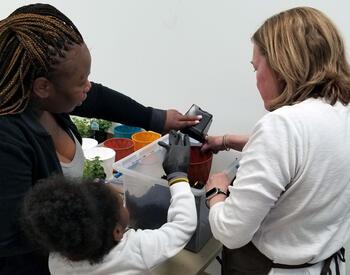
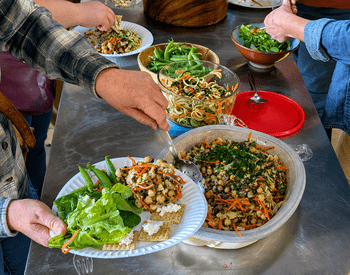
Okay, Culinary Agriculture Vocational Education. So the really exciting thing about our grant is that we are getting to put our learning into practice and we were able to rent out this amazing space at a local campus that used to be a residential program and is now kind of, it's like a campus where there's 45 businesses and we're kind of a snack bar for that campus. So the kids get scheduled for classes there, there's four blocks a day, and they come and they cook food, and they work in the shop, and they help with the garden, and it's really amazing.
00:16:02 Hayley
Yeah, and we had a summer program. this year that was helping set up the kitchen because when we got there, we had to start setting up everything. And we also set up our own garden because before we got there, was no plot at all for a garden. We made the entire thing ourselves.
00:16:22 Michelle
Wow. So how did you actually do that? Like how did you make the garden plot yourself?
00:16:28 Bianca Fernandez
Do you remember how we started?
00:16:32 Hayley
I don't remember how we started, but I remember being involved with, we had like this huge dirt pile and we started like patting it down into the grass and stuff.
00:16:42 Hayley
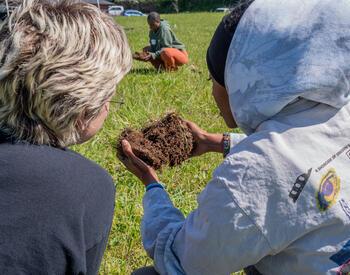
And then I went away for like a few months and I came back and the, whole garden was like there and we were starting to plant stuff and it was super cool. Yeah, we got a huge donation of eight yards of beautiful compost. We also had our own worm bin that the farm garden started. And so we were able to like dump that in the garden. It was like Pee Wee's Big Top Circus garden. Like I've never seen anything grow like this before, way better than any garden I've ever grown at home. It was like a perfect storm of conditions.
00:17:13 Christy Sherding
You guys have the magic touch.
00:17:14 Hayley
Yeah. We also had a bit of outside help because we got, we had seeds from, which elementary school was it? From Guilford Elementary School, they donated a bunch of seeds to us and then we planted those in our garden.
00:17:32 Bianca Fernandez
And we started our own seeds in the winter on grow carts that we had at school. And so now we've opened a little cafe called the Daily Bear Cafe.
00:17:41 Christy Sherding
I want to know more about this cafe. Do you guys work, you make the food, you work in the cafe, you do all of the things.
00:17:47 Hayley
Yep.
00:17:48 Christy Sherding
That's really, really cool.
00:17:52 Camille Kaufman
Yeah, all the things.
00:17:55 Bianca Fernandez
Camille's like, no way.
00:17:57 Christy Sherding
What do you guys make? What's your what's your favorite thing to make?
00:18:00 Bianca Fernandez
What do you think, Jazz? This could be a good answer for you because you're there two blocks every day.
00:18:05 Michelle
At the cafe, Jazz.
00:18:06 Bianca Fernandez
Yeah. Jazz's job is that he gets lunch ready. So he sets up all the containers. We're kind of a cafeteria style model. So there's one hot lunch a day. And there's a calendar that people follow and they decide what days they want to come. It's the most affordable, delicious, local, seasonal, amazing lunch in town, 10 bucks. And you get an entree, 2 salads and a dessert.
00:18:27 Christy Sherding
What a steal $10 only.
00:18:28 Bianca Fernandez
I know. It's amazing.
00:18:29 Christy Sherding
That's awesome.
00:18:30 Bianca Fernandez
So Jazz gets all, because everything all set up, he gets the salad set up and all the desserts and everything ready for lunch every day. Dessert. He's one of my right hand guys. Yeah. Often it's cookies. Recently we made ice cream. Sometimes it's a scone or some snack cake. But we really try to focus on local seasonal stuff. So right now we're doing a lot of cranberries and citrus and okay, so not local, but seasonal. Cranberries and citrus and lemon and those sorts of things. But in season, we go berry picking, we go apple picking, and we use all of, like, you know, as many ingredients as we can, grow ourselves and get from local growers.
00:19:08 Christy Sherding
I want to come work at the cafe. It sounds fun. Can we come visit?
00:19:13 Hayley
Yes.
00:19:14 Bianca Fernandez
Open to the public, please come visit.
00:19:16 Camille Kaufman
Monday through Friday, school hours.
00:19:20 Michelle
Jazz, I'm really curious, what is something you've noticed about being at this conference? Because there's a few high school students here, but there's not a ton of high school students here So what's it like coming to a conference with 800 adults?
00:19:41 Jazz
I mean, it's pretty cool seeing all the adults. It's kind of awkward just being like the only kids here and stuff. It's cool to see like all of them working and like communicating with each other. Yeah.
00:19:54 Michelle
Thanks for that. What ways could we open this conference up to more teens?
00:20:04 Hayley
Maybe get... have more school involvement by having, because it's like a lot of teachers here, right? So why not have some of the teachers like invite like students that they think would be interested in this conference?
00:20:19 Bianca Fernandez
We have something.
00:20:21 Christy Sherding
I was just going to ask if that's something. What if you guys hosted a workshop and talked about what you were doing for other students?
00:20:28 Camille Kaufman
We have something similar to that in Vermont. It's called the Feast Conference. That's through our Farm to School Network. And the folks who organize that, the adults, are actually here. But youth are the ones organizing it. And Alex attended last year as a participant. So wondering if we could bring some of the framework of the youth organization of the conference here. And we do plan to go to that again this year and take our learnings from this conference.
00:20:58 Bianca Fernandez
So we've been working on a slideshow and doing some research about what our workshop might be about. We're thinking about New Mexican food culture and figuring out what kind of recipes we're going to demo, what kind of ingredients we want to bring home with us, and how we can bring back our learning from here to the feast.
00:21:15 Christy Sherding
What's your favorite thing, guys, that you've eaten here? Do you have a favorite food that you've had here Like New Mexican style food that you've never tried before.
00:21:23 Hayley
The enchiladas from yesterday's lunch were really good.
00:21:26 Christy Sherding
They were. They were very good.
00:21:28 Camille Kaufman
What did you have last night?
00:21:31 Alex
We had a green chili burger. It was pretty good. It was falling apart though because it was really big.
00:21:37 Christy Sherding
That sounds delicious.
00:21:39 Michelle
It was really good. Were the green chilies in it or on top of it or?
00:21:43 Alex
Yeah, they were in it. Just like on the burger.
00:21:45 Christy Sherding
Was it spicy? No, just really flavorful.
00:21:50 Michelle
Yeah, there's chilies in everything.
00:21:51 Christy Sherding
Yeah, everything has chilies. My Caesar salad last night had green chilies on it.
00:21:56 Michelle
Yeah, I had, I think, I was like, are these Hatch chilies? And I had street corn. So it was like corn with like lime and mm. Yummy.
00:22:07 Christy Sherding
Yum.
00:22:07 Bianca Fernandez
So good. We're excited to go out for a few more dinners and try different. We made a list of our top five things we each really want to try. New Mexican signature things we want to try.
00:22:19 Hayley
We're actually doing a lot of learning about New Mexican food on this trip because we want to go back to Vermont and introduce a lot of what we've learned here to our other students. And also just get enriched with the food and culture of New Mexico.
00:22:35 Michelle
So Jazz, could you imagine seeing something you ate here in New Mexico in the cafe where you work?
00:22:43 Jazz
I just think mostly like the fruits and... The breakfast and stuff, like the bacon, the eggs, the green chili eggs are definitely like something else. Mostly fruits in the breakfast.
00:22:55 Christy Sherding
That's awesome.
00:22:56 Bianca Fernandez
I'm daydreaming about breakfast burritos in season because it feels like that's one of like, that's such a, every time you look up New Mexican food, that's one of the things you read first, which is so interesting and kind of surprising to me, but I'm really excited about maybe making that a regular on our menu.
00:23:10 Christy Sherding
That would be a fun menu item.
00:23:13 Camille Kaufman
They're also doing an Instagram takeover of their Daily Bear Instagram account this week.
00:23:19 Christy Sherding
You guys are? That's awesome. I'm going to follow you as soon as we're done with this.
00:23:23 Michelle
And we're going to link on our show notes so that whoever listens to our podcast or looks, we'll do that. Is there anything else you'd like our listeners to know or questions you have for us?
00:23:41 Hayley
Is this your first conference for this?
00:23:45 Christy Sherding
It's mine. Yay.
00:23:47 Hayley
Same.
00:23:47 Christy Sherding
Yeah, we're matching.
00:23:49 Michelle
So Some of Us is our first conference, and not for me. I have been involved in the Farm to School Network since it began. And actually, we took a picture last night of folks who were on the original advisory board. Yeah, so I keep getting called OG. I had to look. I googled up OHGEE. I'm so OG. I didn't know. Okay. O dot G dot. I didn't know. It's old guard. I didn't know. You guys, you already knew that. All right. Okay. My son taught me what “GOAT” was too. I didn't know what that was. But why I bring this up is I know You 3 youth are creatives and have your own ideas and approaches to the world. And I just say high five, go for it. Because a bunch of us had this idea of like, why don't we get together? Why don't we do policies? Why don't we do evaluation? Like we were just creative inventing stuff. And now it seems like a really cohesive, well thought out movement with like state and federal policy and a lot of institutions. Institutionalization and funding from all over, but it just starts with seeds of an idea and something you're passionate about, like something you care about, you just go for it, And so it's kind of my answer to, it's not my first conference.
00:25:19 Hayley
What brings you like to the conference? Like why did you want to be here? What made you want to be involved with like agriculture and stuff?
00:25:30 Christy Sherding
So it's my first conference. I am here to make new friends, meet new people doing all this great work in the farm to school, farm to cafeteria space. And it's been awesome. We've been sitting here for the past two days talking to people and I feel like I'm a sponge. I'm just absorbing all the neat, cool things that everyone's doing. And so I really just came here to learn and make friends.
00:25:58 Michelle
And for me, I'll be transparent. I almost didn't want to come. I get overwhelmed being in crowds and traveling and changing time zones. And I thought, I can't go. And I even said to Rick, I might not go. And Rick isn't here. And so having my friend come, Christy, and be supportive was like a big step forward. And of course, once I get here, I love being here. And honestly, meeting you three, and the adults in your life and the people that we're meeting to come by the table and share their stories, that's what motivates me and keeps going and makes it easier to get up in the morning when it's like, oh, we're all tired and on a different time zone. So that's why I came to the conference for.
00:26:43 Bianca Fernandez
Great questions, Haley.
00:26:45 Christy Sherding
That was an excellent question. You might have a future in podcasting.
00:26:49 Hayley
Thank you. I took a journalism class in junior year.
00:26:53 Michelle
These are really good questions.
00:26:57 Bianca Fernandez
I guess if there's anything else I would want to say, it's just that it would be, I have spent such a big part of my life figuring out how to combine my love of agriculture and my interest in social services and how to, you know, I couldn't figure it out for a really long time. So this has been such an amazing opportunity for me. But this is, working in schools is pretty new to me. This is my 6th year in a school setting. And before that, I've done a lot of nonprofit work and child welfare work in addition to farming. And I always thought, I'll never work in a school. It's so boring. That's not where I want to be. And it's amazing how much good work you can do in schools. where you have seven hours a day of captive audience with kids and you can affect so much actual change in their lives and you can build so much relationship out of the 50 minute hour that you get, in other settings with kids. Sometimes you see them once a month, sometimes you see them once a week. And we spend a ridiculous amount of time together, probably too much, I would say. But also getting to watch you guys grow over the last four and some of you six years is kind of the best thing that's ever happened to me and getting to share my love of agriculture with you and watching you now love gardening is pretty amazing. So I would just say that is really important and farm to school is important and farm to cafeteria is important. And I just, I hope that the conversation at some point expands to farm to healing and thinking about the other ways that agriculture really can help all of the parts of us, right? Because when we feel safe is when we can really learn. And that's what we want for you guys in schools is creating environments where you can learn. So I'm just really grateful for you guys. And thank you so much for meeting with us. It was a really exciting opportunity.
00:29:08 Camille Kaufman
Yes, I want to say thank you so much for this platform of lifting up our program and our experience here. And also thank you to Bianca and all of you students. I couldn't think of a better program for the grant that you're a part of. And it's been really great working with them on all of the programs that we do. Just want to plug, so I work with 4-H. So the Farm Club is part of 4-H, but what's really cool about this is that we can look at, when you think of 4-H, and when I joined 4-H on the team, I thought, cows and corn.
00:29:58 Christy Sherding
What does 4-H stand for, just for those people that don't know?
00:30:01 Camille Kaufman
Yes, it stands, it's a youth experiential learning program across the country that is hosted by all extension services from land-grant universities. And 4-H stands for head, heart, hands, and health. So it's a four-leaf clover. And what we're looking at is different ways kids that don't typically experience 4-H, it's been around for 100 years, and it's typically a very agricultural, agrarian program, how to get different kids involved that don't typically experience 4-H.
00:30:37 Camille Kaufman
And this has been a really great program. And hoping that we can bring it to the rest of students in the country.
00:30:49 Michelle
And Haley, did you want to add something too?
00:30:52 Hayley
To circle back to how much this means for the students that get to experience 4-H and Farm Club and the Cave Kitchen and all this amazing stuff, I just wanted to say I've been here for like 4 years and I got to see this all come together with all these amazing people and I think these four years of high school have probably been some of the most impactful years of my life and have gotten me so many amazing connections and so many amazing communities that I really have to thank a lot to Bianca Fernandez for helping me out so much. Thank you.
00:31:34 Michelle
You wouldn't know this because we just met, but I I taught high school in the Bay Area School of Enterprise. I was an emergency credentialed teacher and my high school students got me into school gardening, which is why I ended up doing a doctorate in it and then going on and like starting it for other things and have just stayed in touch with Helene. Hi, Helene. Not that she has time to listen to this, who is now a social worker and in her 40s. And so it's like a great connection and it's just so beautiful to grow alongside people. This is what this is about. It's about amazing good food, but it's really about cultivating humans and cultivating our spirits and community.
00:32:18 Camille Kaufman
Totally.
00:32:20 Christy Sherding
Thank you guys so much for being here. And thank you guys for being such inspirational educators. And you guys as being creative, innovative, future of the world.
00:32:30 Michelle
We can't wait to hear about the new menu updates.
00:32:32 Christy Sherding
See what happens. And what was the Instagram again? I'm going to look it up right now.
00:32:36 Michelle
And we're going to put it on our show notes.
00:32:38 Bianca Fernandez
The Daily Bear Kitchen.
00:32:39 Christy Sherding
The Daily Bear Kitchen.
00:32:40 Bianca Fernandez
Thank you so much for giving us this space.
00:32:43 Michelle
Thank you. Have a great conference.
00:32:46 Christy Sherding
Have fun.
00:32:47 Rick
Thank you again for Bianca and Camille, as well as the students, Haley, Jazz, and Alex.
00:32:53 Michelle
It's so impressive what you have all been able to accomplish together, and we really appreciate you sharing your story with us.
00:33:00 Rick
Farm to School was written, directed, and produced by Rick Sherman and Michelle Markesteyn with Production support from LeAnn Locher and Lauren Tobey of Oregon State University. The podcast was made possible in part by a grant from the United States Department of Agriculture.
00:33:14 Michelle
The content and ideas of the Farm to School podcast do not necessarily reflect the opinions of Oregon State University or the United States Department of Agriculture. And both the USDA and Oregon State University are equal opportunity providers and employers.
00:33:29 Rick
Do you want to learn more about Farm to School?
00:33:30 Michelle
Of course, always.
00:33:32 Rick
Always. Check out other episodes, show notes, contact information, and much more by searching Farm to School Podcast, OSU.
00:33:40 Michelle
Yeah, totally. We'd love to hear from you. Please stop by. Take care.
00:33:43 Rick
Bye everyone.
What happens when Vermont teenagers take farm to school on the road—and land in the middle of a national conference? In this joyful, unscripted hallway conversation from the Farm to Cafeteria Conference in Albuquerque, you’ll meet students and educators from Brattleboro Union High School who are growing food, running a café, and building community from seed to sale. From pickle factories and emu farms to the Daily Bear Café and the CAVE Kitchen, this episode celebrates youth leadership, experiential learning, and the healing power of food. Come for the Vermont charm, stay for the student voices—and leave inspired by what’s possible when we trust young people to lead.
The Farm to School Podcast is produced by Rick Sherman, Farm to School Analyst at the Oregon Department of Education and Michelle Markesteyn, Farm to School Specialist at Oregon State University Extension with production support from LeAnn Locher, OSU Extension. The show is made possible by a grant from the United States Department of Agriculture.
Want to connect? We’d love to hear from you!