
What is the Cottage Food Exemption?
In 2023, the Oregon Legislature passed a law that creates new small-business opportunities for bakers, chefs, and local food producers. Oregon’s Cottage Food Exemption allows people to produce certain low-risk food items in their home kitchens and sell them directly to consumers without a license.
Only food items that are classified as not potentially hazardous are allowed.
Although cottage food producers do not have to undergo an inspection, they must meet basic standards related to food safety, labeling and record-keeping. Home kitchens must be built and maintained in a clean and sanitary manner, and only food items that are classified as not potentially hazardous are allowed. Total annual sales from a cottage food producer are limited to $51,200 as of 2025, with adjustments to the sales cap made annually.
The Cottage Food Exemption is distinct from the Farm Direct Marketing Law, which allows for similar license exemptions for growers processing their produce in specific, low-risk ways. See Oregon’s Farm Direct Marketing Law, EM 9205, for more information on that exemption.
The Cottage Food Exemption sets specific standards for:
- Allowable products.
- Facility requirements.
- Labeling.
- Sales and marketing.
- Record-keeping.
What types of products are allowed?
Allowable cottage foods include many types of shelf-stable foods, but cottage food producers may only sell certain items listed in the regulation that are considered not potentially hazardous. This means that no foods that require temperature control for safety (refrigeration, for example) are allowed. Additionally, no products containing meat, fish or shellfish can be sold as cottage foods, and no products containing marijuana are allowed.
Food products that may be sold under the cottage food exemption are explained below. If a food does not fall into one of these categories, it is not eligible for license exemption under the Cottage Food Exemption.
Baked goods
- Allowable baked goods include bread, rolls, cakes, pies, doughnuts, pastries, cookies, biscuits, crackers and similar goods.
- Not allowed: Baked goods that require refrigeration after production, such as pies, cakes or pastries containing cream, custard, meringue, or cream cheese icings or fillings, as well as focaccia-style breads containing vegetables or cheese.
- Not allowed: Baked goods containing meat, fish, or shellfish, such as potpies or pastries with those ingredients.


Syrups
- Syrups may be made from a variety of ingredients, including fruit juices, tree saps, cane sugar, honey, agave and flavorings. Oregon cottage food law does not specify a single sugar concentration required for all syrups; however, the safety of these products depends on low water activity. To produce safe syrup, your product should have a Brix measurement of 65°, which meets the FDA’s requirements for products labeled as “table syrup” or “syrup.” You can use a refractometer or a hydrometer to confirm the Brix of a prepared syrup.
Federal regulation specifies different percentages of soluble solids that are required for specific types of syrup, including maple, sorghum, lactose and cane syrups, among others. If a producer plans to label their product as one of these specific varieties of syrup, they should refer to 21 C.F.R. § 168B.103 (2025). This guidance applies to the category of table syrups, which allow the greatest degree of flexibility in adding flavorings and base sweeteners. - Not allowed: Syrups with visible particles or solid pieces remaining in the solution.
Spreads: Jams, jellies and fruit butters
- Only fruits with a natural acidity of pH 4.6 or lower may be used. This includes most berries, stone fruits (such as cherries and plums), and pome fruits (such as apples and pears). Jellies are made from fruit juice, jams are made from crushed fruit, and fruit butters are made from fruit pulp concentrated through a long cooking process. OSU Extension provides many recipes and technical guides to producing canned fruit spreads at home safely.
- Not allowed: Spreads made from fruits with a natural pH above 4.6, such as figs, melons, Asian pears, white peaches/nectarines, European elderberries and persimmons.
- Not allowed: Jams, jellies and butters that include low-acid vegetable ingredients. For example, pumpkin butters, hot pepper jellies, or tomato jams are not allowed, even if the low-acid ingredient is used in combination with a high-acid fruit or other acidulant.
Honey or honey products
- Honey products may only include added ingredients if those ingredients have been processed by a licensed food establishment. Honey is shelf-stable due to its low water activity, and added moisture can create an opportunity for pathogen growth. For this reason, OSU Extension recommends using commercial dried ingredients for making infused honey or honey products to be sold under the cottage foods exemption.
- Not allowed: Any honey product containing added raw ingredients is not allowed, such as honey infused with raw berries.
Confectionery items
- Confectionery items are candies and other sweets, such as salted caramels, marshmallow bars, chocolate-covered marshmallows and hard candy. Freeze-dried confectionery items are allowed.
- Not allowed: Candied fresh fruit products, including caramel apples.
Repackaged foods from commercial sources
- The exemption allows for repackaging dried, dehydrated or freeze-dried foods; powdered drink mixes; and dried tea, spices or seasoning blends. All ingredients must come from commercial sources where they were processed by a licensed food processor. Home-dried or freeze-dried ingredients are not allowed on their own or in combination with commercial ingredients under the Cottage Food exemption. The cottage food producer is only allowed to combine and repackage ingredients from a commercial source.
- Not allowed: Any foods that are dried, dehydrated or freeze-dried at home cannot be sold under the Cottage Food Exemption, although the Farm Direct Marketing Exemption provides separate avenues for small-scale growers to dehydrate and sell some products.
Popcorn, nut mixes and roasted coffee beans
- Unpopped kernels as well as packaged, popped kernels are allowed. Dried seasonings and flavorings may be added to these foods only if they are purchased from licensed, commercial sources. Syrups for caramel corn or similar products may be used if they are from commercial sources. Syrups produced by the cottage food producer in accordance with the guidelines for syrups explained above are also allowed.
What are the sanitation requirements for home kitchens?
Cottage food producers do not need to have their home kitchens inspected, but they must ensure the kitchen facility and cooking procedures are sanitary. Anyone participating in cottage food production must have a valid food handler’s card.
Before starting production, the cottage food producer should clean and sanitize the kitchen. Stop all household activities in the kitchen during cottage food preparation. No aspect of cottage food production can take place while the kitchen is being used for eating, cleaning, entertaining or any activity other than cottage food production. Pets must be excluded from the production area during cottage food preparation.
All ingredients, containers and labels used in cottage food production must be kept apart from household foods in separate, closed storage. The kitchen should have separate refrigerated storage for perishable ingredients used in cottage food products. Keep household cleaning materials and chemicals in a separate storage area. No medical supplies should be stored in the kitchen.
What type of labeling is required?
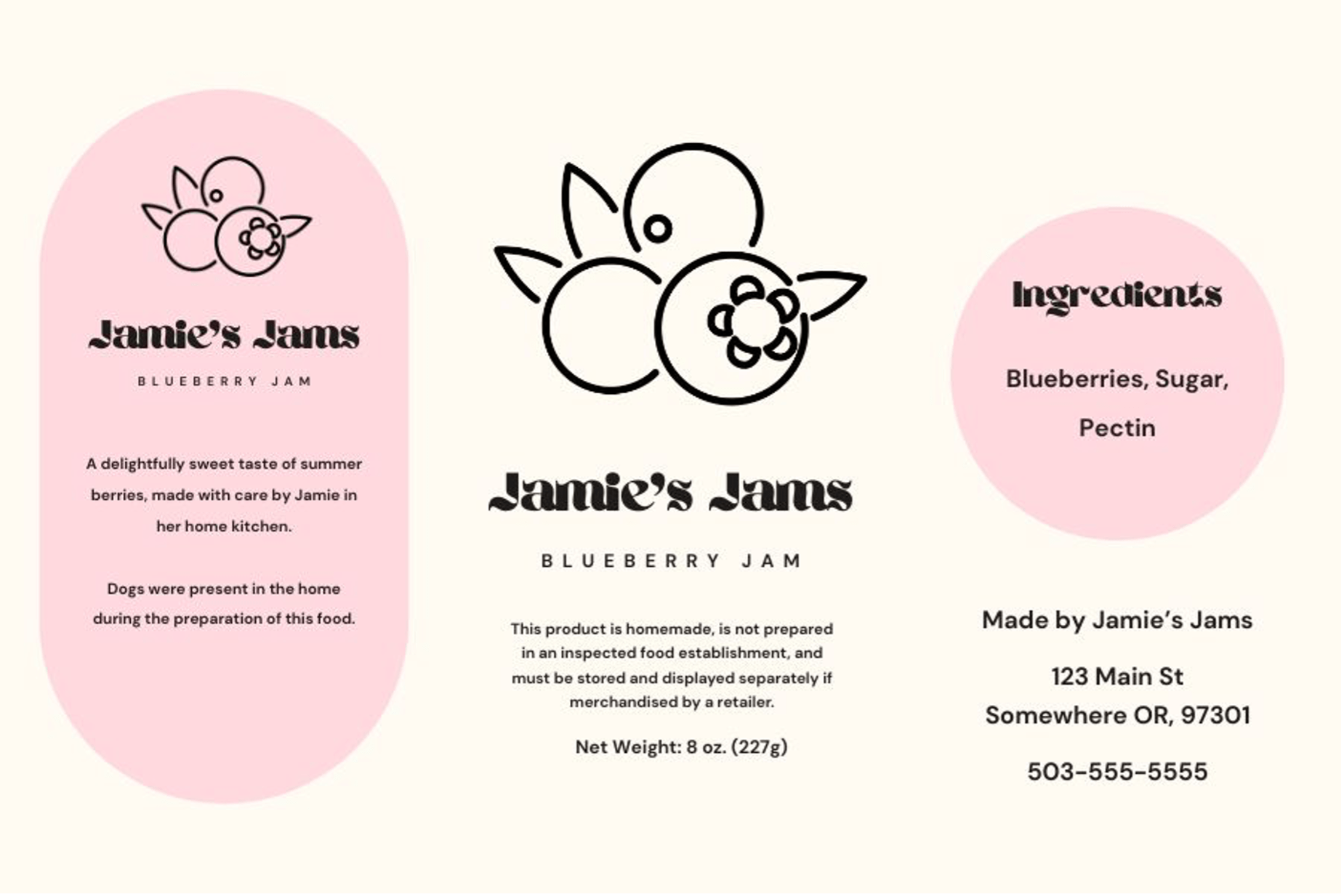
Any products prepared in the home kitchen must contain the following statement on the principal display panel: “This product is homemade, is not prepared in an inspected food establishment and must be stored and displayed separately if merchandised by a retailer.”

The principal display panel for all cottage foods must also include:
- The name of the food.
- The ingredients (and subingredients) of the product in descending order by weight or volume.
- The net weight or net volume of the product in both U.S. and metric units.
- Business name and phone number.
- The address of the food establishment, which may be displayed in one of three ways:
- The full street address, city, state and ZIP code may be used.
- The city, state and ZIP code may be used without the street address if the food establishment is listed in a city directory that includes the business name and street address.
- A Unique Identification Number issued by the Oregon Department of Agriculture may be used in place of an address.
In some circumstances, additional information may be required on the label:
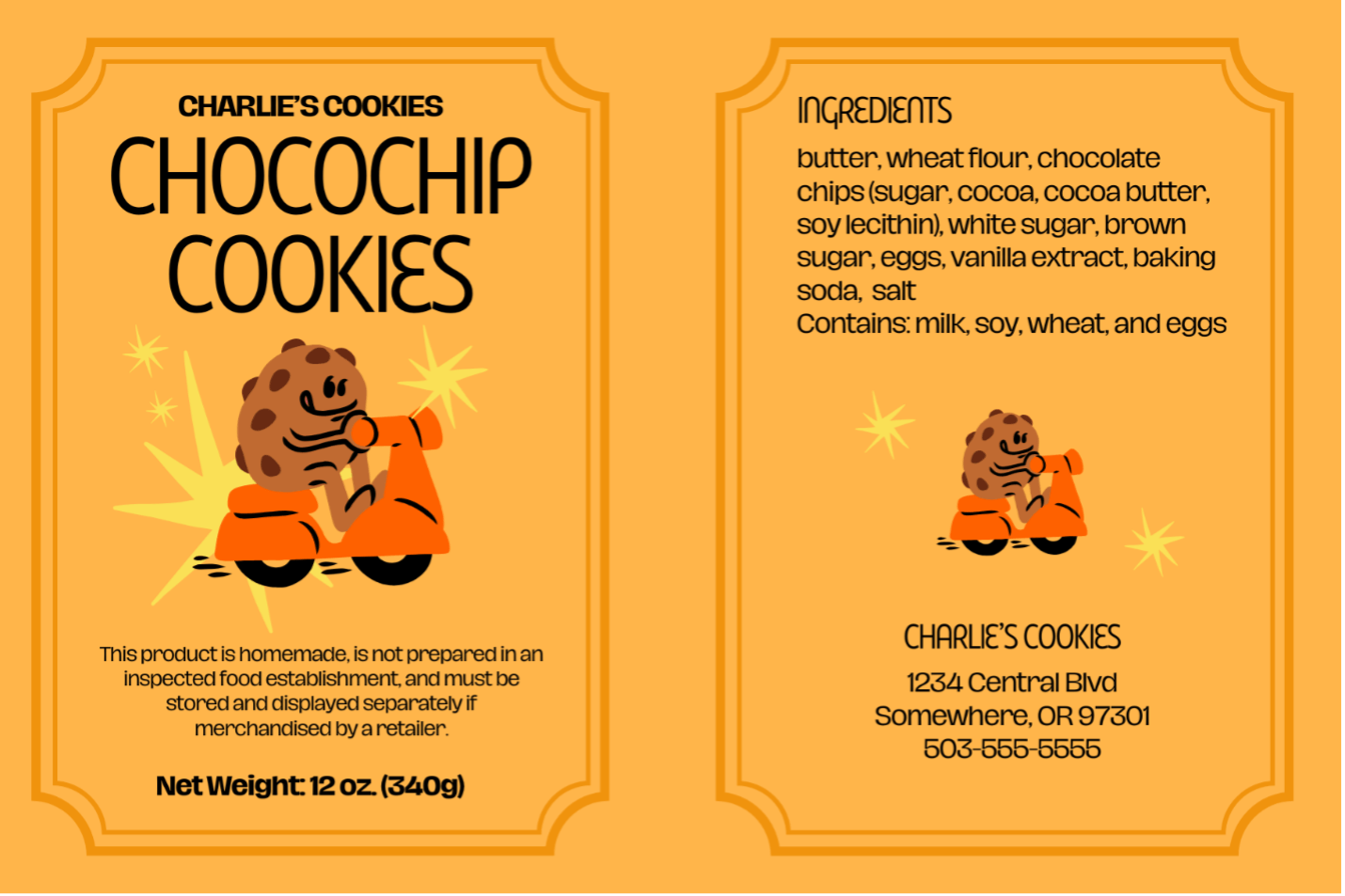
If the food contains any of the nine major allergens identified in federal law, they must be clearly identified in one of two ways. The allergen may be named in the ingredients list in parentheses following the name of the ingredient; for example: “flour (wheat).” Alternately, it may be identified immediately after the ingredients list in a “contains” statement; for example, “Contains wheat, milk, and soy.” The nine major allergens are:
- Milk
- Eggs
- Soy
- Wheat
- Fish (species must be named)
- Crustacean shellfish (species must be named)
- Peanuts
- Tree nuts (species must be named)
- Sesame
Nutritional information is generally not required, but if the label provides any nutrient content claim, health claim or other nutritional information, the producer must abide by the labeling standards detailed in Title 21, Part 101 of the Code of Federal Regulations.
If there are pets in the home, they must be excluded from the kitchen during production, and the food label must include a statement that pets were present. The statement should specify the type of animal present. For example, “Cats were present in the home during the preparation of this food.”
The sample labels show how labels might be designed to meet the standards.
Where can cottage foods be sold?
Cottage foods can be sold through almost any sales channel: from home, online, by mail or at events.
Cottage foods may also be sold to a retailer, but they must be properly packaged and labeled. The retailer must also agree to separate all cottage food products from other foods and use clear signage to indicate that the products are homemade and not prepared in an inspected food establishment. The cottage food producer should document the retailer’s agreement to these requirements and maintain a record of the agreement.
Cottage foods may not be sold to restaurants licensed by a county health department, caterers or institutional food service, including hospitals, schools, day care centers, nursing homes and correctional facilities.
Oregon’s cottage food exemption law applies to foods that are produced and sold in Oregon. Some other states may allow these foods to be sold in their states, but the producer would need to check the regulations for each state.
What records are required?
Cottage food producers must maintain good records that show their annual gross sales, ensuring they have not exceeded the annual sales limit. The sales limit is $51,200 in 2025, with adjustments to the cap made annually.
Producers should also keep records of individual sales, including the product and quantity sold, the price, and the date sold or shipped.
Depending on the sales venue, other records are required:
- If sales are made at events, a record of the physical address and the organizer’s contact information must be included with sales records from the event.
- If sales are made online, the address and contact information of each purchaser must be included with the sales record.
- If sales are made through another food establishment, such as a retailer, the address and contact information for the other establishment must be included in the sales records
Records should be kept for three years and must be made available to the Oregon Department of Agriculture within five business days upon request.
Communication with the Oregon Department of Agriculture
Although a license is not required to produce and sell cottage foods that meet these guidelines, OSU Extension encourages producers to speak with their local ODA food safety inspector before production to ensure eligibility.
ODA may require you to have a product tested in a certified food testing laboratory to ensure that it does not need time/temperature control for safety. Many private food testing laboratories offer these services for a fee. Look for a lab that is ISO/IEC 17025:2017-accredited.
ODA may also require you to obtain a license if products do not meet eligibility requirements, if proper records are not made available to ODA, or if the operator refuses access or interferes with inspections necessary to protect public health.
What if I do not qualify for the Cottage Food Exemption?
If your product does not meet the requirements for the Cottage Foods Exemption, it must be made in an inspected facility under a processing license in order to be sold. There are four options for processing in a licensed facility.
For more information about licensing requirements for domestic kitchens and commercial facilities, and to find your local ODA food safety specialist, see the ODA Food Safety Program.
Note
This document should be regarded strictly as a supplement to Oregon’s Cottage Food Exemption rules and should never be considered a substitute to reading and understanding the regulations. For a complete list of requirements, please consult OAR.
This FAQ was prepared in consultation with the Oregon Department of Agriculture. If you have additional questions not answered here, contact the ODA Food Safety Program at: 503-986-4720, [email protected], 635 Capitol St. NE, Salem, OR 97301-2532.


