
Extensive research on the fate of fire-damaged trees provides guidance for assessing survival based on post-fire observations of three key factors: crown scorch, bark char and root damage.
Vulnerability to fire damage depends on tree species and size. Larger trees with thicker bark and larger amounts of foliage can generally withstand more damage than thin-barked species.Thick-barked species such as Douglas-fir, ponderosa pine, western larch and incense cedar are resistant to fire damage. High levels of crown injury are typically required to kill thick-bark trees. Thin-barked species such as western hemlock, western redcedar, spruce and lodgepole pine are easily killed by fire, even with little crown damage.
It may take several years for trees to die from fire-related injury.
It may take several years for trees to die from fire-related injury. Trees that survive direct injuries from fire often become more vulnerable to secondary factors, such as insect infestations and drought stress.
|
Heavy–severe; trees likely to die |
Moderate–significant; trees may die; less predictable; careful assessment or wait and see |
Light–minor; trees not likely to die |
|
|---|---|---|---|
|
Crown |
Little or no live crown remaining | Varying levels of crown scorch | Most of the crown intact |
|
Bole |
Deep char | Varying levels of bole char | Very little bole char |
|
Base, root crown |
Deep basal char over all four quarters (total circumference) | Varyng levels of basal char over two to four quarters | Very little basal char over one quarter or less |
For in-depth guidance on assessing fire-damaged conifers, see Post Fire Assessment of Tree Status and Marking Guidelines for Conifers in Oregon and Washington, Hood et al., 2020.
Crown injury rating
When assessing fire damage, injury to the live crown is the first and most important consideration. Crown injury significantly influences a tree's likelihood of survival after fire.
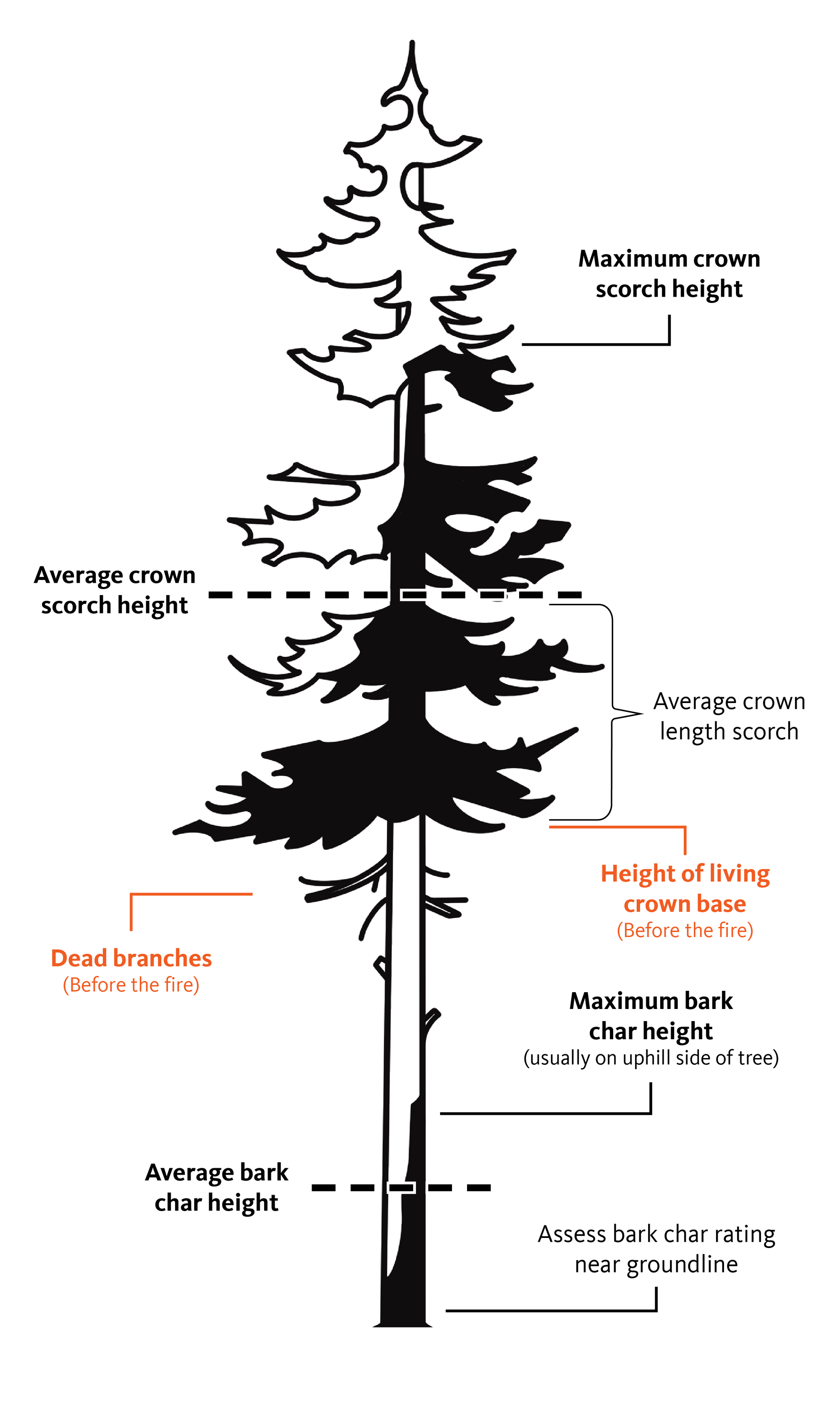
Crown scorch
Crown scorch refers to the portion of the prefire live crown that has been killed by heat, even if the foliage is not consumed. It is estimated as a percentage of the pre-fire live crown that has been damaged or killed.
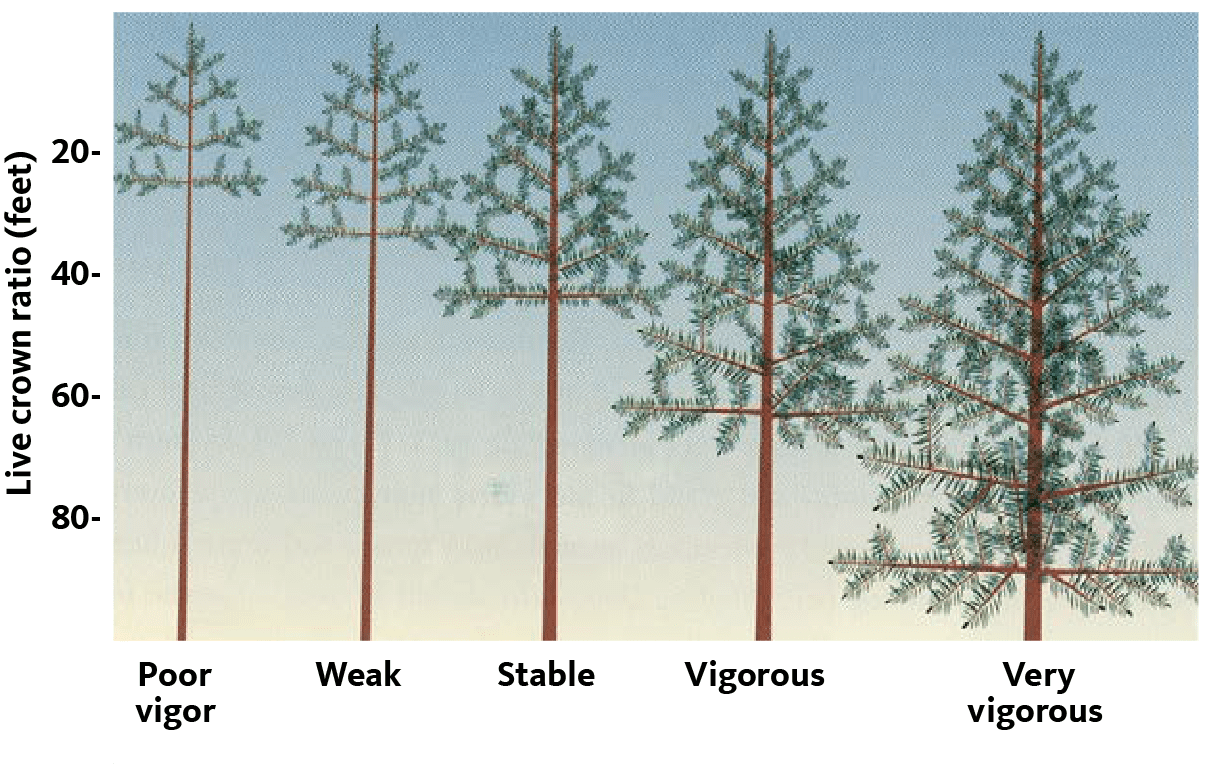
Live crown ratio
Even in the absence of fire injury, a tree’s vigor and ability to recover are strongly related to its live crown ratio, which is the proportion of the tree’s total height occupied by live, green foliage. Trees with a live crown ratio of 35% or greater generally have better chances of survival, though this threshold may vary depending on species and site conditions. This is especially true if they are left more exposed following the removal of neighboring trees.
Assessing damage based on bark char
This involves examining the bole, base and roots. Bark char on thin-bark species is a reliable indicator of cambium death, but it is not as reliable on species with thick bark. Cambium is the living tissue under the bark.
Heavy–severe bark char damage
- Fire penetrates bark, but not necessarily to the wood.
- Species loses its bark characteristics.
- Bark smoothed; all ridges are gone.
- Considerable or deep duff and woody debris consumption around base.
- Many roots exposed and charred due to combustion of organic matter.
Moderate–significant bark char damage
- Bark is uniformly black except some inner fissures; species bark characteristics are still discernable.
- Some organic matter consumed in the burned area.
- Some roots may be exposed and charred.
Light–minor bark char damage
- Bark is not completely blackened; species bark characteristics obvious; edges of bark plates charred.
- Little duff or organic matter consumed.
- Roots not exposed or charred.
Tolerance for risk
Decisions about whether or not to remove injured trees depend upon your tolerance for risk. You may have a low tolerance for risk, where it is essential to avoid leaving trees that may die (for example, where damaged trees could pose a threat to safety or property).
You may have a higher tolerance for risk of tree death in forest settings where your goal is to save any trees that may live.
Longer-term outlook
Damaged trees that survive a fire can recover and live for many years. However, fire scars can create entry points for wood decay, increasing the risk of stem breakage over time. To prevent this, trees must regain enough vigor to grow new wood around the wound and seal out decay.
Interestingly, even trees with partial decay can provide valuable habitat, serving as excellent wildlife trees.
See the tree assessment criteria below for major conifer species in Oregon and Washington. For help assessing fire injury on your trees, contact your local OSU Extension office or the Oregon Department of Forestry.
Tree assessment criteria
|
Species |
Criteria |
5–11.9 inches in diameter |
12–20.9 inches in diameter |
21+ inches in diameter |
|---|---|---|---|---|
|
Pacific silver fir |
Crown scorch |
Greater than 30% volume | Greater than 40% volume | |
|
Bark char |
Greater than or equal to 50% any char | |||
|
White fir or hybirds |
Crown scorch |
Greater than or equal to 70% volume | ||
|
Bark char |
Greater than or equal to 75% deep char | |||
|
Grand fir |
Crown scorch |
Greater than or equal to 60% volume | ||
|
Bark char |
Greater than or equal to 50% any char | Greater than or equal to 75% moderate or deep char | ||
|
Subalpine fire |
Crown scorch |
Greater than 30% volume | Greater than 40% volume | |
|
Bark char |
Greater than 50% any char | |||
|
Red fir |
Crown scorch |
Greater than or equal to 70% volume | ||
|
Bark char |
Greater than 75% deep char | |||
|
Incense cedar |
Crown scorch |
Greater than or equal to 85% volume | ||
|
Bark char |
Greater than 75% deep char | |||
|
Western larch |
Crown scorch |
If needles on: greater than or equal to 80% crown length. If needles off: average char height over entire tree length greater than 70% | ||
|
Bark char |
Greater than 75% deep char | Bole char not a predictive injury indicator | ||
|
Englemann spruce |
Crown scorch |
Greater than or equal to 75% volume | ||
|
Bark char |
Greater than 75% any char | |||
|
Sitka spruce |
Crown scorch |
Greater than or equal to 75% volume | ||
|
Bark char |
Greater than 75% any char | |||
|
Lodgepole pine |
Crown scorch |
Greater than or equal to 40% volume | ||
|
Bark char |
Greater than or equal to 75% any char | |||
|
Whitebark pine |
Crown scorch |
Greater than or equal to 40% volume | ||
|
Bark char |
Greater than or equal to 75% any char | |||
|
Sugar pine |
Crown scorch |
Greater than or equal to 70% volume | ||
|
Bark char |
Greater than 90% moderate or deep char | |||
|
Western white pine |
Crown scorch |
Greater than 30% volume | ||
|
Bark char |
Greater than or equal to 90% any char | |||
|
Ponderosa pine |
Crown scorch |
Pre-bud break (volume): greater than or equal to 85% needles scorched if less than 10% blackened needles OR greater than 40% needles scorched if greater than 10% blackened needles. Post-bud break (volume): 70% crown volume killed (no new growth) | ||
|
Bark char |
Greater than 90% deep char | |||
|
Douglas-fir |
Crown scorch |
Greater than 65% crown volume | ||
|
Bark char |
Greater than 50% deep char | Greater than 75% deep char | ||
|
Western red cedar |
Crown scorch |
Greater than 20% crown volume | Greater than 40% crown volume | Greater than 60% crown volume |
|
Bark char |
Greater than 50% any char | Greater than 75% any char | ||
|
Western hemlock |
Crown scorch |
Greater than or equal to 20% crown volume | ||
|
Bark char |
Greater than or equal to 90% any char | |||
|
Mountain hemlock |
Crown scorch |
Greater than or equal to 20% crown volume | ||
|
Bark char |
Greater than or equal to 90% any char | |||
From: Post Fire Assessment of Tree Status and Marking Guidelines for Conifers in Oregon and Washington Hood et al., 2020.
Note: If a species is host to bark beetles or wood borers and there is boring dust and attack signs that are not due to red turpentine beetle around more than 50% of the bole circumference, the tree will die regardless of fire injury.
If your trees have been damaged by fire, deciding whether to remove them or give them a chance to recover depends on your goals and how much risk you're comfortable with, especially if the trees are near structures or frequently used areas.
About the author

Related publications


