
What makes a tree hazardous?
A tree is considered hazardous if it has defects or structural weaknesses that may cause failure, resulting in property damage, personal injury or death. The postburn environment surrounding a hazardous tree can be equally, if not more, dangerous than the tree itself.
Common prefire factors in tree failure
- Tree species
- Age
- Decay
- Wounds
- Cankers
- Seams
- Lean
- Branch angle
- Branch type
- Crown vigor
- Crown form or shape
- Root condition
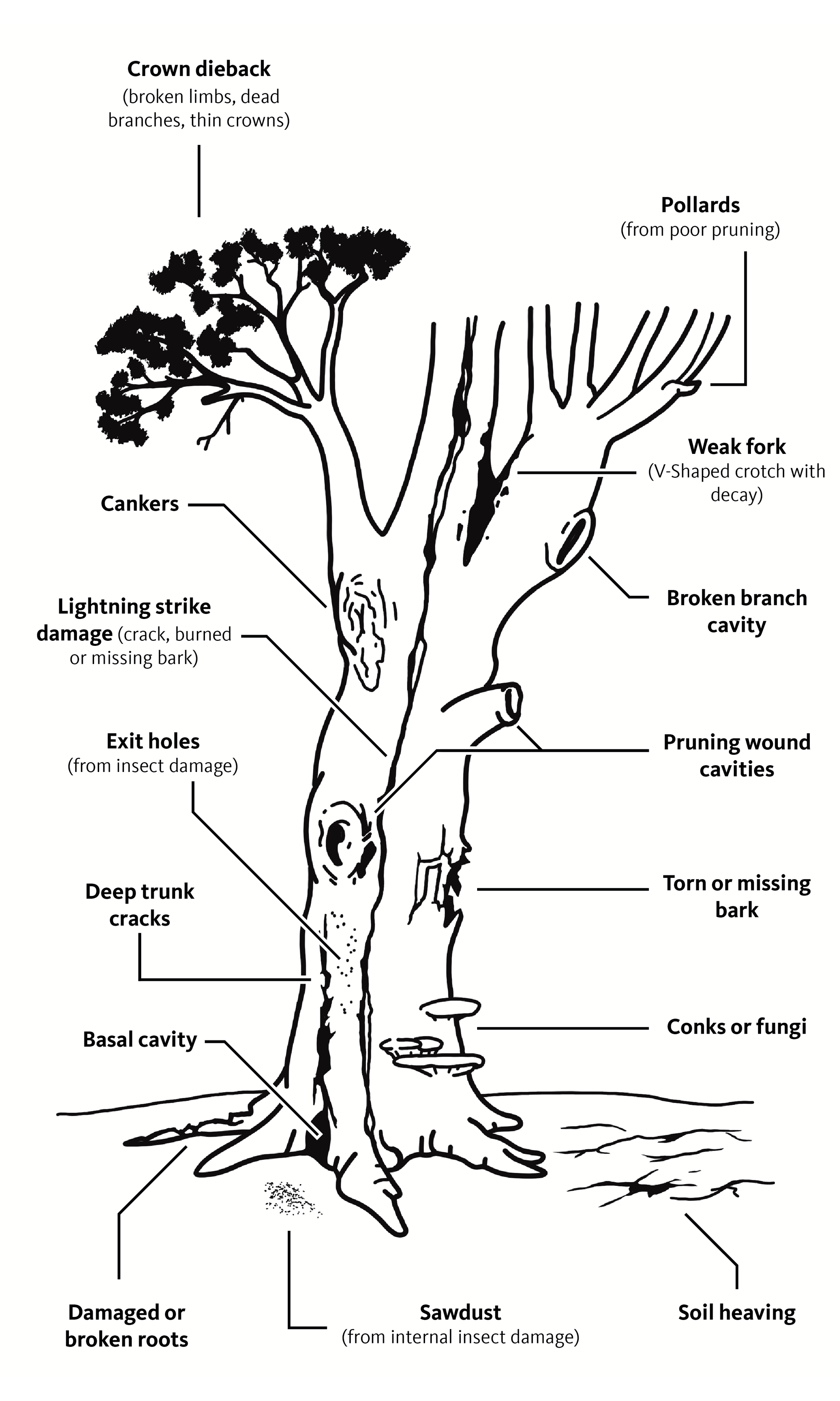
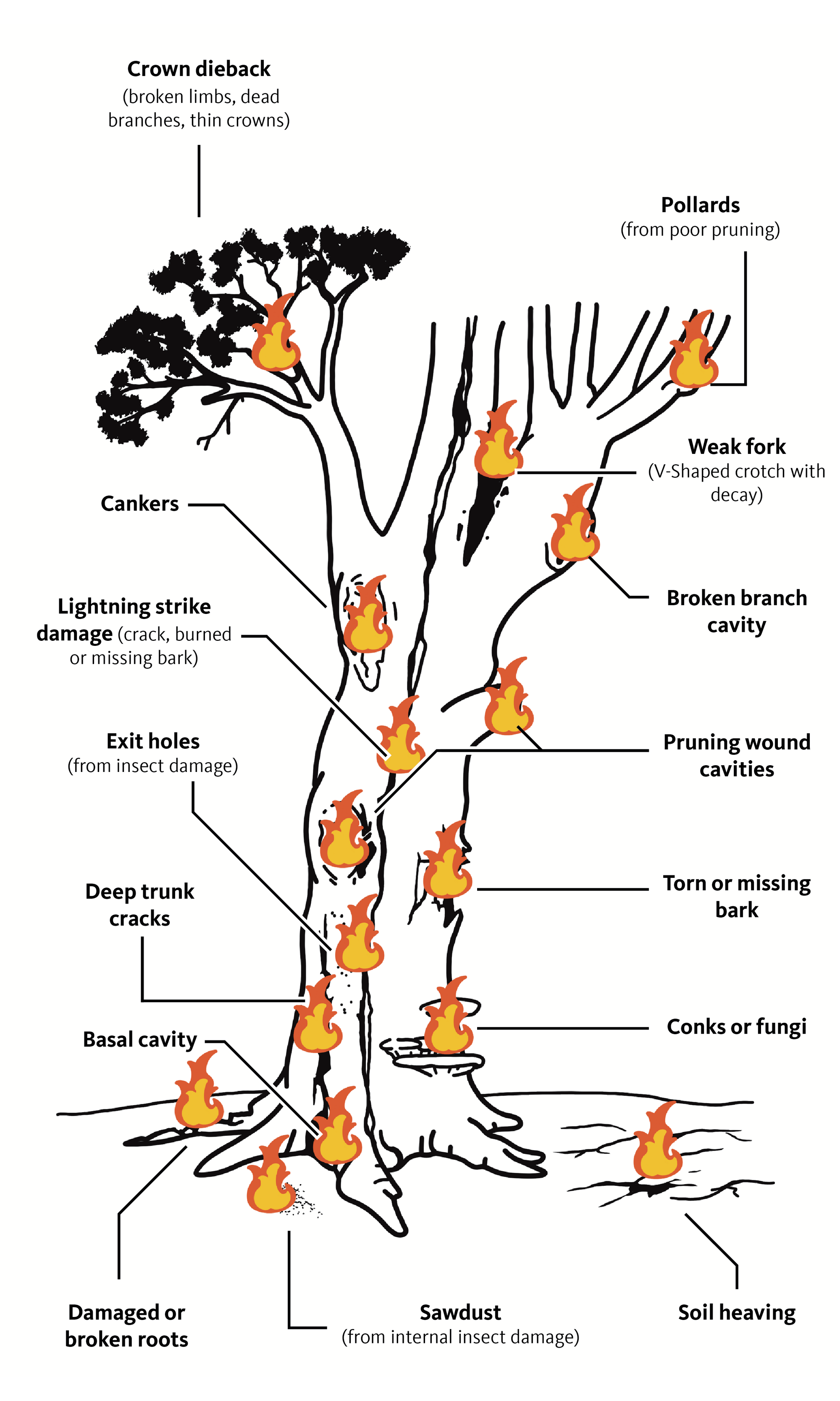
Let's examine two significant hazard tree traits: whether it produces resin, and whether the tree is alive or dead.
Resinous vs. nonresinous species
Resinous trees secrete a sticky, decay-resistant substance that helps protect against injury or infection. Resin contains volatile oils that are flammable.
Douglas-fir, larch and pine are resinous trees.
Spruce is partially resinous, while fir and hemlock trees are not resinous.
Cedar is nonresinous but resistant to decay. Hardwoods are also nonresinous, but some are more decay-resistant than others.
Living vs. dead
Dead trees have a high potential for failure.
Live trees should not automatically be considered to have a low potential for failure if they have been damaged by fire or present other signs of failure.
Postfire hazard tree assessments
Based upon probabilities as well as some assumptions about the future:
- Is the tree likely to fail or fall?
- When is tree likely to fail or fall?
- Is a target likely to be present when the tree fails or falls?
Inspection and hazard assessments
- Check to ensure entry and exit from areas surrounding the tree are safe.
- Start at tree bottom or top, depending on height, damage and initial observations of potential failure
- Use binoculars
- Check from all angles
- Look for targets
- Document results
- Consider using a hazard assessment for decision-making
Seven steps to develop a tree risk rating
- Identify the possible target.
- Identify the tree part(s) that could strike the target.
- Evaluate the likelihood of each part failing. Is failure improbable, possible, probable or imminent?
- Evaluate the likelihood of the tree part striking the target. Is it very low, low, medium or high?
- For each failure mode, identify the likelihood of tree failure impacting a specified target. Is it very unlikely, unlikely, somewhat likely, likely or very likely?
- For each failure mode, estimate the consequences of failure. Are they negligible, minor, significant or severe?
- For each failure mode, designate the risk — low, moderate, high or extreme.
Example of International Society of Arboriculture rating system
|
Likelihood of impacting target |
||||
|---|---|---|---|---|
|
Likelihood of failure |
Very low |
Low |
Medium |
High |
|
Imminent |
Unlikely | Somewhat likely | Likely | Very likely |
|
Probable |
Unlikely | Unlikely | Somewhat likely | Likely |
|
Possible |
Unlikely | Unlikely | Unlikely | Somewhat likely |
|
Improbable |
Unlikely | Unlikely | Unlikely | Unlikely |
|
Consequences |
||||
|---|---|---|---|---|
|
Likelihood of failure and impact |
Negligible |
Minor |
Significant |
Severe |
|
Very likely |
Low | Moderate | High | Extreme |
|
Likely |
Low | Moderate | High | High |
|
Somewhat likely |
Low | Low | Moderate | Moderate |
|
Unlikely |
Low | Low | Low | Low |
References
- Field Guide for Hazard-tree Identification and Mitigation On Developed Sites in Oregon and Washington Forests. U.S. Department of Agriculture Forest Service, Oregon Department of Forestry and Washington State Department of Natural Resources. 2014.
- A Guide to Identifying, Assessing, and Managing Hazard Trees in Developed Recreational Sites of the Northern Rocky Mountains and the Intermountain West. U.S. Department of Agriculture, Forest Service, 2017.
- International Society of Arborists Tree Risk Assessment Manual, Second Edition, 2017.
Related publications


