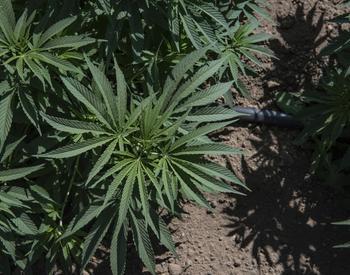
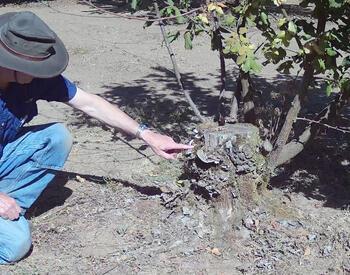
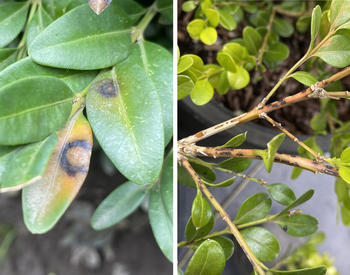
In the high desert of Central Oregon, farmers produce some of the world’s most valuable hybrid carrot seed. But their fields face a persistent and costly threat: a plant disease called bacterial blight, caused by the bacterium Xanthomonas hortorum pv. carotae (Xhc). This pathogen can cause blighted leaves, damaged flowers and infested seeds, reducing seed quality and yields.
For farmers and the seed industry, this means they can start exploring new disease management practices that span the full growing season — not just during harvest.
While previous research showed that Xhc can become airborne during harvest and travel up to a mile, there was a critical knowledge gap: when else, and how often, is the bacterium airborne throughout the year? Without knowing when the pathogen spreads, farmers and researchers could not effectively time disease management strategies.
To find out, Oregon State University scientists Jeness Scott and Jeremiah Dung at the OSU Central Oregon Agricultural Research and Extension Center in Madras launched a yearlong study in two commercial carrot seed fields in Central Oregon. They installed specialized air samplers that ran continuously for more than 13 months (excluding winter) to capture airborne particles. Scott and Dung then used sensitive DNA testing to estimate the number of Xhc genomes in the air samples.
What they found changed how we understand this disease. It takes more than a year to produce carrot seed. Even before the annual fall harvest begins, the young seedlings intended to produce next year’s crop are already growing in the field. It turns out that harvest activities such as combining are not the only way Xhc can become airborne.
They found that Xhc was airborne more than 80% of the time during the growing season in both fields. The pathogen showed up in the air as early as September, shortly after planting and harvest of the previous year’s seed, and it reappeared during spring, summer and the autumn harvest months. This indicates that plants are likely exposed to airborne Xhc not only during harvest but throughout much of the growing season.
The study, published in the journal Plant Disease, also confirmed that the bacterium was present on carrot leaves before winter and in early spring, meaning it can establish early and survive cold months. In one field, leaf samples collected during spring and summer had extremely high bacterial levels, consistent with those known to cause disease symptoms.
These results suggest that disease-causing bacteria in the air, along with the overlapping timing of nearby carrot seed fields, help the bacteria survive from one growing season to the next — a process known as the “green bridge” — and that host plants may be exposed to airborne bacteria through much of the year. This helps explain why bacterial blight has become a recurring and endemic issue in many carrot root and seed production regions.
Follow-up research recently published in Plant Disease helped explain how carrot bacterial blight spreads during harvest and what influences how far it can move. In field experiments near Madras, researchers tracked harvest debris carrying the pathogen and found that both particle size and distance from the source helped predict how much of the bacterium was detected.
Larger particles settled back into the field being harvested, while smaller particles were more likely to stay airborne longer, potentially exposing plants in other fields and contributing to a pathogen green bridge. By pairing new particle traps with weather data and real-time air monitoring, this study offers a clearer picture of when harvest conditions increase spread risk.
The recent study, conducted with researchers from the U.S. department of Agriculture Agricultural Research Service and University of Utah, was led by Katelyn Baldino, former graduate student and current faculty research assistant in the OSU Department of Botany and Plant Pathology.
Together with the findings published in 2025, this research lays the groundwork for practical risk-assessment tools to guide field operations and disease management decisions.
For farmers and the seed industry, this means they can start exploring disease management practices that span the full growing season, not just harvest. These might include treatments to slow the establishment of Xhc on leaf surfaces, more precise field sanitation, and timing fieldwork to reduce bacterial dispersal.
By identifying the hidden windows of pathogen activity, this research offers a path forward to protect one of Oregon’s most valuable specialty crops and support its long-term sustainability.
The studies were supported by the USDA National Institute of Food and Agriculture Specialty Crop Research Initiative (project No. 2020-51181-32154), the Western Integrated Pest Management Center (project ID 1616) and the Agricultural Research Foundation, with additional support for the second study from USDA-ARS (project 2072-22000-045-00D).