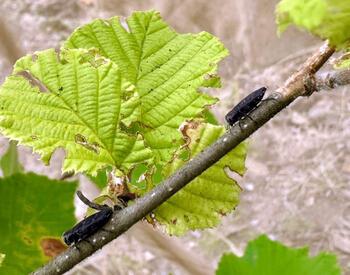
CORVALLIS, Ore. – A voracious insect — the bronze birch borer — is killing birch trees across Oregon, prompting Oregon State University Extension Service to warn homeowners about how to spot and manage infestations early.
“If you don’t know you have an infestation, it’s usually too late. Then you have to take the tree out, which is expensive.”
Previously established in Eastern Oregon, the bronze birch borer was first reported west of the Cascade Range in 2003 in Portland, where it has since killed hundreds of trees. The beetle has spread as far south as Klamath Falls, according to Nicole Sanchez, Extension horticulturist with Oregon State University.
The first symptoms of an infestation appear in the tree’s canopy: sparse, yellowing, stunted leaves and flagging branches. Twigs begin to fall, and entire branches may eventually die. By the time these symptoms are noticeable, the tree may already be too damaged to recover.
“If you don’t know you have an infestation, it’s usually too late,” Sanchez said. “Then you have to take the tree out, which is expensive.”
Treatment options are limited and costly
There is no easy solution once an infestation begins. Cultural practices such as mulching and deep watering may help protect healthy trees or those in early stages of infestation. However, if intervention is necessary, chemical treatment is the only proven method of control.
“People don’t want to hear that because of the effect pesticides have on beneficial insects and because they cost a lot,” Sanchez said. “But it’s either that or the tree dies. Either way it’s expensive.”
She cautions homeowners to use insecticides correctly. Systemic insecticides should be applied at the tree’s drip line — where the outermost branches reach — not next to the trunk. In many cases, it’s best to consult a certified arborist.
While birch trees are wind-pollinated, their catkins may attract bees. To reduce the risk to pollinators, insecticides should only be applied after flowering in spring and never when flowers attractive to bees are in bloom nearby. Always follow product label directions — it’s the law.
Understanding the bronze birch borer life cycle
The bronze birch borer is a North American native beetle. Adults are olive to brown with metallic copper-colored wings and bodies, shaped like a small football. The beetle lays eggs under loose bark near the tops of trees. After about two weeks, larvae hatch and tunnel into the cambium — the layer responsible for moving water and nutrients — where they feed for two years. As they feed, they excrete frass, which clogs vascular pathways and causes damage.
The most visible sign of larval emergence is a D-shaped hole in the bark, but by the time these appear, the damage is often extensive.
“Because the insect larvae feed at the top of the tree, damage sometimes is not obvious right away,” Sanchez said.
Some birch species are more susceptible than others
The bronze birch borer is especially attracted to white-barked birch species such as:
- European white birch (Betula pendula)
- White-barked Himalayan birch (Betula utilis var. jacquemontii)
- European white weeping birch (Betula pendula ‘Youngii’)
Native river birch (Betula nigra) and certain cultivars have proven resistant. These include:
- ‘Heritage’ river birch (Betula nigra ‘Heritage’)
- ‘Whitespire Senior’ gray birch (Betula populifolia ‘Whitespire Senior’)
These trees feature peeling bark in shades from tan to light brown and are better suited for areas at risk of bronze birch borer infestation.
Stress makes trees vulnerable
Stress is a key factor in birch borer attacks. Birch trees have shallow roots and thrive in cool, moist environments — not in hot, dry urban settings. Trees planted in parking strips or exposed locations are especially vulnerable.
“Most people don’t think about watering mature trees,” Sanchez said. “In general, all birch are moisture-loving trees. They’re not great in drought, so they need to be watered.”
To reduce stress:
- Apply mulch to keep roots cool and moist.
- Water regularly and deeply — about 10 inches of soil depth.
- Provide partial shade when possible.
Knowing when it’s too late
Sanchez co-authored Homeowner guide to managing bronze birch borer, which includes a visual chart to help assess the severity of damage — from healthy trees to those requiring removal.
“Try to be realistic,” she said. “If 40% of the tree or more is affected, it’s probably not cost effective to treat it. We don’t take these decisions lightly. We want to help people realize too late comes a lot sooner than people realize. It’s a tough pill to swallow.”
Previously titled Serious pest targets popular white-bark birch trees