CORVALLIS, Ore. — After years of drought, and then a month of record-breaking heat in 2021, Maud Powell and her husband made a decision that still carries grief: They sold their family farm.
“When we left our farm, I realized our experience wasn’t unique. Other farmers and ranchers were also grieving — not just the loss of land or livelihood, but the erosion of a way of life they had worked to sustain.”
For 23 years, the couple had transformed a Southern Oregon cattle ranch into a productive vegetable and seed farm. They fed hundreds of families through a Community Supported Agriculture program, trained new farmers, grew certified organic vegetable and flower seed and built deep ties to the land.
They also adapted as conditions changed. Powell, an Oregon State University Extension Service small farms specialist, brought home the latest agricultural research. They shifted from overhead irrigation to drip tape, planted drought-tolerant crops and seed varieties, and worked to conserve water.
But as drought continued, their creek dried up. During the 2021 Pacific Northwest heat dome, they pumped water between ponds to keep irrigating, then began buying water from town and having it delivered by truck.
One night during the heat dome, her husband told her they would have to move if they wanted to keep farming.
The moment became the emotional starting point for a new commentary in the journal Health Affairs by Powell and co-authors who argue that climate change is not only an agricultural, economic and environmental issue. It is also a mental health issue for farmers and ranchers.
The commentary calls for climate adaptation efforts to include support for the stress, anxiety and grief that farmers and ranchers experience as changing conditions affect their land, livelihoods and identities.
“When we left our farm, I realized our experience wasn’t unique,” Powell said. “Other farmers and ranchers were also grieving — not just the loss of land or livelihood, but the erosion of a way of life they had worked to sustain.”
Powell, professor of practice in the OSU Extension Small Farms Program, wrote the commentary with Mary Halbleib, professor of practice in the OSU Department of Crop and Soil Science; David Rothwell, associate professor in human development and family sciences in the OSU College of Liberal Arts; and Chad Reznicek, a behavioral health specialist with the Colorado AgrAbility Project at Colorado State University.
Climate change adds pressure
The authors define climate grief as grief, sadness and mourning tied to actual or expected losses from climate change. For agricultural producers, those losses can include damaged ecosystems, changing landscapes, lost livelihoods, cultural identity and a sense that the future is no longer stable or predictable.
Farming and ranching have always required people to manage risk. But the commentary says climate change adds new layers of short- and long-term uncertainty.
Rising temperatures, reduced snowpack, disrupted irrigation, wildfire, flooding, erosion, heat stress in livestock, new pest pressure and changing planting schedules are making it harder for producers to plan and adapt.
Powell and Halbleib surveyed 51 Oregon farmers in 2024 and found that 88% said addressing climate stress and grief in agricultural communities was important or very important. In follow-up interviews and focus groups with 46 of the farmers, producers described helplessness, anxiety and despair linked to environmental change.
Participants shared experiences with drought, flooding, wildfires, erratic weather and the resulting operational and financial impacts. Many described grief as they watched soil fertility decline, extreme weather increase and ecosystems they rely on degrade.
Climate change is not the only stressor. The commentary also points to trade instability, tariffs and shifting federal policies as sources of uncertainty. With more than 20% of U.S. farm income tied to exports, global market disruptions can intensify stress.
Oregon State program offers a model
The Oregon State work grew from a 2022 climate resilience training for Oregon agricultural professionals, where climate grief and stress were introduced. Participants responded positively and asked for more training.
OSU Extension and community partners in Southern Oregon then formed a working group to help food producers understand stress and grief related to climate change, strengthen emotional resilience and learn about mental health resources.
In 2023, Powell and Halbleib received funding from the U.S. Department of Agriculture’s Farm and Ranch Stress Assistance Network to develop Climate Stress and Grief: Building Resilience in Farmers and Ranchers.
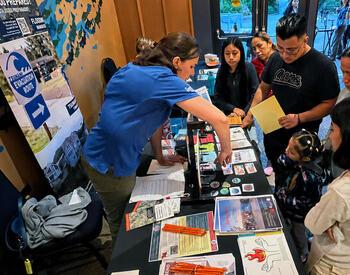
The program uses psychoeducation, which provides information about behavioral health, emotions and coping strategies. The team developed a 30-minute awareness session for agricultural programs and a 75-minute workshop with peer-to-peer discussion, experiential exercises and resilience practices.
Participants also have access to practical tools, including the Climate Emotion Wheel and a directory of climate-aware therapists. OSU Extension also offers the publication Understanding and living with climate grief and climate stress for farmers and ranchers.
Since 2023, Powell and Halbleib’s team has been invited to deliver the interventions 61 times in eight states. The team also received funding from USDA Sustainable Agriculture Research and Education to develop a train-the-trainer program for 75 agricultural service providers.
“Mental well-being programming must be grounded in the culture of farming and ranching communities while also providing a safe and practical way for groups to explore the emotions resulting from climate-related losses,” Halbleib said.
Authors call for stronger policy support
The authors argue that mental health should be part of agricultural climate resilience efforts, not treated as separate from them.
They point to the Farm and Ranch Stress Assistance Network as an important step but say current initiatives remain fragmented, underfunded and poorly evaluated. They call for stronger, more consistent funding through the farm bill.
Other recommendations include strengthening the rural behavioral health workforce, expanding access to telehealth and broadband, supporting farmer-led peer networks, funding mental health programs run by Extension and other agricultural service agencies, and supporting hotlines that understand agricultural stress.
The commentary concludes that agricultural resilience cannot focus only on new technologies, production practices and climate adaptation strategies. It must also include the emotional well-being of the people who produce food and fiber.
“We are asking farmers to carry the burden of adaptation without adequately supporting their emotional and psychological resilience. Focusing on farmer mental health is a form of resilience infrastructure,” Powell said.