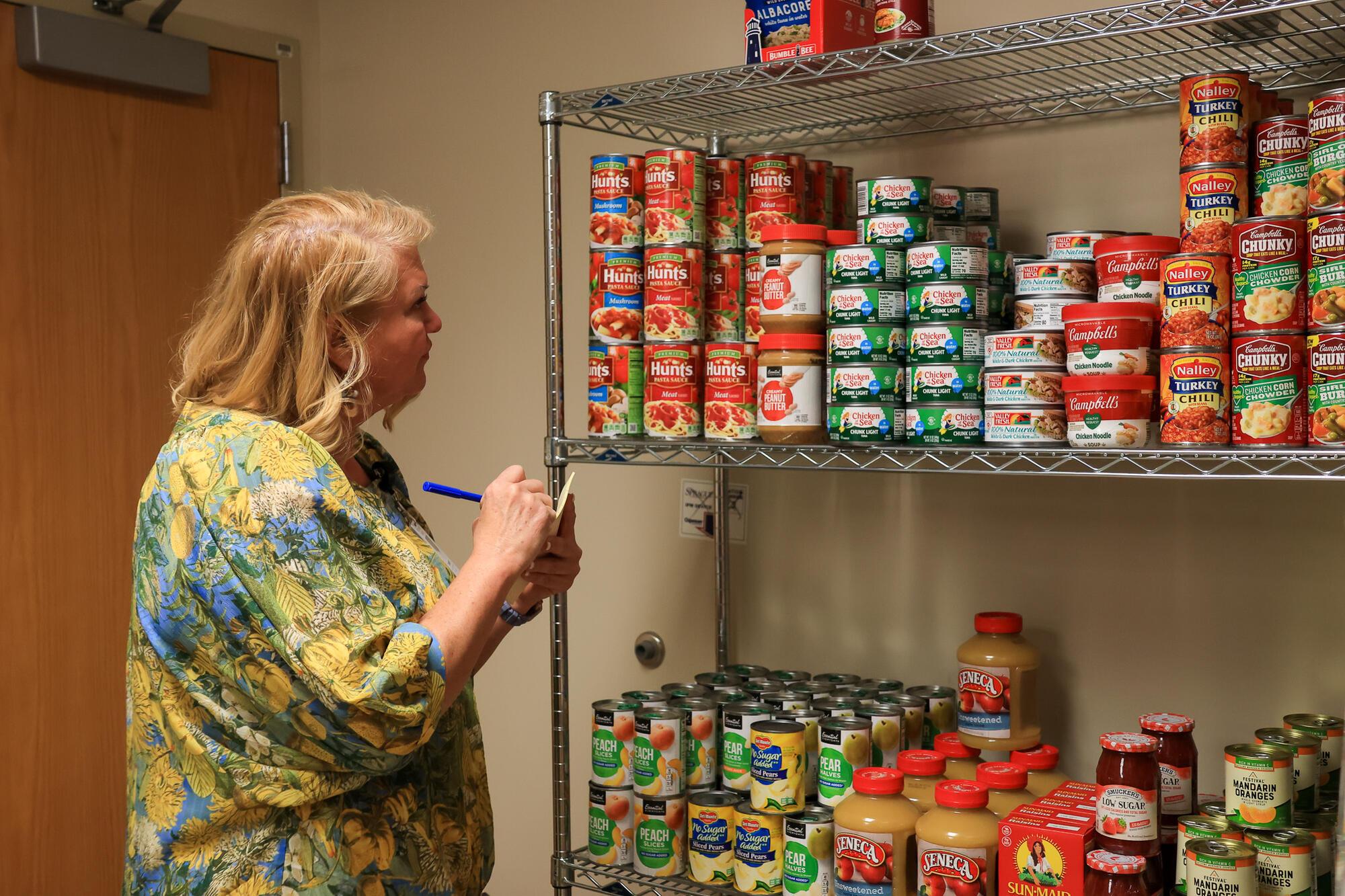
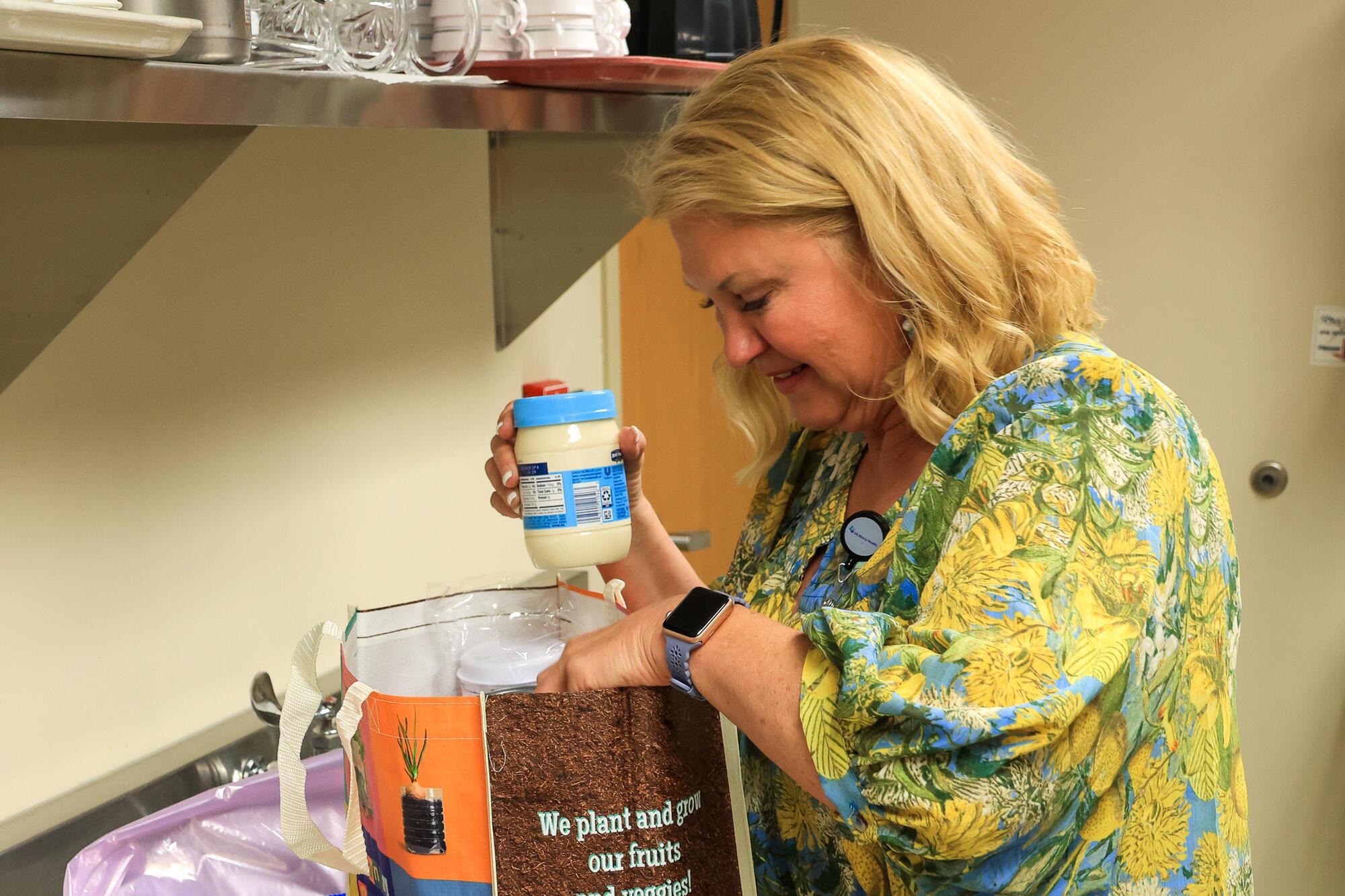
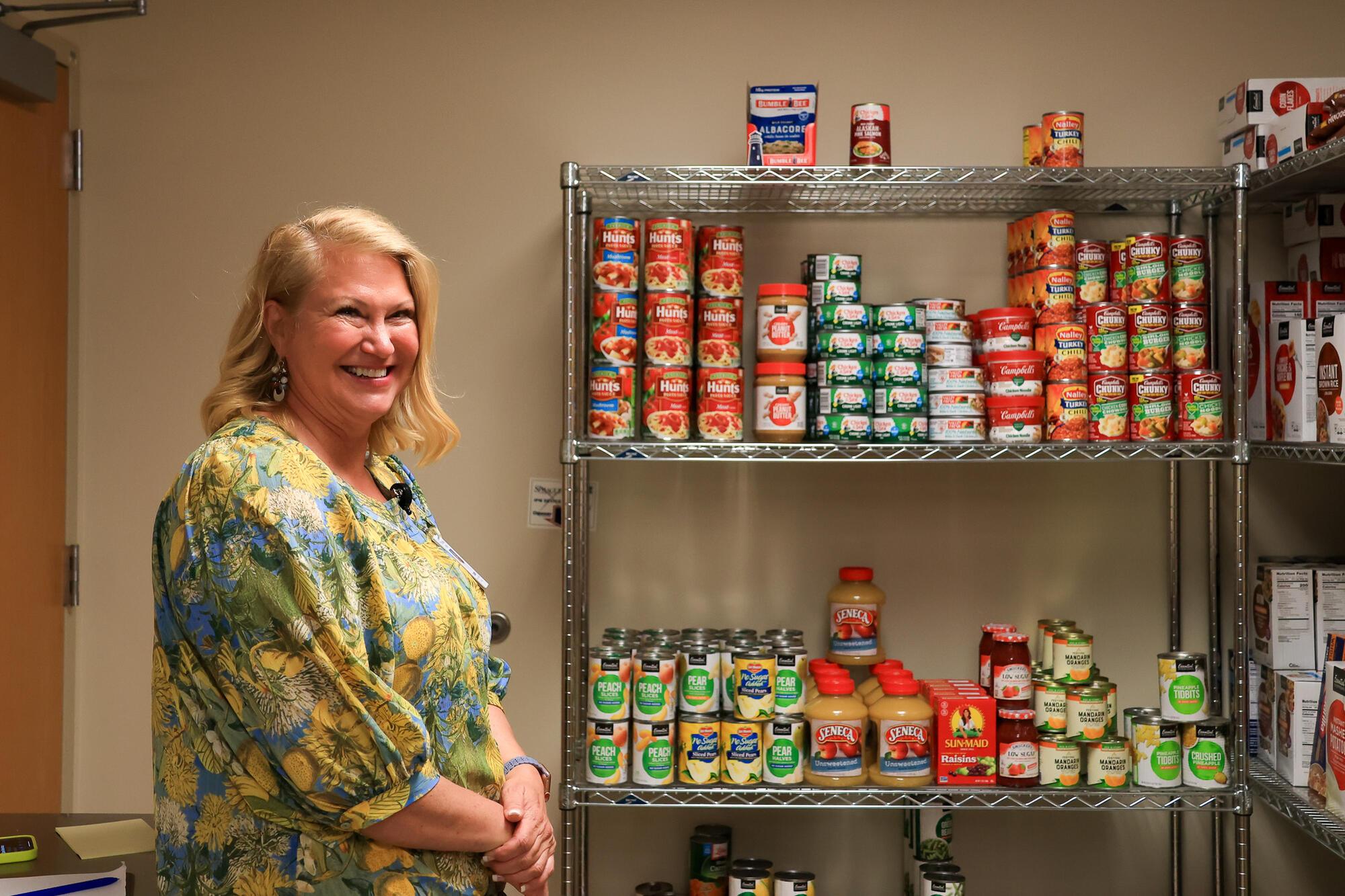
ROSEBURG, Ore. — Tammy Rondeau moves through the hospital’s food closet with quiet purpose, jotting down labels, checking expiration dates and updating her spreadsheet. She checks freezer temperatures, restocks spices and neatly arranges shelves of canned tuna and whole grains.
Every item matters — because for Rondeau, it could mean the difference between a patient going hungry or healing at home.
Rondeau is the community health worker behind the Food Closet pilot program at CHI Mercy Health, a member of CommonSpirit, in Roseburg. With grants and gifts from the Mercy Foundation, the hospital and Oregon State University Extension Service’s Supplemental Nutrition Education (SNAP-Ed) Program in Douglas County launched this joint initiative in November 2023 to help discharged patients continue their recovery with access to nutritious food and other essential support.
“If someone leaves the hospital and doesn’t know where their next meal is coming from, they’re more likely to end up back there.”
“The worry of hunger gives patients anxiety while healing from illness,” said Mandy Hatfield, OSU Extension’s SNAP-Ed program coordinator in Douglas County. “Food is a basic need. And if someone leaves the hospital and doesn’t know where their next meal is coming from, they’re more likely to end up back there.”
Healing beyond hospital walls
The Food Closet program is a response to the rising food insecurity in Douglas County, where one in seven people lives below the poverty line and one in eight people faces food insecurity, according to the U.S. Census Bureau. Despite qualifying for assistance like SNAP, approximately 11,206 county residents were not signing up, while some were unhoused or lacked kitchen facilities, according to data from the Oregon Hunger Task Force in 2023.
The core of the program is a one-on-one consultation with Rondeau when a patient is admitted to a hospital to understand their personal circumstances — whether they have a refrigerator, a stove or a place to live. Based on that conversation, if a patient is flagged for food insecurity, she tailors after-discharge support by providing two weeks of food, shelf-stable or frozen meals, a cooking kit and Food Hero recipes.
Food Hero is a statewide initiative of OSU Extension SNAP-Ed. All the recipes are tested according to criteria, such as overall flavor, color and texture. Food Hero meals are low-cost and feature easy to find ingredients, easy to follow instructions and minimal preparation time.
Some patients are connected with long-term programs like SNAP, Meals on Wheels or the Oregon Health Plan for their health care needs. For unhoused patients, supplies are tailored — a backpack of portable, high-nutrition items with minimal prep needed and a plastic cutting board. From January to March, Rondeau supported more than 70 patients.
“Before this program, the most challenging part was money,” she said. “A lot of people can barely make rent, and healthy food is expensive.”
Recipes, resources and care
What sets the Food Closet apart isn’t just the meals. It’s the care and attention to detail offered along the way.
Hatfield and Rondeau choose items with common health conditions in mind — low-sodium options for heart patients, whole grains and plant-based proteins for those managing diabetes. They partnered with a local grocery store, Sherm’s Thunderbird Market, to supply fresh items and distribute OSU Extension’s Food Hero newsletters right in the aisles. Recently, Rondeau connected with three local farmers market locations that were willing to accept $15 vouchers provided by the program for patients to purchase fresh produce after discharge.
They even include a spice kit with eight different spices including chili powder, cumin, garlic powder, cinnamon, ginger, pine, rosemary and oregano.
“People rarely spend money on spices, but they make a big difference when you’re trying to eat healthy and enjoy it,” Hatfield said.
The response to holistic care is the heartwarming appreciation from patients. Kate Orsingher, a registered nurse and quality department leader at Mercy, recalled a patient learning to eat differently after a life-changing diagnosis. He didn’t know Orsingher, who oversees community health workers, was making rounds that day, but he and his wife couldn’t stop talking about how supported they felt.
“They said the food and guidance gave them confidence to make changes,” Orsingher said. “It’s hard to figure out low-sugar or low-sodium food when you feel so vulnerable when being discharged. I really felt there was such a sense of security from this patient and his wife because of the Food Closet.”
Programs like this, she added, “are like a hug. They tell patients: they are not just patients in the hospital, they are members of our community, and we care about this community.”
Between January and June 2024, the pilot program served 106 patients, connecting them with food and additional services. Of those, 61 received full cooking kits. Three were enrolled in Meals on Wheels. More than 40 individuals were already on the Oregon Health Plan or SNAP, but others received assistance with enrollment.
Since December, Mercy Medical Center has been running the program on its own. With funding from the Oregon Health Authority, additional grants from CommonSpirit Health, other regional funders and community donations, the hospital was able to hire a second community health worker in May.
Lisa Platt, president of Mercy Foundation, said the hospital is committed to building on its partnerships and collaborations like OSU Extension.
“We’re bringing a human touch to what truly helps people heal,” she said. “It’s about making sure patients know we are here to support the moment they leave the hospital—with the nutrition, the education and the care they need to heal and stay well at home.”
She recalled one moment that stuck with her: a patient asked Rondeau, “You’ve done so much helping me, what can I do for you?”
“That’s one of the greatest compliments we could ever receive,” she said. “It means they felt cared for. And that’s the whole point.”
If you are interested in donating to the Food Closet, you can make a tax-deductible donation through Mercy Foundation at 2700 NW Stewart Parkway, Roseburg, OR 97471, or online.