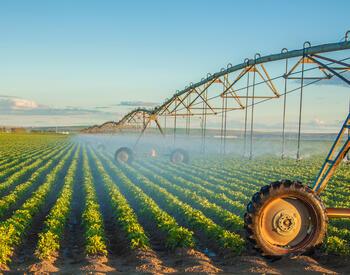
CORVALLIS, Ore. – Managing water scarcity in Oregon’s Willamette River Basin would be more effective if conservation actions occurred earlier and upstream — before drought-related shortages occur — according to a new study published in Nature Sustainability.
The findings suggest that even well-designed water conservation policies may be ineffective if implemented downstream or after critical seasonal windows have passed.
“This is a case of a mismatch in terms of where and when conservation occurs relative to where and when shortages actually happen."
“This is a case of a mismatch in terms of where and when conservation occurs relative to where and when shortages actually happen,” said William Jaeger, lead author of the study and professor in Oregon State University’s College of Agricultural Sciences.
The study is based on simulations using Willamette Envision, a computer model developed to represent the complex interactions between water supply and demand in the Willamette River Basin. The model considers natural and human demands from farms, cities, forests and fish habitats.
The research was funded by the National Science Foundation and the National Oceanic and Atmospheric Administration and aims to inform policy responses to drought in Oregon and other river basins.
“This study has relevance beyond the Willamette River Basin,” Jaeger said. “It highlights a broader principle that successful drought mitigation depends on aligning policy interventions with the actual timing and location of water shortages.”
Water conservation alone is not enough
The analysis focused on a simulated near-term drought scenario similar to Oregon’s 2015 drought. In the simulation, early season low flows created severe water shortages for farms and cities. Critically, federal reservoirs were unable to meet minimum instream flow requirements set by the Endangered Species Act to protect fish, including threatened salmon populations.
Jaeger noted that while conservation policies such as incentives for farmers and urban water users — or adjustments to dam operations — are effective in theory, they often fall short in practice if applied too late or in the wrong places.
“For example, if you conserve water in July, it doesn’t help solve a shortage that happened in April,” Jaeger said. “Those critical environmental flows are in April, May and June, but most irrigation happens in June and July. So even if people reduce their irrigation use in summer, it doesn’t offset earlier shortfalls.”
Institutional responses matter
While behavioral changes by individuals are helpful, the study found that institutional responses — such as reservoir operation policies with built-in drought contingencies — may have a greater impact on mitigating drought.
One key challenge is that the very infrastructure used to manage water — the dams — also contributes to the problem. Since 1900, more than 15 large dams and many smaller ones have been built in the Willamette Basin, 13 of which are operated by the U.S. Army Corps of Engineers.
Dams built primarily for flood control have also become storage and flow management tools. But they have disrupted natural river processes and contributed to the decline of anadromous fish like salmon, triggering the minimum flow protections now mandated under the Endangered Species Act.
“Were it not for the dams, the ESA-mandated instream flows might not exist,” the study authors wrote. “These flows are a response to the impact of dams on fish migration and abundance.”
Broader lessons for drought planning
Jaeger is also the lead author of the OSU Extension publication Water, economics and climate change in Oregon's Willamette Basin, which expands on findings from the Willamette Water 2100 project.
“This research helps policymakers recognize when and where water scarcity will arise, and what types of responses can be most effective,” Jaeger said.
Co-authors on the study included:
- Adell Amos, the Clayton R. Hess Professor of Law, University of Oregon
- Christian Langpap, associate professor, Department of Applied Economics, Oregon State University
- Kathleen Moore, research scientist, School of Environmental and Marine Affairs, University of Washington
- Andrew J. Plantinga, professor, Bren School of Environmental Science and Management, University of California, Santa Barbara
- David R. Conklin, Oregon Freshwater Simulations, Portland
Previously titled New analysis reveals challenges for drought management in Oregon’s Willamette River Basin