CORVALLIS, Ore. — Something looked a little off about the cluster of blueberries lying on a lab bench in Cordley Hall at Oregon State University.
The berries’ appearance motivated their owner to submit them to the OSU Plant Clinic. Bill Gerth, a senior faculty research assistant in the clinic, has carefully laid out the berries next to a form that he’ll fill out to begin the process of revealing the source of the problem.
“The citizens of Oregon are our clientele. We’re here to serve them. If they have an issue with a plant that is diseased or they think is diseased, we’re here for them.”
Gerth, an entomologist who joined the Plant Clinic as a diagnostician earlier this year, has a question for Plant Clinic director Mana Ohkura about the form. After a short conversation, Ohkura sits at a nearby microscope, peering at a different submitted sample.
This is the daily routine at the Plant Clinic in the Department of Botany and Plant Pathology in the College of Agricultural Sciences. The fee-based diagnostic clinic, which is supported by the college and the Oregon State University Extension Service, offers expert analysis, guidance for disease control, and hands-on learning support as part of Oregon State’s larger Extension and research mission.
Clients include commercial growers of all sizes, field representatives of chemical and fertilizer companies, home gardeners, and staff from state and federal agencies in Oregon and beyond.
Diagnosing problems and identifying insects is just part of the clinic’s mission. Extended education is provided by helping clients recognize the nature of a plant or insect problem and by sharing information needed to manage it using appropriate control methods — including chemical, cultural and biological measures.
“The citizens of Oregon are our clientele,” said Joey Spatafora, University Distinguished Professor and head of the Department of Botany and Plant Pathology. “If they need something identified related to plant health, we do it. We’re here to serve them. If they have an issue with a plant that is diseased or they think is diseased, we’re here for them.”
Solving plant mysteries since 1954
When it opened in 1954, the OSU Plant Clinic was thought to be the second of its kind in the United States, according to Melodie Putnam, who retired in 2023 after serving 30 years as clinic director.
The first sample was a lilac, for which Pseudomonas syringae and Botrytis were diagnosed, Putnam said. That year, 769 samples were submitted. By comparison, in 2024 the clinic received more than 2,100 samples from more than 400 clients.
Putnam, a Fellow of the American Phytopathological Society, processed about 30,000 diagnostic samples from more than 400 plant species throughout her career. She provided leadership in the National Plant Diagnostic Network (NPDN), establishing Oregon State as a key Western region diagnostic lab.
The clinic joined NPDN in 2003, serving the part of the Western region comprised of Oregon, Alaska, California, Hawaii, Idaho and Washington, and U.S. territories American Samoa and Guam.
Putnam acquired new equipment, implemented updated techniques, and adopted emerging technologies as they became accessible. She developed and staffed a molecular laboratory in 2004 with financial assistance from NPDN.
The clinic was among the first university-associated diagnostic laboratories to routinely offer a DNA test that identifies specific organisms by targeting their unique genetic material. It was also the first to install an Illumina DNA sequencer, a machine that reads DNA sequences using light signals.
“It was my desire to modernize and anticipate the needs of the growers, so we were there for when that need arose,” Putnam said. “It was grower-driven. I wanted to provide services that the growers would need and find useful.”
Oregon is agriculturally diverse — more than 225 distinct crops are grown here, ranging from ornamental plants for the nursery and greenhouse industry, to grass seed to hazelnuts, potatoes and onions.
As a result, the clinic would routinely receive more than 2,000 samples a year during her time as director, Putnam said.
“We have a large diversity of pathogens due to the diversity of the crops we grow here,” Putnam said. “When you’re dealing with so many crops, they all have their own suite of problems to solve.”
Ohkura, who earned a doctorate in plant pathology at the University of Arizona, was hired as Putnam’s successor in 2024 after a national search.
“I really like solving puzzles,” said Ohkura, an assistant professor of practice in the Department of Botany and Plant Pathology. “Each sample is a puzzle for me to solve. I look at the symptoms and think about the host its on, what kind of chemical sprays might have been applied, what season it is, and all the different factors that could affect disease development. Putting together all the pieces of information can reveal what caused the symptoms.”
Monitoring pathogens
Jeff Chang, professor and lead advisor for the biological data sciences undergraduate program in the Department of Botany and Plant Pathology, has frequently collaborated with the Plant Clinic on research projects, including those supporting Oregon’s billion-dollar nursery and greenhouse industry.
Chang said working with the clinic has helped him understand the translational value of his lab’s research.
“The Plant Clinic maintains a culture collection of plant pathogens that have been tremendously valuable resources for my lab’s research,” Chang said. “These experiences have motivated me to direct research to help agricultural stakeholders and to cooperate with research and Extension scientists.”
Ohkura and Spatafora emphasize the Plant Clinic’s role in the National Plant Diagnostic Network, which was established by the U.S. Department of Agriculture National Institute of Food and Agriculture and the Department of Homeland Security to enhance agricultural biosecurity by detecting instances of biological attack.
“By diagnosing diseases and identifying pathogens, we have a responsibility to report any pathogens that we think pose regulatory or biosecurity risks to the state and the country,” Ohkura said.
“In agriculture, we’re constantly at the forefront of monitoring for pathogens that could be the next chestnut blight, the next Dutch elm disease, the next sudden oak death,” Spatafora said. “We’re constantly monitoring for the next pathogen that we must act on quickly to ensure a safe and secure food supply.”
While most submissions to the clinic come directly from agricultural producers or consultants, another source are OSU Extension county offices, where samples are dropped off and sent to the clinic for diagnosis.
“The samples we get from county Extension offices are often from home gardeners,” Ohkura said. “Some diseases are easier to diagnose without any kind of lab test because the symptoms are obvious. But when the symptoms aren’t characteristic of a specific disease and lab tests are required, those get forwarded to the clinic for confirmation.”
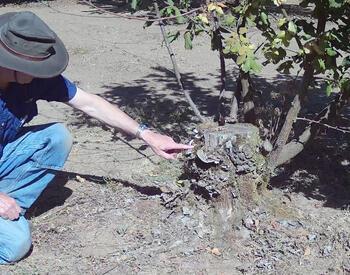
A significant portion of home gardening samples come from trees.
“If it’s been on their property for a long time, that tree can have a lot of sentimental and aesthetic value,” she said. “Maybe it’s their favorite shady spot. Each person has a motivation for the tree they want to save. They want to know what the problem is so they can manage it.”
Tackling tree diseases
Some of the clinic’s most impactful work has involved diseases affecting trees in different parts of the state — eastern filbert blight in the Willamette Valley and sudden oak death in southwestern Oregon.
Eastern filbert blight is a fungal disease that affects hazelnut trees, causing cankers on branches, dieback and reduced yield. Thanks to work in the Plant Clinic, along with OSU’s fungicide research and breeding programs, resistant hazelnut cultivars were developed and adopted, helping many growers recover and expand production.
New strains of eastern filbert blight are now infecting genetically resistant trees, and the clinic is addressing that problem as well.
“The clinic has played a very important role in the diagnosis and management of eastern filbert blight,” Spatafora said.
Sudden oak death is a serious plant disease caused by the water mold Phytophthora ramorum, which has led to widespread mortality of tanoaks in southwestern Oregon forests, altering ecosystems, increasing fire risk and disrupting habitats for native wildlife. It has also triggered intensive containment efforts, including quarantines and removal of infected trees, to slow the disease’s spread and protect uninfected areas.
In 2024, the Plant Clinic detected Phytophthora austrocedri for the first time in the United States from a juniper sample submitted by a nursery. The pathogen infects plants in the cypress family, including juniper and arborvitae, posing a risk to the nursery industry. Native forest species, such as Port-Orford-cedar and western red cedar, are also at risk should this pathogen establish in forestlands.
Those suspicious-looking blueberries submitted to the clinic this past spring? One never knows what might be lurking in that fruit. Every sample is important.
“I like being able to provide information to clients and help them manage the problem,” Ohkura said.