

Introduction
Forest succession is the replacement, sorting and change of vegetation over time. Disturbances that kill some or most of the overstory trees kick off a process of succession. A disturbance can be large and intense, like a wildfire or clear-cut. Or, it can be small, such as a surface fire or pocket of disease.
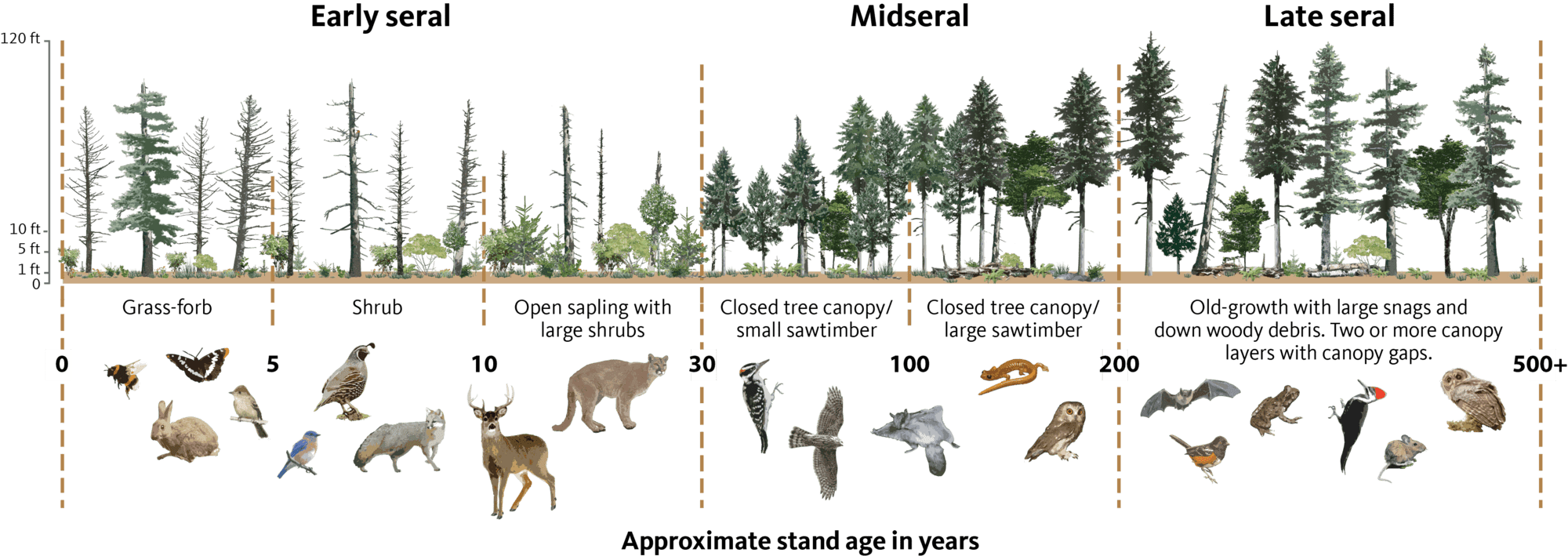
Disturbance followed by succession over a long period of time is called sere (Figure 1). Douglas-fir forests of the Pacific Northwest can follow many different paths of succession.
Following a major disturbance, a simple sere may be dominated by grasses, forbs and shrubs, with some surviving large trees and standing dead (snags) and dying trees, or snags. As time goes on, trees grow and the forest matures. Without further disturbance, it will progress to old-growth forest conditions.
Each phase of succession is referred to as a seral stage (Figure 1).
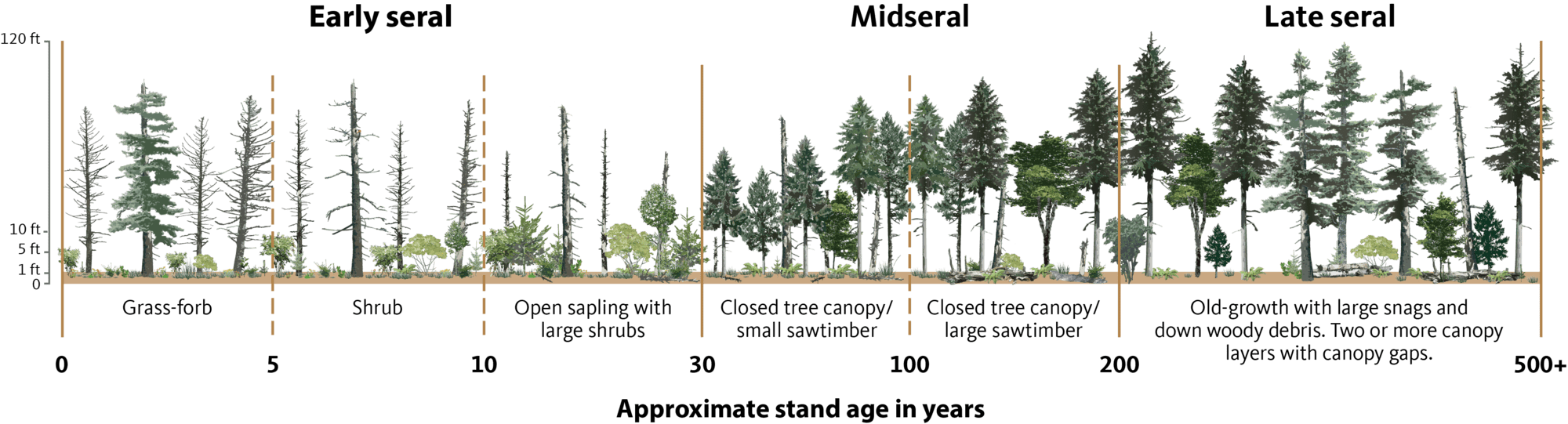
The early-seral stage begins at initial disturbance and lasts until trees develop a closed canopy and shade out early vegetation. If trees have been planted or if they regenerate on their own, this early succession stage may last 10–15 years. However, it could extend decades longer. Sometimes, too few trees are left to provide seed for tree establishment or additional fires occur. On hot and dry sites, plant and forest regrowth may proceed more slowly.
Mid-seral conditions develop after tree canopy closure and last for many decades as trees grow and compete with one another.
Over time, competition-related tree mortality and various small, low-intensity disturbances create larger openings. This results in a structurally diverse system with large trees, understory shrubs, large snags and downed wood. This is a late-seral condition typical of Douglas-fir old-growth forests.
Forests of other types (such as dry forest settings) and in other locations also proceed through successional stages. However, the time spent in each stage and its typical structural characteristics vary.
Early-seral forest
Early-seral forest follows a major disturbance, such as a timber harvest, wildfire or windstorm. Such disturbances in Douglas-fir forests often create large openings. They may expose mineral soil, create snags and downed wood, and make available resources such as light, water, nutrients and space. Plant species that thrive in open conditions exploit these resources.
Early-seral plants are established from seed or resprout from top-killed plants. Seed comes from the soil seed bank or is transported by wind, water, insects or wildlife. Shrubs and hardwood trees resprout or emerge from below-ground tubers, bulbs or surviving roots.
Over time, changing site conditions, competition among plant species and subsequent disturbances alter the species composition in this early phase of forest growth. This may eventually lead to a site dominated by trees. However, subsequent disturbances, such as a low-severity fire, may prevent tree dominance and extend the period of early forest conditions for decades.
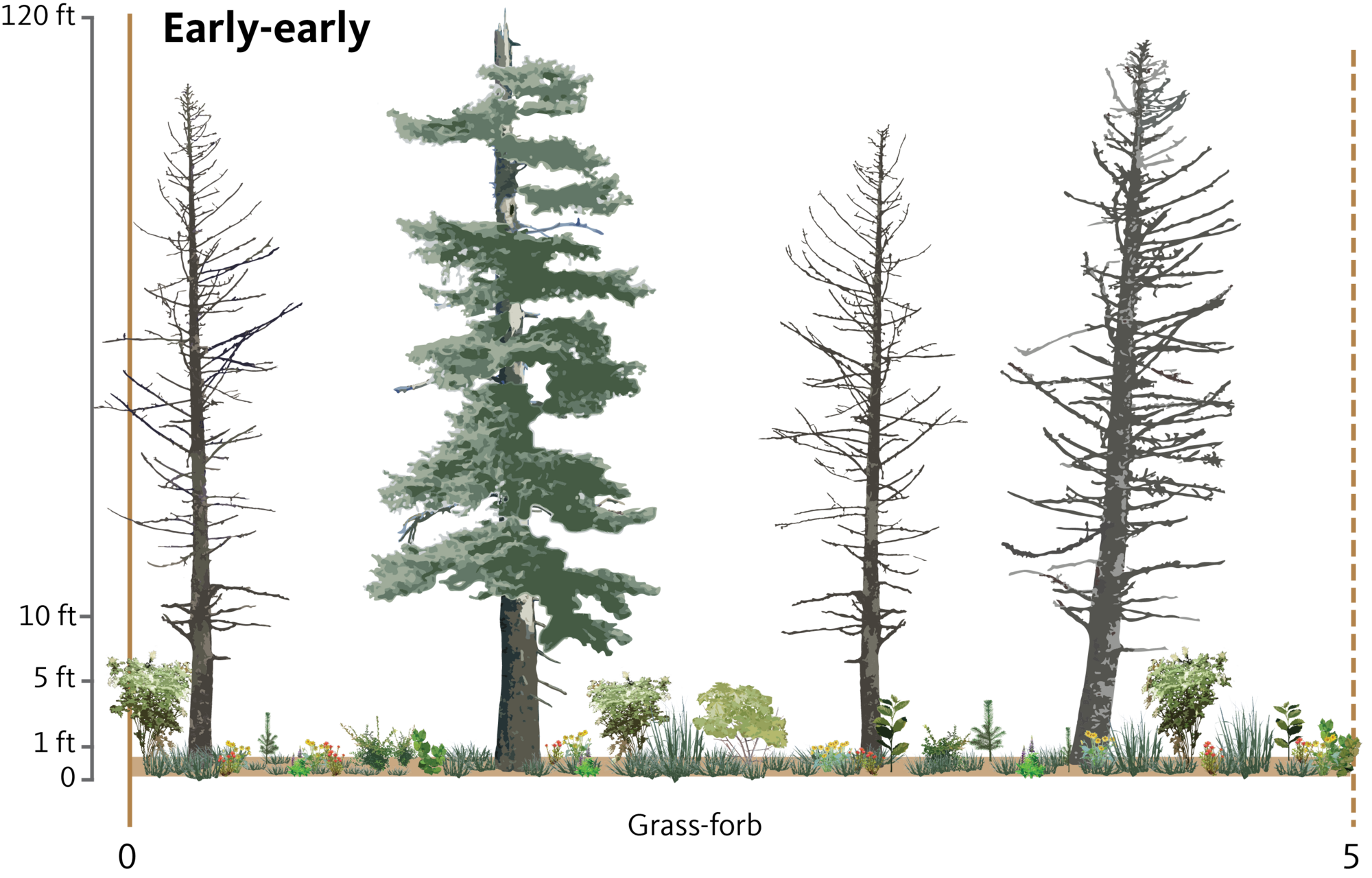
The early-seral stage can be divided into early-early, mid-early and late-early phases (Figures 2A–C). Each of these phases can progress rapidly, from a few years up to a decade. They are characterized by different vegetation structures and compositions that provide food, cover and conditions for different suites of wildlife. These conditions create habitat for insects (including pollinators), birds, reptiles, amphibians and mammals.
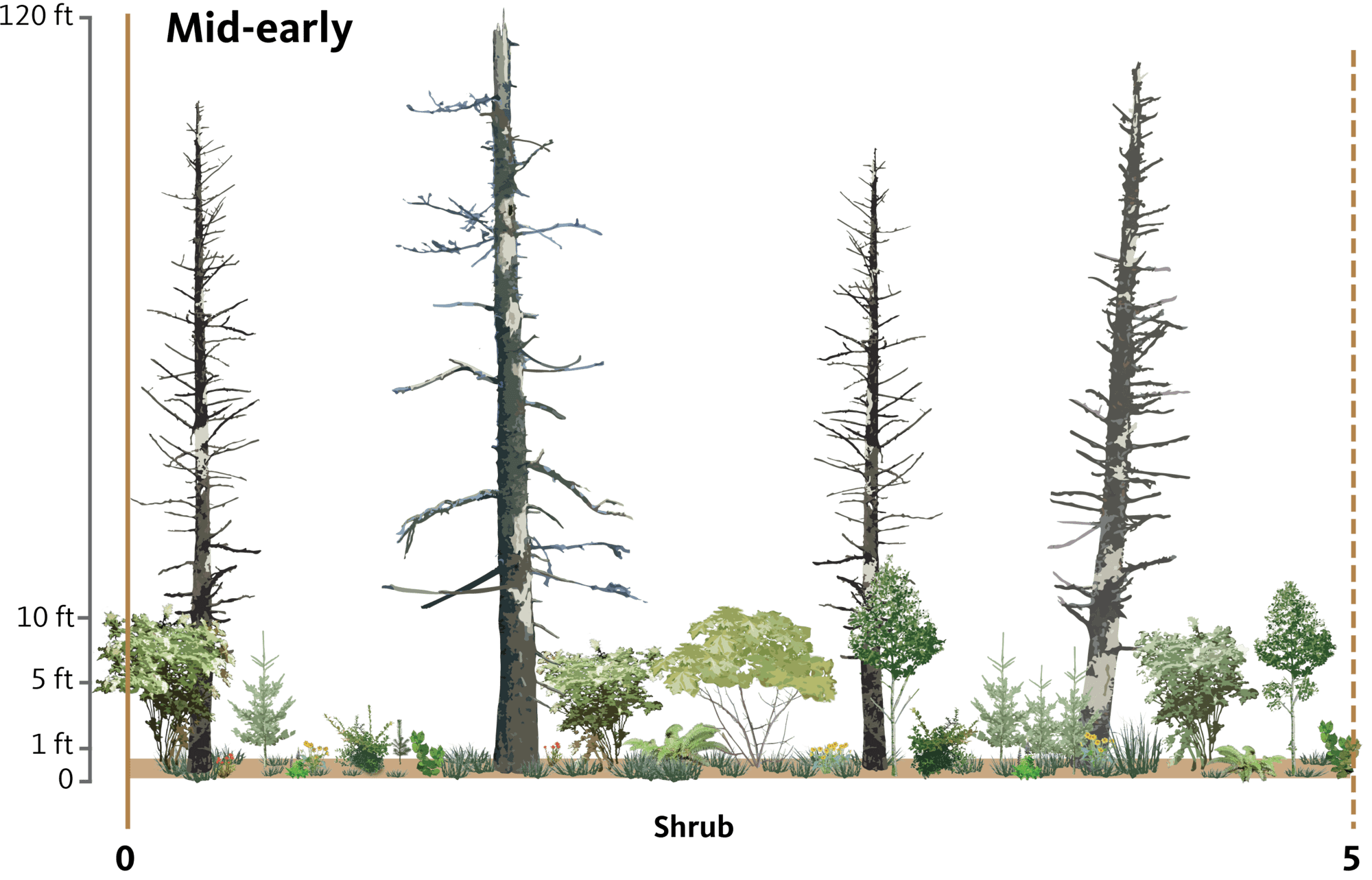
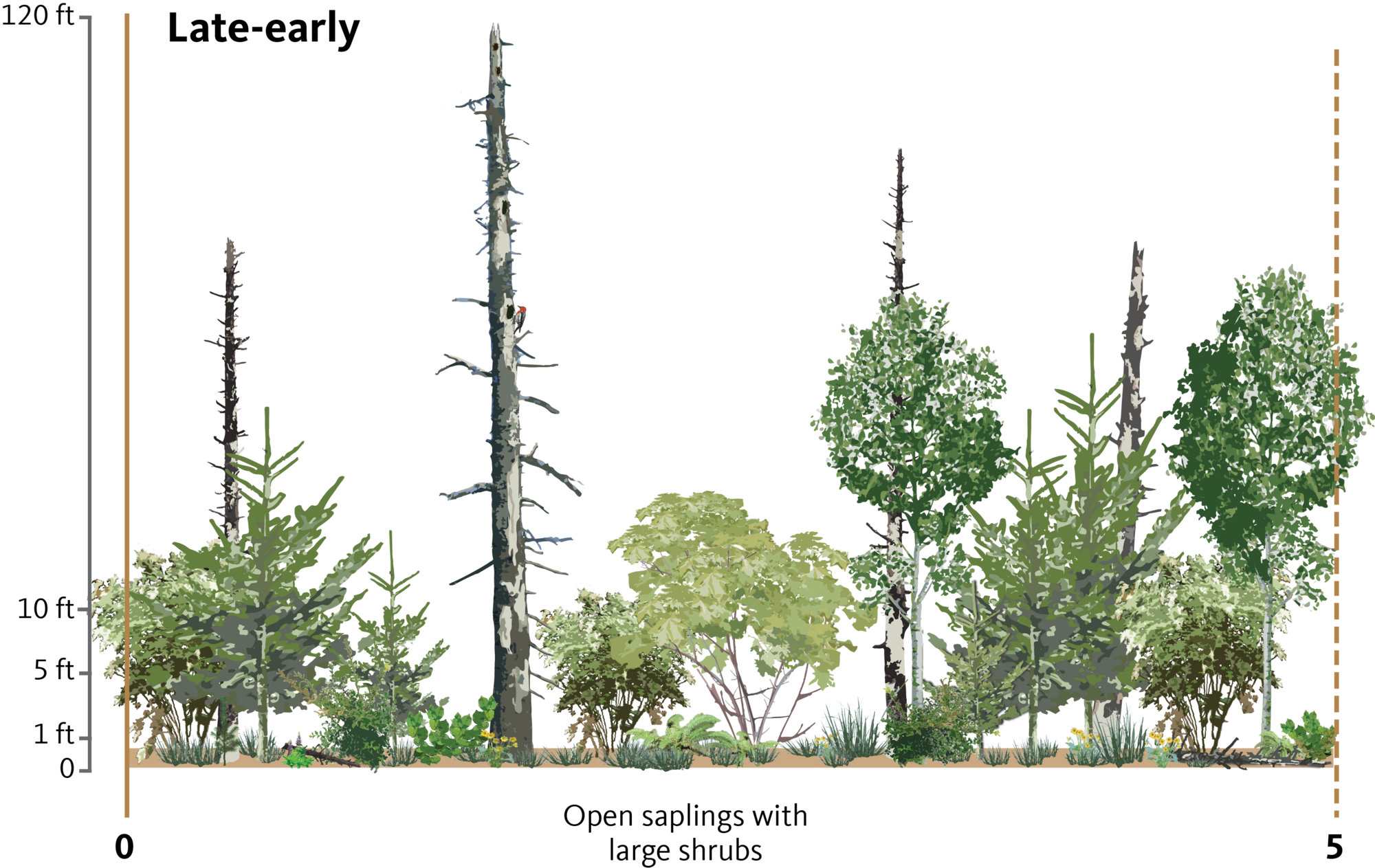
If invasive plants such as thistle or scotch broom are present during early phases, they will exploit site resources and quickly dominate. These invasive species can outcompete native vegetation and suppress native plants, negatively affecting insect and wildlife habitat. However, some invasive plants do provide resources useful to native species, such as pollen and nectar. If few trees regenerate in the early-early and mid-early phases of succession, the early-late phase, dominated by shrubs, may persist for decades.
The early-seral stage is characterized by an abundance of open-light conditions. This may look different in different Douglas-fir forests, depending on the nature of the disturbance that initiated it.
Why is early-seral forest important?
Early-seral forests often feature a richer variety of plants than forests in later stages of development. Light availability and lack of competition from established trees can enable many shade-intolerant grasses, forbs and shrubs to thrive for brief periods. This provides important habitat for insects such as bees, flies, moths and butterflies. These insects, in turn, provide food for songbirds, bats and reptiles (Figure 3).
A diverse understory also provides cover for songbirds, small mammals and game species such as quail and turkey. It provides food for deer, elk and moose. Many of these smaller species are food sources for predators, such as cougars, raptors, fox, coyote, raccoon, skunk and marten. Lastly, the understory provides traditional foods for Indigenous communities, such as huckleberries and other culturally important plants.
Dead trees and downed wood in early-seral forests provide important habitat features. They host insects and fungi, as well as provide cover and nesting substrate for small mammals, reptiles and birds.
Creating and maintaining a variety of early-seral conditions on forest land you own or manage can increase biodiversity across the landscape. These forests provide conditions not found in later seral stages.
Some wildlife species require resources from both early-seral conditions and later seral stages of forest succession. They thrive in areas where forests in varying stages converge.
Look beyond property boundaries to see what seral stages are abundant or lacking in the larger landscape or watershed. Providing those seral stages that are uncommon elsewhere on property you own or manage will boost overall biodiversity.
In closing, managing forest ecosystems following a natural disturbance or after timber harvests can profoundly affect the abundance, timing and quality of early-seral habitat. Forest managers are learning and testing new ways, guided by research, to maintain and enhance this important and often underappreciated stage of forest succession.
Resources
Early Seral-associated Songbirds, Oregon Forest Resources Institute.
Woodland Fish & Wildlife Group publications:
- Forest Bee Pollinators
- Small Mammals in Managed Woodlands
- Quail on Small Woodlands
- Managing Forest Habitats for Migrant Songbirds
- Habitat Management for Turkeys on Small Woodlands
- Bats and Small Woodlands
- Reptiles in Managed Woodlands
Of Bees and Blooms: A New Scorecard For Selecting Pollinator-Friendly Plants in Restoration. USDA Forest Service.
About the authors


Related publications


