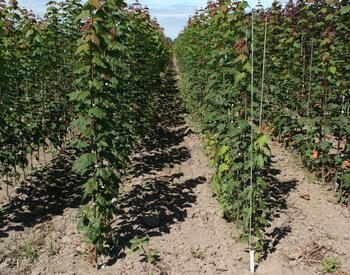
Oregon is the center of the U.S. hazelnut industry, and the crop is an important driver of farm income, processing activity and rural economic vitality in the Willamette Valley. Hazelnuts support growers, nurseries, processors, exporters and the communities connected to that supply chain.
Showing which disease-management practices do not improve yield helps producers avoid unnecessary expenses, protect profitability and plan more effectively for orchard replacement.
Eastern filbert blight is a persistent disease in Oregon’s hazelnut orchards, weakening trees and reducing yields over time. Many older orchards remain susceptible, even as growers transition to newer resistant varieties. For growers with heavily infected orchards, the challenge is both biological and economic. Orchards can continue producing for years, but tree health declines and management costs increase. Growers must decide how much to invest in maintaining aging orchards while planning for eventual removal and replanting.
Pruning to remove diseased wood is a common management practice, but it is labor-intensive and costly. Some growers have also considered cutting heavily infected trees back to stumps and regrowing them from new shoots.
These questions created a need for applied research that could help growers reduce unnecessary costs, protect returns and make better orchard transition decisions.
Researchers with Oregon State University Extension Service and the Oregon State University College of Agricultural Sciences conducted a seven-year study in a mature hazelnut orchard to compare pruning strategies for managing eastern filbert blight.
The study evaluated three approaches: cutting trees back severely and regrowing them from shoots, carefully pruning out diseased branches each year, and leaving trees unpruned for disease management. All trees received standard fungicide treatments and typical orchard care.
By testing these strategies over multiple years, Oregon State generated practical information growers can use in real orchard decisions and gave the hazelnut industry clearer guidance on which management costs are likely to produce a return.
Findings help growers avoid low-return spending
The study, published in the journal Plant Health Progress, found that intensive pruning of heavily infected trees did not improve production. Trees that were carefully pruned produced similar yields to those that were not pruned.
Trees that were cut back to stumps performed the worst. Although they regrew over time, they produced significantly fewer nuts and never matched the yields of the other treatments.
Across all treatments, trees declined as the disease progressed. Wood decay, dead branches and canopy loss were common, regardless of pruning approach.
The findings showed that growers with heavily infected orchards can reduce costs by limiting pruning while maintaining comparable yields and returns until the orchard is replaced. The research also showed that severely cutting trees back and regrowing them is not an economically effective strategy.
Instead, growers can maintain profitability by minimizing inputs and continuing harvest if returns exceed costs. Planning for orchard removal and replanting with resistant cultivars remains the most effective long-term strategy.
Public value
This research provides a clear return on public investment by helping hazelnut growers make lower-cost, higher-value management decisions.
By showing which disease-management practices do not improve yield, Oregon State helps producers avoid unnecessary expenses, protect profitability and plan more effectively for orchard replacement. That strengthens farm businesses, supports industry stability and contributes to the economic resilience of Oregon’s rural communities.
This work demonstrates the value of investing in applied research and Extension that solve real production problems, improve economic decision-making and support the long-term competitiveness of Oregon agriculture.
The study authors include Jay Pscheidt, professor and statewide Extension plant pathology specialist, and Pscheidt’s colleagues in the Department of Botany and Plant Pathology: faculty research assistants Stephanie Heckert, Steve Cluskey and Nicole DiManno Martin.
This research was supported in part by the Oregon Hazelnut Commission, a commodity commission and agency of the State of Oregon under the Oregon Department of Agriculture.