In addition to selling crops and animal products, farms earn income from a variety of other sources. These alternative income sources fall under what the U.S. Department of Agriculture (USDA) refers to as “farm-related income” and include things like:
- Rental payments
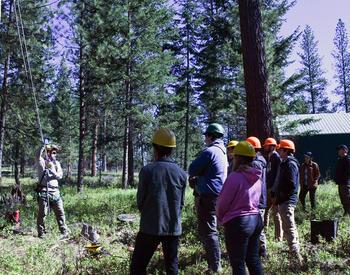
- Forest product sales
- Custom work and services
- Income from agritourism and farm-based recreation
Building on an OSU Extension report released earlier this year, this article will explore what the 2022 Census of Agriculture tells us about the agritourism and recreational services provided by Oregon’s farms.
The USDA defines agritourism and recreational service income as “income from recreational services such as hunting, fishing, farm or wine tours, hay rides, etc.” This definition leaves out an explicit mention of things that many would consider to be agritourism, such as event hosting — such as harvest festivals and farm-to-table dinners — on-farm lodging, and u-pick operations. All of these seem like they could potentially count under the USDA’s definition, but without making them explicit, it is hard to say how producers would interpret whether their activities count as agritourism. While the ambiguity in the USDA’s definition is a notable downside of using the[CB1] census data for this purpose, there are few other sources for data on how agritourism has developed over time in Oregon.
State-level data
- In 2022, the census reports that 507 farms in Oregon (1.4% of all farms in the state) earned income from agritourism and recreational services.
- The 2022 agritourism farm count represents a small, 26-farm increase over the number of agritourism farms reported in the 2017 Census of Agriculture.
- Compared against the rest of the United States, Oregon ranks 23rd in agritourism farm count and 29th in the percentage of farms participating in agritourism.
- The 507 agritourism farms in Oregon earned $19 million in total income from agritourism and recreational services, ranking 22nd in the U.S. On a per-farm basis, this amounts to roughly $38,000 per farm, putting Oregon 31st in the U.S.
- Texas, with 4,816 agritourism farms, ranks first in agritourism farm count, accounting for about 17% of all agritourism operations in the U.S. California, North Carolina, New York and Colorado are the other states in the top five.
- States with the highest percentage of farms participating in agritourism tend to be in the northeast, with four of the top five being in New England. The exception is Alaska. In these states, 4-5% of farms earn income from agritourism.
County-level data
- All counties in Oregon had at least one farm participating in agritourism in 2022.
- The Willamette Valley is an agritourism hotspot, with counties there generally having more agritourism farms than those in Eastern Oregon and along the coast. This is attributable to this region having a high population concentration, giving producers a large base of potential customers for agritourism and recreational services.
- Clackamas (57 agritourism farms), Washington (51), and Lane (42) are the top three counties by agritourism farm count in the state.
- Outside of the Willamette Valley, Deschutes, Douglas, Jackson counties all had at least 25 agritourism farms.
- As a percentage of total farms, Wheeler and Gilliam counties have high concentrations of agritourism farms, with both (along with Multnomah County) having more than 5% of farms participating in agritourism.
- On an income-per-farm basis, however, there is not a clear pattern across Oregon’s production regions. Note that because of reporting confidentiality, data on agritourism income are not available for most counties with relatively few agritourism farms.
- Of those reporting, Grant ($2.1 million per agritourism farm), Morrow ($1.2 million), and Jefferson ($734,000) counties are the top three. This suggests that agritourism farms are diverse, with farms across the state supplementing farm income through these alternative activities.