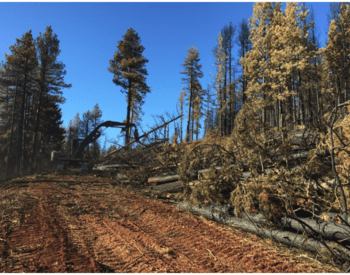
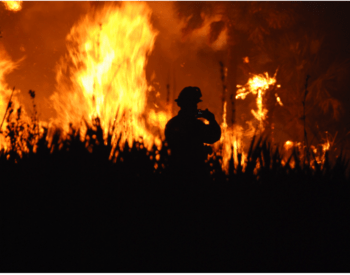
Severe wildfires have affected more than 6,000 landowners in Oregon since 2020, and postfire restoration on private, nonindustrial forestlands has been uneven statewide.
To better understand what helps landowners restore their forestlands and what obstacles exist, the Landowner Experience After Fire (LEAF) Study surveyed private forest landowners across Oregon in 2023 and 2024 on their experiences with forest management following wildfire.
The LEAF study and site assessment tools help partner organizations scale support to non-industrial forest landowners by guiding landowners to technical and financial assistance that will improve the likelihood of success in reforestation investments through timely on- the-ground work.
Survey participants included landowners who experienced wildfire on their wooded properties within the previous decade. More than 200 landowners responded, many impacted by the 2020 Labor Day fires.
Survey findings highlighted both resilience and need. Landowners remained highly interested in their forests after fire, even when damage was severe. At the same time, respondents identified recurring barriers, including a greader capacity for technical guidance and funding, as well as high seedling mortality after planting.
The study also showed that landowners with forest management experience before a fire were more likely to complete restoration work afterward when working with natural resource-based agencies and organizations.
Importantly, landowners were more likely to accomplish on-the-ground recovery when connected to supportive organizations such as soil and water conservation districts and local offices of the Oregon Department of Forestry and Oregon State University Extension Service.
LEAF findings were translated into practical tools
The LEAF project team analyzed survey results and translated them into practical tools for agencies and organizations working with fire-impacted landowners.
To provide guidance for initial post-wildfire interactions with private landowners and strengthen coordination, the LEAF team convened a working group of seven stakeholders from soil and water conservation districts, local restoration groups and the Oregon Department of Forestry to co-develop a site assessment template and guidance documents.
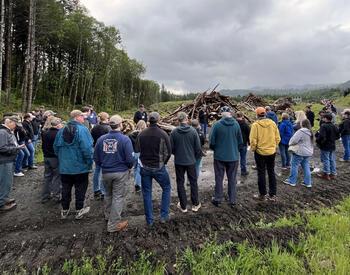
From 2024 to 2025, the team tested and refined a site assessment template and guide on landowner properties statewide, from Labor Day fire affected properties in Western Oregon to fire-impacted sites from 2024 fires in Eastern Oregon.
In 2025, OSU Extension published the final, peer-reviewed resource: Postfire follow-up: Using the LEAF assessment template. The team presented the tool to potential users across OSU Extension Forestry and Natural Resources Program and partner organizations and began developing a digital version designed to allow offline use, secure photo and data storage, and improved privacy protections for landowners.
The project increased partner capacity statewide
The LEAF effort has already increased the capacity of professionals and partners supporting post-wildfire recovery.
- Findings from the LEAF study have been shared broadly through presentations, a podcast episode, and publications in progress, improving how agencies and organizations offer assistance and prioritize needs on private, non-industrial forested lands following wildfire.
- The LEAF Site Assessment Template and guide provide a repeatable first-step framework for initial site visits, helping natural resource professionals and local organizations identify conditions on a property, clarify landowner goals, prioritize next steps, and connect landowners to technical assistance and financial resources.
- More than 50 employees from soil and water conservation districts, watershed councils and other partner organizations have received training or presentations on how to use the template.
The project also strengthened regional collaboration. The LEAF team supported the Pacific Northwest Reforestation Network led by Sustainable Northwest and American Forests, with a focus on post-wildfire reforestation, and contributed to efforts to secure funding to continue that work. Additional workshops are planned for 2026.
The team is also collaborating with the University of Oregon on a best-practices briefing for post-wildfire restoration for communities and organizations, planned for publication in 2026.
This final year of the LEAF project, the team is developing and hosting a landowner workshop on preparing for post-fire recovery before wildfire occurs, to be offered three to four times around Oregon. The team is also developing a short video series on common post-fire topics such as wildfire impacts, reforestation, salvage logging, community resources and tax considerations.
Public value
When more landowners can navigate post-fire decisions with timely, consistent guidance, they are more likely to successfully complete forest restoration activities.
The LEAF study and site assessment tools help partner organizations scale support to non-industrial forest landowners by guiding landowners to technical and financial assistance that will improve the likelihood of success in reforestation investments through timely on- the-ground work.
Strengthening landowner recovery capacity also supports broader public priorities — healthier forests, safer communities, resilient rural economies and more effective use of public and philanthropic restoration dollars.