Boxwood blight causes serious losses in nursery production by making plants unsalable and increasing management costs. Oregon is the nation’s leading producer of boxwood, supplying about one-fifth of the U.S. market, so disease outbreaks have important consequences for growers and the broader nursery economy.
This research gives Oregon’s nursery industry practical, low-cost strategies to reduce losses from a major disease in a high-value crop.
Growers make routine decisions about plant spacing and irrigation to use land, labor and water efficiently. But those same decisions also shape the humidity, temperature and leaf wetness inside the plant canopy, conditions that can either slow or accelerate disease spread. Growers had limited field-based information on how spacing and irrigation practices affect boxwood blight under Oregon production conditions.
Researchers with Oregon State University and the U.S. Department of Agriculture’s Agricultural Research Service (USDA-ARS) evaluated how plant spacing and irrigation frequency influenced boxwood blight in container-grown ‘Green Velvet’ boxwood produced in greenhouses.
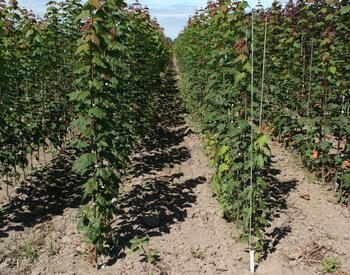
They compared plants grown pot tight, with canopies touching, to plants spaced 15 centimeters apart, with separated canopies. They also tested irrigation applied one, two or three times a day while keeping the total daily water volume the same.
The team tracked disease incidence, disease severity and pathogen movement over time and measured canopy conditions including temperature, humidity and leaf wetness.
Wider spacing sharply reduced disease spread
The study, published in the journal PhytoFrontiers, found that spacing was the most important factor affecting disease spread. Boxwood blight spread only among plants grown pot tight and did not spread to plants spaced 15 centimeters apart.
These results only apply to boxwood grown under greenhouse conditions. The disease would be expected to travel farther outdoors, where wind would increase the distance that spores can be splashed by rain or irrigation.
Irrigation frequency mattered only when plants were touching. Under pot-tight spacing, disease became more severe and spread faster as irrigation frequency increased, with the highest risk in plants irrigated three times a day.
Season also played a major role. Disease spread fastest in spring and fall, when weather was cool and wet, and slowed during warm, dry summer periods and in colder winter conditions.
The findings show that simple production changes can significantly reduce losses: keeping canopies from touching and irrigating less often so foliage dries faster lowers disease risk and slows pathogen movement within a nursery.
Study authors included:
- Jerry Weiland, research plant pathologist, USDA-ARS Horticultural Crops Disease and Pest Management Research Unit, Corvallis; courtesy appointment, OSU Department of Botany and Plant Pathology
- Mana Ohkura, assistant professor of practice and director of the OSU Plant Clinic, Department of Botany and Plant Pathology
- Carolyn Scagel, research scientist, USDA-ARS Horticultural Crops Production and Genetic Improvement Research Unit, Corvallis; courtesy appointment, Department of Botany and Plant Pathology
- Jesse Mitchell, biological science technician, USDA-ARS Horticultural Crops Disease and Pest Management Research Unit, Corvallis
- Bryan Beck, biological science technician, USDA-ARS Horticultural Crops Disease and Pest Management Research Unit, Corvallis
- Lloyd Nackley, associate professor and OSU Extension nursery production and greenhouse specialist, Department of Horticulture
Public value
This research gives Oregon’s nursery industry practical, low-cost strategies to reduce losses from a major disease in a high-value crop.
By showing that wider plant spacing and less frequent irrigation can sharply reduce boxwood blight spread, Oregon State and USDA help growers lower risk, protect inventory and make better use of fungicides, labor and water. That supports more efficient production and strengthens the competitiveness of one of Oregon’s signature nursery sectors.
The study shows the return on investment from applied research that helps growers solve costly production problems with management changes they can implement immediately.
Funding for the study was provided by the USDA-NIFA Specialty Crops Research Initiative project 2020-51181-32135; USDA-ARS projects 2072-22000-046-000-D, 2072-21000-0055-00D and 2072-21000-059-000D; and USDA-ARS Floriculture and Nursery Research Initiative project 0500-00059-001-00-D.