Transcript
00:00 Patty Skinkis
This is the Hi-Res Vineyard Nutrition Podcast Series, devoted to helping the grape and wine industry understand more about how to monitor and manage vineyard health through grapevine nutrition research. I am your host, Dr. Patty Skinkis, Professor and Viticulture Extension Specialist at Oregon State University.
00:22 Patty Skinkis
Interpreting results of vineyard nutrient testing is very challenging for many growers. And as an extension specialist, I often get requests to interpret vineyard soils and grapevine tissue samples with a grower sending me or showing me their outputs from their testing lab. Really, they're just trying to get some guidance on what to do with the numbers. They're very interested in keeping a finger on the pulse of what's going on in their vineyard, and they want to ensure that they have good vineyard health, but they don't necessarily know what to do with all of that information.
When we started the HiRes Vineyard Nutrition Project in 2021, we had a nationwide industry survey that asked questions about how growers look at their vineyard nutrient management—what kind of samples they were taking, when were they taking those, and how they interpreted the results. The vast majority responded that they rely on someone else to interpret those results for them—whether that be a crop advisor, a crop consultant, agronomist, whatever you want to name those individuals who help provide that guidance and product. But they also turn to Extension services in their local community to help guide their nutrient applications or just to determine what to do. So as I work on the HiRes Vineyard Nutrition Project as the outreach person, we're finding that there's this need amongst consultants and Extension agents out there, who may not all serve as viticulturists, to really know how we handle this professional development for ourselves, but also for the industry who needs to know what to do with their tissue tests.
This is why I've invited Cain Hickey to join us today. Dr. Cain Hickey is an extension professional, and his official title at Penn State University is Assistant Teaching Professor of Viticulture. He started a really important and cool regional project to help himself and other growers in his region to better manage vineyard nutrition. Cain has been working in viticulture extension for a long time—I think maybe almost 10 years. He is well known in his state and across the US as one of the Eastern [US] viticulture experts. He can be found presenting at state, regional, national, and international conferences for both his peers in viticulture and other wine grape industries. Cain is well known for his Extension work from publications to videos and he has landed himself a place in the classroom, teaching the future generations of viticulture students at Penn State. Cain works with the Penn State Grape and Wine Team and the Pennsylvania wine grape industry to solve vineyard management issues and to optimize production practices, including vineyard nutrition.
Thanks for joining us today, Cain.
03:18 Cain Hickey
Thank you for having me, Patty. Glad to be here.
03:21 Patty Skinkis
It's great to have you join because in just our conversations about extension and viticulture over the years, I really came to know about this new project that you're doing about trying to get information on what growers have in their vineyards in terms of nutrient status. I want to know a little bit more about how you came up with the project and just to give the sense for the audience to know a little bit more about what you're doing.
03:48 Cain Hickey
Well, thanks for having me on. I think how the project came about was, about four or five years ago, when I was at the University of Georgia, I started working on a publication on nutrition management, right? Because when we think of viticulturists, what are the silos of viticulture, and it's like, there's canopy management, and then, of course, we're not specialists at it, but disease management, and we'll just say pest management, and then you have disease management, weed management, and insect management. Then, you have harvest date and those sorts of things, but other than those silos, which, I focused a fair amount on canopy management, like during my PhD and in early years as a faculty member. I thought, well, I haven't really delved into the nutrition world too much. So, I wanted to learn more about it. I also wanted to help growers learn more about it.
So, I thought, usually what I try to do—I’m collaborative in spirit for the most part--I went and found who we would consider the current standards for vineyard nutrition research. I went and sought the collaboration of Paul Schreiner. So, Paul and I worked on that extension publication together. And what that publication was, was: what are best practices in general and paraphrasing, what are best practices for determining nutrient status in your vineyards. So, the methods, the tissues, the timing and things like that. I think that really opened the door for me in terms of being interested in vineyard nutrition, was just working on that publication and learning more about it myself.
05:26 Patty Skinkis
Yeah, and that is one of the most up-to-date or most recent vineyard nutrition extension guides in the US. So, when we started the project, we kind of looked around [at] what's all there, we kind of already knew it, at least myself—we have those all on our website. So, if you want to check out Cain's extension publication he's talking about, it's under grower resources on our website, but it is one of the newest ones. (https://highresvineyardnutrition.com/grower-research-information/)
And of course, many people know Paul Schreiner. He's one of our co-PIs on the HiRes Vineyard Nutrition Project. So, it's good to see kind of a branch off coming from just working on learning more, which we all must do as academics. We all have our areas that we need to learn more.
And especially as extension. We're always the jack-of-all-trades and we have to identify what are the things we know and need to know more of, and then we can share that with others. So, can you tell us a little bit about what the project is and how you're doing it?
06:25 Cain Hickey
Yeah, I certainly can. I'll just back up and say one more thing about the extension publication is that, as you mentioned, Patty, being an extension person, sometimes we get asked questions we don't have the immediate answer to and it calls holes in what we know and what we think we know, and maybe calls attention to what we should focus on. So, I think that was the case when folks always ask, well, ‘What's a fertilizer recommendation?’ or ‘What's a foliar spray application?’ or something like that—well, it's hard to give those recommendations without knowing what the status is of the vineyard first. So that's kind of why I think I was interested in writing the publication about diagnosing nutrient status because until you diagnose it and know the status, you really can’t take any other steps or guesses, right? Because you could be treating something that doesn't need [to be] treated. So, I think that's important to know.
07:16 Patty Skinkis
And it's one of the hardest, even amongst our team where like we can tell them what's a guideline, but then what to do with it. It's hard. You need to know a lot more. And ultimately that's also part of what the grower has to determine.
07:28 Cain Hickey
That's right.
07:31 Patty Skinkis
But the flip side is for us to have guidelines, we have to have some level of understanding what you would do with the information.
07:36 Cain Hickey
Correct.
07:37 Patty Skinkis
So, it's a chicken and egg situation. So yeah.
07:39 Cain Hickey
Correct, correct. So the project—so that actually is a good segue into the project because the project is actually—well, so the extension publication was: how do you do this diagnosis and why, what you know, what's the pros and cons between petioles and leaf blades and just that that sort of context—but then this project is doing the diagnosing, right? So, we set out, and I'd like to call—you got to call acknowledgement to your funding sources. So, this project came out of a grant. So, I'll call out the Pennsylvania Wine Marketing Research Board, the Pennsylvania Liquor Control Board, and the Pennsylvania Department of Agriculture for the funding recommendations and the funding support and the logistics of helping us manage and fund this grant.
We thought, okay, so we know this nutrient work is going on through this project, the HiRes Project, and of course I'm friends and did a postdoc with Terry Bates, so I talked a lot about nutrition with him, and of course Paul Schreiner, so this was my way of kind of dipping our toes in the nutrition investigation world along with what's going on, so trying to stay current and relevant and also help our growers by understanding what are our [nutrient] levels across Pennsylvania.
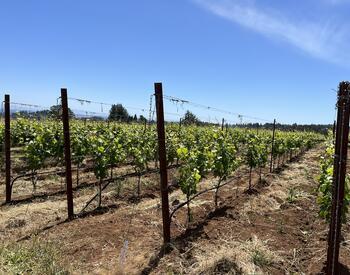
So, the project is taking—this is our first field season, 2024, and we chose five commercial Cabernet Franc vineyards across the state. We did our best to choose vineyards that were in the corners of the state and then maybe centrally located as best as possible. It's not perfect but we feel like that increases our ability to get diversity in nutrient levels because the western part of the state might get rain for part of the season whereas the eastern part may stay dry or vice versa, and of course, we know that rainfall can drive impact and plants’ ability to take up nutrients, right?
So, we thought, why not, why do these all in one corner of the state or even in one site? Why not go across and try to get this diversity and mesoclimate, be it weather, soil type, rootstock, or whatever. The one thing we did keep constant was the scion. So, we said Cabernet Franc, right? And I'm not even sure that was a good idea. But as you know, every study has their limits in terms of experimental design. And it's like, well, why don't we do two cultivars? Well, that doubles the sample size. It doubles the time you must do it.
So, we just said, let's do Cabernet Franc. Because it's a popular, it's probably the most popular red [Vitis] vinifera grape cultivar in Pennsylvania. And probably, I would venture to say, I guess, probably in New York and Virginia too, or if not, one of them, right? So that's what we did—we chose sites in five different commercial vineyards across the state. What we're doing is—do you want me to talk a little bit about the experimental design?
10:27 Patty Skinkis
Yeah, yeah, but first, I mean—maybe this will lead into it—so your decision on location was partly due to spatially locating it throughout the state.
10:36 Cain Hickey
Yes.
10:37 Patty Skinkis
But were there other drivers such as soil type or…?
10:40 Cain Hickey
We did not, we didn't have that. We did have a set of questions, and I can't even recollect what they were. To growers that we were seeking, the first thing was, let's try to get them spread apart. I'm centrally located, I'm in Centre County, which is where Penn State is. So, from us, you can drive every direction for about three and a half hours or four hours before you're out of the state, right. Whether that be northeast, southwest, and so on and so forth. So, we want a spatial separation just because that would improve our chances, at least us thinking, that we could get differences via weather and perhaps soil type too, right?
We did ask the growers things like—well, we wanted to work with vines that were not at the tail end of their productive lifespan or new because we didn't want to work in vineyards that the results were impacted by, say, a systemic virus. Like, why is this vine growing poorly? Oh, that's because it has some sort of wood fungal disease. Well, so vines within like years five, six to 15 or 20 are healthy and productive. After 20, they can start declining from some of these more systemic issues or wood-borne issues. And then when they're young, their roots are too shallow and it's not really a good representation of, you know, commercially mature vine. So, we were kind of picky as to what age they were. We didn't want old vines, and we didn't want young vines for those reasons.
12:04 Patty Skinkis
Yeah, so what was the age? Probably around the 10-year mark or…?
12:08 Cain Hickey
We aim for that, I think some were seven. Again, that varies too because it's not like there's grapes grown in every single township in every county across the state, right? So, you take what you can get a lot of times and that's just what we did. But I would say yes, I think that the age spans were somewhere between say five and 15, but don't quote me on that.
12:27 Patty Skinkis
Okay, great. Yeah, so if you can, [say] just a little bit about how it's designed and what tissues, etc. That'd be great.
12:34 Cain Hickey
Yeah, so what I just said about the vine age and trying to ensure that the vines, like these responses that I will talk about in a second, are not impacted by something else, like to optimize the chance of it being impacted by something soil-driven or water-driven or nutrient-driven, was to ensure that or try to optimize the chance the vines didn't have anything wrong with them systemically.
So, we chose ten replicates in each commercial vineyard, replicate being a panel of vines, so inbetween inner row panel stake length, so maybe four or five vines. We chose 10 of those at each site, of the five commercial sites, and we used grower feedback about the growing conditions across these blocks saying, ‘hey, where do you think vines grow vigorously or less vigorously?’ Then we use visual cues as well.
But a lot of times the growers pointed us into where they thought the high and low vigorous areas were. So, what we did is we set up five of these field replicates in what we would consider the low vigor area or what we thought was the low vigor area. And again, this was all set up around bloom. So, it was pretty revealing about what vines were growing strongly versus weakly—in general. It wasn't like some shoots were four inches and the other shoots were three feet, but you could tell there were some growth differences.
So, we set up five of the 10 panels in the low vigor, and five of the 10 panels in the high vigor, making 10 total panels at each site. The hope [was] that those growth differences were a function of where they were located in the vineyard, as a function of the soil's impact and potentially the nutrient impact on how those vines were growing, right? And then what we did is we went back to those panels, those 10 panels, and we collected petioles and leaf blades at bloom and veraison, right? And so I think when you do the math, we have five sites, 10 panels at each site. So five times 10 is 50 panels. And then you take two growth stages. So that's 100 samples. And then you take two tissues. That's 200 samples we took across the season.100 being petioles and 100 being leaf blades.
And so, it's a big data set, and it's exciting—just that alone is exciting. So, if we stopped right there, right? I think what we would do is get a better understanding of what nutrient ranges are. I didn't say sufficiency. I said nutrient ranges across the state if we stop there alone, but of course we didn't stop there.
And because I've had conversations with you about this, and I've had conversations with the growers about this, and Paul and Terry—if you just have numbers and nutrient numbers only, then it's just numbers. There's no context. So, we wanted to try to add context to those numbers by way of relating some nutrient values and regressing them with commercial responses of interest: yield, crop yield, primary chemistry, which is Brix, pH, and titratable acidity, YAN content at harvest, and then potassium at harvest. And then, we haven't done so yet, but we'll go back and collect pruning weights off all these plots, the 10 replicates and at each site, we're going back. And again, we have all the data of the petiole samples, and the leaf blade samples from bloom and veraison, and we're going back to all those. And we're going to collect—or we collected harvest data, and then we collected berry samples to get harvest juice data, and then we're going to go get pruning weight data. And then what we're going to do is, at each site, try to relate nutrient levels to these responses, whether it be crop yield or all the responses I just mentioned. And then we're going to try to do it across all the sites combined to see if there's some grand trend across the sites. And again, there's lots of things that are confounding those responses: rootstock and management and things like that, but we'll have two kind of scales to look at the data, either site by site within each of the five sites and relating these nutrient values to responses of interest there at each site and then across the sites.
And then of course we have the different growth stages, so we can relate bloom petiole tissues to the responses, we can really relate bloom leaf blade tissue analysis to the responses and the same thing at veraison, so it's a big data set but it's exciting, right, like it's just exciting to know what we're going to find and if we're going to find anything and in the relationships. But like I said, at minimum, if there are no relationships, at least we're going to have a better understanding of what kind of nutrient values we've seen, right?
17:11 Patty Skinkis
Absolutely. Yeah, this is like the dream data set that we had always hoped to have when you have nutrients, especially from a grower location, you know, we have those from research plots or research farms, but we don't have them from commercial settings. So, that's really key.
And I think you're right. This is and exactly why I invited you to the podcast, is to encourage others maybe to do the same. Other extension agents who really don't know what's out there, that maybe they could design a similar study, or even work with growers to do it if you can't get the funding. Have growers, especially if those growers are already taking samples, maybe just assisting with getting a bit more data along those lines.
17:59 Cain Hickey
Yeah. And that's something that I thought if we had extra funds and we could write like a budget revision, can we offer free diagnostics or nutrition concentration testing to anybody who wants to send samples in just so we can have an even larger data set. Because, you know, we're one team. I'm one person, and I can get across to five sites to collect the stuff at bloom, the stuff at veraison, then harvest. And you're doing that, and everybody harvests at the same time, right? So, you've got to go and run. So, logistics become interesting. But even if we could pay somebody or pay some folks and cover their costs of shipping and getting the data to them, we would have access to that data. And so now our data set becomes bigger. The drawback is that with that sampling, we wouldn't have the responses to relate the numbers to, but it still would be, I think, valuable.
18:48 Patty Skinkis
So in order to do this work, I'm thinking about just even the five sites and I know I've done work like this… It takes a lot.
18:54 Cain Hickey
Yeah, you have. Yeah.
18:55 Patty Skinkis
So did you, for the nutrient analysis, I assume you sent those off to a commercial lab or the lab at Penn State.
19:05 Cain Hickey
Yeah, we use our lab right here, the Penn State Agricultural Analytical Lab, great facility. When I was a grad student with Tony Wolf at Virginia Tech, we also sent our nutrition analysis or tissue samples to get analyzed for nutrient concentration there too, right here at Penn State. So, a little plug, shameless plug for the Penn State lab.
19:25 Patty Skinkis
Yeah, and just so you know, the HiRes team, all of the New York researchers send their samples to Penn State.
19:32 Cain Hickey
Oh, well, there you go. So, I'm not biased.
19:35 Patty Skinkis
No, you're not biased. So, it's matching very well with the data that they have. Then how about the fruit chemistry, and particularly the YAN and the potassium, are those being run by you in their lab or…?
19:49 Cain Hickey
No, so that's, as you know, and I think many, many know, at least in Pennsylvania, if not the region—we have a great team at Penn State in terms of our viticulture and enology team. There's just so many people covering different aspects of the industry from business and marketing and consumer things to enology and viticulture. So, this project—Dr. Misha Kwasniewski is a food scientist, and he's collaborating with on it with us. It's, you know how it goes Patty, you've done these projects and it's nice to have that collaborator to do things that you're not skilled enough to do or don't have the bandwidth to do. You know, we said Misha we will flag things, we will collect data, we will go out in the field and harvest. But after that, it's your problem, right? So, now the fruit is going to be analyzed by—in the well-enabled hands of Misha.
20:42 Patty Skinkis
That's great. That partnership is definitely helpful. Yeah, that's great.
20:45 Cain Hickey
Yeah. So it's all in-house here at Penn State is the take-home, I guess.
20:49 Patty Skinkis
Yeah, and it's good to see that strong support from the Pennsylvania industry to support the funding for this because it doesn't happen without funding.
20:58 Cain Hickey
Absolutely.
20:59 Patty Skinkis
So, I'm assuming the industry members were excited for this. Could you talk a little bit about how what the culture is like for nutrient management? Do a lot of growers go and take tissue samples, or is it still something that they you're trying to get more adoption of?
21:15 Cain Hickey
Yeah. I wouldn't say I get a lot of… any time—I shouldn't say anytime—but many times [when] the Penn State Ag Analytical Lab gets a grape sample, they'll share it with us so that—because we're the technical experts in viticulture, and so we get to see some things, but I wouldn't say an overwhelming amount come in. I would say it's still relatively new. I'm not saying that people don't do it—a lot of people have relied on soil tests, and you can read the extension article for why soil tests aren't the necessarily the best. I'm not saying they're not important; they're part of the picture, it's a good thing to do soil tests, and they are part of the picture, but the tissue tests really tell you what the vine is experiencing, right, so soil tests are maybe—what do I call it…nutrient potential? Because they're in there, but compaction could be precluding their ability to be uptake or root distribution or lack of water. So, I called the soil results in a nutrient bank of potential plant nutrition, right?
22:19 Patty Skinkis
Yeah, I like to say it's an ingredient list. So, you know, you get a box of cereal and say, how many nutrients? What's the vitamin B in this? This is what's in the—that doesn't mean that's how much is going to be in your blood.
22:33 Cain Hickey
That's right. That's a good analogy. I like that. I'll have to start using that. But in general, I would say yes, the growers are excited about this. I mean, when an industry board funds something that at least says like, yes, we think it's valid, right? We think it could be important. And then the collaborator growers, that we're working with are great. They've even gone out of the way to let us harvest a little early to make sure they get the data. So, all our grower collaborators are extremely, collaborative in spirit and they value the on-site data and feedback. So, I would say the growers are excited about it and some may not know about it, but my hopes are that when we get the word out, and get some information out about it, that they'll think a little bit more about nutrition. Again, going back to the silos of viticulture or vineyard management. Pathology—you can’t see diseases until they're an issue, right? But you can still see them.
Insects, you scout for them, right? And you see them. Canopy management? You remove shoots, you remove leaves, you position shoots, you can see all that. Nutrition is extremely theoretical because you can't see the nutrients, right? Like you can't squeeze a grape and say, “look at all that nitrogen or potassium.” It's somewhat theoretical, but we know from our plant physiology background that they're extremely important, and it's really important for yield.
And while on the East Coast, we're so used to saying, well, let's take our foot off the gas pedal because our vigor is too high, well, we know that we need to have some level of nutrient sufficiency so that the vine can, well, most importantly, live a long and—because you're farming a vine, a perennial crop. So, you're farming the vine to give you an annual crop year in, year out, so nutrients are extremely important for the longevity and sustainability of the vine, but you still can't see it right. You get numbers back but you're not looking at nitrogen, so it's kind of an interesting thing, I think, for not just commercial growers but us as extension people to grasp because it's part of viticulture that you don't actually see, right?
24:39 Patty Skinkis
Yes, it is a challenge, and you hit the nail on the head. It is important, but really hard to also dissect macro from micronutrients and how all of them play. There's some that we know have certain roles, but the vine only has so many ways to show us that it's got a problem.
24:55 Cain Hickey
Exactly. Well, and you just remind me Patty, there is ways that nutrients show that they're in balance and that's through usually the canopy, the visual canopy symptoms which happened later in the year when the fruit ripening starts, and a canopy can be descriptive of what's going wrong with them, but that might be the only visual cue I can think of where you might have a nutrient imbalance. Other than that, you're relying on numbers.
The thing is, okay, is your yield going down over time? Could that be due to a lack of—so taking data on many things could lead you to diagnosing or at least being interested in taking a nutrient—or getting a sample tested because if your yield is going down, then you're going to be like, well, why is this happening? So, it becomes a diagnosing game. But if your yield is not going down or if you don't know, if you're not taking data, then there might be no impetus to take a test because tests cost money and they take time. And we all know that folks, commercial growers, are busy.
25:53 Patty Skinkis
So now that you've got the project, and I know you still have data waiting to come in and still needs to be analyzed, but do you have an idea of what nutrient issues might exist across your state?
26:05 Cain Hickey
Well, no. Because of the climate we live in, which is humid in general, and we're getting longer and longer drier periods. There's some rain throughout the season, most seasons. Again, we want to take vigor away, and so the first culprit is nitrogen usually. So, I think folks have stepped back on applying as much nitrogen. I think that some savvy growers know that they need some nitrogen because they're removing nitrogen and in terms of grapes, during grape harvest every year. I wouldn't say that nitrogen is an issue unless you're [in] an extremely rocky site, right? It could be where organic matter is low, which is not usually the case. And even then, so, we have enough rain to kind of drive nutrients into the vine. Whereas in like your climate there, in many parts of Oregon and Mediterranean, maybe there's some soil moisture there still around bloom. So, the bloom nutrient samples might not be low, but by veraison things can be pretty dry and you might have some deficiencies, right? Because you don't have the water to move/help nutrient uptake.
27:17 Patty Skinkis
So that reminds me for the audience who might not know about Pennsylvania, can you talk a little bit about the rainfall and kind of your heat units just for context?
27:26 Cain Hickey
Oh, geez, I don’t know if I can actually.
27:30 Patty Skinkis
Just even a range would be fine.
27:33 Cain Hickey
You know, I don’t know about unit-wise, but in general, if I had to guess, I'd say maybe a couple inches a month would be about—and I’m talking Imperial units—not metric, so pardon me. But yeah, I would say a couple inches [of rain] a month. But we've been dry over the last couple of years, for sometimes four, six, eight weeks at a time. I think that's why nutrient concentrations are important to take over time because, at least in our state, rarely are there two years alike. What happens when you took a bloom or veraison sample and it was really dry leading up to there? So you take that sample, and it was dry for the two months leading up to that sample. So, the vine is probably deficient, but perhaps erroneously deficient relative to sufficiency ranges, only because it was maybe atypically dry for that period.
I think that's what I found when I look at this data that we took this year for this project: the bloom data--some of this bloom data seem to not have any—it seemed to be in balance with the recommendations that you and Paul [Schreiner] developed in that fact sheet that you all have. And I think that's because our climate in May and June this year, leading up to bloom, was like your climate. We didn't get a lot of rain. So, my guess was that we would have had excessive levels of some of these nutrients compared to your nutrient guidelines because your nutrient guidelines have been developed in a Mediterranean climate, but it's usually dry in the growing season, whereas ours is usually wet. So, I thought for sure when I compared the bloom samples, we were going to be high compared to your standards out there, but we weren't. And I think it's because we were dry.
29:13 Patty Skinkis
Yeah, and some of those other guidelines to adjust based on what you see is really going to be helpful. That's also something that I think the audience would be interested in—this is how we develop these guidelines is, adjusting it based on: do we see this making sense for the data that we have coming in? That's how we tweaked it in Oregon between Paul's studies and my studies. He tweaked it first, and had done the very detailed studies, and I had more observational work that was like, yeah we're at 1.9% nitrogen, but those canopies don't need any more. Even just like you said, getting the baseline, we will never be at 3% nitrogen in our tissues, but maybe California gets that.
30:02 Cain Hickey
Right. So yeah, you asked me about Pennsylvania weather and somehow, I turned it into that. But I guess the point is that the weather can vary here, right? And it's changing a lot over the last four or five years in terms—I think we're getting warmer, where we're harvesting earlier—the last two years we've harvested relatively early, and I think that's just a nod to the fact that we need to always take into account the fact that—what is happening before we're taking these samples and is that normal, is it atypical? What does that mean? And then like you said, Patty, I think you need to use your visual observations to say, ‘Okay, well, this is telling me I have a nitrogen insufficiency. But my canopy looks healthy. So, what's going on here? What does that mean?’
30:49 Patty Skinkis
And I think another part to all of this that'll be really helpful, especially since you have an enology part to your project, is that there's also things that we know from a plant health perspective, but then we don't necessarily know perfectly for the wine quality perspective. We know, sure, you're measuring YAN. We know YAN's important, pH is important, potassium…That's where we see that the nutrition data is helpful because what will happen is, when we have our grower meetings at the end of the season where we combine the growers and winemakers, there'll be a disconnect. The winemakers will say well we see more reduction, or we see this, and they'll start to surmise what's causing it, and they'll default to the season. Then growers can now say, ‘well no we have the nutrient data, we’re showing here that, you know, we don't [have a deficiency].’ So that's the power of it is—that you'd be able to see and understand, maybe things that are kind of separating the two fields, is this information to now explain ‘okay, what's driving the wine quality?’ We have highly variable seasons here too. Where some years you'll have—we always talk about—is it a high YAN year or a low YAN year, or some years our pH is high, some years it's not. I'm sure you experience some of these things too, and it's really helpful to be able to build those observations over time with what's going on with the end wine. Even just as a region or an area in the state, the growers come together and talk about that or winemakers.
32:26 Cain Hickey
That's a good point. So, each one of these data sets alone, without relating them to each other, could be really important, just like the YAN. What's a YAN value look like across the state? So, it was a high YAN year for you in Oregon? Is that when it rains more, you get more soil moisture than you expect?
32:41 Patty Skinkis
Yeah, usually yes. Yeah, but it gets confusing because then we also have higher pruning weights. Sometimes we have high pruning weights, plenty of nitrogen in the tissues and then a low YAN in our fruit. Not always, but there's these disjointed relationships. It's not perfect. We can't always see a perfect relationship of our tissue nitrogen to our YANs. Or even the potassium issue, where my group is just starting to work more on looking more at potassium in the fruit. Traditionally you always looked at YAN, always looked at nutrition, but not usually looked at potassium as much. We have started to do that within the last two years. So more to come on that.
33:26 Cain Hickey
You bring up a good point. And I think like five minutes ago, you asked what are some of the nutritional issues in Pennsylvania? And I would say by and large, because we have organic matter in many sites, I would say that we're not worried about nutrients, in general, in terms of being deficient. But one thing that we're worried about in excess is potassium. So that's why I told you we're measuring primary chemistry, YAN and potassium. We cherry pick potassium for a reason because we know of its issues in the winery and the issues it can cause. So, I would say high potassium is something that our industry in general is concerned with. Because we know of its relationship to, you know, an indirect increase in pH, microbial instability and color instability and things. So, we didn't just throw a dart at the nutrients we could measure. We chose potassium for a practical reason.
34:18 Patty Skinkis
Absolutely. It completely makes sense.
Well, you know, it's been great to learn about this project. I'm going to be interested in hearing about some of the results in the future. But I want to wrap up.
34:30 Cain Hickey
So can I interrupt you for one time though?
34:31 Patty Skinkis
Oh, go ahead. Sure.
34:33 Cain Hickey
Because the good news is that we have a second year of funding. And we just talked about how important multiple years are, so, we get to do this at least one more year. So, thanks to the funders.
34:41 Patty Skinkis
Absolutely. Anybody who knows my program, I love big studies, meaning spatially, and long term.
34:50 Cain Hickey
Yes. The Crop Load Study. Yes. Forever famous.
34:53 Patty Skinkis
So, [that] just means not very many publications, but at least it's quality data. So, I agree, long-term studies are absolutely needed.
But I also wanted to ask you a fun question to wrap up.
35:06 Cain Hickey
Okay, yes.
35:08 Patty Skinkis
So, I know you are an avid mountain biker. So, if anybody knows Cain, they know he talks about two things, viticulture and mountain biking. So, what is your favorite place of all time that you have mountain biked and why?
35:25 Cain Hickey
Okay, this is a fun question, and thanks for humoring me. I guess, because those are two of my favorite things to talk about. I’ve recently had the opportunity—I've only been mountain biking for about six years, and a lot of my friends have been mountain biking for 15, 20, 25 years. So, six years is not that long considering all the people that I ride with and how long they've been around, but I've recently had the opportunity to go ride in Colorado and in Montana this summer.
But right here in State College [PA], we have an amazing cycling scene, and I can ride my mountain bike from my doorstep to the trailhead. So, I don't even pack my mountain bike. I ride it on the road to the trailhead in Rothrock State Forest. It's three miles away so it's quicker just to ride there than it is to pack my bike on my car, drive there, unpack it and get geared up—so there's this little part of Rothrock State Forest which many here know about. It's called Shingletown and it's rocky and it's technical. And some people say, ‘We can't even walk there. How do you ride your bike there?’ But I just love it because it's so accessible and it's convenient. I think when things are accessible and convenient, sometimes we tend to overlook their value. But when I take myself back to the first time I rode my bike there and thought I was like in some rural part of a national forest in Maine—like, it really feels that way with all the rhododendron and the hemlock and the rocks. I am just overwhelmed with its beauty every time I ride there. So, I have to say, my favorite place I've ever ridden is the place that I ride sometimes multiple times a week. And it's because I like to think that for my psyche, it's like, why not love what you have? And that's what we have. And so that's my favorite place that I've ever ridden my bike—is the place I get to ride all the time.
37:17 Patty Skinkis
I love it.
Thanks so much, Cain. I really appreciate you joining us today and sharing your story about you and mountain biking, and of course your nutrient project that I think is going to be a great project to help Pennsylvania and to help guide your future directions in vineyard nutrient recommendations, but also a fantastic example of what others in Extension can do to generate similar datasets. So, thank you.
37:50 Cain Hickey
Thank you. And I will say that Misha [Kwasniewski] was my collaborator and so was Dr. Michaela Centinari. So those were the three PIs along with our vineyard technical support, Don Smith, who's amazing, and all our collaborators. So, I just want to thank each one of those individuals because each one of those PIs and collaborators, are extremely important.
38:12 Patty Skinkis
Absolutely. Having a strong team is always important. And you do have a great team.
38:17 Cain Hickey
Yes, we do.
38:19 Patty Skinkis
Absolutely. Well, thank you. And anyone who's listening, if you want to learn more about the Hi-Res Vineyard Nutrition Project and learn more about Cain’s Extension publication we spoke about earlier in the podcast, that's at our website, highresvineyardnutrition.com and you can also find us on social media.
Show notes and links:
Learn more about the HiRes Vineyard Nutrition Project:
Website: https://highresvineyardnutrition.com/
Learn more about Cain Hickey
Website: https://extension.psu.edu/cain-hickey
Resources mentioned in the podcast:
PennState Agricultural Analytical Services Laboratory
Related podcast episodes:
Season 1, Episode 3 | The Grapevine “Blood Test” (Paul Schreiner)
Season 1, Episode 8 | Honoring the Past, Building the Future (Matt Fidelibus)
Season 1, Episode 10 | Defining Economic Value of Vineyard Nutrient Management (John Woodill)
Season 2, Episode 1 | Research is at Two-Way Street (Patty Skinkis)
Season 3, Episode 4 | Vineyard Nitrogen and Potassium Impacts on Wine Quality (Emily Hodson)
Podcast listener survey: https://oregonstate.qualtrics.com/jfe/form/SV_bvkyFYGqwy23AWi
This podcast is funded through the National Institute of Food and Agriculture’s (NIFA) Specialty Crop Research Initiative Coordinated Agricultural Projects (CAP) grant. Project Award Number: 2020-51181-32159.
Audio mixed by John Adams.
Have you ever wondered how vineyard nutrient guidelines are determined? It is through real world applications and Extension collaboration. Dr. Cain Hickey, Assistant Teaching Professor of Viticulture at Penn State Extension talks about a statewide vineyard nutrition project he is conducting to determine the baseline for commercial vineyards in Pennsylvania. Discover how tissue sampling is linked with vine health and wine quality outcomes to develop regional nutrient guidelines.
Show notes and links:
- Learn more about the HiRes Vineyard Nutrition Project
- Learn more about Cain Hickey
Resources mentioned in the podcast
Related podcast episodes
- Season 1, Episode 3 | The Grapevine “Blood Test” (Paul Schreiner)
- Season 1, Episode 8 | Honoring the Past, Building the Future (Matt Fidelibus)
- Season 1, Episode 10 | Defining Economic Value of Vineyard Nutrient Management (John Woodill)
- Season 2, Episode 1 | Research is at Two-Way Street (Patty Skinkis)
- Season 3, Episode 4 | Vineyard Nitrogen and Potassium Impacts on Wine Quality (Emily Hodson)
We need your feedback! If you have been enjoying the podcast, please complete a brief survey.
Acknowledgements
This podcast was funded through the National Institute of Food and Agriculture’s (NIFA) Specialty Crop Research Initiative Coordinated Agricultural Projects (CAP) grant. Project Award Number: 2020-51181-32159. The continuation of the podcast is being funded by the Viticulture Extension Program at Oregon State University.
Audio mixed by John Adams.