Douglas-fir is one of the world’s most economically important tree species. In southwest Oregon, it is the dominant tree in many low- to mid-elevation forests. Douglas-fir provides critical wildlife habitat, stores carbon and supports the region’s timber economy.
But in the Klamath Mountains, Douglas-fir is experiencing a “decline spiral” driven by multiple stressors — including drought, higher summer temperatures and increased atmospheric aridity. These conditions weaken the trees, making them more vulnerable to insects and fungi. Dead and fallen Douglas-fir trees also increase the risk of hotter, more extreme wildfires, especially in areas with less than 35 inches of annual precipitation.
Researchers from the Oregon State University College of Forestry partnered with the U.S. Department of Agriculture Forest Service to better understand the causes of Douglas-fir mortality. They used data from the Aerial Detection Survey and OSU’s PRISM Climate Group, collected field data, analyzed climate trends and developed tools to help landowners and managers assess stand-level risk as the climate changes.
The study found that tree mortality is caused by a combination of factors — with the flatheaded fir borer identified as the primary insect linked to Douglas-fir death. Researchers mapped current hotspots and projected that areas of Douglas-fir mortality are likely to increase significantly over the next 30 years.
To support adaptive forest management, the team developed a risk assessment tool that helps predict the likelihood of future infestations and mortality events. The tool can guide landowners toward planting or favoring more drought-tolerant species — such as oaks and pines — on dry sites. This approach aims to reduce overabundance of Douglas-fir and build long-term forest resilience.
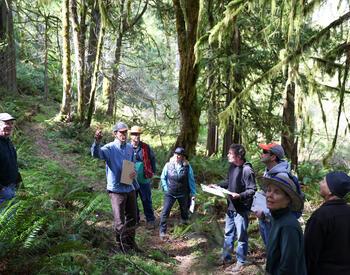
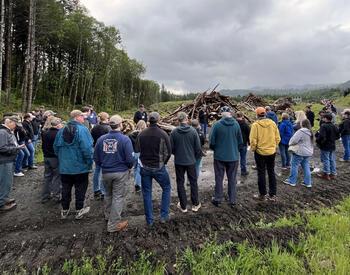
The findings were shared with landowners and professionals through presentations, field tours and a daylong workshop — reaching about 700 participants at local, state and national levels.
The results are summarized in the OSU Extension publication Trees on the edge: Understanding Douglas-fir decline and mortality in southwest Oregon.