Outdoor School funding updates for 2025-2027
Outdoor School Statewide Funding Distribution Project
Following the 20% reduction to statewide outdoor school funding in the summer of 2025, OSU Extension Outdoor School Program took steps to operate within a reduced budget.
This work has continued through the Outdoor School Statewide Funding Distribution Project, launched earlier this year to develop a community-informed and sustainable approach to funding Outdoor School statewide. Building on last summer’s Community Engagement Project, this effort reflects extensive input from partners across the state. We are deeply grateful to everyone who contributed their perspectives; your feedback has been essential in shaping a more equitable and transparent funding model.
This funding model responds to a fundamental challenge: current funding levels are not sufficient to fully meet the goals established in State law or to provide comprehensive Outdoor School access for all students. As a result, the model prioritizes equitable access within existing constraints. This is a first iteration, not a final solution. The model will continue to evolve through ongoing evaluation, community engagement and future funding changes.
School funding forecast and Funding Distribution Model overview
Specific funding forecasts for grantees (districts and applying ESDs) have been shared with district outdoor school designates and will be updated on this webpage in the coming days.
Below is an overview of the funding distribution model to help interpret the information within your funding forecast. The “at a glance” section highlights the key elements needed to understand the model, while the “deeper dive” section currently provides a detailed overview of the community engagement process. In the coming weeks, that section will expand to include additional context and explain the rationale behind each model component.
At a glance
How the Funding Distribution Model functions
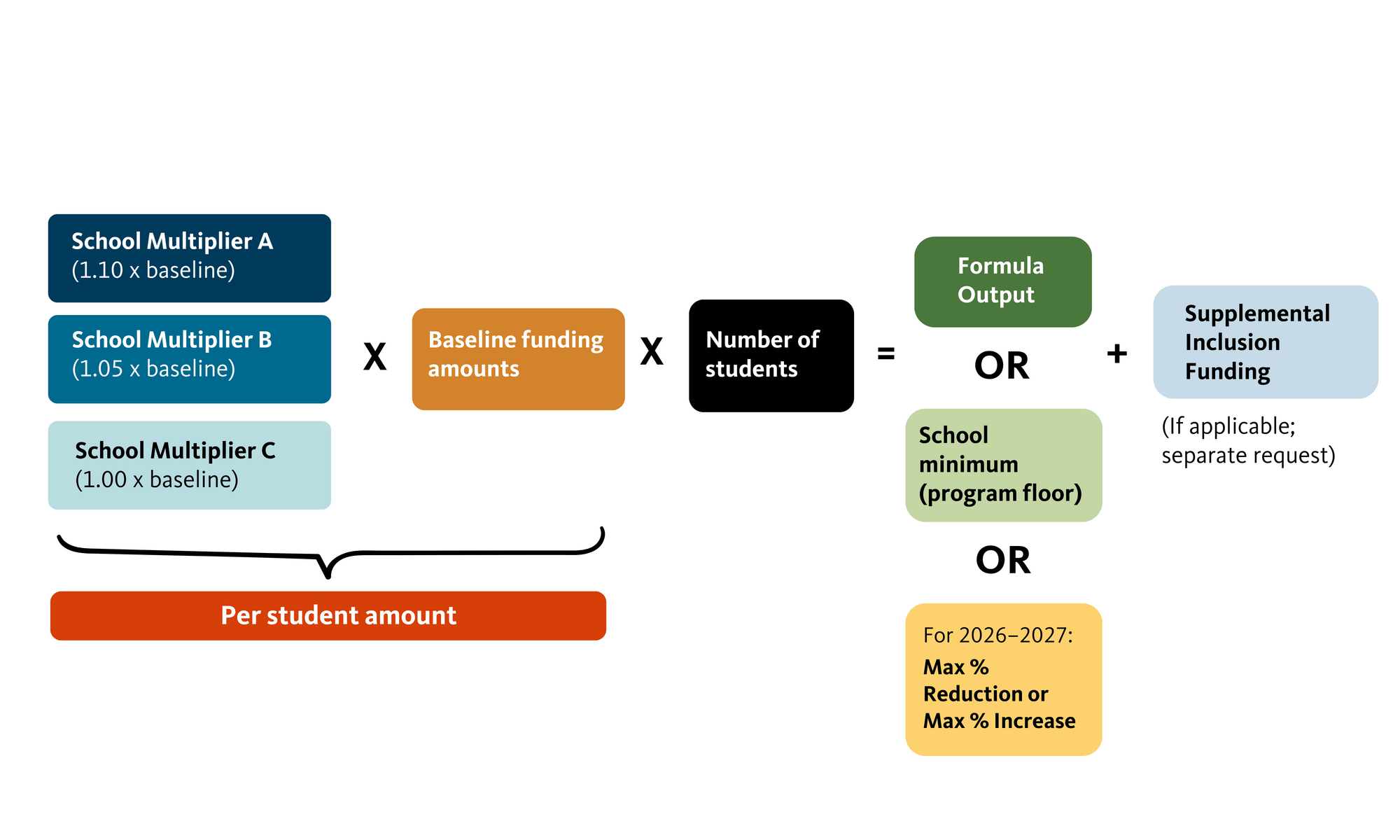
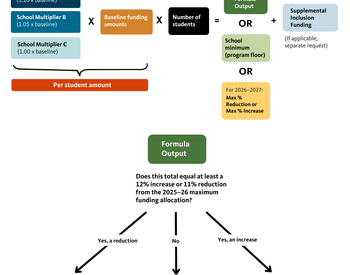
First, each school is placed into a tier based on student demographics. Each tier has a multiplier that is applied to a baseline funding amount. That adjusted per-student amount is then multiplied by the number of students to calculate the formula output. Schools are guaranteed a minimum funding level to ensure that all schools, regardless of enrollment size, receive a functional baseline of funding sufficient to operate an outdoor school program. Information about the supplemental inclusion funding process will be forthcoming this spring.
How the Funding Distribution
Model is being applied for 2026-27
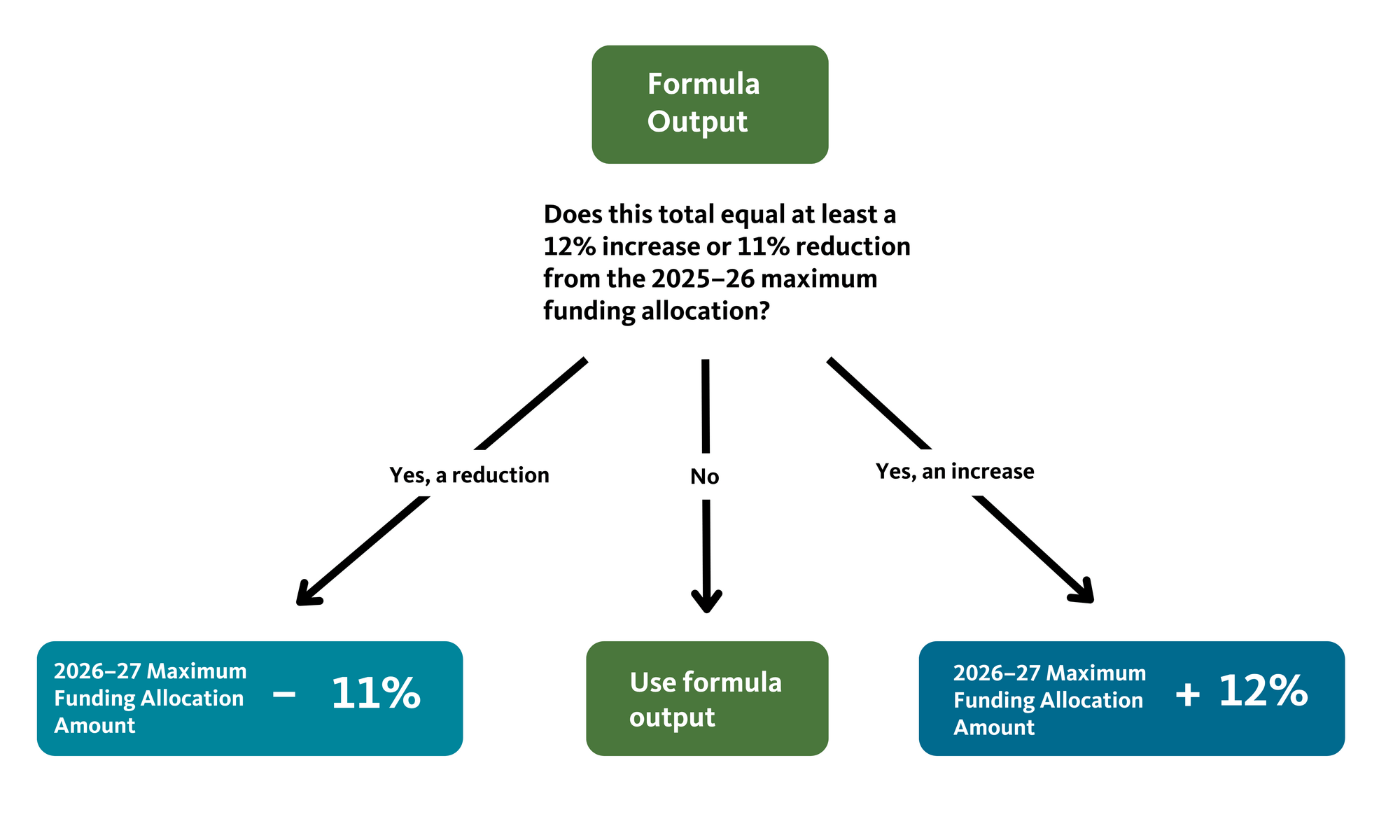
Second, for the 2026–27 year, the model is applied with safeguards to prevent large funding swings. Because overall funding is still lower than previous spending, changes are capped at 12% increase and 11% decrease compared to a school’s 2025–26 funding level. If the calculated amount exceeds that range, it is adjusted to stay within the cap; otherwise, the formula output is used.
Deeper dive
Funding Distribution Model explanation
The new funding distribution model takes a per-student amount and multiplies it by the number of students to determine a school’s funding forecast. However, the actual calculation is more complicated. Additionally, for 2026-2027, the model makes adjustments for schools that have had costs well above or below the statewide average as part of a change management strategy as we transition to the new formula.
This resource provides a detailed walkthrough of how the funding model was implemented to generate school-level 2026-2027 funding forecasts.
Community engagement process
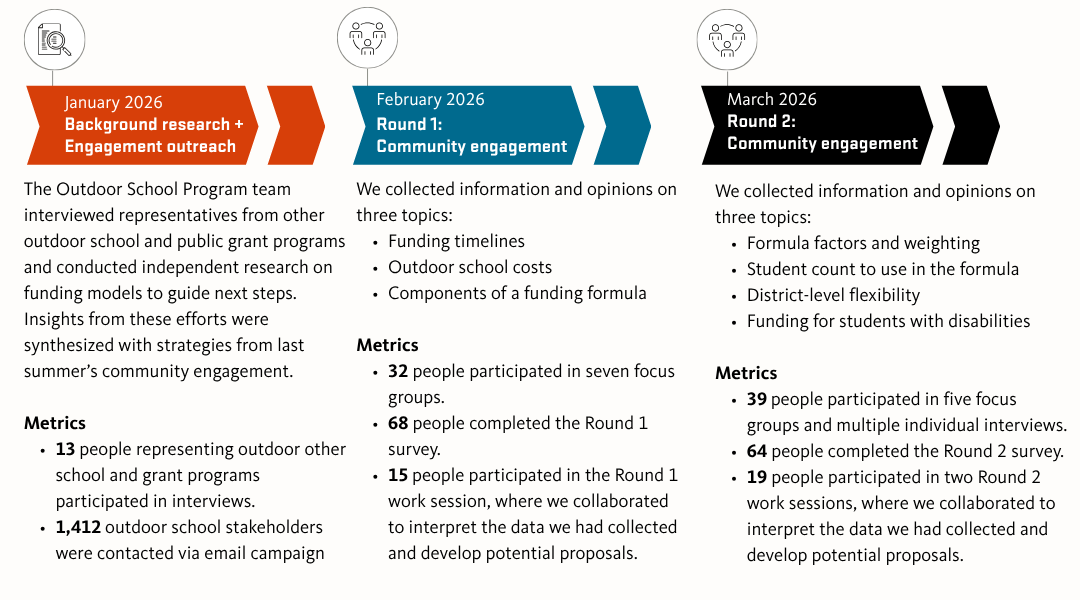
Learn more about how the Outdoor School Program developed this model through an eight-week statewide engagement process involving educators, program providers, and district leaders from across Oregon, in conjunction with guidance from the Outdoor School Advisory Committee.
In the coming weeks, this section will also include additional context and explain the rationale behind each model component.
Review the community engagement overview
Funding Distribution Model background information
Who helped design this model?
The model was developed through an eight-week statewide engagement process that included educators, program providers, and district leaders from across Oregon, with additional input from the Outdoor School Advisory Committee, ensuring the approach reflects broad stakeholder input from across the system.
Is this model permanent?
No, this model represents a first iteration and will be refined annually through an ongoing process of feedback, evaluation, and adjustment. Future versions will be responsive to the needs of schools and districts statewide and adaptable as funding levels change. Though the formula will change over time, we do not expect to ever return to a system in which schools are reimbursed for all costs they incur without working within the formula-derived allocations.
What does this mean for the future of outdoor school?
This model represents an important step toward a more equitable and sustainable system. Still, it underscores a critical reality: Current funding levels are insufficient to meet the expectations set by state law. Fully restoring and expanding Outdoor School opportunities for all students will require a return to voter-approved funding levels.
Why is funding changing this year compared to last year?
In the first year of the biennium, a ~20% budget reduction required a rapid transition to a funding formula to manage costs and maintain access. The 2025-26 formula allocated amounts to schools that were based primarily on the prior year’s outdoor school spending. While effective in the short term, the approach exacerbated underlying funding inequities. This year, the model has been refined to better align funding with student needs and actual program costs, resulting in a more equitable and consistent distribution of limited statewide resources.
Why did my school receive less funding than 2025-26?
Some schools are receiving less for the 2026-27 school year because their historical costs were considerably higher than the statewide average, and/or because the model prioritizes students with higher needs (such as disabilities, poverty, and English learners). These weights are not arbitrary; they are aligned with the state’s existing education funding formula to ensure consistency and fairness. To maintain stability, year-to-year changes are capped at +12% and -11%, which helps prevent sudden and significant funding changes. Without this cap, some schools would see very large funding increases or decreases in a single year. The cap allows a more gradual transition and supports stability across the outdoor school network of districts and providers.
Why are some schools getting more funding than others, especially during a statewide budget reduction?
Some schools have historically reported outdoor school costs well below state averages, and the variable percentage reduction to their programs for 2025-2026 threatened their ability to operate a viable, minimum outdoor school program. To meet the mandate of outdoor school for all, schools that were well below the baseline funding need an increase to sustain outdoor school. The new funding formula, which aims to reduce funding variation, results in an increased allocation for these schools. However, a maximum increase of 12% over last year’s reduced allocation does not return any school to its spending levels before the budget reduction. It does incrementally redistribute funding back to schools that are trying to preserve minimum program lengths.
Why not just fund every school equally?
Equal funding does not account for differences in the costs of serving students. The funding model adjusts for these differences by weighting certain student populations—such as students with disabilities, students experiencing poverty, and English learners—more heavily. These weights are not arbitrary; they are aligned with the state’s existing education funding formula to ensure consistency and fairness. Additionally, small schools and schools with historically low-cost programs were assigned a “program minimum” funding amount to assist with economies-of-scale challenges.
Why are longer outdoor school programs not fully funded?
For 2026-2027, the per-student funding baselines are the same for all program lengths, due to the available budget in the 2025-27 biennium. Schools can still offer longer programs, but may need additional local or partner support.
The new funding model is structured to provide flexibility as we move into the future. When additional funding becomes available, the baselines can be expanded to support a fuller range of program lengths.
How does the formula account for regional differences that a statewide formula may not capture?
Funding is allocated at the school level and adjusted based on each school’s demographics, attendance patterns, and program type. While the model is designed to reflect local variation as much as possible, no single model can fully capture all regional differences. To address this, some of the additional $700,000–$1,000,000 supplemental funds are available to support schools with unique or higher-cost needs across different regions.
Applications
When will applications open for the 2026-27 school year?
Now that funding forecasts are being distributed in the spring of the prior school year, the purposes of the outdoor school funding application will shift slightly compared to past usage. The primary purposes of the application will be to:
- Collect a school’s expected costs, up to the amount in their forecast (unused funds will move to the supplemental funds reserve)
- Confirm a school’s expected program details
- Collect actual enrollment counts for the attending grades
- Gather information on a school’s plans for student inclusion at outdoor school
- Generate a district’s official work order
Applications will open in early September with a deadline of October 15. The application period has been shifted to allow for schools to report actual enrollment once the school year begins. We will have a process for adjusting allocations if district-wide enrollment changes considerably after an application has been completed. Schools that attend outdoor school in September will be able to request an official work order earlier if needed.
Funding forecasts
Where can I learn more about funding forecasts and how they were calculated?
We describe the details of the funding formula and model-specific FAQs in our Model Explanation resource.
Why was my school assigned the Program Minimum?
The program minimum ensures that all schools receive a baseline level of funding sufficient to operate an Outdoor School program, regardless of enrollment size. For smaller schools, a standard per-student calculation may not generate enough funding to cover fixed costs such as staff coordination, transportation, site fees, and instructional materials.
Your school was assigned the program minimum because the formula-based amount fell below this baseline. The minimum ensures that all students have access to a viable program, even in schools with smaller student populations.
Because funding is very limited in the current biennium, we manually reviewed every school that was assigned the $8,000 program minimum for 2026-2027. For schools that are projected to spend less than half of the program minimum (based on historical spending), we assigned a lower minimum of $4,000. These adjustments allowed for funding that is unlikely to be used to be redistributed through the formula. The use of two levels of program minimums is expected to be temporary. In the future, unused funds from schools assigned the program minimum will go into the supplemental funds pots. (Outdoor school grant reimbursements are always for actual expenses.)
What does each column in the funding allocation spreadsheet mean?
For a glossary of definitions relating to the budget formula model, please see the ‘glossary’ tab on the funding allocation sheet your district received, or review them here.
What data and values are being used to anticipate student attendance for outdoor school?
Anticipated student attendance is based on the current year enrollment in the grades that attend outdoor school and a school’s historical attendance rates at outdoor school. We start by finding the school’s highest attendance rate achieved in the last three years of outdoor school. We then add 2 percentage points to this highest historical rate to encourage increasing participation. This boosted attendance rate is then multiplied by enrollment data (provided by ODE early in the calendar year).
For example, if a school has 50 students enrolled, and their highest attendance rate in the last three years was 93%, their student count would be calculated as:
50 * (0.93 + 0.02) = 47.5 students. The school’s funding forecast will be based on 47.5 attending students.
Are charter school budget allocations independent of the total district budget and interchange funds policy?
Charter schools will have their budgets calculated and allocated through the same formula process as all other schools in the district. Districts will be allowed to transfer individual school allocations among schools (with some limits) to ensure all students have equitable access to outdoor school programming. However, charter school budgets cannot be transferred to the main district budget unless the charter school and district choose to work together in their outdoor school program planning and enter into a written agreement to pool their budgets.
What if we’re planning to do a different program format (overnight or day-only) from what OSU used in the funding forecasts?
If your school intends to switch from overnight to day-only programming, or from day-only to overnight programming, your allocation will need to be recalculated based on your chosen program format. Please indicate this change in plans by completing the Program Details Change Form as soon as possible. Reach out to your Regional Program Manager with any questions or updates.
If my school’s funding forecast cannot cover our current outdoor school programming, what should I do?
We suggest beginning conversations with your outdoor school provider or the site you rent from to collaborate on options for reducing costs. Explore the resources on the webpage above to explain the current budget cut to aid in those conversations.
If negotiations cannot be reached with your provider and/or sites to fit within your budget, please reach out to your Regional Program Manager as soon as possible to discuss options and potential solutions.
Policies
Do school districts or schools have to use a specific provider to receive funding?
No. Districts and schools are not required to use a specific provider as a condition of receiving outdoor school funding. Districts may select any provider that meets applicable program requirements and supports allowable (eligible) uses of funds. Continuation with a prior provider is not required. Districts may also choose to develop their own programs. In selecting a provider, districts are encouraged to consider alignment with instructional goals, student supports (including social-emotional learning), and accessibility and inclusion to ensure all students can participate meaningfully. If a district or school has questions about options, they should reach out to your Regional Program Manager.
Can districts move funding between schools?
Yes, districts will be allowed to move funding between schools in many cases, including to account for enrollment changes across schools in the district. We will post a detailed policy soon. In the meantime, here are a few key details:
- Districts will be required to attest that the transfer of funds increases or maintains participation and does not reduce access.
- Districts cannot move funds away from charter schools within their district unless they have a written agreement from the charter school to cooperatively merge their budgets.
- Districts will generally not be allowed to transfer funds between schools doing different program types (e.g., from a school doing a 3-day, 0-night program to a 4-day, 3-night program), except with prior approval.
- Will there be a Supplemental Funds Request process?
Yes, the model includes a dedicated supplemental fund to support schools with unique or exceptional needs, including students requiring predefined types of additional services. More details about qualifying expenses will be provided in the coming months.
What is the process and timeline for notifying OSU if our 2026-27 enrollment is different from what OSU used in the funding forecasts?
Districts will be required to enter actual enrollment numbers into their applications in the fall. If the entire district enrollment in the grade(s) participating in outdoor school increases or decreases by 20% or more from the forecasted enrollment, we will recalculate the allocation for each school using the updated enrollment numbers. Individual schools will almost always have some enrollment increases and decreases. The district will be able to interchange schools’ outdoor school funds to accommodate enrollment shifts, distributing funds as needed to achieve outdoor school access for all students.
Will there be a Supplemental Funds Request process?
Yes, the model includes a dedicated supplemental fund to support schools with unique or exceptional needs, including students requiring predefined types of additional services. More details about qualifying expenses will be provided in the coming months.
What can supplemental funds cover?
We are retaining a reserve of supplemental funds to provide additional funding in specific cases. Supplemental funds will be used for:
- Students with qualifying exceptional needs (policy coming Spring 2026)
- High School Leaders support (policy coming Spring 2026)
- Enrollment adjustments when the district enrollment in the attending grade level has increased or decreased by 20% or more.
What is the process and timeline for applying for supplemental funds for inclusion of students with exceptional needs?
Supplemental funds for student inclusion will have a simple application form, separate from the Online Application and Reporting System (OARS). This application will be available mid-August until late September for schools attending outdoor school in the Fall. For schools attending outdoor school in the Spring, the form will have a late January application deadline.
What is the process and timeline for applying for supplemental funds for supporting high school leaders?
Supplemental funds for supporting high school leaders (HSLs) are a new opportunity added for the 2026-27 school year. The process for reporting HSL participants has not yet been finalized. Schools and districts with HSL participants can expect a short form to report how many qualifying HSL experiences were had during the Fall and Spring outdoor school seasons. The exact amount of supplemental funds available for HSL support is not yet determined and will be calculated after districts complete funding applications. The HSL supplemental funding will be included in a district’s reimbursement payment.
Opportunities to engage
Share your outdoor school stories
OSU Extension Outdoor School and our partner, Friends of Outdoor School, are dedicated to bringing outdoor education to Oregon’s students, and your stories showcase the powerful impact outdoor school has. We invite you to share your story through writing, video, or another format, so together we can capture the transformative stories of outdoor school, demonstrate the impacts of the funding reduction, and build support for restoring funding.