AURORA, Ore. — Just as a small group once bet on wine in Oregon, another group is now determined to see whether olives can make it here.
There are about 50 commercial growers and would-be farmers in the state, tending fewer than 100 acres of olives, almost all in the Willamette Valley. They see potential in a tree that likes heat and summer drought but know Oregon sits near the northern edge of what olives can tolerate.
In 2017 several small-acreage farmers asked the Oregon State University Extension Service to look at olives as a new crop. With funding from the U.S. Department of Agriculture’s Sustainable Agricultural Research and Education program, the Olea Project began to explore whether olives could be a viable alternative.
“We’ve had a lot of interest from small farmers because they are experiencing the increasing droughts and warmer summer temperatures,” said Heather Stoven, OSU Extension horticulturist in Yamhill County. “There are a lot of issues with not having enough irrigation to produce other crops. It does seem that olives may be able to do well in those conditions.”
Cold is the hurdle
Climate change is not delivering only heat. Sudden winter cold snaps are showing up more often, and olives usually grow in regions with milder winters such as the Mediterranean. Oregon, at about 45 degrees latitude, is at the margin.
Olives can handle short dips to about 25°F, but prolonged or poorly timed cold will injure or kill trees. Many cultivars also need a stretch of chilly weather below 45°F to set flowers and fruit, so growers walk a narrow line. A mild winter followed by a frost-free spring can mean a good crop; a hard freeze at the wrong time can set growers back.
Durant Olive Mill in Dundee has shown what is possible. For 18 years the Durant family has planted, milled and bottled premium oils, and co-owner Paul Durant has worked with the Extension team to share what he has learned.
“We have five single-cultivar oils and a Tuscan blend that’s super unique,” Durant said. “I liken the Arbequina to a white wine, very fruity and mild as compared to the Tuscan, which is more robust like a red wine. We try to educate people how to use different olive oils with different foods. It’s meant to enhance the flavor of food. That’s the beauty of olive oil.”
Durant has also lost trees in cold events, a reminder of what the research is trying to solve.
What OSU is testing
To help Oregon growers, the Olea Project is focused on finding cultivars that:
- Withstand Oregon’s winter cold.
- Can be propagated and transplanted successfully in-state.
- Produce fruit suitable for high-quality oil or, for a smaller segment of growers, table olives.
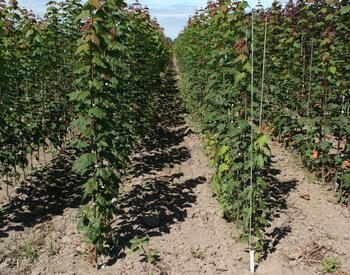
At the OSU North Willamette Research and Extension Center in Aurora, the team is evaluating 420 trees representing 118 cultivars on a one-acre trial. Most were obtained as cuttings from the USDA Germplasm Repository in Davis, California, and rooted at the center. The trial was established from 1-gallon plants in 2021.
“The replicated trial with multiple trees for each cultivar gives us the ability to control for different factors, variability in the field and that sort of thing,” said Neil Bell, an OSU Extension horticulturist who retired and stayed on to finish the work. “We should have a good idea over time of which ones really do grow and produce best under our conditions.”
Researchers will watch the trees over several more winters and measure hardiness, size, flowering, fruit set, yield and fruit size. If they can identify cultivars that live through cold snaps and bear well, Oregon growers and nurseries will be able to produce their own trees at lower cost than importing from California.
For Oregon’s small but determined olive community, that kind of local, research-based guidance is the next step toward a specialty crop that fits the state’s changing conditions.